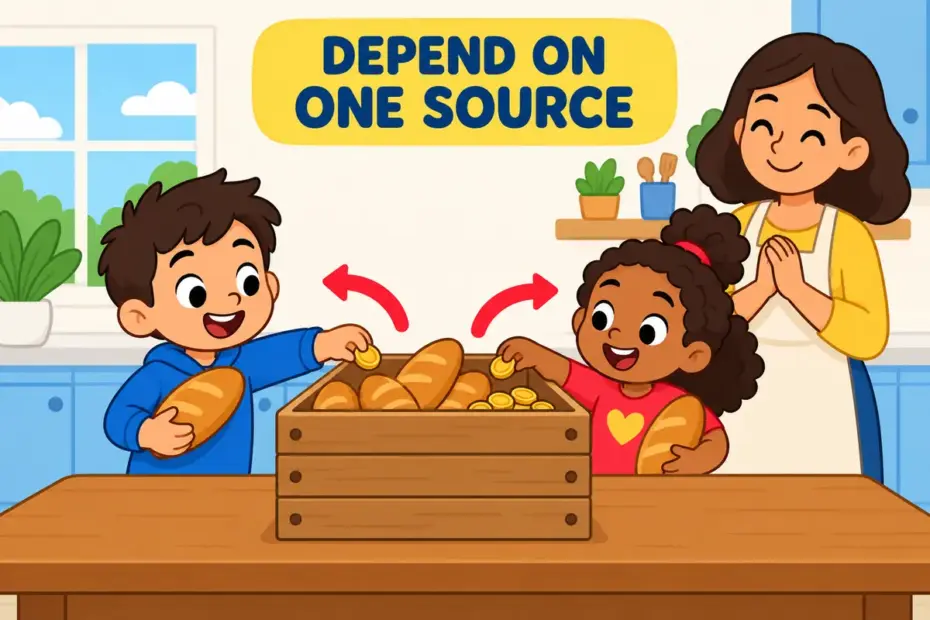
Live off is a phrasal verb meaning to depend on something or someone for money, food or support, as in “They live off their savings.” To use live off in a sentence, put the source of support straight after the verb, because the object always follows off and never splits the phrase.
Live off at a glance
- Live off is an inseparable phrasal verb; the object follows off, as in live off savings.
- Its forms are lives off, lived off and living off.
- The two senses are depending on a source for money or food, and drawing a living from land or a resource.
- The source is usually parents, savings, benefits, wages, the land or a single crop.
- The commonest error is adding of, as in live off of, which most guides treat as redundant.
What does live off mean?
Live off is a phrasal verb meaning to rely on a source for the money or food that keeps you going. The Cambridge entry for live off records both the dependence sense and the food sense, and the difference matters: one is about income, the other about diet or survival. A single source, from savings to a mountain pasture, always follows the verb.
| Sense | Plain meaning | Example sentence |
|---|---|---|
| Depend for support | Rely on someone or something for money or food | As students they lived off part-time wages. |
| Take food from | Eat mainly one thing | The herd lives off tough mountain grass. |
| Draw a living from | Make an income from land or a resource | The family lived off the orchard for years. |
One limitation matters here. Live off carries a faint note of dependence, so it can sound critical when the source is another person: a neutral report would say supported by rather than living off. The phrase stays fair for savings, wages and land, and grows sharper when aimed at people.
How do you use live off in a sentence?
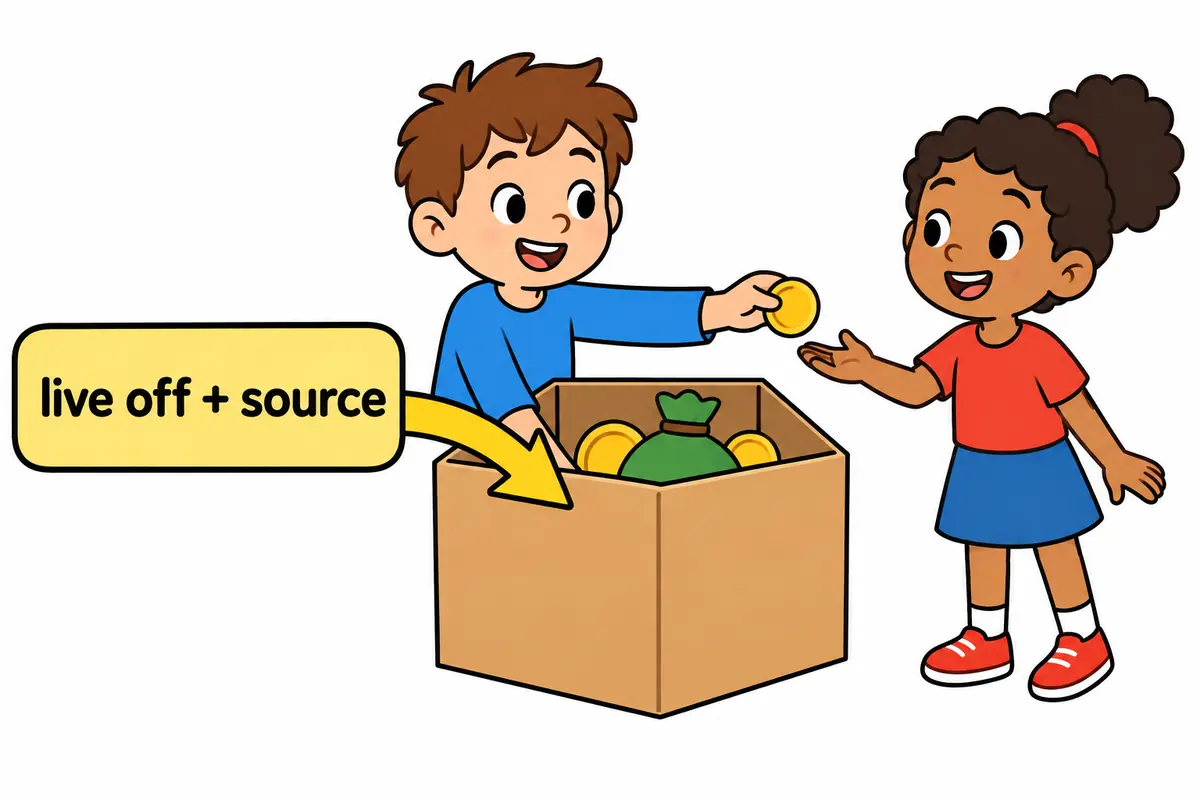
Live off is transitive and inseparable, so the object sits directly after off and the two words never separate. The pattern table below shows the four shapes that cover almost every real sentence.
| Pattern | Example | What it signals |
|---|---|---|
| live off + source | He lives off a small pension. | The thing that supplies money or food. |
| live off + person | They lived off their eldest son. | Dependence on another person’s income. |
| live off + the land | The tribe lives off the land. | Self-sufficiency drawn from nature. |
| living off + source | She is living off royalties this year. | The continuous form stresses an ongoing arrangement. |
Because the particle never moves, you cannot say live your savings off. A pronoun object still follows off, giving live off them. A closely related verb is provide for, which names the act of giving support rather than receiving it.
Live off in a sentence: examples across contexts
The phrase keeps one meaning while the source changes. The twelve sentences below move from a classroom to a history book, and each names exactly what supplies the support.
| Context | Example sentence | Why this works |
|---|---|---|
| Classroom | The class project lives off donated cardboard and paint. | A non-financial source keeps the meaning clear. |
| Family talk | My cousin still lives off his parents at thirty. | A person as source carries the note of dependence. |
| Personal finance | Retirees may live off dividends rather than a salary. | Names a neutral, self-earned source. |
| Farming | The valley farms live off a single harvest each year. | A crop as source shows how narrow the phrase can be. |
| Sports writing | The underdog team lived off scraps of possession. | Sports metaphors extend the phrase to non-money resources. |
| Travel | For a month they lived off bread, olives and river water. | The take-food sense appears in vivid description. |
| News report | Thousands of families live off the minimum wage. | A factual public use of the dependence sense. |
| Conversation | We cannot live off takeaways forever. | Everyday speech often mixes diet and money. |
| Literature | The old trapper had lived off the land for forty years. | The self-sufficiency sense suits narrative prose. |
| Charity appeal | Many students live off one meal and a bus pass. | A concrete detail makes the hardship vivid. |
| Business feature | The start-up lived off a single investor for two years. | Names a narrow funding source without judging it. |
| History writing | Whole villages once lived off the river and its fish. | The land sense suits description of an older economy. |
Live off vs subsist
Live off is the everyday phrase and subsist is its formal relative. Both mean keeping going on a limited source, but subsist belongs to reports and academic prose about survival, while live off fits ordinary writing. Where the focus falls on the giver, support a household is the better verb, and for the food sense feed a family keeps attention on who eats rather than who pays.
| Attribute | live off | subsist |
|---|---|---|
| Register | Neutral, everyday | Formal, technical |
| Typical source | Parents, savings, land, wages | A bare minimum of food or income |
| Tone | Can imply dependence | Neutral, often grim |
| Grammar | Takes an object directly | Usually subsist on |
| Common in speech | Yes | Rarely |
| Best for | Everyday writing and news | Reports and academic prose |
Verdict: use live off in normal writing, and reserve subsist for a formal report about survival on very little. When the amount is barely enough to get by, survive on is more precise than either.
Live off in formal writing
Live off is neutral enough for a news report, but a policy paper or a contract usually wants a plainer, more technical verb. The table below maps the phrase onto wording that suits an official document, where the personal note of the phrasal verb would sit oddly.
| Informal phrase | Formal alternative | Example |
|---|---|---|
| live off a grant | be funded by a grant | The laboratory is funded by a public grant. |
| live off benefits | receive income support | Households in the survey received income support. |
| live off the land | be self-sufficient from the land | The community was self-sufficient from the land. |
| live off investments | draw an income from investments | He draws an income from a small portfolio. |
None of those alternatives carries the faint hint of dependence that live off can add, which is exactly why they belong in writing that must stay neutral. A single extra word often decides whether a reader hears a plain fact or a mild judgement about the person concerned.
Common collocations with live off
- live off savings, when the money was put aside earlier.
- live off benefits or a pension, when a regular payment is the source.
- live off the land, the fixed phrase for self-sufficiency.
- live off your parents, the phrasing that most clearly implies dependence.
- live off one crop or one income, which stresses how narrow the source is.
Word forms and grammar of live off
The phrase inflects on live alone; the particle off never changes. Do not swap in the lookalike live down, which means to make people forget an embarrassment and has nothing to do with money.
| Form | Part of speech | Example |
|---|---|---|
| live off | base phrase | Many artists live off grants. |
| lives off | third person singular | He lives off a fixed salary. |
| lived off | past and past participle | They lived off the garden that summer. |
| living off | present participle | Living off one crop is risky. |
| live off the land | fixed phrase | The settlers learned to live off the land. |
| not separable | grammar note | Say live off a grant, never live a grant off. |
Common mistakes with live off
- Incorrect:
He lives off of his brother.Correct: He lives off his brother. Rule: Off already carries the sense of from, so off of is redundant. - Incorrect:
She lives her savings off.Correct: She lives off her savings. Rule: Live off is inseparable, so the particle stays with the verb. - Incorrect:
They live off in Paris.Correct: They live in Paris. Rule: Live off always needs a source; without one, use live alone. - Incorrect:
The family is living off from the land.Correct: The family is living off the land. Rule: The verb takes its object directly, without from.
Practice using live off
Work through the six items, then check the reasoning rather than only the answer.
- Fill the gap: For two years the band ______ ticket sales alone.
- Choose the better word: A formal report on survival might use (subsist / live off).
- Correct the error: She lives her pension off.
- Build a sentence: use live off the land about a group of settlers.
- Spot the register: which suits a finance article – retirees live off dividends, or retirees live off of dividends?
- Rewrite in the continuous form: My sister depends on freelance fees this year. Use living off.
Answers
- lived off – ticket sales are the source, placed after off.
- subsist – the formal register suits a report on bare survival.
- She lives off her pension – the phrase is inseparable.
- Model answer: The settlers lived off the land through their first hard winter.
- Retirees live off dividends – careful writing drops the redundant of.
- My sister is living off freelance fees this year – the continuous form marks an ongoing arrangement.
The bottom line
Use live off in a sentence when something or someone supplies the money, food or support that keeps a person going, and keep the source directly after off. Two points decide most sentences: the phrase is inseparable, so the object never splits it, and it covers both income and diet, from savings to the land. When the tone must stay formal, subsist on or support are the safer choices.
Frequently asked questions about live off
Is it live off or live off of?
Live off is the standard form, and live off of is usually treated as redundant because off already carries the sense of from. You will hear live off of in casual speech, but careful writing drops the of. Choose live off his parents, not live off of his parents.
What does live off the land mean?
To live off the land means to survive using what you can grow, hunt or gather rather than buying food. It is a fixed phrase that points to self-sufficiency, and it uses the same verb as living off savings, with nature as the source of support.
Is live off separable?
No. Live off is an inseparable phrasal verb, so the object always follows the particle: live off a grant, not live a grant off. Even a pronoun stays after off, giving live off it. Separating the two words turns the sentence into nonsense.
What is the difference between live off and subsist on?
Both describe depending on a source, but they differ in register. Live off is the everyday phrase used in speech and general writing. Subsist on belongs to formal or technical prose, especially when the source is barely enough to survive.