Correction to the older examples below: For a neutral observation, complete “Look like you are ready” as “You look like you are ready” or “It looks like you are ready.” Also, do not add another looks after the phrase look like: write “She looks like her sister.”
How to Use “Look Like” in a Sentence
Look like can describe a resemblance or what something appears likely to be. The sentence pattern and context show which meaning is intended.
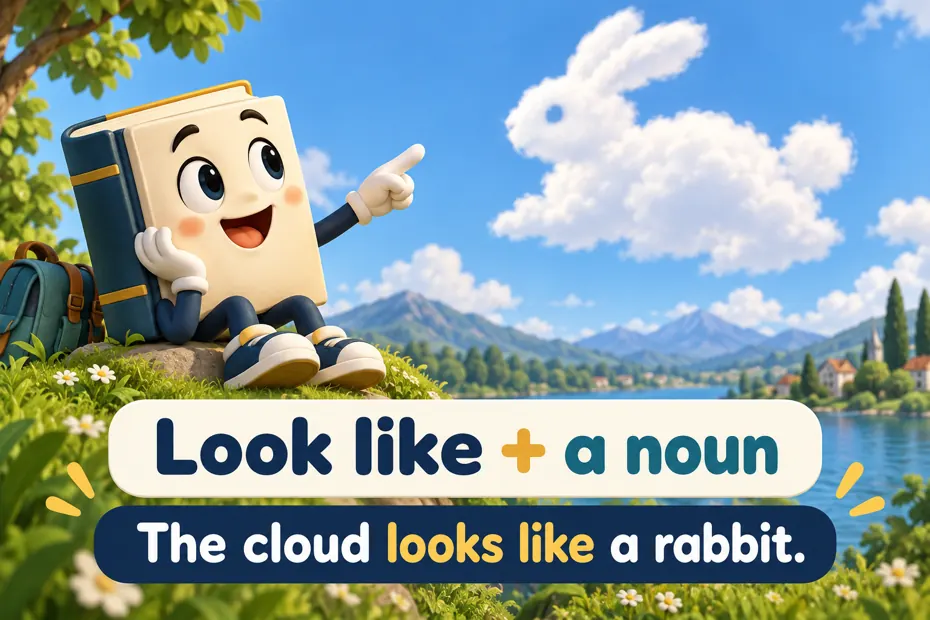
Look like + a noun phrase: resemblance or appearance
Use look like before a noun or noun phrase to compare a person or thing with another person or thing: “From the hill, the island looks like a sleeping whale.” The comparison is about appearance, not identity.
- “That old suitcase looks like a treasure chest.”
- “The twins look like their aunt when they smile.”
- “This soup looks like a thick tomato stew.”

It looks like + a clause: something seems likely
In everyday English, it looks like can introduce a full clause when the speaker thinks an event is likely: “It looks like our train is running late.” Cambridge notes this use for possibility, while its grammar guidance describes like in this pattern as informal and says some formal contexts prefer as if or as though. Choose the wording that suits the setting.
- “It looks like the garden needs another day of sun.”
- “It looks as if the garden needs another day of sun.”
The two garden examples express a similar impression; the as if version is a useful option in more formal prose.
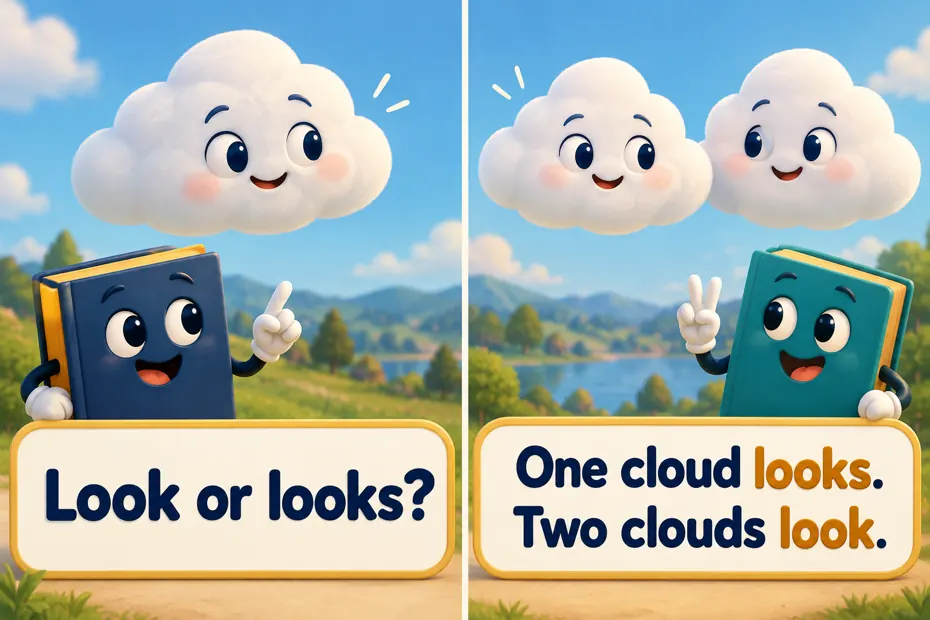
Match the verb to the subject
Use looks with a singular subject and look with a plural subject or you: “The clouds look like waves,” but “That cloud looks like a wave.” In the likelihood pattern, the fixed subject it takes looks: “It looks like the roads are clear.”
Quick distinction
| Pattern | Example | Meaning |
|---|---|---|
| look like + noun | The cloud looks like a rabbit. | Resemblance |
| look + adjective | The rabbit looks sleepy. | Appearance |
| it looks like + clause | It looks like rain is coming. | Impression or likelihood |
| look at + noun | Look at the rabbit. | Direct your eyes toward it |
In “Mina looks like her sister,” the phrase after like is a noun phrase and the meaning is resemblance. In “It looks like Mina has finished,” the words after like form a clause and the meaning is that the situation seems likely. Do not confuse either pattern with look at, which means direct your eyes toward something.
Questions, negatives, and past-time examples
Use does or do to form questions and negatives in the simple present: “Does the cake look like a castle?” and “The cake does not look like a castle.” After does, return to the base form look. “Does it looks like a castle?” repeats the third-person ending and should be corrected.
- What does the new building look like?
- The lamps do not look like the ones in the photograph.
- Yesterday the pond looked like a sheet of glass.
- Did the costume look like a robot?
- It did not look like the storm would pass quickly.
The past form looked works with singular and plural subjects. After did, use look. If you are reporting an earlier impression, keep the time clear: “At noon, it looked like the match would be cancelled.” That records a prediction at noon; it does not tell the reader what eventually happened.
Frequently asked questions
Should I write “looks happy” or “looks like happy”? Write “looks happy.” A direct adjective describing the subject normally follows the linking verb without like. Compare “The dog looks sleepy” with “The dog looks like a sleepy bear.” The second sentence includes a noun phrase after like and makes a comparison.
Does look like prove that something is true? No. It presents an appearance or an impression. “The stone looks like gold” does not establish that the stone is gold. In a factual report, distinguish what you observed from what you confirmed. Add the test or evidence if the identification matters.
What does “What is she like?” ask? It usually asks about a person’s character or general qualities. “What does she look like?” asks about appearance. Keep the two questions separate when teaching them: an answer such as “patient and helpful” fits the first, while “wearing a green coat” can fit the second.
Can I use look like with a pronoun? Yes. Use an object-form pronoun after the comparison: “The portrait looks like her,” “The toy looks like it,” or “He looks like me.” A full clause follows a different pattern: “It looks like she is ready.” Choose the form that belongs to the actual sentence.
Have you ever found yourself unsure of how to accurately describe something that resembles another object or person? This is where the phrase “look like” comes into play. When using “look like,” you are essentially indicating a similarity or comparison between two things based on their physical appearance.
Whether you are trying to convey a striking resemblance, a subtle similarity, or a vague likeness, using “look like” helps express these visual connections effectively. This construction is commonly used in everyday conversations, creative writing, descriptive passages, and more to provide clarity and paint a clear picture for the reader or listener.
7 Examples Of Look Like Used In a Sentence For Kids
- The sun looks like a big yellow ball in the sky.
- An apple looks like a red round fruit.
- A panda looks like a black and white bear.
- The moon looks like a big white circle at night.
- A flower looks like a colorful and pretty plant.
- A banana looks like a long yellow fruit.
- A butterfly looks like a beautiful insect with colorful wings.
14 Sentences with Look Like Examples
- Look like you’re ready to ace that exam tomorrow.
- Look like you could use a study break right about now.
- Look like you’ve been pulling all-nighters to meet deadlines.
- Look like you’ve found the perfect spot in the library to study.
- Look like you’re trying to decipher your professor’s handwriting.
- Look like you’re contemplating joining another club on campus.
- Look like you’re enjoying your favorite street food during a break.
- Look like you’ve finally understood that complicated math problem.
- Look like you’re struggling to stay awake during a boring lecture.
- Look like you’re debating whether to attend that college fest or study instead.
- Look like you’re ready for a break from all those group projects.
- Look like you’re trying to decide which career path to pursue.
- Look like you’re attending a workshop to boost your skills.
- Look like you’re browsing through notes for last-minute revision before an exam.
How To Use Look Like in Sentences?
Look Like is a phrase that is used to compare similarities between two things or people in a sentence. It is important to note that “Look Like” is followed by a noun or pronoun to complete the comparison.
To use Look Like in a sentence, first identify the two things or people you want to compare. For example, “She looks like her sister.” In this sentence, “she” and “her sister” are the two subjects being compared.
When constructing a sentence using Look Like, place the phrase between the subjects you are comparing. For example, “The cake looks like a piece of art.” In this sentence, “the cake” is being compared to “a piece of art.”
Remember to use the verb “looks” after Look Like to express the comparison in the present tense. For example, “The new car looks like a sports car.” Here, the new car is being compared to a sports car.
Practice using Look Like in sentences to become more familiar with how to make comparisons. It is a useful phrase for expressing similarities between different objects or people.
Conclusion
In conclusion, sentences with “look like” are used to compare or describe similarities in appearance between two or more things. These sentences can help convey visual comparisons or impressions to the reader, giving a clear picture of how something appears or is perceived. For example, “The new car looks like a sleek spaceship,” offers a vivid description that aids in visualizing the appearance of the vehicle.
By using “look like” in sentences, writers can paint a picture for their audience, creating a more engaging and descriptive narrative. This simple phrase is a powerful tool for communication, allowing for easy comprehension and visualization of the subject at hand.


