
Lucid describes something expressed clearly or a mind thinking clearly. To use lucid in a sentence, decide which sense you mean, then attach it to a noun such as explanation, prose, moment or sky: “Her lucid summary settled the argument.” The adjective praises clarity, not simplicity, so a hard idea can still be lucid.
Lucid at a glance
- Lucid is an adjective; its forms are lucidly (adverb), lucidity and lucidness (nouns).
- It has three senses: easy to understand, able to think clearly, and bright or luminous.
- The usual nouns are explanation, prose, writing, moment, interval, dream and sky.
- Lucid belongs to careful writing and to medical reports, where it marks a clear mental state.
- The commonest error is doubling the idea, as in a clear and lucid account, since lucid already means clear.
What does lucid mean?
Lucid is an adjective meaning expressed clearly and easy to follow, or able to think clearly. The Cambridge entry for lucid and the Merriam-Webster entry both separate the clarity of thought from the clarity of style, and a third literary sense adds brightness.
| Sense | Plain meaning | Example sentence |
|---|---|---|
| Clear to follow | Written or spoken so it is easy to understand | She gave a lucid account of the rules. |
| Clear in mind | Able to think and speak coherently | The patient was lucid by the morning. |
| Bright, luminous | Literary: full of light or shining | A lucid sky opened above the hills. |
The first two senses dominate modern prose, and the third survives mostly in poetry, where luminous is the plainer partner. A coherent argument holds together, while a lucid one is also easy to follow.
One limitation is worth stating clearly. Lucid does not mean simple. A lucid explanation can be dense and technical, provided it is organised well enough to follow, so writers who want to say easy should choose a different adjective.
How do you use lucid in a sentence?
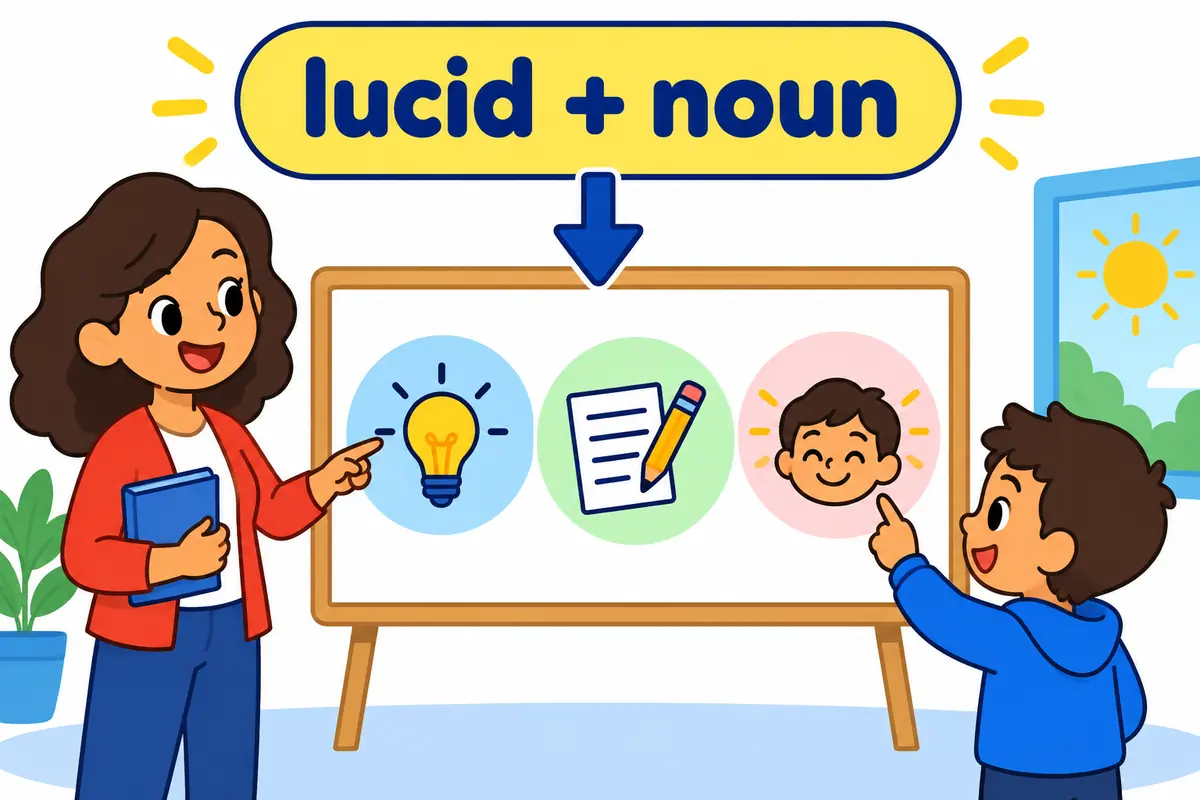
Place lucid before the noun that carries the clarity, or use it after a linking verb such as be, seem or remain. The five patterns below cover most real sentences, from a book review to a ward round.
| Pattern | Example | What it signals |
|---|---|---|
| lucid + writing or speech | The report is a lucid piece of analysis. | Praise for clear expression. |
| lucid + explanation or account | He offered a lucid explanation of the tax. | Clarity applied to a specific task. |
| lucid + moment or interval | She had a lucid moment before the fever returned. | Clear thinking set against confusion. |
| be or remain lucid | The witness remained lucid throughout. | Reports a continuing mental state. |
| lucid + dream | He kept a diary of his lucid dreams. | The fixed phrase for a dream you know is a dream. |
Lucid in a sentence: examples across contexts
Lucid moves easily from a textbook to a hospital ward. The nine sentences below keep the same adjective while the setting changes, and each one shows what is being praised.
| Context | Example sentence | Why this works |
|---|---|---|
| Classroom | Her lucid diagram made the water cycle easy to follow. | Clarity attached to a teaching aid. |
| Workplace email | Thanks for the lucid summary of the meeting. | Polite praise in a professional register. |
| Book review | The novel is lucid even when the plot turns strange. | Clarity survives a complex subject. |
| Medical notes | The patient was lucid and oriented on arrival. | The standard clinical sense of clear thinking. |
| Academic prose | A lucid introduction frames the whole study. | Names the part that carries the clarity. |
| News report | Her lucid testimony held the courtroom’s attention. | Clarity under formal scrutiny. |
| Poetry | A lucid river ran through the dark valley. | The literary brightness sense in action. |
| Conversation | You were not lucid after the anaesthetic. | Everyday use of the clear-mind sense. |
| Sports report | The captain gave a lucid account of the collapse. | Formal clarity applied to a setback. |
Only the medical and conversational examples report thinking rather than style. In the rest, lucid is a compliment paid to how well something is put together.
Lucid vs clear
Lucid and clear overlap almost completely, and the difference is tone rather than meaning. Clear is the everyday word, lucid the more formal and admiring one. A transparent explanation is open about its reasons, which is a different virtue.
| Attribute | lucid | clear |
|---|---|---|
| Core meaning | Easy to follow, well organised | Free from confusion |
| Typical subject | Writing, explanation, mind, dream | Anything from water to rules |
| Register | Formal and admiring | Neutral and common |
| What it implies | Skill in the writer or speaker | Absence of muddle |
| Range | Narrower and more literary | Wide and everyday |
Verdict: choose clear for everyday description and lucid when you want to praise the skill behind the clarity.
Word forms and grammar of lucid
Lucid forms its adverb and nouns regularly, and the abstract noun lucidity is common in medical and literary criticism. The table also lists the rare noun and the comparative built with more.
| Form | Part of speech | Example |
|---|---|---|
| lucid | adjective | The guide is short and lucid. |
| lucidly | adverb | She wrote lucidly about a hard subject. |
| lucidity | noun | His lucidity never left him. |
| lucidness | noun, rare | The lucidness of the proof surprised readers. |
| more lucid, most lucid | comparative and superlative | The second edition is more lucid. |
Common mistakes with lucid
- Incorrect:
Her argument was lucid and very clear.Correct: Her argument was lucid. Rule: Lucid already means clear, so adding clear is redundant. - Incorrect:
The patient was lucidly during the visit.Correct: The patient was lucid during the visit. Rule: The adjective follows was; lucidly is an adverb and needs a verb to modify. - Incorrect:
The sleepy cat gave a lucid yawn.Correct: The sleepy cat gave a placid yawn. Rule: Placid means calm; lucid means clear, so the two look-alikes are not interchangeable. - Incorrect:
He had a lucid dream in which everything was blurred.Correct: He had a lucid dream in which he knew he was dreaming. Rule: A lucid dream is one you recognise as a dream, not one with soft focus. - Incorrect:
The teacher gave lucidity instructions.Correct: The teacher gave lucid instructions. Rule: Lucidity is a noun; use lucid before another noun.
Practice using lucid
Work through the six items, then check the reasoning beside each answer.
- Fill the gap: The manual is ______, so a beginner can follow every step.
- Choose the better word: The lake lay (lucid / placid) in the still morning air.
- Correct the error: Her lucidity explanation impressed the panel.
- Build a sentence: use lucid moment about a patient recovering from a fever.
- Spot the register: which belongs in a medical note – The patient was lucid and oriented, or The patient was super with it?
- Rewrite with the adverb: He explained the rules in a lucid way. Use lucidly instead.
Answers
- lucid – it describes the manual as easy to follow.
- placid – the still water is calm, not clear, so placid is the right sense.
- Her lucid explanation impressed the panel – the adjective, not the noun, must precede explanation.
- Model answer: The patient had a lucid moment and recognised her family.
- The patient was lucid and oriented – a clinical note keeps the standard formal wording.
- He explained the rules lucidly – the adverb describes how the explaining was done.
The bottom line
Use lucid in a sentence to praise clear expression or report clear thinking, and place it before the noun that carries the clarity. The two facts that settle most sentences are that lucid means well organised rather than simple, and that the same word covers both a well-written page and a mind that has come back to itself. For plain description, plain and clear are the everyday choices.

Frequently asked questions about lucid
Is lucid a positive word?
Lucid is almost always a compliment, because it praises the skill that makes an idea easy to follow or the return of clear thinking after confusion. It is neutral only in clinical notes, where it simply records a mental state without judging it. Positive or neutral, it is never an insult.
What is a lucid dream?
A lucid dream is a dream in which the sleeper knows they are dreaming and may even guide what happens. The phrase turns on the clear-mind sense of lucid. It has nothing to do with image sharpness, so a blurred dream that you recognise as a dream is still lucid.
Can lucid describe a person?
It can, but it describes their thinking rather than their personality. A lucid patient or speaker is thinking clearly at that moment. To praise someone’s general intelligence, writers choose lucid only for clarity of mind or expression, not for charm, warmth or talent.
What is the noun form of lucid?
The usual noun is lucidity, as in she explained it with great lucidity. A rare variant is lucidness, which appears mainly in older writing. Both name the quality of being clear, while the adverb lucidly describes how something is said or written.
Have you ever struggled to articulate your thoughts clearly and cohesively? This is where the concept of “lucid” communication becomes crucial. Achieving lucidity in communication means expressing yourself in a way that is easily understood by others, with a clarity and precision that leaves no room for confusion.
Whether you’re writing an email, giving a presentation, or having a conversation, using lucid language can significantly enhance the effectiveness of your message. By eliminating ambiguity and vagueness, you ensure that your ideas are conveyed accurately and resonate with your audience.
7 Examples Of Lucid Used In a Sentence For Kids
- I had a lucid dream last night about flying in the sky.
- The teacher explained the lesson in a lucid way so everyone understood.
- The pond was so clear that the fish were swimming in a lucid water.
- The stars in the night sky were shining so brightly, it was a lucid sight.
- The butterfly had beautiful and lucid wings fluttering in the garden.
- The rainbow after the rain was a lucid arc in the sky.
- The crystal vase was so lucid that you could see the flowers inside perfectly.
14 Sentences with Lucid Examples
- Lucid writing is essential for scoring high in exams.
- It is important to maintain a lucid mind while studying for long hours.
- Creating a lucid study schedule can help in managing time efficiently.
- Lucid communication skills are beneficial in group discussions and presentations.
- Taking breaks while studying can help in maintaining a lucid focus.
- It is crucial to have a lucid understanding of concepts before moving on to the next topic.
- A lucid explanation can make complex topics easier to comprehend.
- Using lucid language in academic writing can improve the readability of the content.
- Lucid notes are key to revising effectively before exams.
- Students often prefer lucid textbooks that explain concepts clearly.
- Lucid thinking can help in solving complex problems in mathematics and science.
- It is advisable to maintain a lucid discussion with professors for better clarity on subjects.
- Improving lucid reasoning skills can enhance critical thinking abilities.
- Opting for lucid online resources can aid in supplementing classroom learning.
How To Use Lucid in Sentences?
To use the word “Lucid” in a sentence, follow these simple steps:
-
Understanding the Meaning: Before incorporating the word “Lucid” into your sentence, make sure you have a clear understanding of its meaning. “Lucid” means clear and easily understood.
-
Context: Think of a situation where clarity or clearness can be highlighted. For example, “After a good night’s sleep, I had a lucid dream where everything felt real and clear.”
-
Position: Place the word “Lucid” appropriately in your sentence to ensure it flows naturally. It is often used to describe thoughts, dreams, or explanations that are coherent and easily comprehensible.
-
Practice: Try constructing different sentences using the word “Lucid” to get comfortable with its usage. For instance, “His explanation was so lucid that even the most complex concepts seemed simple to grasp.”
-
Feedback: Share your sentences with others to receive feedback on how effectively you have used the word “Lucid” in context.
-
Variety: Experiment with using the word “Lucid” in various contexts to broaden your understanding of its applications.
By following these steps, you can effectively incorporate the word “Lucid” into your sentences. Remember to pay attention to its meaning and usage to communicate clearly and effectively.
Conclusion
In conclusion, the examples of sentences crafted with the keyword “lucid” demonstrate clarity and simplicity in communication. The use of lucid sentences in writing and speech ensures that ideas are easily understood by the audience without ambiguity or confusion. This results in effective communication that conveys information clearly and succinctly.
By incorporating lucid sentences into our daily communication, we can enhance our ability to convey thoughts and information with precision and ease. Whether in professional documents, academic papers, or casual conversations, the power of lucid sentences lies in their ability to make complex ideas accessible to a broad range of individuals. Ultimately, mastering the art of crafting lucid sentences is a valuable skill that can lead to more effective and engaging communication in various aspects of life.


