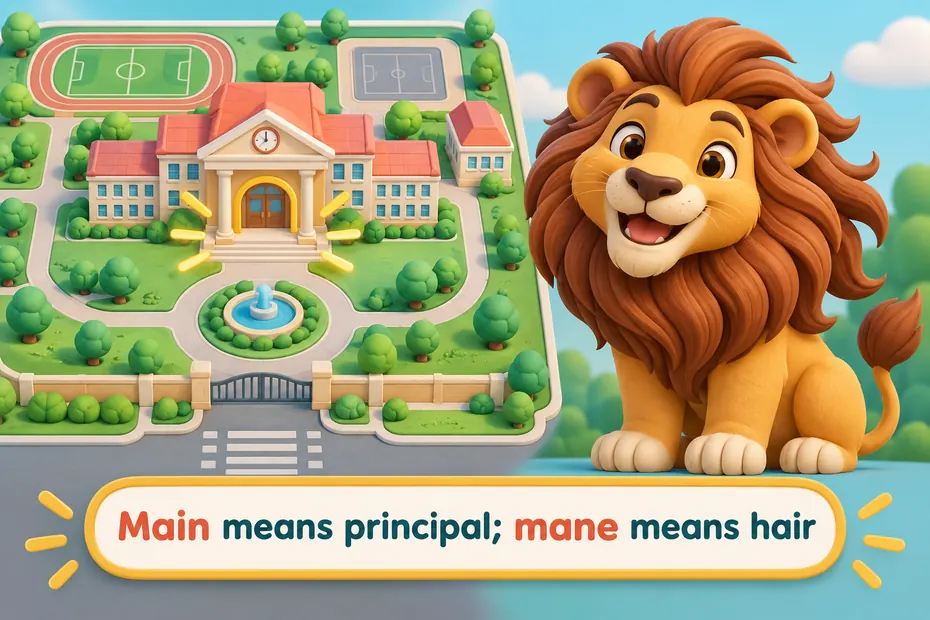
Main vs mane: the quick answer
Main usually describes something principal or most important: the main road, main idea, or main reason. Mane names long, thick hair around an animal’s neck or head, such as a horse’s mane or a lion’s mane. Both words sound like “mayn,” so listening alone will not identify the spelling. Look at what the sentence means.
Think of this sentence: “The lion’s mane was the main attraction.” The hair is a mane; being the most important attraction makes it main. The words can appear together without having the same grammatical job.

Key facts before you write
- Main commonly works as an adjective before a noun.
- Mane works as a noun and can take an article: a mane, the mane.
- Main also has noun senses, including a principal utility pipe or circuit.
- Mane can describe someone’s long, thick head hair as well as animal hair.
- Neither spelling is a replacement for the other simply because they rhyme.
How to use main
If you mean chief, primary, or principal, choose main. A main entrance is the principal entrance. A main character has a central role in a story. A main concern is a concern receiving the greatest attention. These phrases show main describing another noun, rather than naming hair.
Try replacing main with “principal.” “The principal reason for the delay was rain” keeps the intended meaning of “The main reason for the delay was rain.” This is a meaning check, not a demand to use the longer word in your final sentence.
In an essay, a main idea expresses the central point of a passage. Supporting details develop that point. When revising, ask which statement explains the paragraph as a whole. Do not call every detail a main idea merely because it is interesting.
Main is not restricted to adjectives. A water main is a principal pipe in a water system; the plural mains can refer to a utility supply. Context tells you whether “the main” names a pipe or whether “main” describes something else. Merriam-Webster records these noun meanings alongside the common adjective meaning. Merriam-Webster: main.
How to use mane
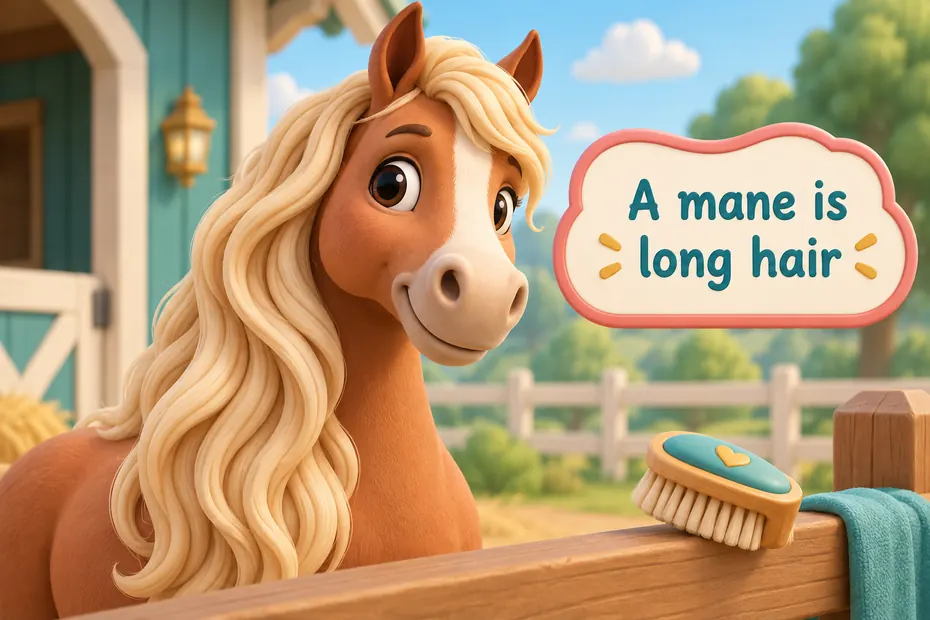
A mane is long, heavy hair, especially around the neck or head of animals such as horses and lions. You can describe its color, texture, movement, or care: a dark mane, a tangled mane, a flowing mane. In “She brushed the horse’s mane,” mane is the object of brushed.
Writers also use mane for a person’s long, thick hair. “The actor shook his silver mane” creates a more vivid image than simply saying hair. This use is appropriate when the description suits the person; it does not mean every hairstyle must be called a mane. The human-hair sense is also recorded in Merriam-Webster’s mane entry.
The plural is manes: “The horses’ manes blew in the wind.” For possession, use an apostrophe: “the lion’s mane” for one lion and “the lions’ manes” for several lions. First decide whether you are naming hair, then decide whether the sentence needs singular, plural, or possessive punctuation.

Compare the meanings in sentences
| Context | Correct choice | Reason |
|---|---|---|
| Our ___ goal is to finish today. | main | Goal is the principal goal. |
| The pony has a black ___. | mane | The sentence names hair. |
| A broken water ___ closed the street. | main | Main names a principal utility pipe. |
| His thick ___ fell over his shoulders. | mane | Mane describes long, heavy human hair. |
| The ___ road passes the stable. | main | Main describes the principal road. |
These examples were written for this guide. Notice that an animal nearby does not automatically require mane: “The horse was the main attraction” still means the principal attraction. Likewise, a person in a sentence does not exclude mane, since that word can describe human hair.
A spelling check you can use anywhere
- Identify the thing or quality you intend to describe.
- If the intended meaning is principal, try main.
- If the intended meaning is long, thick hair, try mane.
- If the sentence refers to a utility pipe or supply, check the noun meaning of main.
- Read the whole sentence again to confirm the meaning.
A useful memory cue is “a mane is hair.” Imagine the final e as a curl at the end of a long strand. For main, remember a main idea: it carries the principal point. These cues help with spelling, but the dictionary meanings remain the actual reason to choose the word.
Practice: choose main or mane
Complete these sentences: (1) The ___ issue is cost. (2) We combed the pony’s ___. (3) The workers repaired the water ___. (4) The lion’s ___ drew visitors to the ___ exhibit.
Answers: (1) main, because it describes the principal issue; (2) mane, because it names hair; (3) main, because it names a utility pipe; (4) mane, main, because the first names hair and the second describes the principal exhibit.
Frequently asked questions
Do main and mane sound different?
They share the pronunciation “mayn” in standard dictionary pronunciation. Their different spelling and meanings make them homophones.
Can main be a noun?
Yes. A water main is one everyday example. Main is therefore not always an adjective, even though adjective phrases such as main point are common.
Can a person have a mane?
Yes. Mane can describe long, thick head hair. This often gives a sentence a vivid descriptive tone.
Is main attraction correct when the attraction is a lion?
Yes. Main describes the attraction’s importance. If you describe the lion’s hair, choose mane: “The lion’s mane was the main attraction.”
Key Takeaways
- “Main” and “mane” are commonly confused words in English, but they have distinct meanings.
- “Main” is an adjective that means primary or principal, while “mane” is a noun that refers to the long hair on the neck of certain animals, such as horses or lions.
- “Main” is used to describe something that is central or most important, while “mane” describes the hair on an animal’s neck.
- It is important to use these words appropriately and avoid common mistakes by understanding their differences.
- Consider the context in which you are using the word and choose the correct one accordingly.
- “Main” can also be used as a noun to refer to a principal pipe or conduit through which something flows, such as water or electricity.
Understanding the Difference
One commonly confused pair of words in English is “main” and “mane.” Both words sound similar but have distinct meanings. Let’s explore the difference between them.
Definition of “Main”
The word “main” is an adjective that means primary or principal. It refers to something that is central or most important in a group or collection. Here are a few examples of how “main” can be used:
- The main character in the story is a brave and determined hero.
- The main objective of this project is to increase sales.
- The main reason for the traffic congestion is the ongoing construction work.
Definition of “Mane”
On the other hand, the word “mane” is a noun that refers to the long hair along the top of certain animals’ necks. It is commonly used when describing horses or lions. Here are some examples of how “mane” can be used:
- The majestic lion had a thick and flowing mane.
- She brushed the horse’s mane before the riding competition.
- The horse’s white mane shimmered in the sunlight.
Differences between “Main” and “Mane”
Although “main” and “mane” may sound alike, they have completely different meanings. Here are the key differences:
Main:
- It is an adjective.
- It means primary or principal.
- It refers to something that is central or most important.
- It is a noun.
- It refers to long hair on the neck of an animal, especially a horse or lion.
Remember, “main” is used to describe importance or priority, while “mane” describes the long hair on an animal’s neck.
Understanding the distinction between these two words will help you use them correctly and avoid confusion in your writing. Now let’s move on to exploring more commonly misused and confused words in English.
Main as an Adjective
When it comes to the word “main,” it is important to understand its usage as an adjective. As an experienced writer, I have encountered instances where people mistakenly substitute “mane” for “main” and vice versa. Let’s jump into the definition and proper usage of “main” to help you avoid any confusion.
Definition of Main:
“Main” is an adjective that means primary or principal. It is used to describe something that is of utmost importance or relevance. This word is commonly used to emphasize the most significant or essential aspect of a particular subject. Understanding this distinction is crucial for effective communication.
Examples of Main Usage:
- In a sentence: “The main focus of my research is finding a cure for cancer.”
- In a sentence: “The company’s main objective is to provide exceptional customer service.”
- In a sentence: “During the interview, I highlighted my main strengths, including problem-solving and teamwork.”
Difference between Main and Mane:
Now that we have a clear understanding of the adjective “main,” it is important to differentiate it from the noun “mane.” While “main” refers to something being primary or principal, “mane” refers specifically to the long hair on the neck of certain animals, such as horses or lions. Understanding the difference between these two words can help us avoid confusion in writing.
In the next section, we’ll explore “mane” in more detail and provide examples of its usage. Stay tuned for a comprehensive understanding of this commonly confused word pair.
Main as a Noun
When we think of the word “main,” it is commonly understood as an adjective meaning primary or principal. But, it can also be used as a noun in certain contexts. Let’s explore the definition and usage of “main” as a noun.
The noun form of “main” refers to a principal pipe or conduit through which something flows, such as water, electricity, or even ideas. It is often used in the context of infrastructure or systems. For example:
- The streets of the city were flooded due to a burst main.
- He is responsible for overseeing the maintenance of the water mains in the neighborhood.
In these cases, “main” is specifically referring to the central pipe or conduit that carries the essential substance or information to its intended destination.
It is important to note that “main” as a noun is not as commonly used or encountered as its adjective form. But, understanding its meaning and usage can still be beneficial, especially in technical or specialized contexts.
To summarize, while “main” is primarily used as an adjective to mean primary or principal, it can also function as a noun to refer to a principal pipe or conduit. By recognizing and utilizing this noun form correctly, we can further enhance our communication skills and avoid confusion in writing.
Remember to keep in mind the difference between “main” as an adjective and “mane” as a noun to ensure precise and effective communication.
Mane as a Noun
When it comes to the word “mane,” we switch gears from its usage as an adjective to its noun form. Let’s jump into what this means and how it differs from “main.”
Definition of Mane: A noun, “mane” refers specifically to the long hair on the neck of certain animals, such as lions, horses, and some other mammals. It’s a distinctive feature that adds to the visual appeal of these creatures.
You may be wondering how to use “mane” correctly in a sentence. Here are a few examples to make it easier for you:
- “The lion’s majestic mane flowed in the wind as it roared.”
- “She braided the horse’s mane before going for a ride.”
- “The tiger’s fierce appearance was accentuated by its thick, orange mane.”
As you can see, “mane” brings to mind the image of a flowing, long-haired neck of an animal, enhancing their beauty and defining their characteristic features.
It’s important to differentiate between “mane” as a noun and “main” as an adjective. “Main” refers to something that is primary or principal, while “mane” specifically describes the hair on an animal’s neck.
Now that we’ve explored the noun form of “mane,” it’s time to move on and take a closer look at another usage of the word “main.”
Stay tuned for the next section, where we’ll jump into the noun usage of “main” and discover its fascinating implications in infrastructure and systems.
Common Mistakes
When it comes to the words “main” and “mane,” one of the most common mistakes is simply confusing their meanings and usage. Let’s investigate into some of these common mistakes and how to avoid them.
The Difference Between “Main” and “Mane”
A common mistake is not understanding the difference between “main” and “mane.” While they may sound similar, they have distinct meanings. Here’s a quick breakdown:
- “Main” is an adjective that means primary or principal. It refers to something that is of utmost importance or the most significant. For example, you might say, “The main reason for their success was their strong work ethic.”
- On the other hand, “mane” is a noun that specifically refers to the long hair on the neck of certain animals, such as horses or lions. So, if you’re talking about a horse’s long flowing hair, you would say, “The horse has a beautiful, thick mane.”
Using the Words Appropriately
Another common mistake is using these words interchangeably when they shouldn’t be. To ensure accurate communication, it’s essential to use the correct word in the right context. Here are a few examples to illustrate the proper usage:
- “We need to fix the main water pipe.” (Here, “main” is used as a noun, referring to the principal water pipe.)
- “She brushed her horse’s mane before the competition.” (In this sentence, “mane” is used as a noun, describing the long hair on the horse’s neck.)
- “The main character in the story was well-developed.” (In this case, “main” functions as an adjective, describing the primary character in the story.)
By understanding the nuanced differences between “main” and “mane,” we can avoid common mistakes and use these words appropriately. Next, let’s explore the noun usage of “main” in the context of infrastructure and systems.
Tips for Proper Usage
When it comes to using “main” and “mane” correctly, it’s important to understand the differences between them and use them appropriately. Here are some tips to help you in using these words accurately:
- Different Meanings:
- “Main” is an adjective that means primary or principal. It describes something that is of utmost importance or significance.
- “Mane” is a noun that specifically refers to the long hair on the neck of certain animals, such as horses or lions.
- Context Matters:
- Consider the context in which you are using the word. Use “main” when you want to express something as the primary or principal element. For example, “The main reason for his success was his perseverance.”
- Use “mane” when you want to talk about the long hair on the neck of an animal. For instance, “The lion’s majestic mane flowed in the wind.”
- Using “Main” as a Noun:
- While “main” is primarily used as an adjective, it can also be used as a noun to refer to a principal pipe or conduit through which something flows, such as water, electricity, or ideas.
- For example, “The main supplies electricity to the entire building.”
- Avoid Common Mistakes:
- It’s important to avoid common mistakes made with “main” and “mane.” Remember the key differences between them and use them accurately in your writing or conversation. Using the wrong word can lead to confusion and misinterpretations.
By following these tips, you can enhance your understanding and usage of “main” and “mane.” Using the correct word in the right context is essential for effective communication.
Now that we have covered the tips for proper usage, let’s dive deeper into the noun usage of “main” in the context of infrastructure and systems. This will give you a comprehensive understanding of the word and how it is commonly used.
Conclusion
Understanding the proper usage of “main” and “mane” is crucial to effective communication. In this text, I have provided valuable tips to help you differentiate between these two words and use them appropriately.
By highlighting the distinctions between “main” and “mane,” I have emphasized the significance of accuracy in language. It is essential to recognize that “main” refers to a principal pipe or conduit, while “mane” refers to the long hair on the neck of an animal.
Besides, I have discussed the noun usage of “main” in the context of infrastructure and systems. This demonstrates the versatility of the word and its relevance in various fields.
In the next section, I will investigate deeper into the noun usage of “main” and explore its applications in more detail. Stay tuned for a comprehensive understanding of this word’s diverse uses.
Remember, using “main” and “mane” correctly will enhance your writing and ensure effective communication.
Frequently Asked Questions
Q: What does the article discuss?
A: The article discusses the proper usage of the words “main” and “mane”. It explains their differences and emphasizes the importance of using them accurately.
Q: What is the noun usage of “main” mentioned in the article?
A: The noun usage of “main” refers to a principal pipe or conduit through which something flows, typically used in the context of infrastructure and systems.
Q: Will the article explore the noun usage of “main” in more detail?
A: Yes, the article mentions that the next section will delve deeper into the noun usage of “main”.


