
Maladroit means awkward or clumsy, especially in the way a person moves, speaks or handles a social situation. To use maladroit in a sentence, apply it to a person or an action that lacks grace: “His maladroit apology made the room quieter.” The adjective usually describes a remark, a gesture or a manner, not a machine.
Maladroit at a glance
- Maladroit is an adjective; its other forms are maladroitly and maladroitness.
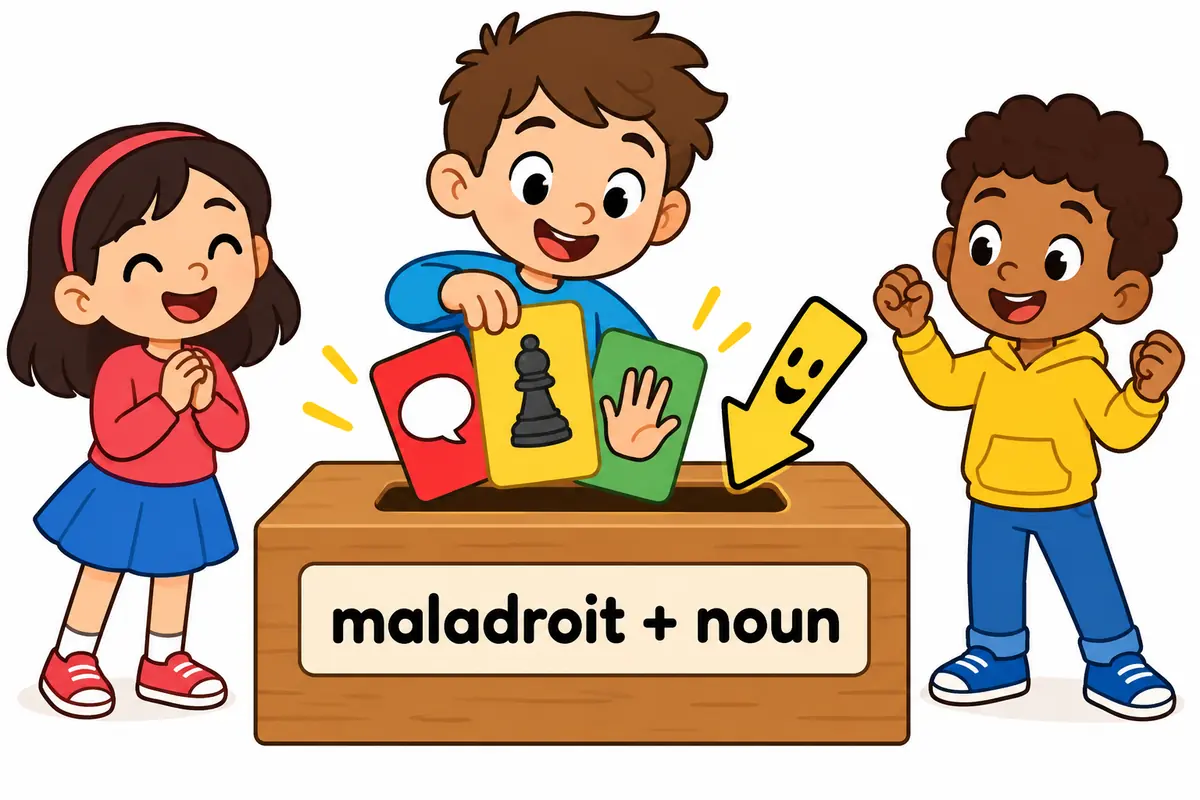
- The commonest pattern is maladroit + noun, as in a maladroit remark.
- It covers both physical clumsiness and social awkwardness.
- The word sits in formal or literary writing; speech prefers awkward or clumsy.
- The usual mistake is using maladroit as a noun: he is a maladroit.
What does maladroit mean?
Maladroit is an adjective meaning awkward, clumsy or inelegant, especially in social behaviour or in the handling of a situation. The Cambridge entry for maladroit records the core sense of clumsiness, and the two uses below separate a clumsy body from a clumsy judgement. Where you mean physical coordination alone, clumsy is the plainer choice.
| Sense | Plain meaning | Example sentence |
|---|---|---|
| Physical awkwardness | Moving without control or grace | The maladroit waiter sent two glasses sliding off the tray. |
| Social awkwardness | Acting without tact or timing | A maladroit joke about her accent ended the interview early. |
| Botched handling | Managing a task with visible ineptitude | The maladroit rollout left half the staff locked out of the system. |
How do you use maladroit in a sentence?
Maladroit nearly always attaches to a noun or follows the verb be, and the preposition that follows it is at, not in. These four patterns cover most real uses.
| Pattern | Example | What it signals |
|---|---|---|
| maladroit + noun | It was a maladroit move to announce layoffs at the picnic. | The awkwardness belongs to the action. |
| be + maladroit | He is maladroit with strangers. | A standing trait rather than one incident. |
| maladroit at + noun or -ing | She is maladroit at small talk. | Names the exact skill that is missing. |
| too maladroit to + verb | He was too maladroit to chair the meeting. | Explains why a role or task failed. |
Maladroit in a sentence: examples across contexts
Each row places maladroit in a register where the word earns its keep, with one line explaining the fit.
| Context | Example sentence | Why this works |
|---|---|---|
| Classroom feedback | The tutor called the essay promising but maladroit in its structure. | It criticises execution without attacking the writer. |
| Workplace email | Please excuse my maladroit wording in yesterday’s message. | Self-deprecation softens a formal apology. |
| News report | The minister’s maladroit handling of the flood response drew cross-party criticism. | It labels a public failure of judgement. |
| Sports writing | A maladroit touch from the defender gifted the striker a goal. | It describes a single clumsy moment. |
| Literary criticism | The novel’s maladroit dialogue keeps the reader at a distance. | It judges craft rather than content. |
| Academic writing | The study’s maladroit sampling weakens every conclusion it draws. | It is a precise term for methodological clumsiness. |
| Conversation | I felt maladroit at dinner, knocking over my glass twice. | First person makes the awkwardness immediate. |
| Customer review | The maladroit assembly instructions cost me a full hour. | It blames a design’s lack of grace. |
Maladroit vs clumsy
Maladroit and clumsy overlap around the body, but not in the judgement behind them. The table sets the two side by side.
| Attribute | Maladroit | Clumsy |
|---|---|---|
| Core meaning | Awkward in manner, action or tact | Awkward in movement or handling |
| Register | Formal or literary | Neutral, common in speech |
| Typical subject | Remarks, decisions, diplomacy | Hands, feet, tools, falls |
| Extra implication | A failure of judgement or grace | A failure of coordination |
| Frequency | Uncommon | Everyday |
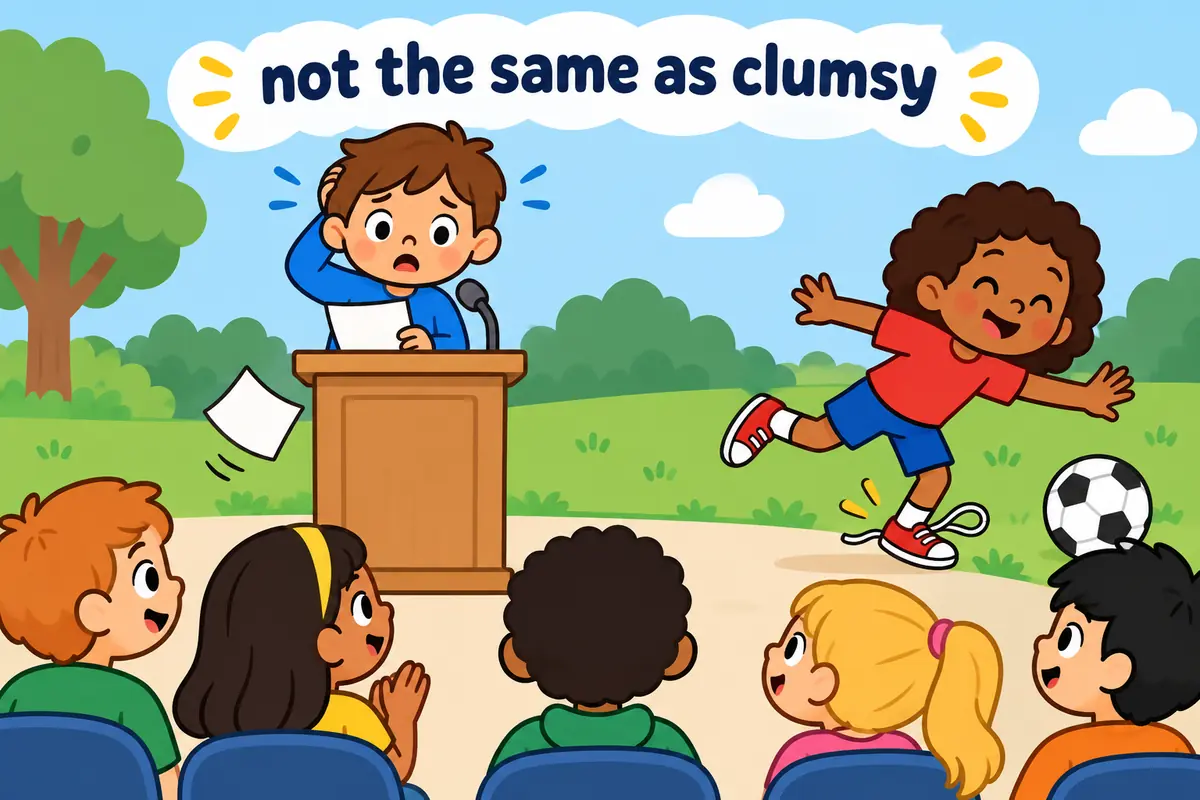
Use maladroit when judgement or social grace is at fault, and clumsy when the problem is purely physical. Nearby words shift the emphasis: awkward situations feel uncomfortable rather than failed, inelegant phrasing offends the ear, inept handling reveals missing skill, a tactless question wounds on purpose, and ungraceful movement simply looks ungainly.
Word forms and grammar of maladroit
| Form | Part of speech | Example |
|---|---|---|
| maladroit | adjective | a maladroit reply |
| maladroitly | adverb | He replied maladroitly. |
| maladroitness | noun | Her maladroitness with figures cost the firm. |
| maladroit as a noun | non-standard | He is a maladroit. — write He is maladroit. |
| maladroiter, maladroitest | rare comparative | more maladroit is the usual form. |
Common mistakes with maladroit
- Incorrect:
He is a maladroit.Correct: He is maladroit. Rule: the word is an adjective, so it needs no article or noun slot. - Incorrect:
She acted maladroit.Correct: She acted maladroitly. Rule: a verb needs the adverb form, not the adjective. - Incorrect:
maladroit in dancing.Correct: maladroit at dancing. Rule: the adjective pairs with at, not in, before a skill. - Incorrect:
The maladroit machine jammed again.Correct: The clumsy machine jammed again. Rule: maladroit describes people and their actions, not objects. - Incorrect:
His maladroit insult was cruel.Correct: His deliberate insult was cruel. Rule: maladroit means awkward, not intentionally unkind.
Practice using maladroit
Try the exercises, then check the reasoned answers below.
- Fill in the blank: The negotiator’s ________ remark stalled the talks.
- Choose the better word: The toddler is (maladroit / clumsy) with a spoon.
- Correct the error: Her maladroit in interviews worried the coach.
- Build a sentence: describe a badly timed email, using maladroit + noun.
- Spot the register: which fits a formal report? (a) The handover was maladroit. (b) The handover was a mess.
- Fill in the blank: He is too ________ to dance without treading on toes.
Answers
- maladroit — the adjective modifies remark.
- clumsy — the problem is pure coordination in a toddler.
- Her maladroitness in interviews worried the coach — in needs a noun, so use maladroitness, or write maladroit at interviews.
- The maladroit email reached the client by mistake — maladroit + noun names the awkward action.
- (a) — maladroit suits the formal register of a report.
- maladroit — the adjective follows too and precedes to + verb.
The bottom line
Maladroit is a formal adjective for awkwardness in movement, manner or judgement, and maladroit in a sentence usually attaches to a noun or follows be. Choose clumsy for plain physical coordination, and reserve maladroit for a failure of grace or tact. Its noun and adverb forms, maladroitness and maladroitly, are less common but standard. The word never carries any sense of malice, so it cannot stand in for deliberate cruelty.
Frequently asked questions about maladroit
Is maladroit a common word?
Maladroit is uncommon in everyday speech and appears mainly in formal, literary or journalistic writing. Native speakers understand it but usually reach for awkward or clumsy in conversation. Learning it improves reading and formal writing rather than casual chat. It rewards recognition more than production.
Does maladroit mean evil or unkind?
No. Maladroit means awkward or clumsy, not cruel or wicked. A maladroit remark is one delivered without tact or timing, not one intended to wound. If the harm was meant, use deliberate or spiteful instead. The word stays close to awkward, never to evil.
Can maladroit describe an object?
Rarely, and usually only when the object reflects human choices. A maladroit design suggests that its makers handled the task clumsily. For the physical clumsiness of a thing itself, clumsy is the natural choice, because machines and tools are not maladroit in their own right.
What is the opposite of maladroit?
The opposite of maladroit is adroit, meaning skilful and deft. Related positives include graceful, tactful and polished. A person who is adroit handles both tools and conversations with ease, while a maladroit person fumbles them. Adroit is the direct antonym, not just a milder synonym.
Ever found yourself fumbling or clumsy in your actions? Welcome to the world of the “maladroit.” Maladroit is a term used to describe someone who is awkward, inept, or lacking in skill or dexterity.
Whether it’s struggling to carry a pile of books without dropping them, tripping over your own feet, or constantly spilling drinks, being labeled as maladroit can sometimes feel like a clumsy curse. While it may lead to some embarrassing moments, it’s important to remember that everyone has their moments of clumsiness or ineptitude.
7 Examples Of Maladroit Used In a Sentence For Kids
- Maladroit Sally spilled her juice all over the table.
- It was maladroit of Tommy to trip and fall while walking.
- The cat was maladroit when it knocked over the vase.
- Emma felt maladroit when she dropped her toy on the floor.
- The funny clown was always maladroit with his juggling balls.
- We all laughed when Sarah’s maladroit dance moves made her fall.
- The little boy was maladroit as he tried to tie his shoelaces.
14 Sentences with Maladroit Examples
- During the debate competition, he made a maladroit attempt to rebut the opposition’s argument.
- She felt maladroit trying to cook Indian cuisine for the first time in her college dorm.
- The student’s maladroit handling of the lab equipment almost caused an accident.
- Despite his best efforts, his maladroit dance moves at the college party drew some giggles from the crowd.
- Her maladroit attempt to make friends with her new roommates ended in awkward silence.
- Trying to speak in a foreign language, he stumbled over his words, sounding maladroit in front of his classmates.
- The student’s maladroit attempt to fix the projector during the presentation only led to more technical issues.
- Her maladroit handling of the group project caused frustration among her team members.
- The college’s attempt to implement a new grading system was met with maladroit confusion among the students.
- The professor’s maladroit explanation of the complex theory left the students more puzzled than enlightened.
- Despite his enthusiasm, his maladroit attempts to join the college football team only resulted in multiple fumbles.
- The student’s maladroit choice of words in the research paper led to confusion among the readers.
- The attempt to organize a flash mob on campus ended up being a maladroit mess of mismatched moves.
- Her maladroit handling of the delicate equipment in the chemistry lab earned her a scolding from the professor.
How To Use Maladroit in Sentences?
To use the word Maladroit in a sentence, it is important to first understand its meaning. Maladroit is an adjective that describes someone who is clumsy, awkward, or unskillful in their actions. Here is a simple guide on how to incorporate Maladroit into a sentence:
-
Identify a situation where someone is displaying clumsiness or lack of skill.
-
Think about how to describe this behavior using the word Maladroit.
-
Construct a sentence that includes Maladroit to accurately communicate the idea of awkwardness or clumsiness.
For example:
- “Despite his good intentions, John’s maladroit attempt to juggle the fragile vases resulted in a disaster.”
- “She made a maladroit attempt to fix the broken chair, only managing to make it wobble even more.”
- “The comedian’s maladroit delivery of the punchline left the audience confused instead of amused.”
By using Maladroit in a sentence, you can effectively convey the idea of someone being clumsy, awkward, or unskillful. Practicing with different scenarios will help you become more comfortable incorporating this word into your vocabulary.
Conclusion
In conclusion, the examples of maladroit sentences demonstrated a lack of skill or finesse in their construction, leading to confusion or awkwardness in communication. These sentences were marked by clumsy or inept expression, evident in their tangled syntax and convoluted phrasing. Avoiding maladroit sentences is essential for effective communication, as clarity and precision are key to transmitting ideas successfully.
By recognizing and correcting maladroit sentences, one can enhance the clarity and coherence of their writing or speech. Attention to organization, word choice, and structure can help eliminate awkward or confusing constructions, improving the overall impact of the message conveyed. Striving for more adept and skillful expression will result in more effective communication and better conveyance of ideas to the intended audience.


