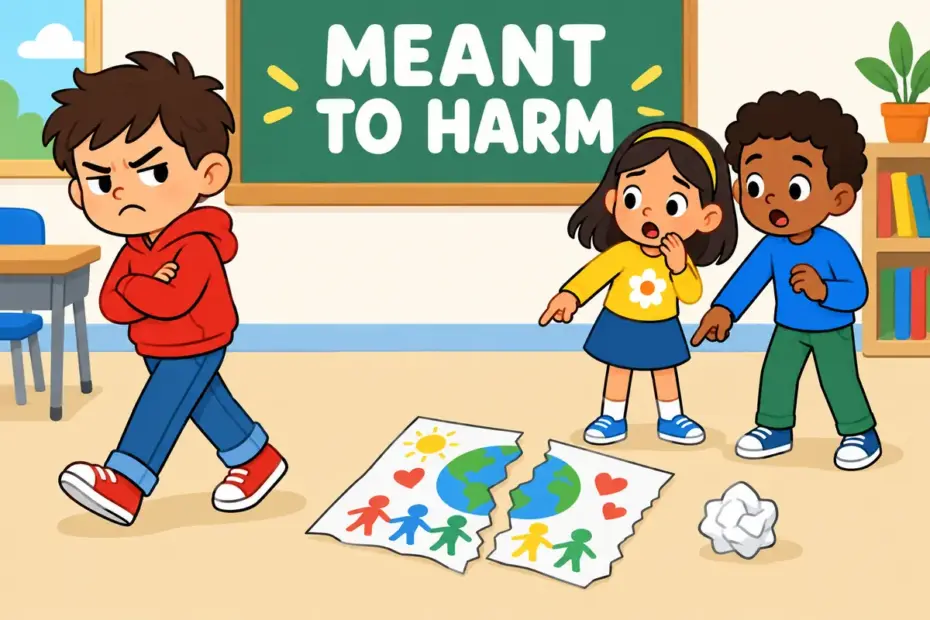
Malicious describes a person or act that is intended to harm, hurt or damage someone. To use malicious in a sentence, put it before the noun it judges: “A malicious rumour spread through the office.” The adjective names intent, so it fits legal writing about damage and technical writing about software rather than everyday annoyance.
Malicious at a glance
- Malicious is an adjective; the noun is malice and the adverb is maliciously.
- The core meaning is intending harm to a person or their reputation.
- The usual collocations are malicious intent, malicious damage, malicious gossip and malicious software.
- The word judges motive, so it is common in legal and computing contexts.
- The commonest error is confusing malicious with malignant, which is a medical term.
What does malicious mean?
Malicious is an adjective meaning intended to harm, hurt or damage someone. The Cambridge entry for malicious points to the noun malice, and that noun is the clue: the adjective always reports a motive, not merely a result.
| Sense | Plain meaning | Example sentence |
|---|---|---|
| Intending harm | Wanting to hurt a person | A malicious note was left on her desk. |
| Damaging property or reputation | Done in order to cause loss | The fire was ruled malicious damage. |
| Computing | Software written to damage or steal | The update blocked malicious code. |
One limitation is worth stating plainly. Malicious names motive, so it is not the right word for harm caused by carelessness. A spill can be harmful without being malicious, and a malicious plan can fail with no harm done at all.
How do you use malicious in a sentence?
Malicious behaves like most judging adjectives: it fits before a noun or after a linking verb, and its adverb attaches the motive to an action. Four patterns cover most sentences.
| Pattern | Example | What it signals |
|---|---|---|
| malicious + noun | The court found malicious intent. | The adjective modifies the harm directly. |
| be + malicious | The message seemed deliberately malicious. | Describes a motive after a linking verb. |
| maliciously + verb | He maliciously deleted the files. | The adverb ties motive to an action. |
| malicious + noun + toward/against | The campaign was malicious toward newcomers. | Names the target of the intent. |
The everyday word for a small, petty version of this motive is spiteful behaviour, which suggests resentment rather than deep harm.

Malicious in a sentence: examples across contexts
Malicious keeps its meaning across registers but changes its neighbours. The eight sentences below move from a playground to a courtroom and a server log.
| Context | Example sentence | Why this works |
|---|---|---|
| Classroom | Nobody believed the malicious rumour about the new pupil. | A school setting shows the everyday sense of intended harm. |
| Workplace email | A malicious message about a colleague reached the whole team. | The adjective describes reputational damage. |
| News report | Police are treating the fire as malicious. | A short legal framing of deliberate harm. |
| Legal writing | The claim rested on malicious prosecution. | A fixed legal phrase for an abuse of process. |
| Computing | The scan flagged three malicious files. | Technical writing uses the adjective for hostile software. |
| Conversation | That was a malicious thing to say. | The adjective judges motive in plain speech. |
| Academic writing | The study measured how malicious intent spreads online. | An abstract noun follows, keeping the tone formal. |
| Social media | A malicious account posted the same lie repeatedly. | The adjective describes a persistent hostile source. |
The legal phrases are fixed, so malicious damage and malicious prosecution should not be rearranged. Elsewhere the word behaves like any judging adjective and can follow a linking verb.
What is the difference between malicious and malevolent?
Malicious describes a specific harmful act or intention, while malevolent feelings describe a deeper, lasting wish for evil. Spiteful is the smallest of the three, reserved for petty resentment.
| Attribute | malicious | malevolent | spiteful |
|---|---|---|---|
| Scope | A particular act or plan | A general disposition | A small, personal grievance |
| Strength | Deliberate harm | Deep and settled evil | Petty and resentful |
| Typical subject | An act, message or file | A person, gaze or force | A comment or gesture |
| Register | Legal, technical, everyday | Literary and formal | Everyday |
| Implied intensity | Moderate to high | Very high | Low |
Verdict: use malicious for a concrete harmful intent, malevolent for a lasting evil nature, and spiteful for a small act of resentment.
Word forms and grammar of malicious
Malicious shares its root with malice, and the adverb maliciously is the form that carries the motive into an action clause.
| Form | Part of speech | Example |
|---|---|---|
| malice | noun | She acted out of pure malice. |
| malicious | adjective | The rumour was clearly malicious. |
| maliciously | adverb | The files were maliciously altered. |
| maliciousness | noun | The report noted the maliciousness of the act. |
| malign | verb | Rivals tried to malign the new coach. |
| malignant | adjective, medical | The growth was found to be malignant. |
The adverb maliciously is useful because it lets a sentence say who did the harm and why in one clause.
Common mistakes with malicious
Two pairs cause most errors: the medical malignant and the noun malice, which are often reached for when the adjective is needed.
- Incorrect:
The weather was malicious and ruined the picnic.Correct: The weather was harsh and ruined the picnic. Rule: Malicious requires a mind that intends harm; weather has no motive. - Incorrect:
Doctors removed a malicious tumour.Correct: Doctors removed a malignant tumour. Rule: Malignant is the medical adjective for a cancerous growth; malicious describes intent. - Incorrect:
He is a malicious.Correct: He is a malicious person. Rule: Malicious is an adjective, so it needs a noun, not a noun slot. - Incorrect:
She said it with malice intent.Correct: She said it with malicious intent. Rule: The fixed phrase uses the adjective malicious before intent, not the noun malice.
Practice using malicious
Work through the six items, then check the reasoning rather than only the answer.
- Fill the gap: The email contained a ______ link that stole passwords.
- Choose the better word: The gossip was (malicious / malignant) and damaged her reputation.
- Correct the error: The storm was malicious and tore down the fence.
- Build a sentence: use maliciously + verb about someone deleting a classmate’s work.
- Spot the register: which belongs in a police report — the fire was malicious, or the fire was really mean?
- Rewrite with the noun: He acted with malicious intent. Use malice instead.
Answers
- malicious — the link intends harm, so the adjective describes motive.
- malicious — the gossip intended harm; malignant is a medical term.
- The storm was fierce and tore down the fence — a storm has no intent to harm.
- Model answer: Someone maliciously deleted the shared file just before the deadline.
- The fire was malicious — a police report keeps the fixed legal phrase.
- He acted with malice — the noun follows the preposition with.
The bottom line
Use malicious in a sentence when a person or their act intends harm, and keep the word close to the harm it describes. Two nuances decide most sentences: the adjective reports a motive rather than a result, and its medical near-twin malignant means something else entirely. Where only the damage matters, harmful is the safer choice.
Frequently asked questions about malicious
Is malicious a legal word?
Malicious appears in legal phrases such as malicious damage and malicious prosecution, where it marks a deliberate intention to harm. It also works in ordinary sentences about rumours or messages. The legal use is fixed, but the everyday use simply reports motive.
What is the difference between malicious and malignant?
Malicious describes an intention to harm, as in a malicious rumour. Malignant is a medical word for a cancerous growth that spreads. They share a root meaning of evil, but only malignant is used for disease, so a doctor removes a malignant tumour.
Can an accident be called malicious?
No. An accident is unintended, and malicious requires a mind that wants to cause harm. A careless driver who causes damage may be negligent, and the result may be harmful, but neither word claims the deliberate motive that malicious carries.
What is the noun form of malicious?
The noun is malice, meaning a desire to harm others. Maliciousness also exists but is rarer and often sounds clumsy. Use malice in the fixed phrase with malice, as in she acted with malice rather than by accident or a careless mistake.
Have you ever encountered a sentence with “malicious” in it and wondered what it truly meant? The word “malicious” is often used to describe something intentionally harmful or spiteful.
When a person’s actions are deemed malicious, it implies that they have the intent to cause harm or distress. In legal contexts, malicious behavior may result in serious consequences.
7 Examples Of Malicious Used In a Sentence For Kids
- The malicious cat scratched the furniture.
- The malicious wolf showed its sharp teeth.
- The malicious witch cast a spell on the princess.
- The malicious crow stole the shiny jewelry.
- The malicious dragon breathed fire on the village.
- The malicious snake hissed at the farmer.
- The malicious ghost frightened the children.
14 Sentences with Malicious Examples
- Malicious rumors were spread about the new professor, causing unnecessary stress among the students.
- The hacker launched a malicious attack on the campus network, causing chaos during exams.
- A malicious prank caused a student to fail an important presentation by tampering with their materials.
- The senior student’s malicious behavior towards the freshmen tarnished the college’s reputation.
- The competitive atmosphere in the class turned malicious as students resorted to sabotage to outperform each other.
- A group of students created a malicious petition to get a favorite professor fired, leading to unnecessary tension on campus.
- The student council election turned malicious with candidates spreading lies about each other to gain votes.
- The malicious actions of a few students led to a ban on certain recreational activities for the entire campus.
- A malicious student organization was caught cheating in a university event, causing them to lose credibility.
- Some students engaged in malicious behavior by defacing campus property with hurtful graffiti.
- A malicious email scam targeted college students, stealing their personal information and causing financial harm.
- The rivalry between two student clubs turned malicious as members resorted to underhanded tactics to undermine each other.
- A student’s malicious spreading of false information led to a disciplinary action against innocent classmates.
- The toxic behavior of a few students created a malicious environment, making it difficult for others to focus on their studies.
How To Use Malicious in Sentences?
When malicious is used in a sentence, it describes someone’s intention to harm or cause trouble to others. For example, you can say, “He had a malicious grin on his face as he spread rumors about his coworker.”
To use malicious correctly in a sentence, it is important to understand its meaning and context. You can identify a malicious act or behavior by looking for signs of ill will or harmful intentions.
Here are a few examples of how malicious can be used in sentences:
- “She received a malicious email that contained a virus.”
- “The lawsuit claimed that the company’s actions were malicious and intended to damage their reputation.”
- “It was clear from his tone that his comment was meant to be malicious and hurtful.”
Remember that malicious is an adjective, so it is typically used to describe a person’s actions, intentions, or behavior. It is important to use malicious carefully and accurately in sentences to convey the intended meaning.
By practicing incorporating malicious into your sentences, you can improve your vocabulary and communication skills. Just remember to use it in situations where someone or something is intentionally causing harm or trouble.
Conclusion
In conclusion, malicious sentences are harmful or intentioned to cause harm or damage, whether they are written, spoken, or coded. These sentences can include false information, hate speech, or even malicious code designed to disrupt systems or steal data. It is important to be cautious and vigilant when encountering such sentences, whether online or in person, to prevent potential harm or negative consequences. By being aware of the potential impact of malicious sentences and taking steps to protect oneself and others, we can help mitigate the risks associated with them and promote a safer and more secure environment for communication and interaction.


