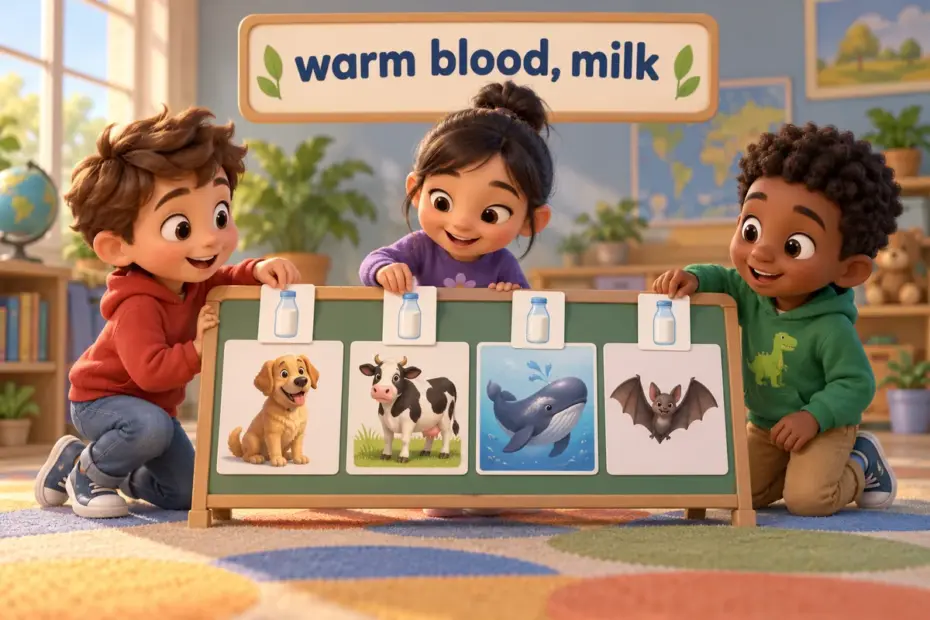
Mammals names in English cover a wide group of animals that share warm blood, hair and milk for their young, from the dog on the rug to the whale in the sea. The names divide into clear families such as land mammals, marine mammals and flying mammals, and one example shows the pattern: a bat is a flying mammal.
Mammals names in English at a glance
- Mammals are warm-blooded animals with hair and milk for their young.
- Most give birth to live young, but a few, such as the platypus, lay eggs.
- The names divide into land, marine, flying and marsupial groups.
- Mammal is a count noun, so one mammal becomes several mammals.
- The commonest error is calling every mammal an animal and forgetting the reverse.
What are mammals?
A mammal is a warm-blooded animal that feeds its young on milk, and the group is defined by that shared feature rather than by size or habitat. The single base noun behaves like any other count noun, as shown in mammal in a sentence. A dog, a cow, a whale and a human are all mammals, while a frog, a snake and a butterfly are not, so the name mammal points to one branch of the animal kingdom rather than to animals in general.
| Group | Defining feature | Common names |
|---|---|---|
| Land mammals | live on land and walk or run | dog, cat, horse, cow, elephant, lion |
| Marine mammals | live in water and surface to breathe | whale, dolphin, seal, walrus, manatee |
| Flying mammals | the only mammals that truly fly | bat, fruit bat, horseshoe bat |
| Marsupials | carry young in a pouch | kangaroo, koala, wombat, opossum |
| Egg-laying mammals | lay eggs instead of giving birth | platypus, echidna |
How are mammal names built?
Most mammal names are a single word or a describing word plus a base noun, and the pattern tells you the habitat, the size or the place. The plural of the base word appears in mammals in a sentence.
| Pattern | Example | What it signals |
|---|---|---|
| base noun alone | horse | the whole animal in one word |
| habitat + base noun | tree kangaroo | where the animal lives |
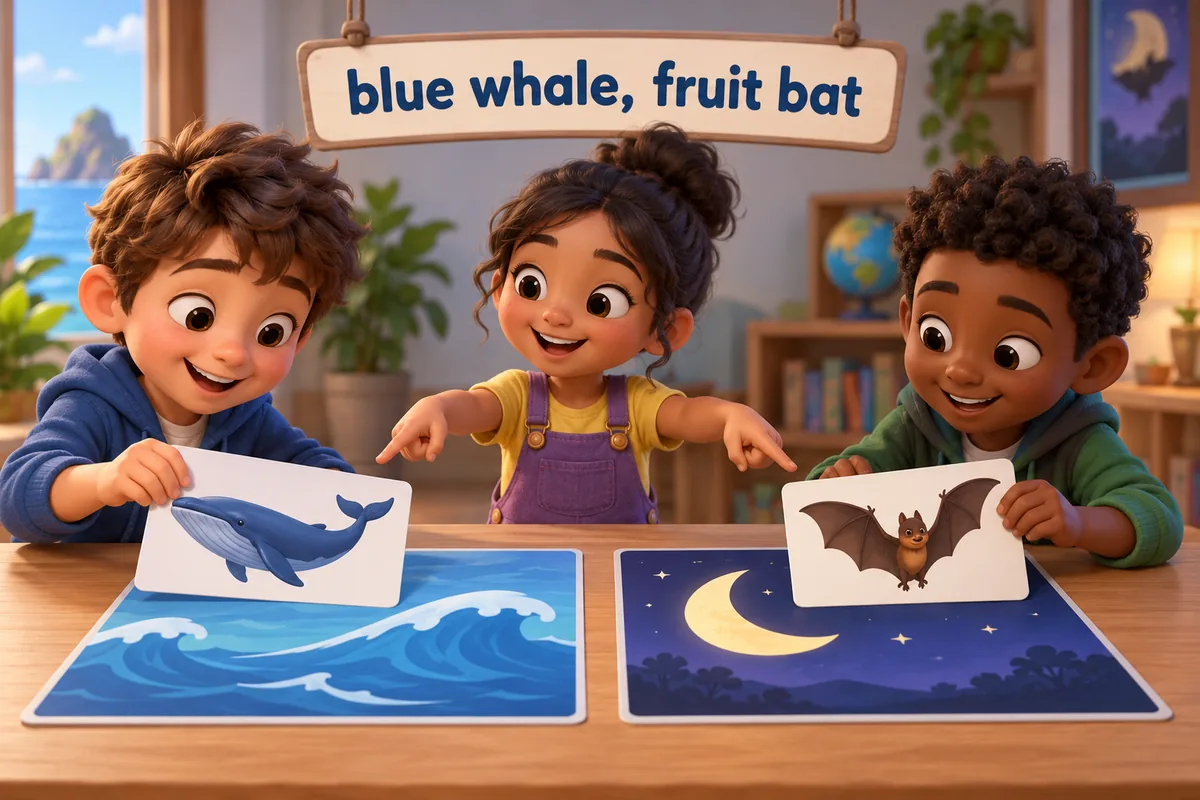
| size or feature + base | blue whale | a striking trait of the species |
| place + base noun | African elephant | a region where it is found |
| descriptor + base noun | fruit bat | the food it eats |
Mammals names in English across contexts
The names appear in science lessons, nature writing and ordinary speech, and the register decides how much detail each name carries. The same word becomes part of a long compound in mammoth in a sentence, where it names an extinct relative.
| Context | Example sentence | Why this works |
|---|---|---|
| Classroom | A whale is a mammal that lives in the ocean. | ties the name to a defining feature |
| Nature writing | Bats leave their roost at dusk to hunt insects. | names a group with a routine |
| Science report | The platypus lays eggs, unlike most mammals. | uses an exception as an example |
| Everyday speech | Our dog is the friendliest mammal in the house. | a plain, humorous statement |
| Field guide | The African elephant has large, fan-shaped ears. | a species with a defining feature |
| Zoo sign | The koala carries its young in a pouch. | a group trait stated clearly |
| Farm note | Each cow needs fresh water daily. | a farm mammal named by its needs |
| Story | A seal slipped from the rock into the grey sea. | a vivid single animal |
| Fact sheet | Mammals are warm-blooded and grow hair. | a defining trait in one line |
| Exam answer | Name one mammal that lives in water. | asks for a single correct noun |
Which word should you use?
Several names are close relatives that learners mix, and the difference usually lies in a body feature or a habitat. The word mammon, a near-spelling of mammal, appears in a very different sense in mammon in a sentence, where it means wealth rather than an animal.
| Pair | Usual difference | Example |
|---|---|---|
| mammal and animal | animal is the wider word; mammal is one branch | Every mammal is an animal, but not every animal is a mammal. |
| dolphin and porpoise | dolphins have a longer snout and a curved fin | The dolphin leapt beside the boat. |
| seal and sea lion | sea lions have visible ear flaps and walk on their flippers | A sea lion barked from the rock. |
| ape and monkey | apes have no tail; most monkeys do | The ape used a stick as a tool. |
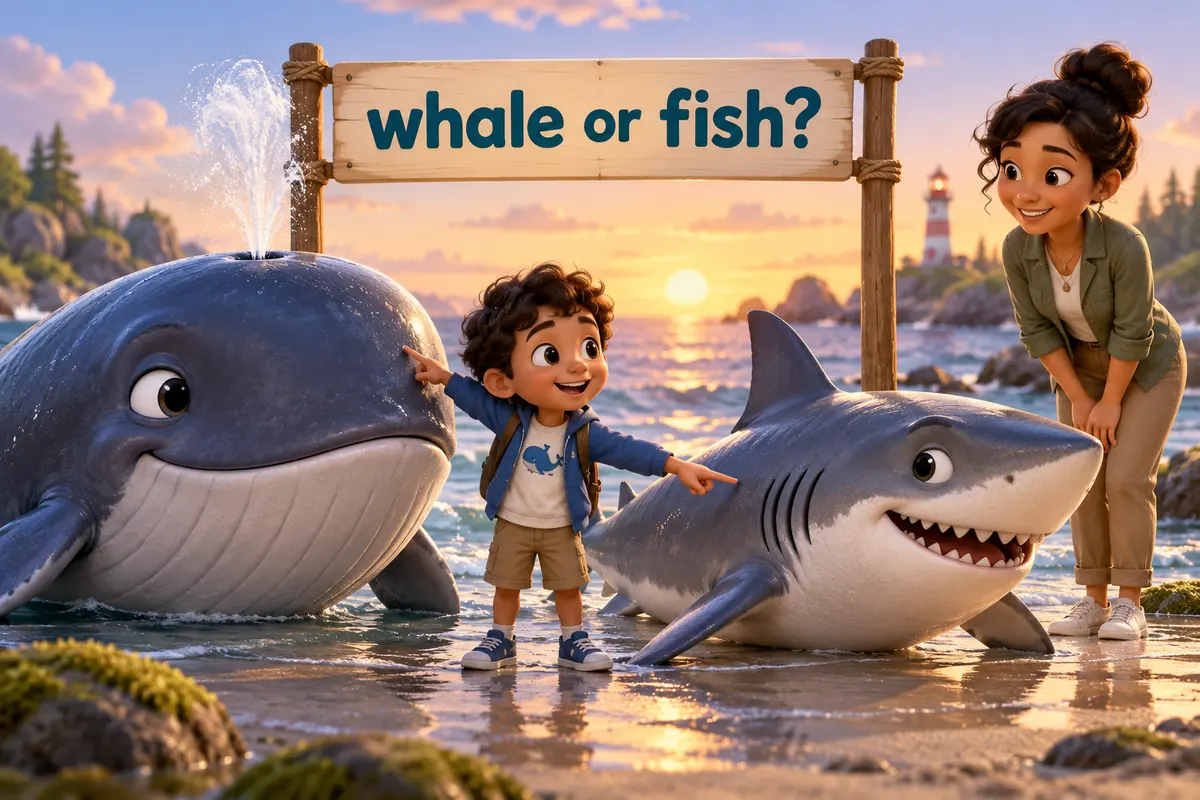
| whale and shark | a whale breathes air; a shark breathes through gills | The whale surfaced to breathe. |
Choose the wider word animal when the branch does not matter, and mammal when the feature does. The shared trait, milk and warm blood, is what keeps a whale with a cow and separates it from the fish it resembles; habitat alone is a poor guide, as the air-breathing whale shows.
Word forms and grammar of mammal names
Mammal is a regular count noun, and its adjective form names the whole class in scientific writing.
| Form | Part of speech | Example |
|---|---|---|
| mammal | count noun | A bat is a mammal. |
| mammals | count noun, plural | Mammals feed their young on milk. |
| mammalian | adjective | Whales share mammalian features. |
| mammalogy | noun | She studies mammalogy at university. |
| warm-blooded | adjective | Mammals are warm-blooded. |
| pouch | noun | A kangaroo carries its young in a pouch. |
| pup | noun | A seal pup stays close to its mother. |
Use mammal for the whole animal and mammalian only as an adjective, as in mammalian hair or mammalian features. The plural mammals takes a plural verb, so write mammals are warm-blooded, and keep the singular mammal for one animal.
Common mistakes with mammal names
Mistake 1: mammal treated as a synonym for animal. Incorrect: A frog is a mammal that lives near ponds. Correct: A frog is an amphibian; a dog is a mammal. Rule: mammal is one branch of the animal kingdom, not its name.
Mistake 2: the whale called a fish. Incorrect: The whale is the largest fish in the sea. Correct: The whale is the largest mammal in the sea. Rule: a whale breathes air and feeds milk, so it is a mammal, not a fish.
Mistake 3: mammalian used as a noun. Incorrect: The mammalian lives in groups. Correct: The mammal lives in groups. Rule: mammalian is an adjective, and the noun form is mammal.
Mistake 4: missing plural on a general statement. Incorrect: All mammal need water. Correct: All mammals need water. Rule: all takes a plural count noun.
Mistake 5: mammal confused with its near-spelling mammoth. Incorrect: The mammoth gives milk to its young, so it is a mammal today. Correct: The mammoth gave milk to its young, and its living relatives are mammals. Rule: mammoth names an extinct elephant, while mammal names the whole class.
Practice using mammal names
- Fill in the blank: A whale is a ___ that breathes air.
- Choose the better word: A platypus is a (mammal / fish) that lays eggs.
- Correct the error: All mammal need water.
- Build a sentence: use bat to describe a flying mammal at dusk.
- Spot the register: which suits a science report, (a) that sea cow thing, or (b) The manatee is a marine mammal?
- Fill in the blank: A kangaroo carries its young in a ___.
Answers
- mammal, because a whale breathes air and feeds milk.
- mammal, because a platypus has fur and produces milk despite laying eggs.
- All mammals need water; all takes a plural noun.
- A bat hunted insects in the fading light of dusk.
- (b), because a science report uses the precise group name.
- pouch, because a marsupial carries its young in a pouch.
The bottom line
Mammals names in English gather into clear groups, and the shared features of hair, warm blood and milk are the safest test. Land, marine, flying and marsupial groups carry most of the everyday words, and the egg-laying platypus and echidna are the famous exceptions. Name the group when the exact species is unknown, and the species when a precise example matters.
Frequently asked questions about mammals
Is a whale a mammal or a fish?
A whale is a mammal. It breathes air through a blowhole, is warm-blooded, grows a small amount of hair and feeds its young on milk. A shark is the fish it is often confused with, and the shark breathes through gills instead of surfacing for air.
Which mammals lay eggs?
Only the monotremes lay eggs, and the group is small: the platypus and the echidnas of Australia and New Guinea. They still feed their young on milk and grow hair, which keeps them inside the mammal group despite the unusual way their young are born.
What is the difference between an ape and a monkey?
Apes have no tail, a broader chest and larger brains, while most monkeys have a tail. Apes include gorillas, chimpanzees, orangutans and humans. Monkeys split into two large groups and are generally smaller and more varied in shape than the apes.
Are dolphins and porpoises both mammals?
Yes. Dolphins and porpoises are both marine mammals that breathe air and feed their young on milk. They differ in the snout and the fin: dolphins usually have a longer snout and a curved dorsal fin, while porpoises have a shorter, rounder face and a triangular fin.