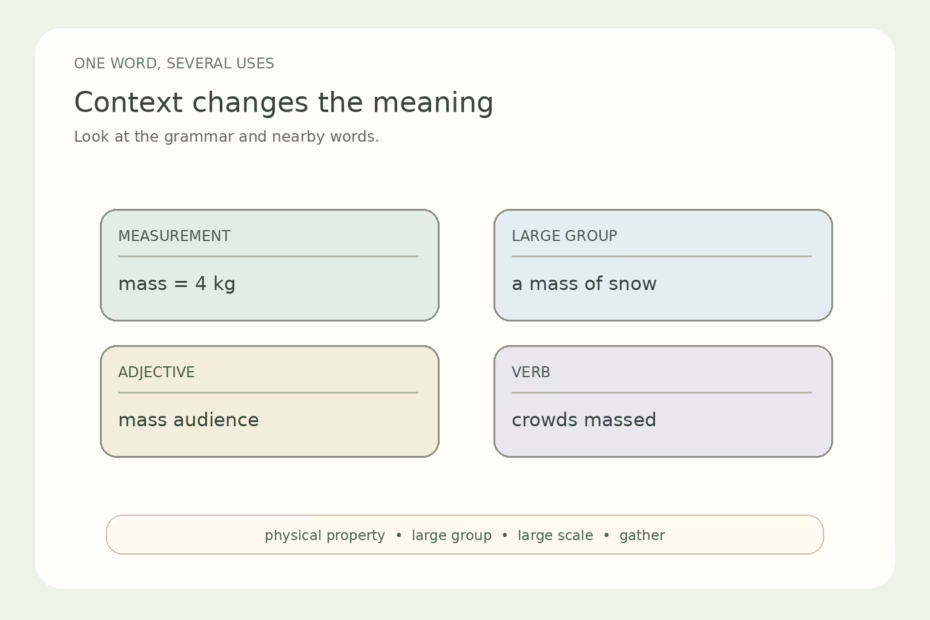
Mass has several related meanings, so the surrounding words help identify which one a sentence uses. It can name a physical property, a large quantity or group, or a large-scale activity; as a verb, it can mean to gather. Oxford Learner’s Dictionaries lists these noun senses and the adjective and verb forms, which is why one sentence pattern does not fit every use.
Common meanings of mass
- Physical property: “The mass of the sample is 250 grams.” In science, mass describes an object’s inertia or how much matter it contains.
- A large amount or group: “A mass of snow blocked the road,” or “A mass of students waited outside the hall.” Here, a mass of is a countable phrase for a large quantity or cluster.
- Large-scale or involving many people: “The documentary reached a mass audience.” In this use, mass is an adjective before a noun, as in mass media or mass production.
- Gather in a group: “Demonstrators massed near the entrance.” The verb usually describes people, troops, or objects gathering closely or in large numbers.
- Religious service: “They attended Mass on Sunday.” In Christian contexts, Mass is capitalized when referring to the service.
Mass, weight, and volume are different
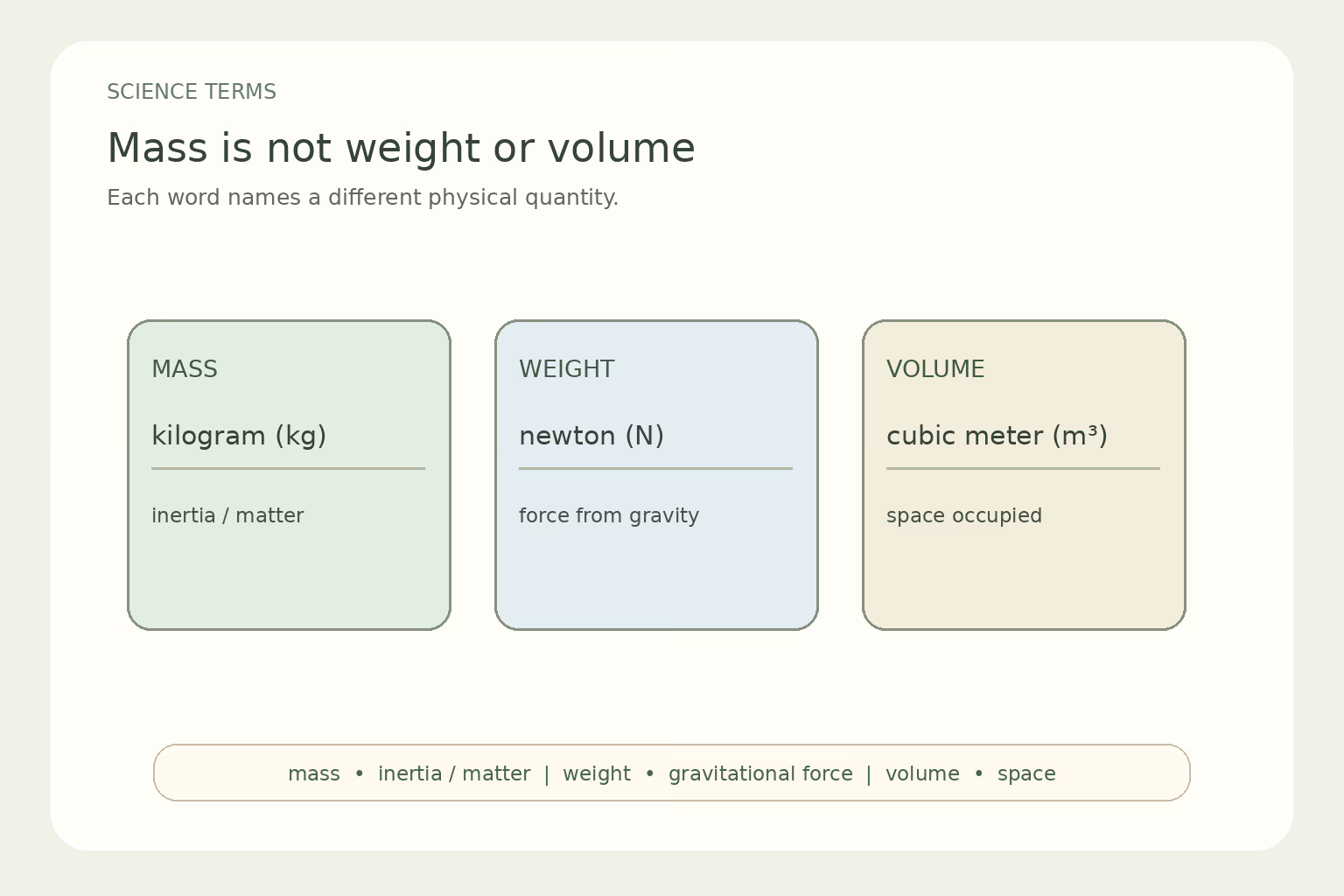
In physics, mass measures inertia or the amount of matter in an object. The SI unit is the kilogram. Weight is the force gravity exerts on that mass, measured in newtons in technical contexts. An object’s mass stays the same when it moves to a place with different gravity, while its weight changes. In everyday conversation, people often say “weight” when they mean a reading in kilograms or pounds, but scientific sentences should keep the terms distinct. The National Institute of Standards and Technology explains the difference.
Volume is the amount of space an object or substance occupies. A large object can have a low mass if it is made of a low-density material, and a compact object can have a high mass. Therefore, avoid defining mass as “physical weight or volume.” Name the measure you mean: “The rock has a mass of two kilograms,” “Its weight on the Moon is lower,” or “The block has a volume of 800 cubic centimeters.”
Useful sentence patterns
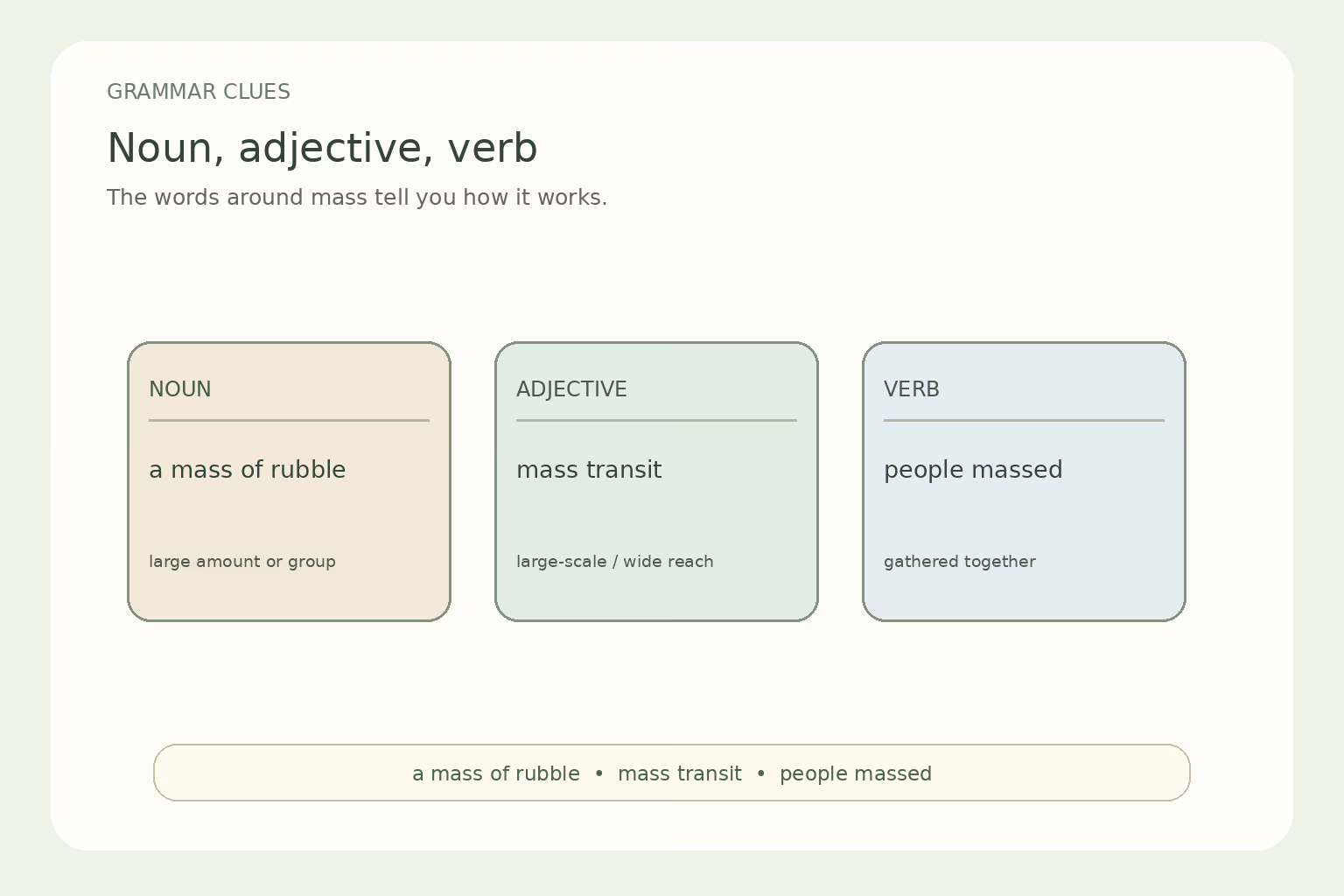
The grammar changes with the meaning. Use the mass of + object for a measurement, a mass of + noun for a large quantity or cluster, and mass + noun when it means “large-scale.” Use mass + at/in/near + place for the verb “gather.” Compare:
- “The mass of the package is listed in kilograms.” (scientific or measurement sense)
- “A mass of boxes filled the storeroom.” (a large cluster)
- “Mass production lowered the cost of each part.” (adjective)
- “Clouds massed over the hills before the storm.” (verb)
- “The family attended Mass after the holiday.” (religious service)
Common wording to revise
“Heavy things have more mass” can work as a rough comparison when gravity is the same, but mass and heaviness are not interchangeable scientific terms. “The scale measured the object’s mass” may be acceptable in everyday contexts; in a laboratory, name the measuring instrument and method precisely. Also, a mass variety is not a natural way to say that there are many choices. Write a wide variety or a large selection. Use mass as an adjective in established combinations such as mass audience, mass transit, and mass production.
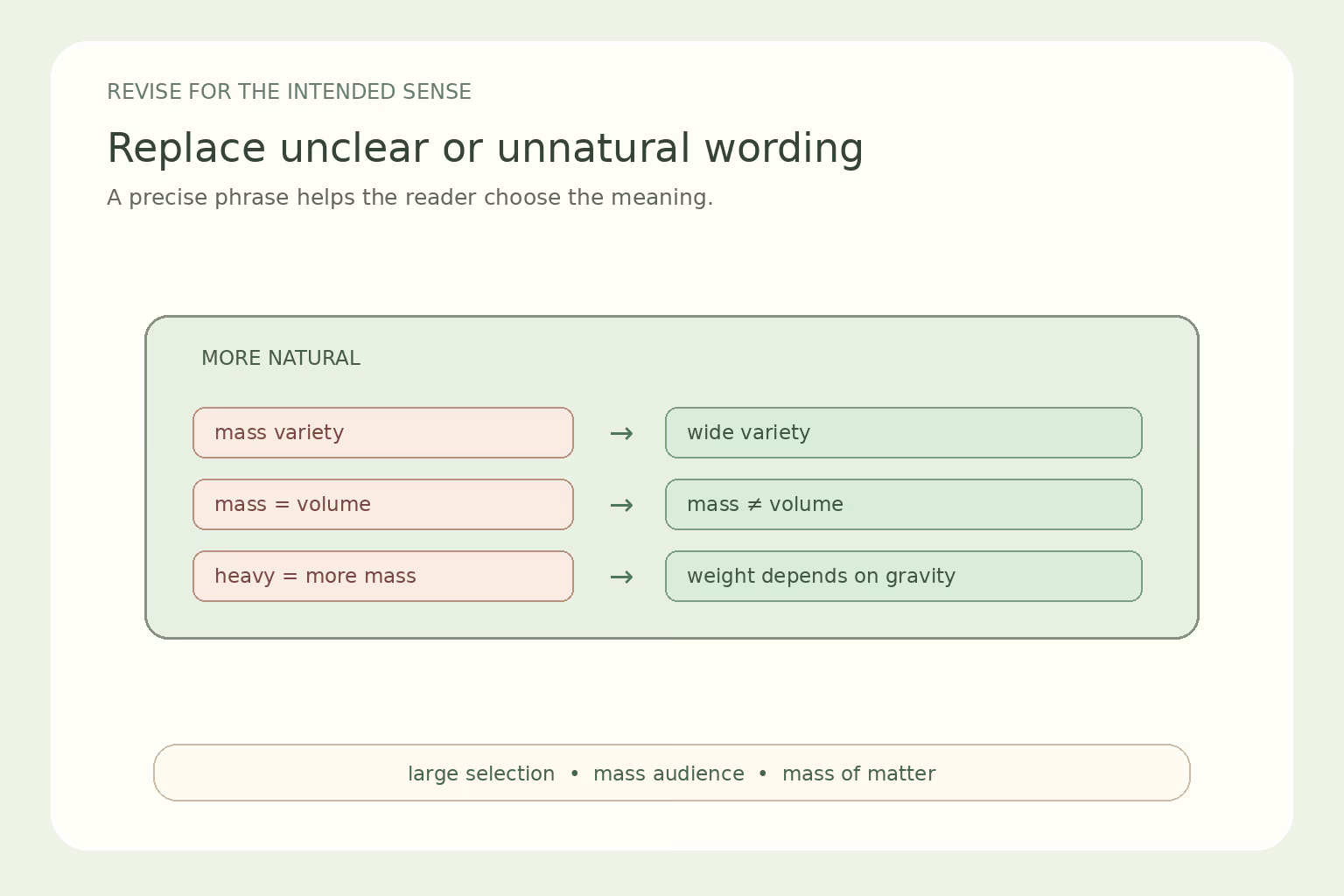
To write a clear example, give readers a clue about the sense: name a unit for scientific mass, use a mass of for a cluster, place mass before a large-scale activity, or show where people massed. This makes the intended meaning easier to recognize.
Have you ever wondered what exactly “mass” means in the world of physics? In simple terms, mass refers to the measure of the amount of matter in an object.
In physics, mass plays a crucial role in determining an object’s resistance to changes in its motion and gravitational force interactions.
7 Examples Of Mass Used In a Sentence For Kids
- Mass is how much matter is in an object.
- We can measure the mass of different things using a scale.
- Heavy things have a lot of mass.
- Light things have less mass.
- Mass can help us understand how heavy or light something is.
- The mass of a small rock is different from the mass of a big rock.
- By comparing mass, we can determine which object is heavier.
14 Sentences with Mass Examples
- Mass communication plays a vital role in today’s digital age.
- The lecture hall was filled with a mass of students eager to learn.
- The annual cultural fest drew a mass audience from various colleges.
- The library was a mass of books, with students studying diligently.
- The protest gathered a mass of students demanding better campus facilities.
- The canteen offers a mass variety of food options to cater to diverse tastes.
- The campus gym was filled with students working out in a mass fitness frenzy.
- The college auditorium hosted a mass talent show with performances from students.
- The upcoming exams had students cramming in a mass study session.
- The college ground held a mass sports competition with students participating in various events.
- The college newsletter reached a mass audience of students and faculty members.
- The academic advisor provided guidance to a mass of students regarding course selections.
- The campus bookstore had a mass collection of textbooks and stationery supplies.
- The college festival involved a mass collaboration of student clubs and organizations.
How To Use Mass in Sentences?
Mass can be used in a sentence as a noun referring to a large quantity or amount of something. For example, “She had a mass of paperwork to complete before the end of the day.”
Alternatively, mass can also refer to a religious service, in particular, the celebration of the Eucharist in the Roman Catholic Church. An example sentence could be, “The family attended Mass together on Sunday morning.”
When using mass as a verb, it means to gather or assemble in large numbers. For instance, “Protesters planned to mass outside City Hall to demand change.”
Remember, mass can be used in different contexts and can have various meanings depending on its usage in a sentence. It is essential to pay attention to the sentence’s structure and the words surrounding mass to understand its intended meaning accurately.
Practice using mass in sentences to become more comfortable with its different usages and meanings. This will help you communicate more effectively and expand your vocabulary.
Conclusion
In summary, sentences with mass refer to those that contain substances or objects with physical weight or volume. These sentences can describe the properties, characteristics, or actions of materials or items that have mass, such as rocks, water, or furniture. Understanding sentences with mass is essential for comprehending physical descriptions, scientific explanations, and everyday observations involving tangible objects.
By recognizing and analyzing sentences with mass, readers can gain a deeper understanding of the physical world around them and the relationships between different objects and substances. Whether discussing the density of an object, the volume of a liquid, or the weight of an item, sentences with mass provide concrete details that contribute to clearer communication and more precise descriptions.


