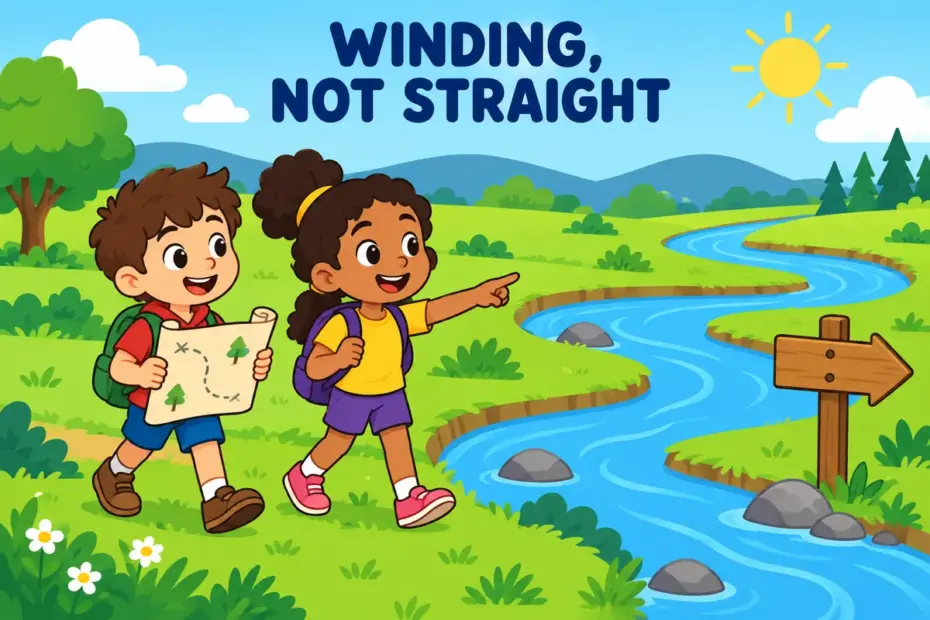
Meander means to follow a winding course, and the verb describes a river, a road or a walk that turns gently instead of going straight. To use meander in a sentence, name the winding thing and let the verb carry the slow, unhurried movement: “The creek meanders past the mill.”
Meander at a glance
- Meander is mainly an intransitive verb; its forms are meanders, meandered, meandering and the noun meanderings.
- The two verb senses are following a winding course and moving with no fixed route.
- Its usual subjects are rivers, roads, paths, walks, conversations and pieces of writing.
- Meander is neutral in register and common in travel writing, geography and descriptive essays.
- The commonest error is treating meander as transitive, as in meander the river.
What does meander mean?
Meander is a verb meaning to follow a winding, indirect course, and it is also a noun for one of those bends. The Cambridge entry for meander records the winding-water sense first and the aimless-walking sense second. The difference shows in the subject: a river meanders because of its shape, while a person or a talk meanders because it lacks direction. Where a route only curves once, curve is the plainer choice, because meander suggests a long series of turns.
| Sense | Plain meaning | Example sentence |
|---|---|---|
| Winding course | To follow a twisting line, like a river or a road | The lane meanders along the edge of the orchard. |
| Aimless movement | To walk, talk or write with no clear destination | The conversation meandered from football to algebra. |
| Noun: a bend | One curve in a winding river or road | Trout gather at the deepest meander of the stream. |
How do you use meander in a sentence?
Meander is almost always intransitive, so the winding thing is the subject and no object follows. The verb takes a prepositional phrase of place when the route matters and a bare adverb when only the manner matters. A meant object, as in meander the path, is the single most common learner slip with this verb.
| Pattern | Example | What it signals |
|---|---|---|
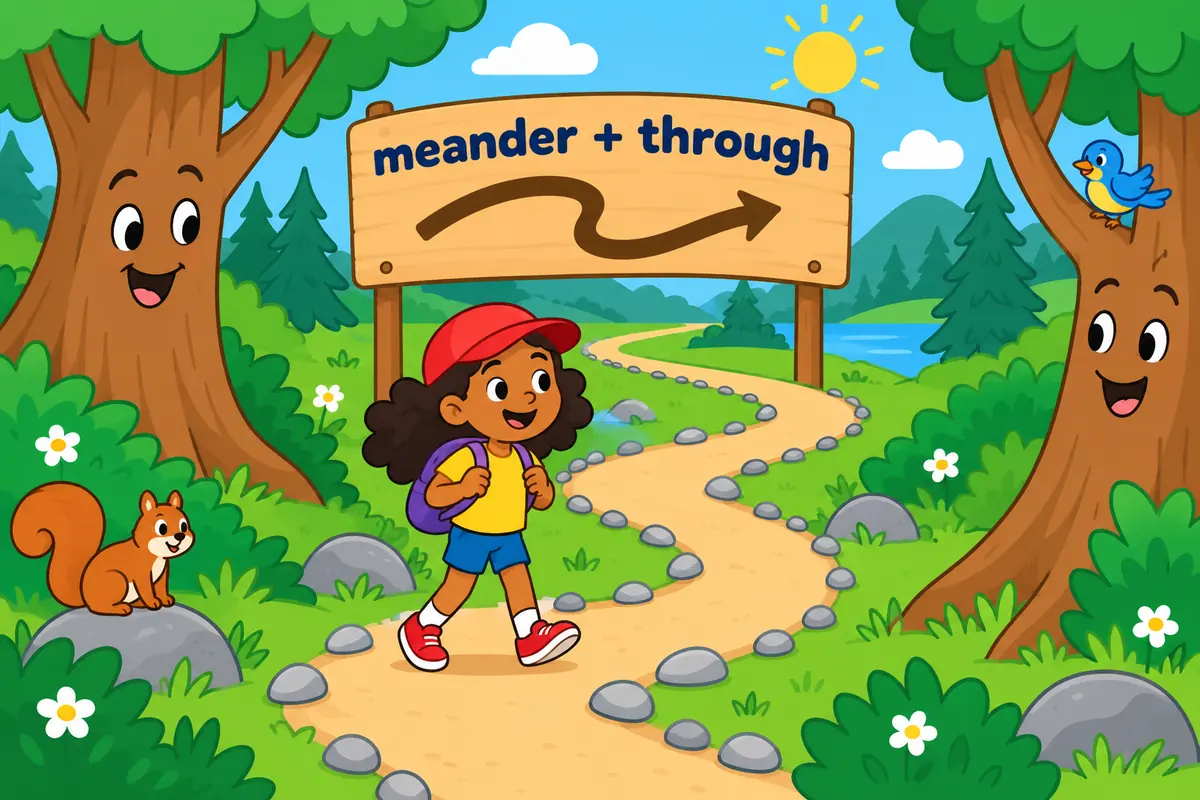
| meander + through / across / along + place | The trail meanders through a birch wood. | The route, or a journey along it |
| meander + adverb | The stream meanders lazily past the gate. | Manner, not destination |
| meander + into / on | The lecture meandered into local history. | A talk drifting away from its topic |
| the meander of / a meander in | A meander in the river marks the old boundary. | The noun: one bend, a fixed landmark |
Meander in a sentence: examples across contexts
Each sentence below shows meander doing a different job, from physical geography to the shape of an argument.
| Context | Example sentence | Why this works |
|---|---|---|
| Geography | The river meanders for ten miles before it reaches the sea. | Distance and winding both matter, so meander earns its place over flow. |
| Travel writing | We meandered through the market, stopping whenever a stall looked interesting. | The pace is deliberately slow and directionless. |
| Classroom | The lesson meandered after the projector failed. | The verb lightly criticises lost focus without naming a cause. |
| Conversation | Our chat meandered from homework to holiday plans. | Topics shift like bends in a road. |
| Academic prose | The essay meanders in its opening pages before stating a thesis. | Meander is a compact, pointed criticism of structure. |
| News report | The border road meanders along a disputed ridge. | Geography explains why the route is not straight. |
| Workplace email | Could we tighten the draft? It meanders before the recommendation. | A polite way to ask for a shorter, clearer argument. |
| Nature journal | A single meander shelters the whole heron colony. | The noun names one specific bend as a habitat. |
Meander vs wander
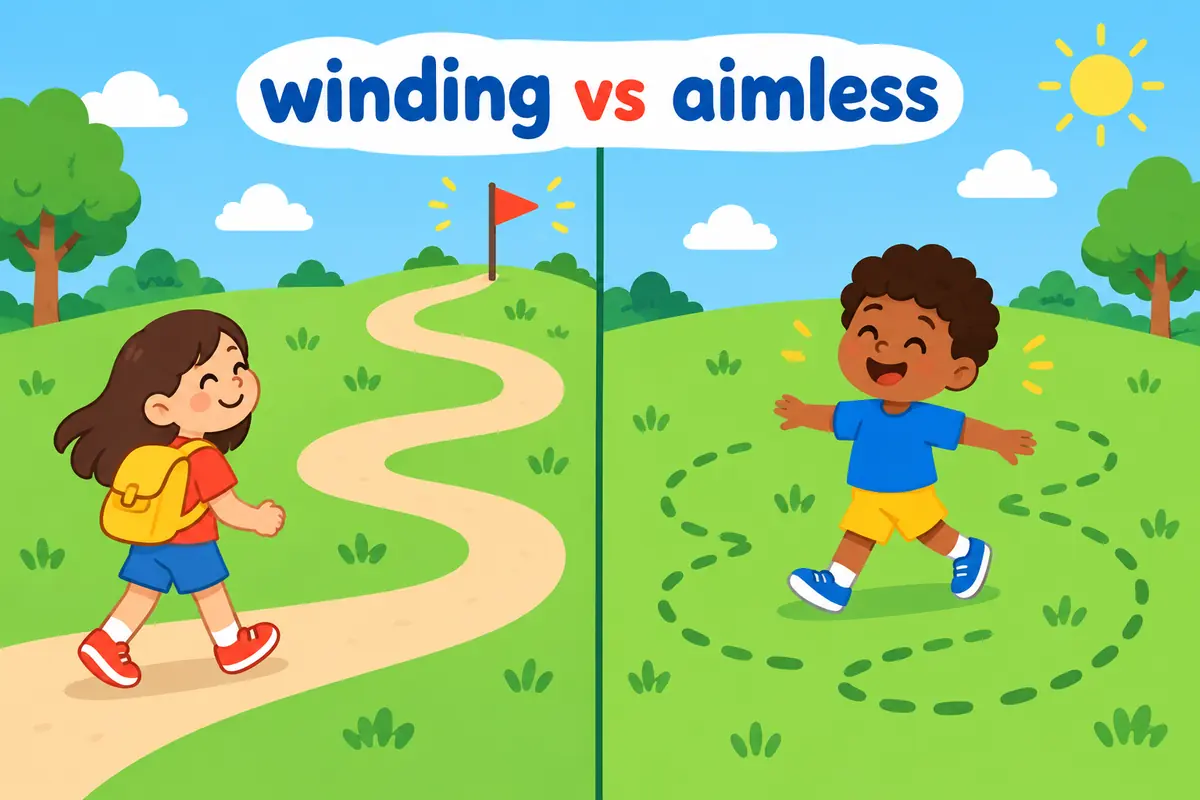
Meander and wander both describe unhurried movement, but only meander implies a curving line. For speech that loses its thread, ramble through the subject is the closer verb, because a ramble has no shape at all.
| Attribute | Meander | Wander |
|---|---|---|
| Core meaning | Move in a winding, S-shaped course | Move about with no fixed route or aim |
| Typical subject | Rivers, roads, paths, trails | People, animals, attention, thoughts |
| Shape of the movement | Curves that can be drawn on a map | Any loose, scattered movement |
| Implied pace | Slow but steady along a line | Slow and often stopping or turning back |
| Metaphor for talk | A talk that drifts but keeps a thread | Attention that leaves the subject entirely |
Use meander for something with a direction that keeps bending, and wander off the topic only when the thread is truly lost. When a walk covers wide open ground instead of one bending line, roam the hills is the better verb.
Word forms and grammar of meander
| Form | Part of speech | Example |
|---|---|---|
| meander | verb, base form | Rivers meander most on flat ground. |
| meanders | verb, third person singular; noun plural | The path meanders; several meanders cut through the marsh. |
| meandered | verb, past tense and past participle | The brook meandered under the footbridge. |
| meandering | present participle; adjective | A meandering lane led to the farmhouse. |
| meanderings | noun, plural | His meanderings filled two notebooks. |
| meander the river | non-standard transitive use | Incorrect: The map shows how the river meanders the valley. |
The related adjective and noun sit on an existing meandering page and share the same root, so the forms look alike but behave differently: the adjective needs a noun after it, the plural noun does not.
Common mistakes with meander
The old road meanders slowly into town yesterday.Correct: The old road meandered slowly into town yesterday. Rule: meander is a verb, so the tense marker changes the verb itself, not a helping word.We meandered the forest for an hour.Correct: We meandered through the forest for an hour. Rule: meander is intransitive and needs a preposition before its place.The train meandered to the city at ninety miles an hour.Correct: The train hurtled to the city at ninety miles an hour. Rule: meander implies slow, gentle turning, not speed.He meandered into the point after an hour.Correct: He meandered for an hour before reaching the point. Rule: meander into suggests drifting off topic, not arriving at it.The path meander past the gate.Correct: The path meanders past the gate. Rule: a singular subject takes the s form of the verb.
Practice using meander
- Fill in the blank: The footpath ____ through the rice fields. Use the correct present form.
- Choose the better word: A slow walk that keeps curving along one path meanders / wanders. Pick the winding verb.
- Correct the error: The stream meander past the old mill.
- Correct the error: We meandered the gallery all afternoon.
- Build a sentence about a river using the pattern meander through.
- Spot the register: Which sentence suits a geography report, and which suits a text to a friend?
Answers
- meanders. The subject The footpath is singular, so the verb ends in s.
- meanders. Meander describes a winding line; wander only says there is no aim.
- The stream meanders past the old mill. The singular subject needs the s form.
- We meandered through the gallery all afternoon. Meander is intransitive and needs through.
- Sample: The river meanders through three counties before reaching the coast. It follows meander + through + place.
- The geography report takes The river meanders across the floodplain; the friend gets We meandered around town.
The bottom line
Knowing when to use meander in a sentence comes down to shape: the word suits rivers, roads and slow walks that turn and turn again. The verb is intransitive, so a preposition such as through or along normally appears before the place. When nothing is winding and the only point is aimlessness, wander is the safer choice.
Frequently asked questions about meander
Is meander a verb or a noun?
Meander is both. As a verb it means to follow a winding course or to move with no fixed route, as in the river meanders through the valley. As a noun it names a single bend, as in the deepest meander of the stream. The verb is far more common than the noun.
What is the difference between meander and meandering?
Meander is the base verb and can also be a noun. Meandering is the present participle, used after be to show an action in progress, as in the path is meandering downhill. It also works as an adjective before a noun, as in a meandering lane, where it describes a lasting shape rather than a current action.
Can meander take a direct object?
No. Meander is intransitive, so it never takes a direct object. You meander through a market or along a lane, never meander the market. The only apparent exception is the noun phrase a meander, where the word simply names a bend. If you need an object, choose a transitive verb such as trace or follow.
Does meander always mean water?
No. The river sense is the most concrete, but the verb also applies to roads, paths, walks, conversations, arguments and pieces of writing. When it describes speech or prose, meander is mildly critical, suggesting the text drifts instead of moving forward. The noun is usually kept for a bend in a river or road.
Have you ever gotten lost in thought while taking a leisurely walk, allowing your mind to wander aimlessly from one thought to another? This casual and indirect way of moving or speaking is known as meandering.
Meandering involves a relaxed and unhurried pace, often characterized by a winding or indirect course. Whether you’re strolling through a park or telling a story full of tangents, the act of meandering adds a sense of leisurely exploration and thoughtful reflection to your journey.
7 Examples Of Meander Used In a Sentence For Kids
- Meander along the river and see the fish swim.
- Let’s meander through the garden to find colorful flowers.
- The path will meander through the forest full of trees.
- Meander around the playground and find a fun slide.
- We can meander around the park and play on the swings.
- The river will meander through the hills and valleys.
- Meander through the maze and find the hidden treasure.
14 Sentences with Meander Examples
- As college students, we often meander through the city on weekends to explore new cafes and restaurants.
- Sometimes, I like to meander through the library shelves to discover hidden gems in the form of books.
- The botanical gardens near our campus are the perfect place to meander and relax after a long day of classes.
- During breaks between lectures, my friends and I like to meander around the campus to catch up and share updates.
- It’s easy to meander off the main path in our college campus and stumble upon peaceful spots to study or relax.
- The charming streets around our college are great for meandering and discovering quaint shops and eateries.
- We enjoy taking breaks from our studies to meander along the river that flows near our college.
- Whenever we have free time, my classmates and I like to meander through the nearby markets to shop for essentials and treats.
- It’s therapeutic to meander through the campus gardens, admiring the flora and fauna that surrounds us.
- I often meander in the sports complex to find a quiet spot to practice my yoga routines.
- Our college is situated in a bustling area, which gives us ample opportunities to meander and experience city life.
- The nearby hills provide a perfect backdrop for a leisurely meander with friends on weekends.
- During the monsoon season, we love to meander in the rain and enjoy the cool breeze on our college’s outdoor grounds.
- One of my favorite ways to unwind after exams is to meander along the peaceful pathways in the campus gardens.
How To Use Meander in Sentences?
To use “Meander” in a sentence, follow these steps:
-
Understand the Meaning: Before using the word “Meander,” make sure you understand its definition. Meander means to proceed in a winding and indirect course.
-
Choose Your Context: Determine the context in which you want to use the word “Meander.” It can be used to describe physical movements, thoughts, or conversations that are indirect or circuitous.
-
Construct Your Sentence: Once you have a clear understanding of the word “Meander” and the context in which you want to use it, construct your sentence. Start by introducing the subject or the main idea you want to convey.
-
Incorporate “Meander”: Place “Meander” in your sentence where it fits naturally. For example, “The river began to meander through the lush green valley, creating a picturesque scene.”
-
Review and Revise: After incorporating “Meander” in your sentence, review it to ensure that it conveys your intended meaning accurately. Make any necessary revisions to improve the clarity and flow of the sentence.
-
Practice and Seek Feedback: To become more comfortable using the word “Meander,” practice incorporating it into different sentences. Seek feedback from others to refine your usage and enhance your understanding of the word.
By following these steps, you can effectively incorporate “Meander” into your writing and communication with confidence.
Conclusion
In conclusion, meander refers to a winding or indirect course, much like a river flowing in a serpentine pattern. Just as a river meanders its way through the land, sentences that meander take a roundabout path to communicate their meaning. These sentences may lack clarity and directness, leading to confusion or boredom in the reader.
To improve writing and ensure clarity, it is important to avoid constructing sentences that meander. By crafting concise and direct sentences, writers can effectively convey their ideas and engage their audience more effectively. Steering clear of meandering sentences helps to maintain the reader’s focus and delivers information in a straightforward manner.


