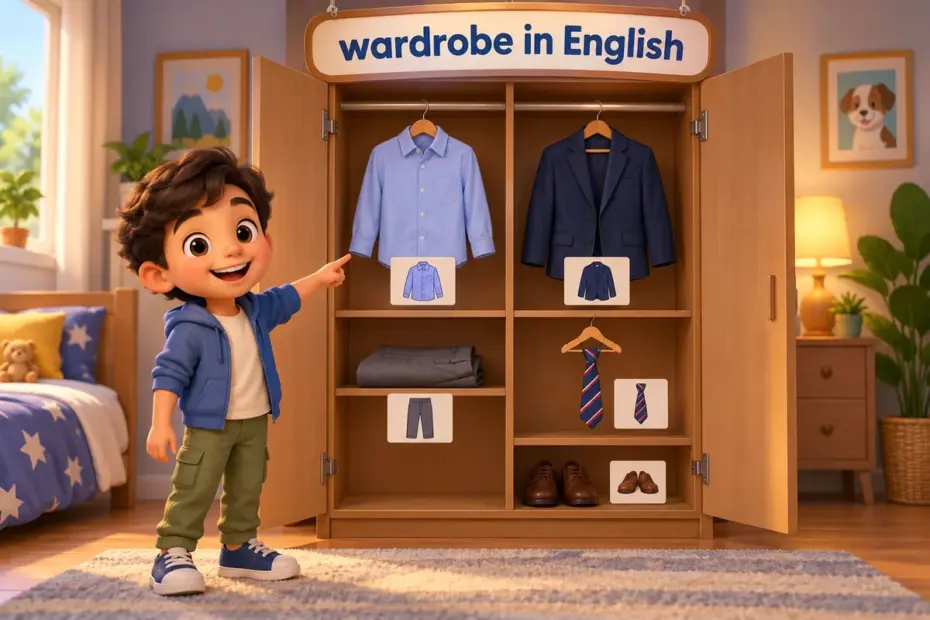
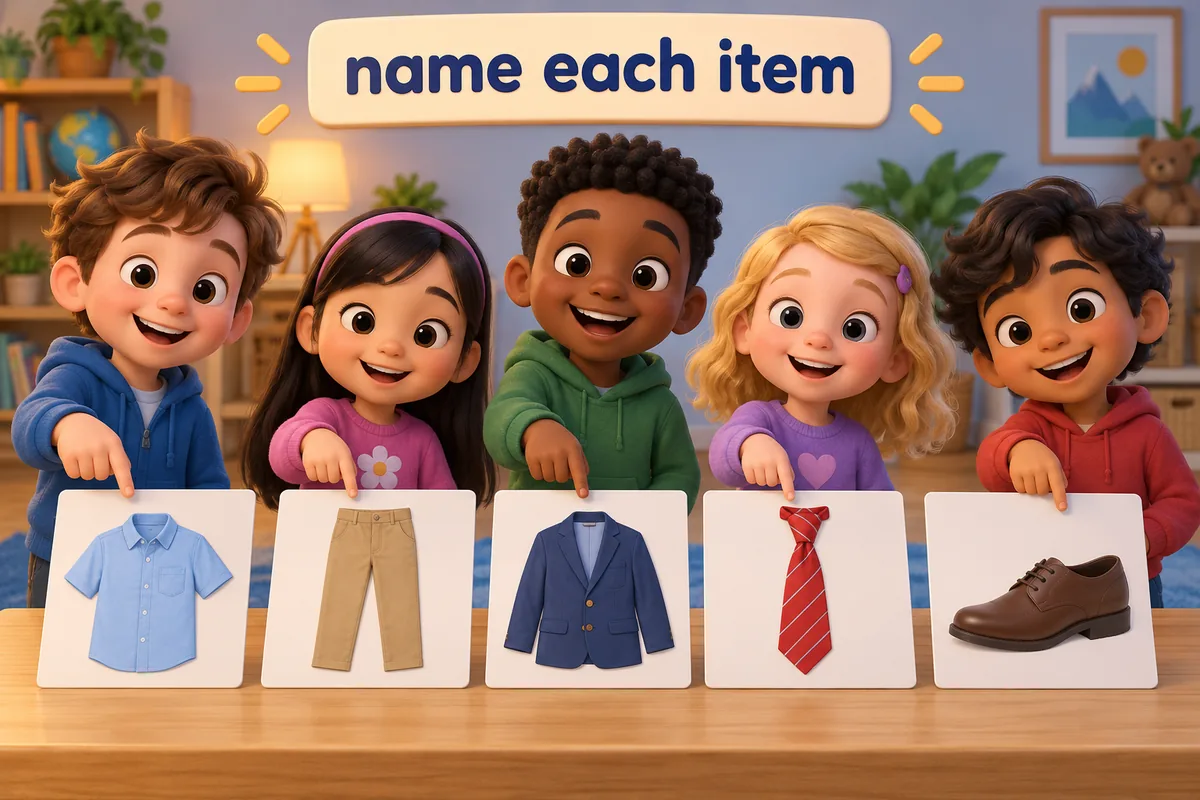
Mens clothes names with pictures cover the everyday wardrobe, from the shirt and trousers to the jacket, tie and shoes. Learning the names in groups makes it easy to describe what someone is wearing and to shop or write with confidence.
Mens clothes names at a glance
- Everyday mens clothes names are short single words: shirt, tie, jacket, shoe.
- A few garments are always plural: trousers, jeans, shorts and pyjamas.
- Some names need two words, as in polo shirt or bow tie.
- The plural of a garment is regular for most names: shirts, jackets, coats, socks.
- The commonest error is writing mens with an apostrophe in the wrong place, or clothes as cloths.
What are mens clothes names with pictures?
Mens clothes names with pictures are the common words for the items a man wears, grouped by where they sit on the body. A single table keeps the whole wardrobe together, and naming each item as you picture it fixes the word faster than reading a plain list. More everyday frames appear in clothes in a sentence.
| Garment | Usually worn | One fact |
|---|---|---|
| Shirt | upper body, with buttons | A formal shirt takes a collar and cuffs. |
| T-shirt | upper body, casual | Short sleeves and no buttons. |
| Polo shirt | upper body, smart casual | Has a collar and a short button placket. |
| Trousers | legs, two legs joined | Always plural, like jeans and shorts. |
| Jeans | legs, casual | Made from denim, always plural. |
| Shorts | legs, warm weather | Cut above the knee, always plural. |
| Suit | whole body, formal | A jacket and trousers cut from one cloth. |
| Jacket | upper body, outer layer | Opens at the front and often has lapels. |
| Blazer | upper body, smarter | A jacket worn without matching trousers. |
| Coat | upper body, cold weather | A heavy outer layer for winter. |
| Sweater | upper body, knitwear | Pulled over the head, often wool. |
| Hoodie | upper body, casual | A sweatshirt with a hood. |
| Tie | neck, formal | Knotted at the collar under a shirt. |
| Bow tie | neck, formal | Tied in a loop rather than hanging down. |
| Belt | waist | Holds trousers and often has a buckle. |
| Socks | feet, under shoes | Usually a matching pair, sold as pairs. |
| Trainers | feet, casual | Soft sports shoes, always plural. |
| Boots | feet and ankles | Cover the ankle and often lace up. |
| Cap | head, casual | Has a peak and no full brim. |
| Scarf | neck, cold weather | Wrapped for warmth, often wool. |
| Gloves | hands, cold weather | Usually a matching pair. |
| Waistcoat | torso, over a shirt | Sleeveless, worn under a jacket. |
| Cardigan | upper body, knitwear | Opens at the front with buttons. |
| Raincoat | upper body, wet weather | Made from a waterproof fabric. |
One honest limit belongs here. A wardrobe holds far more names than this table, from the waistcoat and the cardigan to the loafer and the sandal, so the list is a practical core rather than a complete inventory of every garment.
How do you use mens clothes names in a sentence?
Each garment name is a countable noun, and the small words around it carry the meaning. Descriptive words for fabric and fit sit in adjectives for clothes.
| Pattern | Example | What it signals |
|---|---|---|
| a + garment | He wore a grey jacket to the interview. | one item |
| plural garment | His trousers were still wet. | an always-plural item |
| a pair of + plural | She bought a pair of shoes. | a matched set |
| verb + object + preposition | He put on his coat and left. | dressing quickly |
| the + garment + is + adjective | The shirt is too tight across the shoulders. | a description of fit |
Mens clothes names: examples across contexts
The same garment words move from a shop floor to a laundry label, and each setting frames them a little differently.
| Context | Example sentence | Why this works |
|---|---|---|
| Shop assistant | These trousers come in three lengths. | an always-plural item |
| Dressing for work | He wore a navy suit and a plain tie. | formal dress |
| Laundry label | Wash the shirt at thirty degrees and hang it to dry. | a care instruction |
| Conversation | Have you seen my other sock? | an everyday question |
| Weather note | Take a coat, because it will rain later. | advice for conditions |
| Sports report | The team changed into fresh shorts at half time. | kit in a report |
| Shopping list | New belt, two pairs of socks, one cap. | a quick record |
| Wedding plan | Each guest wears a jacket, and the groom wears a bow tie. | a formal rule |
| Packing note | Pack one sweater, two T-shirts and a light jacket. | a travel list |
| Exam answer | Trousers and jeans are plural nouns in English. | a grammar claim |
| Tailor’s note | The jacket needs the sleeves taken up by an inch. | a fitting detail |
| Cold-weather advice | Wear gloves and a scarf, because the wind is biting. | a warning for weather |
Which clothing words cause confusion?
A handful of spelling and plural traps sit around the wardrobe. The usual mix-up of close and clothes appears in close vs clothes.
| Word or pair | Meaning | Example |
|---|---|---|
| clothes / cloths | garments / pieces of fabric | Fold the clothes; wipe it with cloths. |
| close / clothes | near or shut / garments | The shop is close; the clothes are new. |
| trousers | one item, plural form | These trousers are new. |
| mens / men’s | the label form / possessive of men | The mens section holds a range. |
| suit / suite | jacket and trousers / a set of rooms | He wore a suit; they booked a suite. |
Word forms and grammar of mens clothes names
The core words build a small grammar of their own, from the plural-only noun to the compound. An extra set of describing words sits in adjective for clothes, and older ways of naming a full outfit appear in suit of clothes in a sentence.
| Form | Part of speech | Example |
|---|---|---|
| shirt | noun | This shirt has a stiff collar. |
| shirts | plural noun | Two shirts are in the wash. |
| trousers | plural-only noun | The trousers are on the chair. |
| a pair of trousers | counting phrase | She bought a pair of trousers. |
| shirt pocket | compound noun | He kept a pen in his shirt pocket. |
| well-dressed | compound adjective | He is always well-dressed at work. |
Common mistakes with mens clothes names
Mistake 1: a singular verb with a plural garment. Incorrect: My trousers is too long. Correct: My trousers are too long. Rule: trousers, jeans and shorts take a plural verb.
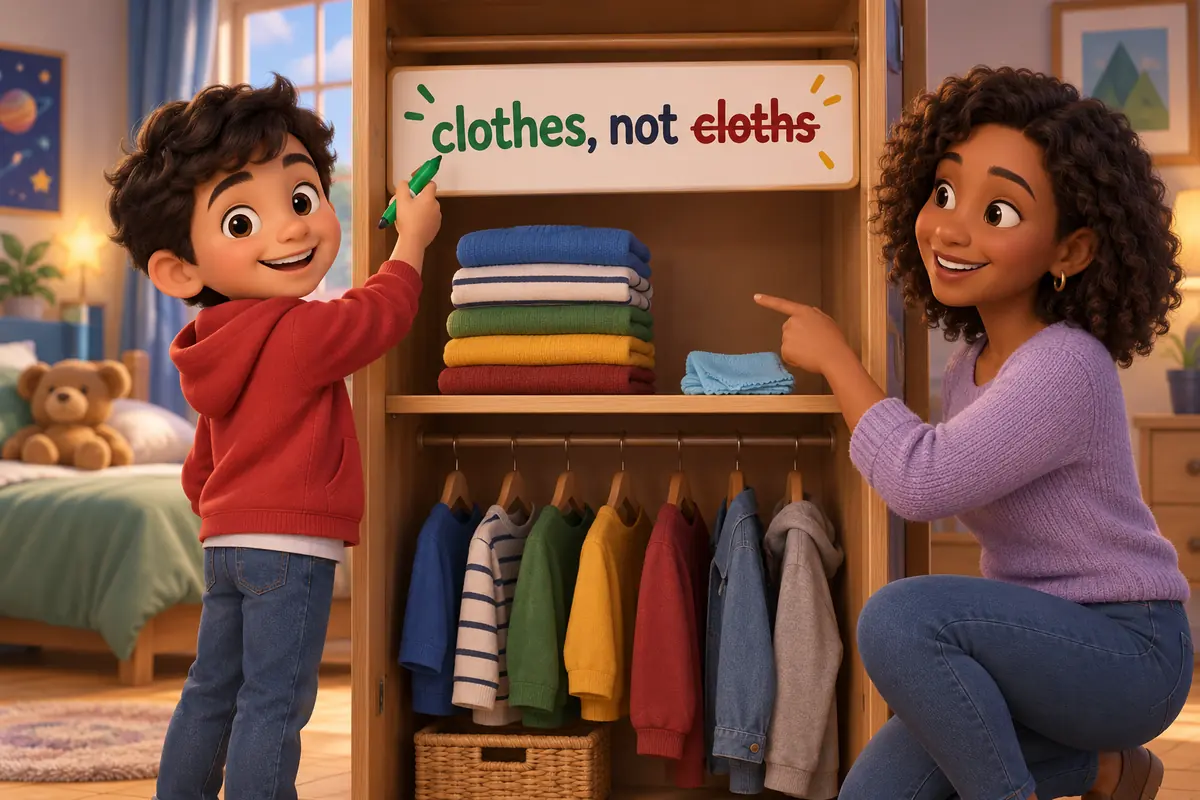
Mistake 2: cloths for clothes. Incorrect: Hang the cloths in the wardrobe. Correct: Hang the clothes in the wardrobe. Rule: clothes names garments; cloths names pieces of fabric.
Mistake 3: counting an always-plural noun. Incorrect: He bought a trousers. Correct: He bought a pair of trousers. Rule: plural-only nouns are counted with a pair of.
Mistake 4: the wrong possessive. Incorrect: This is the mens’ coat. Correct: This is the men’s coat. Rule: the possessive of men is men’s, an apostrophe before the s.
Mistake 5: a garment and its false friend. Incorrect: They stayed in a suit at the hotel. Correct: They stayed in a suite at the hotel. Rule: a suit is a jacket and trousers; a suite is a set of rooms.
Practice using mens clothes names
Each item below asks for one garment name or one corrected form, and every answer gives the reason rather than the key alone.
- Fill in the blank: He knotted his ___ before the interview.
- Choose the better word: Fold the (cloths / clothes) and put them away.
- Correct the error: My jeans is too tight.
- Build a sentence: use a pair of about buying shoes.
- Spot the register: which line suits a laundry label, (a) Wash dark colours separately, or (b) Give the darks a wash on their own, yeah?
- Fill in the blank: She tied the laces on her new ___.
Answers
- tie, because a tie is knotted at the collar.
- clothes, because clothes names garments and cloths names fabric.
- My jeans are too tight; jeans is an always-plural noun.
- She bought a pair of shoes in the sale.
- (a), because a care label uses plain, direct instructions.
- shoes, because shoes are fastened with laces.
The bottom line
Mens clothes names with pictures are best learned as a labelled wardrobe, starting with the everyday items such as shirt, trousers, jacket, tie and shoes. Keep always-plural garments plural, add a pair of when you count them, and write clothes for garments and cloths for fabric. Master the core wardrobe first and the rarer names fall into place.
Frequently asked questions about mens clothes names
What are the basic mens clothes names?
The basic mens clothes names are shirt, T-shirt, polo shirt, trousers, jeans, shorts, suit, jacket, blazer, coat, sweater, hoodie, tie, belt, socks and shoes. These cover most of an everyday wardrobe, so learning this short set lets a learner describe what someone is wearing.
Which clothing names are always plural?
Trousers, jeans, shorts and pyjamas are always plural in English. They take a plural verb, as in these trousers are clean, and they are counted with a pair of, as in a pair of jeans. A single leg of such a garment is not named on its own.
Should it be mens or men’s clothes?
Both forms appear, but they do different jobs. Mens, without an apostrophe, is the shop and label form used in signs such as the mens department. Men’s, with an apostrophe before the s, is the ordinary possessive, as in the men’s coats are on the rail.
Why is clothes never spelled cloths?
Clothes names the garments you wear, and it is always plural in form. Cloths is the plural of cloth, a piece of fabric used for cleaning or covering. The two sound nearly the same, so checking the vowel sound in the middle keeps them apart in writing.