
Mind vs mined: the quick answer
Mind can name thought, memory or intention, and it can be a verb meaning care, object, pay attention or look after. Mined is the past tense or past participle of mine: Workers mined the ore or The writer mined the archive for details. The words sound alike, but they belong to different word families.
Correction to the older discussion below: mind is not only a noun, and mined is not limited to underground excavation. Mining can involve material at the earth’s surface, and the verb has extended meanings involving information. The original’s list of “mined” examples also contains several sentences using mine or mining instead. Those related forms are valid words, but they are not examples of the precise form mined.

Key facts and a comparison table
| Form | Grammar | Meaning cue | Example |
|---|---|---|---|
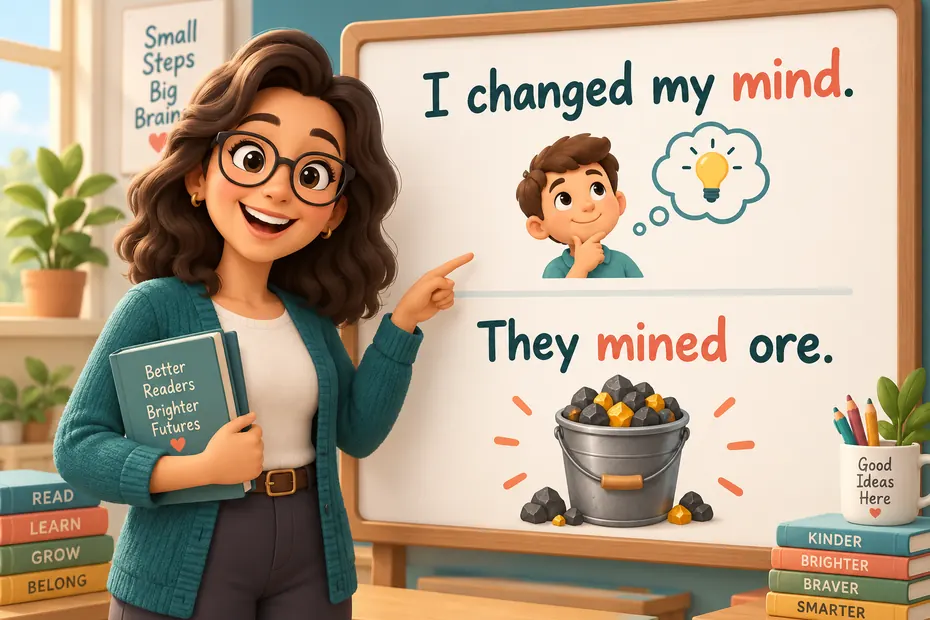
| Mind | Noun | Thought, memory or intention | I changed my mind. |
| Mind | Verb | Care, object or pay attention | Please mind the step. |
| Mined | Past tense or participle of mine | Extracted or searched for useful material | They mined the archive. |
| Minded | Past tense or participle of mind | Cared, objected or looked after | She minded the shop. |
Merriam-Webster’s mind entry includes both noun and verb uses. Its mine entry records mined as a verb form and includes extraction from physical sources or other sources of useful material. Grammar and context resolve the spelling more reliably than pronunciation.

Mind as a noun
In That idea crossed my mind, mind names thought or awareness. In I changed my mind, it concerns an intention or decision. In Keep the deadline in mind, the phrase asks someone to remember the deadline. Mined cannot replace mind in these expressions.
Possessive words often help identify the noun: my mind, her mind, or their minds. For example, The students changed their minds uses minds as a plural noun. The s does not convert it into a mining word.
A phrase such as a brilliant mind can emphasize intellectual ability. You do not need to settle a philosophical definition of consciousness to use the expression correctly. A clear sentence identifies the particular quality or action the writer means.
Mind as a verb
Mind is a verb in I do not mind waiting. Here it means that waiting does not bother the speaker. In Mind the step, it tells someone to pay attention or be careful. In Can you mind the shop?, it asks someone to look after it.
The verb’s past form is minded, not mined: She minded the shop yesterday. Its ongoing form is minding: He is minding the children. Compare She mined the hillside with She minded the shop. The extra d in minded marks a different word family and a different action.
In a polite request, Would you mind opening the window? asks about willingness or objection. The noun window identifies the requested action’s object, while opening follows mind. Using mined would remove the ordinary request meaning.
Mined: extraction and useful information
Mined can describe obtaining material: The workers mined ore from the site. It can also describe searching a source for useful information: The historian mined old letters for details. In the second sentence, no literal excavation occurs; the writer treats the letters as a source to explore.
The past tense and past participle have the same spelling. Compare They mined the deposit with They have mined the deposit. In a passive construction, write The deposit was mined. The helper verb changes, while mined remains the relevant form.
Other dictionary senses exist, so do not assume that every occurrence must describe mineral extraction. Identify what the sentence says was mined and consult the appropriate meaning when necessary. For this comparison, a physical-source example and an archive example show the common contrast without turning the article into a technical mining manual.
Common errors and clear repairs
- I changed my mined. Write I changed my mind.
- The workers mind the ore yesterday. For past extraction, write The workers mined the ore yesterday.
- She mined the children. For looking after them, write She minded the children.
- Do you mined waiting? For objection, write Do you mind waiting?.
- The researcher mined the files for examples. This is a valid extended use.
A useful memory aid is to connect mined with mine plus d. Connect mind with thoughts or attention. Then check whether the sentence needs the noun mind, the verb mind, the past form minded, or the separate mining form mined.
Frequently asked questions
Are mind and mined homophones?
Yes, in ordinary pronunciation. Meaning and spelling distinguish them.
Is mind always a noun?
No. It is a verb in Mind the step and I do not mind.
What is the past tense of mind?
Minded. The past tense of mine is mined.
Can mined describe searching documents?
Yes. She mined the archive for details uses the source-extraction meaning figuratively.
Which spelling belongs in keep in mind?
Mind. The phrase concerns remembering, rather than extracting material.
Have you ever found yourself confused between the words “mind” and “mined”? Don’t worry, you’re not alone! In this text, I’ll guide you on how to use these words appropriately and avoid any embarrassing mix-ups. Understanding the difference between “mind” and “mined” is crucial for effective communication and writing. So, let’s immerse and explore the nuances of these words, and how to use them correctly in various contexts. Whether you’re a native English speaker or learning the language, this article will provide you with the clarity you need to confidently use “mind” and “mined” in your everyday conversations and writing.
Key Takeaways
- “Mind” and “mined” are two distinct words with different meanings and uses.
- “Mind” is a noun that refers to consciousness, thoughts, and mental processes, while “mined” is the past tense and past participle of the verb “mine” and relates to extracting valuable resources from the earth.
- Proper usage of “mind” involves understanding its definition, subjectivity, and individuality, and using it in various contexts such as decision-making, emotions, and awareness.
- Proper usage of “mined” involves understanding its definition, specific usage as a verb in the past tense, and its association with the extraction of valuable resources from the ground.
- Common mistakes to avoid include confusing the difference between “mind” and “mined”, incorrect usage of “mind” as the past tense or past participle, and neglecting context when using “mined”.
- Tips for improving understanding and usage include clarifying the difference between the two words, familiarizing oneself with their definitions and part of speech, being mindful of context, and avoiding common mistakes.
What is the difference between “mind” and “mined”?
Understanding the difference between “mind” and “mined” is essential for effective communication. While these words may sound similar, they have distinct meanings and are used in different contexts. Let’s jump into their definitions and learn how to use them correctly.
Definition of “Mind”
“Mind” is a noun that refers to the faculty of consciousness and thought. It represents the cognitive and intellectual processes of a person. Here are a few key points about “mind”:
- It is used to describe the seat of human consciousness, thoughts, emotions, and memories.
- It can also refer to an individual’s mental or psychological state.
- “Mind” can be used both as a noun and a verb. As a verb, it signifies paying attention to or being aware of something.
Definition of “Mined”
On the other hand, “mined” is the past tense and past participle of the verb “mine.” Here’s what you need to know about “mined”:
- It is primarily used as a verb and relates to extracting valuable resources from the earth, such as minerals, metals, or precious stones.
- “Mined” can also be used figuratively to indicate careful scrutiny or deep exploration of a subject.
Differences Between “Mind” and “Mined”
Now that we understand the individual meanings of “mind” and “mined,” let’s examine the key differences between these words:
| MIND | MINED | |
|---|---|---|
| Part of Speech | Noun | Verb (past tense and past participle) |
| Meaning | Relates to consciousness, thoughts, and mental processes | Relates to extracting valuable resources from the earth |
| Usage Examples | I can’t get her out of my mind. | The coal was mined from deep underground. |
| Related Words | Mental, intellect, awareness | Mining, miner, excavation |
As you can see, the difference between “mind” and “mined” lies in their parts of speech, meanings, and usage. Understanding these distinctions will help you communicate more accurately and avoid confusion.
Understanding the definition of “mind”
The word “mind” is a noun that is often used to refer to consciousness, thought, and mental processes. It is an essential term in the field of psychology and plays a significant role in understanding human behavior and cognition. Here, I’ll investigate into the definition of “mind” and provide a deeper understanding of its meaning and usage.
Definition of “mind”
The term “mind” can be defined as the faculty of consciousness and thought, encompassing a person’s intellect, emotions, and will. It is the center of cognitive activity and shapes our perceptions, beliefs, and behaviors. The mind is responsible for processing information, making decisions, and experiencing emotions.
Key Points to Remember
To fully grasp the concept of the “mind,” it’s essential to keep in mind the following key points:
- Consciousness and Thought: The mind is the seat of our consciousness, which refers to our awareness of ourselves and the world around us. It allows us to think, reason, and form judgments based on our experiences and knowledge.
- Intellect and Emotions: Our mind encompasses both intellect and emotions. It enables us to engage in logical reasoning, problem-solving, and critical thinking, while also experiencing a wide range of emotions such as happiness, sadness, fear, and love.
- Subjectivity and Individuality: The mind is subjective and unique to each individual. It shapes our perceptions and influences how we interpret and respond to the world. This subjectivity highlights the diversity and complexity of human experience.
Examples of Usage
To further illustrate how the term “mind” is used in different contexts, here are a few examples:
- “I couldn’t get her words out of my mind.”
- “He changed his mind about going to the party.”
- “The scientist studied the effects of meditation on the mind.”
- “She has a sharp and analytical mind.”
Understanding the definition of “mind” is crucial for effective communication and to accurately express our thoughts and experiences. It is a fundamental concept that influences our daily lives and helps shape our understanding of ourselves and others.
Understanding the definition of “mined”
As we continue exploring the distinction between the words “mind” and “mined,” let’s investigate into the definition of “mined” and gain a more comprehensive understanding of its usage.
The term “mined” is the past tense and past participle of the verb “mine.” It refers to the act of extracting or digging valuable materials, such as minerals or metals, from the earth. When something is mined, it means that it has been carefully excavated or harvested for its resources.
Here are a few key points to remember about the definition of “mined”:
- Extraction of resources: “Mined” specifically relates to the process of retrieving valuable substances from beneath the surface, such as coal, diamonds, or gold. It implies intensive labor and strategic efforts to uncover and extract these resources.
- Environmental impact: Mining operations can have significant environmental consequences. They can affect landscapes, ecosystems, and communities in various ways, such as altering topography, depleting natural resources, and causing pollution. Sustainability and responsible mining practices play a vital role in mitigating these impacts.
- Historical significance: Mining has played a crucial role throughout history, shaping economies, cultures, and civilizations. It has fueled industrial development, supported trade, and sparked innovation in various fields.
- Diverse mining practices: Mining techniques can vary depending on the type of resource being extracted, geological conditions, and technological advancements. Examples include underground mining, open-pit mining, and placer mining.
Understanding the definition of “mined” provides valuable insight into its specific usage and ensures that we use it appropriately in our communication. By grasping the nuances of this word, we enhance our ability to express concepts related to the extraction of natural resources accurately.
Keep in mind that “mined” is a verb, and it should be used to describe the action of removing valuable substances from the earth.
How to use “mind” correctly
To ensure proper usage of the word “mind,” it’s crucial to understand its definition and various contexts. Let’s explore the correct ways to use this versatile word.
- Definition of “Mind”: “Mind” is a noun that refers to the faculty of consciousness and thought, encompassing a person’s intellect, emotions, and will. It plays a significant role in processing information, making decisions, and experiencing emotions.
- Subjectivity and Individuality: It’s essential to remember, each individual’s mind is unique, shaped by their experiences, beliefs, and perspectives. This subjectivity influences how they perceive the world and make judgments.
- Multiple Facets: The mind comprises various elements, such as intellect, emotions, and will. It allows us to think logically, experience a wide range of emotions, and exercise our decision-making abilities.
- Contextual Usage: The word “mind” can be used in various contexts, including:
- “I changed my mind about going out tonight.”
- “She has a brilliant mind for solving puzzles.”
- “I can’t get him out of my mind.”
- Be Mindful of Ambiguity: When using the word “mind,” it’s important to consider the potential ambiguity that could arise. Ensure that your intended meaning is clear in the given context.
Understanding the correct usage of “mind” enhances communication and allows you to convey your thoughts, feelings, and intentions accurately. By incorporating this knowledge into your writing and speaking, you can effectively express yourself and engage with others.
How to use “mined” correctly
As I explained earlier, “mined” is the past tense and past participle form of the verb “mine.” Now, let’s dive deeper into understanding how to use “mined” correctly in our writing and conversations. Here are some key guidelines to keep in mind:
- Definition of “Mined”: First and foremost, it is important to grasp the definition of “mined.” It refers to the act of extracting valuable materials, such as minerals or metals, from the earth.
- Specific Usage: “Mined” is used to describe the action that has already taken place in the past. It indicates that something has been excavated or extracted from the ground for its inherent value.
- Examples of Usage: Here are a few examples that demonstrate the correct usage of “mined”:
- “The company successfully mined diamonds from the depths of the earth.”
- “They have mined a significant amount of gold from this region.”
- “The archaeologists uncovered ancient artifacts that were carefully mined from the historical site.”
- Environmental Impact: Consider the environmental impact of mining operations. Mining can have significant ecological consequences, including habitat destruction, pollution, and the depletion of natural resources. It is essential to be aware of these issues when discussing mining activities.
- Historical Significance: Recognize the historical significance of mining. Throughout history, mining has played a crucial role in human civilization, providing essential raw materials for various industries and economies.
- Diverse Mining Practices: Finally, be aware that there are different mining practices employed worldwide. These practices can vary based on the type of resource being extracted, the geographical location, and the specific technology used.
Understanding the correct usage of “mined” is vital for effective communication, especially when discussing extraction processes and the impact on our environment. By following these guidelines, you can confidently incorporate “mined” into your writing and conversations while ensuring accuracy and clarity.
Examples of correct usage for “mind”
When it comes to using the word “mind”, there are various contexts and situations where it can be appropriately employed. Let’s explore some examples to gain a better understanding:
- “Can you keep my secret in mind?” – In this sentence, “in mind” means to remember or not forget something. It implies that I want you to keep my secret at the forefront of your thoughts or be mindful of it.
- “I can’t make up my mind about which restaurant to choose.” – Here, “make up my mind” refers to the process of coming to a decision. It indicates that I am having difficulty choosing between different options and need to consider them carefully before reaching a conclusion.
- “She has a brilliant mind for mathematics.” – This phrase highlights someone’s intellectual capacity or ability in a specific area, in this case, mathematics. It suggests that she is exceptionally skilled or talented when it comes to working with numbers and solving complex problems.
- “I just can’t get you out of my mind.” – In this sentence, “out of my mind” expresses intense thoughts or preoccupations about someone or something. It implies that I cannot stop thinking about you, indicating strong emotions or infatuation towards the person.
These examples illustrate how the word “mind” can be used in different contexts, demonstrating its flexibility and versatility in conveying various meanings and ideas. Remember, clarity in communication is important to avoid ambiguity or misunderstanding when using this word.
Understanding the correct usage of “mind” enhances communication and allows for accurate expression of thoughts, feelings, and intentions. Next, let’s investigate into examples of correct usage for the word “mined” to further expand our understanding of these words and their distinctions.
Examples of correct usage for “mined”
When it comes to the word “mined,” understanding its correct usage is essential for effective communication. Here are some examples that illustrate how to use “mined” accurately:
- Environmental Impact: The coal mine in our town has seriously affected the nearby ecosystems.
- Historical Significance: The discovery of gold in California in 1848 led to a gold rush, with thousands of people flocking to the area to mine for the precious metal.
- Diverse Mining Practices: In underground mining, tunnels are dug to extract valuable minerals such as copper and tin.
- Extraction of Natural Resources: The company has mined vast quantities of iron ore from this region for decades.
- Utilization of Technology: The use of advanced machinery allows us to mine more efficiently and safely.
These examples demonstrate the various contexts in which “mined” is used correctly. From discussing environmental implications to historical significance and diverse mining methods, the word “mined” conveys the act of extracting valuable resources from the ground.
Understanding the accurate usage of “mined” allows for precise and effective communication, particularly when describing mining operations and their impact on the environment. By using “mined” appropriately, we convey our knowledge and ensure clarity in our written and spoken language.
Remember, both “mind” and “mined” are distinct words with different meanings and applications. Being mindful of these differences will prevent confusion and enhance your ability to express thoughts, feelings, and ideas accurately.
Common mistakes to avoid when using “mind” and “mined”
When it comes to using “mind” and “mined” correctly, there are certain mistakes that people commonly make. To help you avoid these errors and enhance your communication skills, let’s take a closer look at some of the common pitfalls and how to avoid them:
1. Confusing the Difference Between “Mind” and “Mined”
Many people mistakenly use these words interchangeably, not realizing that they have distinct meanings and uses. It’s important to understand the differences between them to ensure clear and accurate communication.
2. Incorrect Usage of “Mind”
One common mistake is using “mind” when referring to the past tense or past participle of the verb “mine.” Remember, “mind” is a noun that refers to consciousness and thought, while “mined” is the proper form of the verb “mine” when talking about extracting minerals or resources from the earth.
3. Misunderstanding the Definition of “Mind”
Another mistake is not fully grasping the definition of “mind.” It’s not just about intellect and reasoning; it also encompasses a person’s emotions, will, and consciousness. By recognizing the multifaceted nature of the mind, you can use it more accurately in your writing and conversations.
4. Overusing “Mind” as a Filler Word
Sometimes, people use “mind” without giving it much thought, using it as a casual filler word. But, excessive use of “mind” can lead to ambiguity and lack of clarity in your communication. Be mindful of its usage and ensure it adds meaning to your sentences.
5. Neglecting Context when Using “Mined”
When using “mined,” it’s important to consider the context and ensure it accurately conveys the intended meaning. For example, if you’re discussing the environmental impact of mining operations, make sure you use “mined” appropriately to highlight the extraction process.
By being aware of these common mistakes, you can avoid confusion and enhance your ability to express yourself effectively when using “mind” and “mined.” Remember, understanding the correct usage of these words empowers you to communicate with precision and accuracy.
- Confusing the difference between the two words.
- Incorrectly using “mind” as the past tense or past participle
Tips for improving your understanding and usage of “mind” and “mined”
When it comes to correctly using the words “mind” and “mined,” there are a few tips that can help improve your understanding and usage. Let’s explore these tips and enhance your language skills!
Clarify the Difference between the Two
First and foremost, it’s crucial to have a clear understanding of the difference between “mind” and “mined.” While “mind” refers to consciousness and thought, encompassing intellect, emotions, and will, “mined” is the past tense and past participle of the verb “mine” – meaning to extract resources from the earth.
Familiarize Yourself with Definitions
To avoid confusion, it’s essential to familiarize yourself with the definitions of both words. Understanding the context in which “mind” and “mined” are used will enable you to choose the appropriate word for your intended meaning.
Pay Attention to Part of Speech and Usage Examples
Remember, “mind” is a noun, while “mined” is the past tense and past participle of a verb. Being aware of their respective parts of speech will help you use them correctly in sentences. Also, paying attention to usage examples can further solidify your understanding and application of these words.
Be Mindful of Context
Context plays a critical role in using “mind” and “mined” effectively. Considering the setting, subject matter, and intended meaning will help you determine the appropriate word. For instance, “mind” would be appropriate when discussing thoughts, decisions, or intellectual capacity, while “mined” is suitable when referring to extraction processes, environmental impact, or historical significance.
Avoid Common Mistakes
Finally, be mindful of avoiding common mistakes when using these words. Some potential pitfalls to watch out for include confusing the difference between “mind” and “mined”, mistakenly using “mind” as the past tense or past participle, or overusing “mind” as a filler word. Paying attention to context and being precise with your language will help you navigate these complexities.
By following these tips, you can enhance your understanding and usage of “mind” and “mined.” This will not only improve your communication skills but also help you convey your thoughts and ideas accurately. So, keep these pointers in mind and continue to strengthen your command of the English language!
Conclusion
Understanding the difference between “mind” and “mined” is crucial for effective communication. “Mind” refers to consciousness and thought, encompassing a person’s intellect, emotions, and will. It plays a vital role in processing information, making decisions, and experiencing emotions. On the other hand, “mined” is the past tense and past participle of the verb “mine” and is used to describe extraction processes and their impact on the environment.
By being mindful of potential ambiguity and avoiding common mistakes, we can accurately express our thoughts, feelings, and intentions. Clear communication is essential in conveying ideas and ensuring that our message is understood.
To improve our understanding and usage of these words, it is important to clarify their differences, familiarize ourselves with their definitions, and pay attention to their parts of speech and usage examples. Also, considering context and avoiding overuse or incorrect usage will enhance our communication skills.
By following these guidelines, we can confidently and accurately use “mind” and “mined” in our conversations and written communication, effectively conveying our thoughts and ideas.
Frequently Asked Questions
Q: What is the difference between “mind” and “mined”?
A: “Mind” is a noun that refers to consciousness and thought, while “mined” is the past tense and past participle of the verb “mine”.
Q: Can you give examples of how to use the word “mind”?
A: Some examples of using the word “mind” include remembering something, making a decision, highlighting intellectual capacity, and expressing intense thoughts or preoccupations.
Q: How can I use “mined” correctly?
A: “Mined” can be used correctly when discussing environmental impact, historical significance, diverse mining practices, extraction of natural resources, and utilization of technology.
Q: What are common mistakes to avoid when using “mind” and “mined”?
A: Common mistakes to avoid include confusing the difference between the two words, incorrectly using “mind” as the past tense or past participle, misunderstanding the definition of “mind,” overusing “mind” as a filler word, and neglecting context when using “mined”.
Q: How can I improve my understanding and usage of “mind” and “mined”?
A: To improve understanding and usage, clarify the difference between the two words, familiarize yourself with their definitions, pay attention to their parts of speech and usage examples, be mindful of context, and avoid common mistakes.


