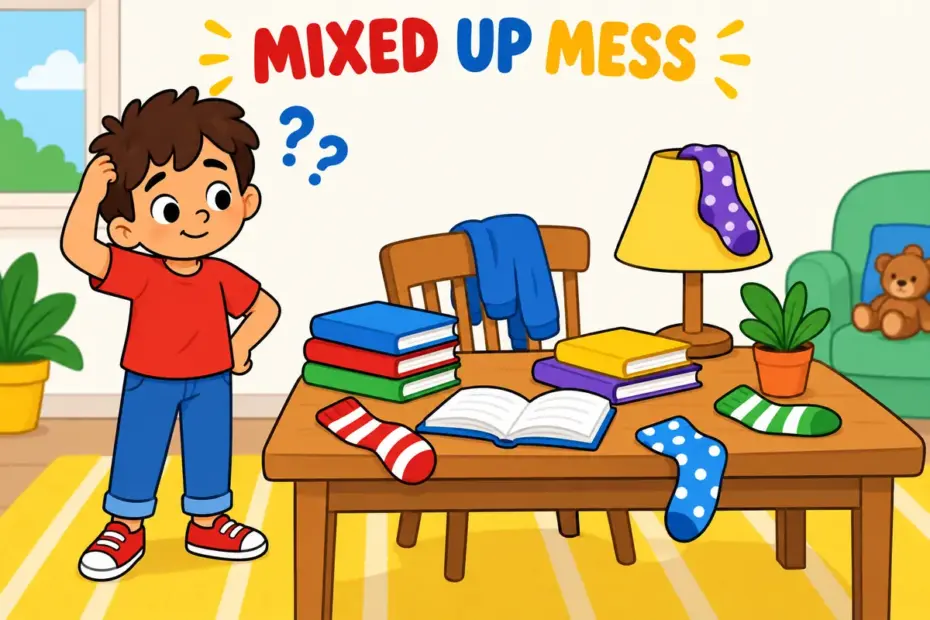
Muddle means to confuse things, mix them up or leave them in a disordered state, and as a noun it names that confusion. To use muddle in a sentence, show what got mixed: “I muddled the two invoices.” The verb takes an object, while the noun usually follows in or into.
Muddle at a glance
- Muddle works as a verb and a noun; its forms include muddles, muddled and muddling.
- As a verb it means to confuse, mix up or make disorderly.
- As a noun it means a confused or disordered state.
- Common patterns are muddle A with B, muddle through, and in a muddle.
- The commonest error is using the noun without an article, as in it was muddle.
What does muddle mean?
Muddle is a verb meaning to confuse or mix things up, and a noun meaning a state of confusion or disorder. The Cambridge entry for muddle records both jobs in one word, which is why the grammar matters. You can muddle the dates, and you can also be in a muddle about the dates.
| Sense | Plain meaning | Example sentence |
|---|---|---|
| Verb: mix up | Confuse one thing with another | He muddled the two passwords. |
| Verb: make disorderly | Put things into a messy state | The rain muddled the trail markings. |
| Noun: confusion | A confused or disordered state | The schedule is in a muddle. |
| Phrasal: cope feebly | Get by without a clear plan | They muddled through the first term. |
One limitation matters. Muddle describes confusion and disorder rather than failure, so a project in a muddle can still succeed. The word is also milder than chaos: a muddled desk is untidy, while a chaotic office has stopped working altogether.
How do you use muddle in a sentence?
The verb takes the thing being mixed as its object, and the preposition with marks the second item. The noun rarely stands alone; it follows in, into or through. Five patterns cover almost every real sentence.
| Pattern | Example | What it signals |
|---|---|---|
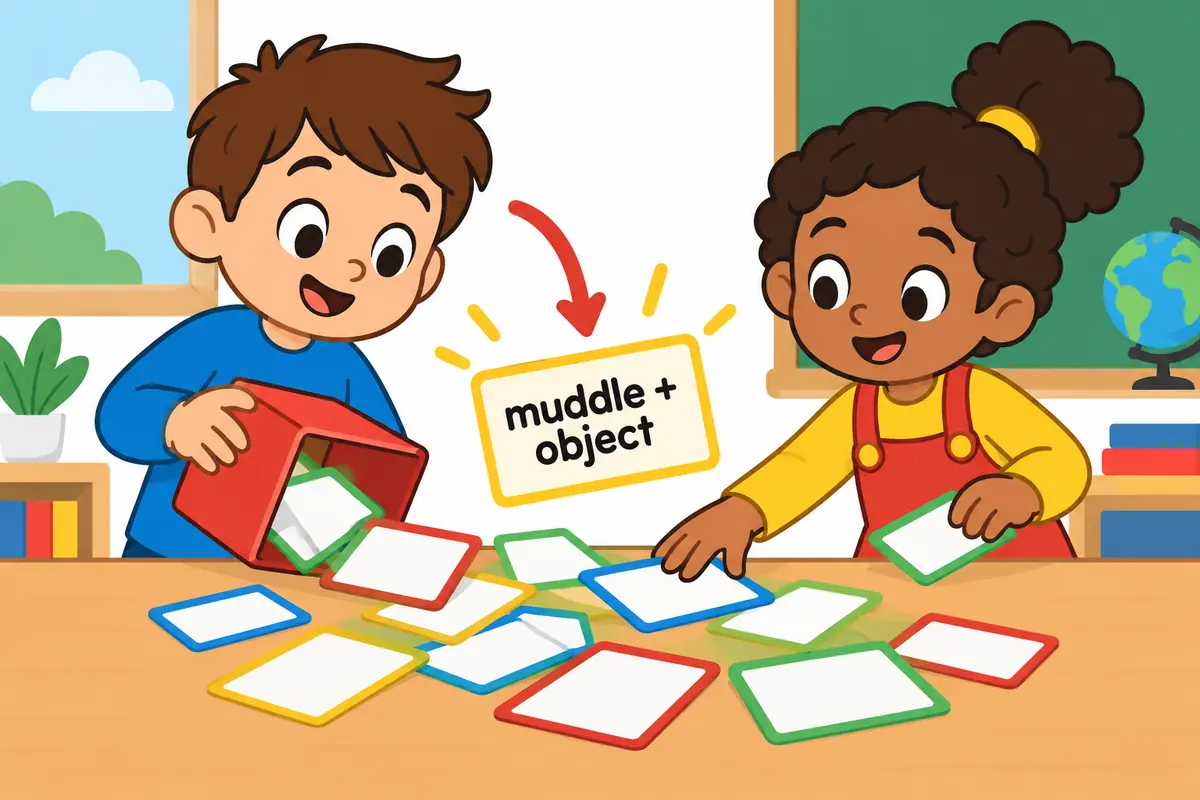
| muddle + object | She muddled the labels on the jars. | The thing put into disorder. |
| muddle A with B | He muddled the twins with each other. | Confusing one thing for another. |
| be in a muddle | The travel plans are in a muddle. | The noun names a confused state. |
| get into a muddle | We got into a muddle over the dates. | Entering confusion by accident. |
| muddle through | They muddled through the storm. | Coping without a clear plan. |
The verb confuse is the plain everyday synonym, while jumble stresses a disordered mixture of physical things. Muddle sits between them, because it can describe both a mental mix-up and a visible mess.
Muddle in a sentence: examples across contexts
Muddle changes scene more than it changes meaning. The nine sentences below move from a classroom to a kitchen, and each one shows what was mixed up or left untidy.
| Context | Example sentence | Why this works |
|---|---|---|
| Classroom | The pupil muddled the two formulas on the test. | A concrete mix-up any teacher would recognise. |
| Workplace email | Sorry, I muddled your order with another client’s. | An apologetic use of muddle A with B. |
| News report | Thick fog muddled the rescue effort along the coast. | The verb applied to a disrupted operation. |
| Conversation | I always mix up the twins’ names. | Everyday confusion between two similar things. |
| Home | The drawers were in a muddle after the move. | The noun describing ordinary household disorder. |
| Academic writing | The argument muddles two separate causes. | A critical use where the verb names a fault in reasoning. |
| Sports report | A late substitution muddled the defence. | The verb applied to a disrupted plan. |
| Cooking | Muddle the mint with the sugar before pouring. | The cocktail sense: to crush ingredients together. |
| History essay | Records of the year are in disarray. | The noun describing disordered evidence. |
The cooking row is a reminder that muddle has a second verb sense, to crush ingredients gently, which is why a bartender muddles mint and a teacher muddles formulas. Context, not the word, tells the two apart.
Muddle vs confuse
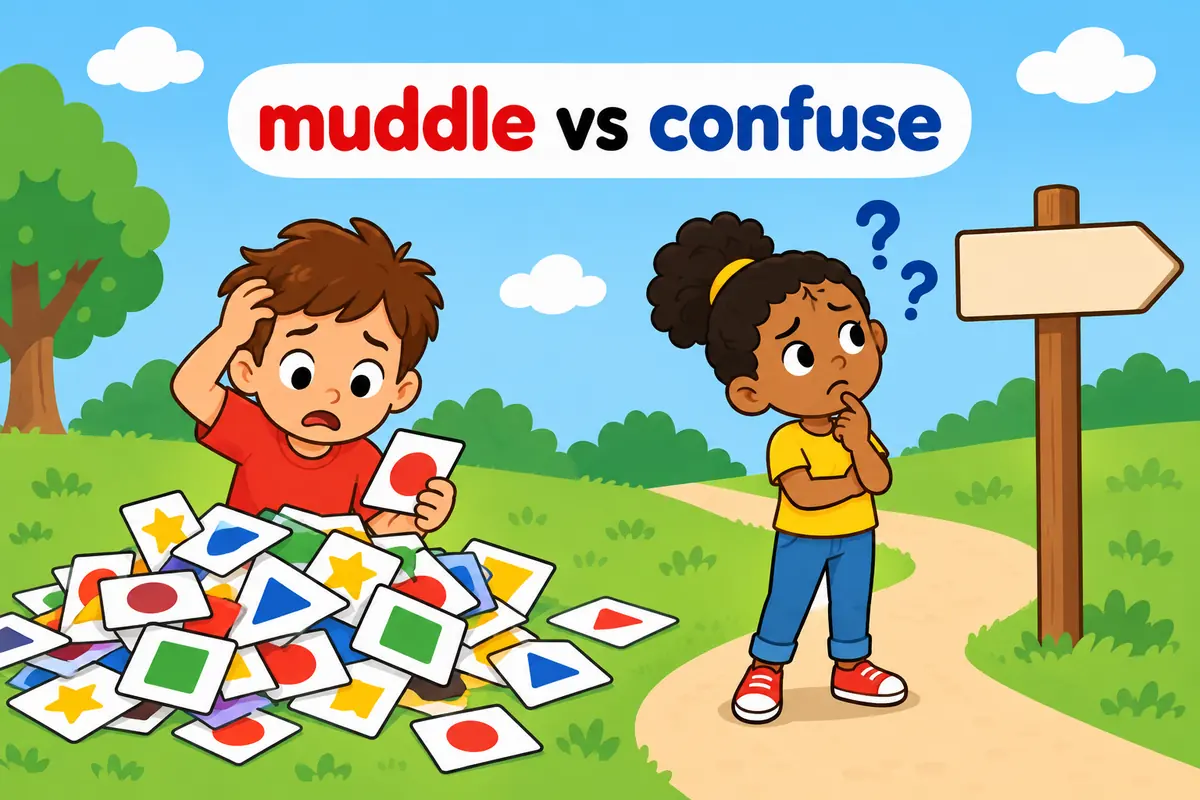
Muddle and confuse overlap, and they are not the same. Confuse means to make somebody unable to think clearly or to fail to tell things apart, while muddle usually involves handling things badly, so the result is disorder as well as uncertainty.
| Attribute | muddle | confuse |
|---|---|---|
| Core action | Mix up or disorder things | Make unclear, or fail to tell apart |
| Typical object | papers, dates, plans, names | a person, a message, an issue |
| Result | Disorder you can see | Uncertainty in the mind |
| Noun available | a muddle | confusion only |
| Tone | Mild and often forgiving | Neutral, can be serious |
| Common phrase | in a muddle, muddle through | confuse A with B |
Verdict: choose confuse for a mind that cannot follow, and muddle when things have been mixed or left untidy, since only muddle carries the noun and the forgiving tone.
Word forms and grammar of muddle
Muddle is unusual because one form serves as both verb and noun, and its participles double as adjectives. The table also lists the phrasal verb and the compound adjective.
| Form | Part of speech | Example |
|---|---|---|
| muddle | verb or noun, base form | Do not muddle the two accounts. |
| muddles | verb, third person; noun plural | She muddles the names; two muddles in one week. |
| muddled | verb, past; adjective | He muddled the dates; a muddled plan. |
| muddling | verb, present participle | You are muddling the issue. |
| muddleheaded | adjective | A muddleheaded decision cost them the lead. |
| muddle through | phrasal verb | We muddled through the inspection. |
The adjective muddled describes a state or a plan, while muddleheaded describes a person who thinks in a confused way.
Common mistakes with muddle
- Incorrect:
It was muddle from the start.Correct: It was a muddle from the start. Rule: As a noun, muddle is countable and needs an article. - Incorrect:
She muddled.Correct: She muddled the two files. Rule: The verb is transitive, so the object must be present. - Incorrect:
He muddled the schedule for the rota.Correct: He muddled the schedule with the rota. Rule: The second item follows with, not for. - Incorrect:
I am muddle about the plan.Correct: I am in a muddle about the plan. Rule: The state uses in a muddle, not the bare noun. - Incorrect:
Please muddle the papers neatly.Correct: Please arrange the papers neatly. Rule: Muddle means to disorder, so it clashes with an adverb of tidiness. - Incorrect:
The muddling of the plan was chaos.Correct: The confusion over the plan was chaos. Rule: Muddle is milder than chaos, so the two words keep different work.
Practice using muddle
Work through the six items, then check the reasoning rather than only the answer.
- Fill the gap: I ______ the two phone numbers and called the wrong person.
- Choose the better word: The instructions were clear, but the labels were (in a muddle / confused).
- Correct the error: The whole trip was muddle after the booking error.
- Build a sentence: use muddle A with B about two similar names.
- Spot the register: which belongs in a formal email — I am in a muddle about the invoice, or I am a bit muddled up about the bill?
- Rewrite with the noun: The arrangements became confused after the delay. Use muddle instead.
Answers
- muddled — the numbers were mixed up, and the verb needs its object.
- in a muddle — the noun names the disordered state of the labels.
- The whole trip was a muddle after the booking error — the countable noun needs an article.
- Model answer: The new teacher muddled Priya with her sister on the first day.
- I am in a muddle about the invoice — formal writing avoids the casual muddled up.
- The arrangements ended in a muddle after the delay — the noun takes in a.
The bottom line
Use muddle in a sentence to describe things that have been mixed up or left in a state of confusion, and pick the verb or the noun from the grammar you need. The two details that settle most sentences are the object and the article: the verb muddles something, while the noun needs in or a, as in in a muddle. When you mean a mind that simply cannot follow, bewilder is the clearer choice.
Frequently asked questions about muddle
Is muddle a verb or a noun?
It is both. As a verb it means to mix things up or make them disorderly, as in he muddled the receipts. As a noun it means a confused state, as in the accounts are in a muddle. The grammar around the word, not the spelling, tells you which job it is doing.
What does muddle through mean?
Muddle through is a phrasal verb meaning to cope with something without a clear plan, and usually to succeed anyway. A small team might muddle through a busy week, surviving on effort rather than organisation. The phrase is mildly forgiving, suggesting that the confusion did not cause real harm.
What is the difference between muddle and confuse?
Muddle usually means mixing up things or leaving them disordered, so the result is visible mess. Confuse means making a person unable to think clearly, or failing to tell two things apart mentally. Only muddle works as a noun, so the accounts are a muddle is correct while the accounts are a confuse is not.
Can muddle mean to crush ingredients?
Yes. In cooking and cocktails, to muddle is to press and twist ingredients gently to release their flavour, as when you muddle mint with sugar. This sense is a tidy, deliberate action, the opposite of the confusion meaning, so context decides which one a reader understands.
Have you ever found yourself in a muddle when trying to explain something clearly? In writing, a muddle occurs when ideas are presented in a confusing or disorganized manner, making it difficult for the reader to understand the message.
A well-crafted example sentence can help untangle the muddle by providing a clear demonstration of the concept or idea being discussed. By showcasing a properly structured sentence, writers can guide readers through complex thoughts and ensure their writing is coherent and easily comprehensible.
7 Examples Of Muddle Used In a Sentence For Kids
- I made a *muddle of my toys when I was tidying up.*
- The paint colors got mixed up and caused a big *muddle.*
- Don’t *muddle up your clothes when choosing what to wear.*
- Let’s clean up the *muddle of books on the floor.*
- I accidentally created a *muddle with my crayons.*
- Try not to *muddle up the puzzle pieces, it will be hard to solve.*
- There was a *muddle of papers on the desk after the art activity.*
14 Sentences with Muddle Examples
- Muddle in your notes can make it harder to study for exams.
- Trying to understand complex concepts can sometimes lead to a muddle in your mind.
- Making last-minute changes to your presentation can create a muddle in your slides.
- Rushing to finish assignments at the last minute can result in a muddle of information.
- Balancing multiple projects can sometimes create a muddle in your schedule.
- Muddle of deadlines can lead to a lot of stress for college students.
- Not organizing your study materials can create a muddle when it’s time to revise.
- Juggling extracurricular activities along with studies can create a muddle in your daily routine.
- Lack of clarity in instructions can cause a muddle in understanding assignments.
- Attempting too many tasks simultaneously can result in a muddle of priorities.
- Trying to study in a noisy environment can create a muddle in your concentration.
- Muddle of thoughts can hinder your creativity when brainstorming ideas.
- Facing unexpected technical issues during online classes can lead to a muddle in your learning process.
- Procrastinating on important tasks can create a muddle of deadlines towards the end of the semester.
How To Use Muddle in Sentences?
Muddle is a verb that means to mix or stir up ingredients in a confused or disorganized manner. Here’s a simple guide on how to use muddle in a sentence:
-
Start with a clear subject: Begin your sentence with a subject, such as “I” or “She.” For example, “I will muddle the berries for the cocktail.”
-
Add the action: After the subject, add the action of muddle. This is the process of mixing or crushing ingredients. For instance, “She likes to muddle mint leaves for her mojitos.”
-
Specify the object: Include the object that is being muddled, which is usually a food ingredient. For instance, “He can muddle the sugar and bitters together for an old-fashioned cocktail.”
-
Complete the sentence: Bring the sentence together by including any additional details or context. For example, “They need to muddle the lime with the sugar before adding the rum for a perfect caipirinha.”
Remember, when using muddle in a sentence, make sure to specify who is doing the action, what is being muddled, and any other relevant information to convey the message clearly. Have fun experimenting with muddle in your cooking and mixology adventures!
Conclusion
In essence, sentences with “muddle” typically depict a state of confusion or disorder. The use of this word indicates a lack of clarity or coherence in the information being conveyed. Such sentences often leave readers feeling perplexed or unsure due to convoluted or jumbled content.
Therefore, it is important to strive for clarity and simplicity in writing to avoid muddling the message intended for the audience. Clear and concise sentences are essential for effective communication, ensuring that the intended meaning is easily understood and not lost in a sea of confusion.


