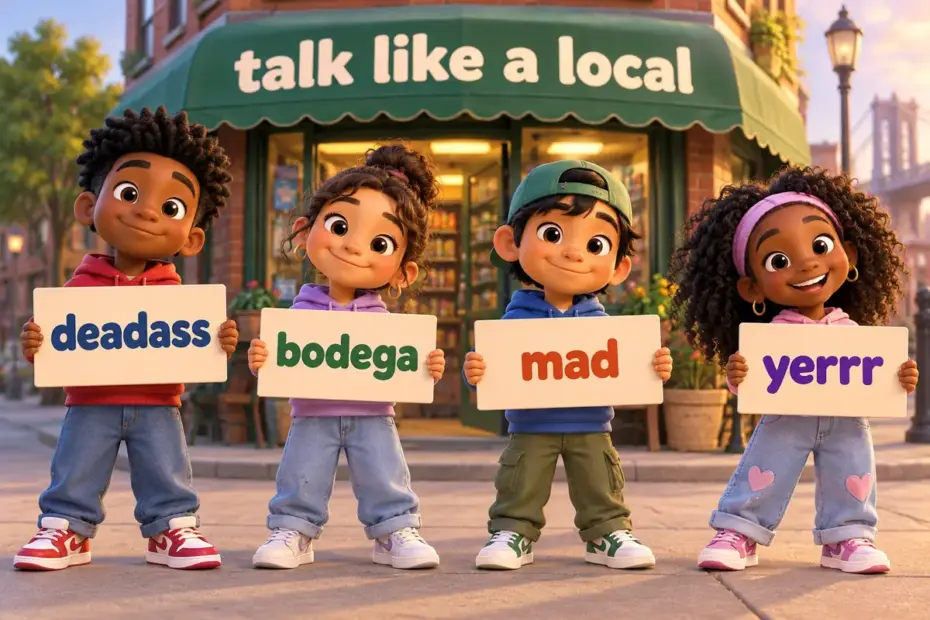
New York slang words are the local terms that mark a speaker as a city regular, from deadass for emphasis to bodega for the corner shop. The words move fast between boroughs and change faster than any list. A single term can place a speaker within a few blocks.
New York slang words at a glance
- New York slang is casual speech that marks a speaker as local rather than visiting.
- Deadass adds firm emphasis, much like seriously or for real.
- A bodega is a small corner shop, not a large supermarket.
- Terms move quickly between boroughs, so meanings shift across the city.
- The commonest mistake is using local slang in a formal or unfamiliar setting.
What do New York slang words mean?
Each term names a habit that the city repeats daily, so deadass adds emphasis, a bodega sells late-night snacks, and mad means very. Visitors reach for the adjectives for new york when one word cannot hold the pace of the city. Plans can change in a new york minute, so a local phrase book rarely stays current.
| Term | Plain meaning | How it is used | Example |
|---|---|---|---|
| deadass | seriously, for real | as an intensifier | That is deadass the best slice here |
| bodega | a small corner shop | as a noun | Grab water from the bodega |
| mad | very, a lot | as an intensifier | That line is mad long |
| brick | very cold | as an adjective | It is brick outside today |
| buggin | joking or overreacting | as a verb | You buggin, that price is wild |
| yerrr | a loud greeting | as an interjection | Yerrr, what is good |
| dip | to leave | as a verb | I am about to dip |
| whip | a car | as a noun | Nice whip, when did you get it |
Local slang is a poor fit for a job interview, a landlord letter or a first message to a stranger, where a clear standard word serves better. Even among friends, a strong term such as deadass loses its force if it lands on a small claim. A borrowed term lands best when it fits the moment, so listen for how locals place it before you try it yourself.
How do you use New York slang in a sentence?
A local term usually sits where its standard equivalent would go, so it takes the same position in the sentence. Each local term needs an example, and slang in a sentence shows how a word settles into a line.
| Pattern | Example | What it signals |
|---|---|---|
| Intensifier before an adjective | That hill is mad steep | Amplifies the adjective |
| Noun replacing a standard word | Meet me at the bodega | Marks a local habit |
| Greeting as an opener | Yerrr, long time | A friendly, informal hello |
| Verb in the present simple | I dip after class | A quick, casual exit |
| Term inside a joke | You buggin for real | Teases a friend lightly |
New York slang across contexts
The same term shifts register from a friend to a manager, so read the setting before you speak. A word that charms a group can stall a formal note.
| Context | Sentence | Why it works |
|---|---|---|
| Chat with a friend | I am deadass not walking there | Adds emphasis among friends |
| Corner shop talk | The bodega on the corner is open late | Names a local fixture |
| Weather chat | It is brick out, grab a coat | Friendly shorthand for cold |
| Dinner plan | Meet at seven, then we can dip early | A quick plan in local terms |
| Weekend talk | That party was mad fun | Intensifies the praise |
| Group message | Yerrr, who is coming Friday | A loud group hello |
| Taxi chat | Just take the whip, parking is a pain | Names the car casually |
| Storytelling | I was buggin when I saw the bill | Describes a shocked reaction |
| Student note | The assignment is mad long | Casual talk between classmates |
| Market chat | That stall is mad cheap on Sundays | Casual praise for a price |
| Basketball talk | He got a bucket, then dipped | Quick action in local terms |
| Neighbour talk | The bodega cat owns the block | Playful local colour |
| Formal email | no local slang at all | Keeps the register professional |
Which New York slang word should you use?
Match the term to the setting and the company, because the same word lands differently in a group and a formal note.
| Situation | Best term | Why |
|---|---|---|
| Agreeing strongly with a friend | deadass | Adds firm emphasis |
| Naming the corner shop | bodega | The common local word |
| Describing cold weather | brick | Short and vivid |
| Saying goodbye casually | dip | Quick and friendly |
| Greeting a group | yerrr | Loud and welcoming |
| A job application | none | Keep formal English |
Use a local term with people who share the code, and switch to standard English when the message has to be clear or formal.
How New York slang words are built
The terms fall into a few families, and each behaves differently in a sentence. Some add force to another word, while others name a thing or an action on their own.
| Family | What it is | Example |
|---|---|---|
| Intensifier | A word that adds force to another | mad in mad fun |
| Noun | A local name for a thing | bodega |
| Verb | An action word | dip |
| Interjection | A standalone call | yerrr |
| Adjective | A describing word | brick meaning cold |
Common mistakes with New York slang
Most errors come from the wrong register or from using a term for the wrong thing.
Incorrect: I am mad tired, in a job interview Correct: I am very tired, in a job interview Rule: local slang marks an informal register, so keep it out of formal settings
Incorrect: the bodega, used for a large supermarket Correct: the bodega, used for a small corner shop Rule: use the term for the thing it actually names
Incorrect: Yerrr, written in a work email Correct: Hello, written in a work email Rule: an interjection suits a friendly group, not a formal thread
Incorrect: It is deadass cold, for a mild chill Correct: It is chilly, for a mild chill Rule: a strong intensifier should match a strong claim
Incorrect: I dip, written to a manager about leaving early Correct: I need to leave a little early, to a manager Rule: clear language serves better when the message matters
Practice using New York slang
Six short tasks check whether you can match a local term to a setting and switch register.
- Fill in the blank: to emphasise a strong opinion to a friend, use blank.
- Choose the better word: for the small corner shop, bodega or supermarket?
- Correct the error: I am mad busy, said in a cover letter.
- Build a sentence: write a group-chat line that greets friends and invites them out.
- Spot the register: which suits a text to a friend, it is brick out, or it is rather cold?
- Fill in the blank: to say you are leaving a party early, you can simply say I am going to blank.
Answers
- deadass, because it adds firm emphasis among friends.
- bodega, because the term names a small corner shop rather than a large store.
- I am very busy, in a cover letter, because a formal document uses standard words.
- Yerrr, who is out tonight, because the greeting welcomes the group casually.
- it is brick out, because the short local term suits a casual text.
- dip, because the verb names a quick, casual exit.

The bottom line
New York slang words mark a speaker as local, so deadass adds emphasis, bodega names the corner shop and mad means very. The terms shift between boroughs and change quickly, so it is safer to listen before you borrow one. Match the term to the company, and switch to standard English whenever the message has to be clear. Listen first, borrow slowly, and let the company decide how far the slang can travel.
Frequently asked questions about New York slang
Is deadass a real word?
Deadass is widely used in New York conversation, where it means seriously or for real. It moved from local speech into music and social media, so it now turns up far beyond the city. It is fine among friends and too casual for a job interview or a formal note.
What does bodega mean?
A bodega is a small corner shop that sells snacks, drinks and everyday basics, often staying open late. The word became a marker of city life because so many corners have one. It does not describe a large supermarket or a chain store.
Where did New York slang come from?
New York slang grows from the many communities that share the city, so it mixes older immigrant words with newer street terms. That mix is why the vocabulary keeps changing and why some terms stay inside a neighbourhood or a generation while others spread quickly.
Should visitors use New York slang?
Visitors can use a term once they are sure of its meaning, and the safest start is a neutral one such as bodega. A borrowed intensifier can sound forced if it lands on the wrong claim. Listening first is the surest way to use a local word naturally.