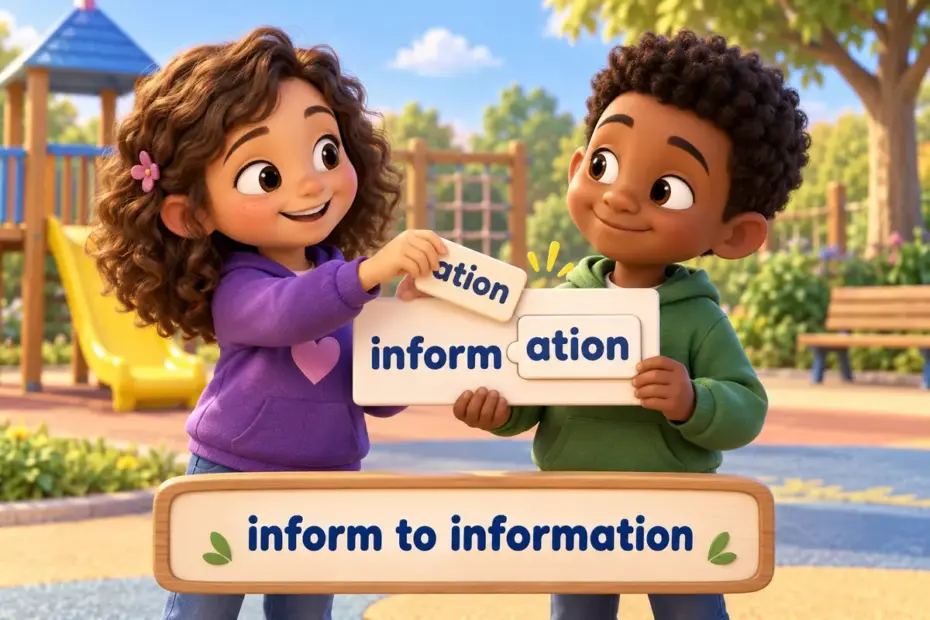
Nouns formed from verbs turn an action into a name, so inform gives information and teach gives teacher. A suffix usually does the work, while a few verbs become nouns with no change at all. This guide lists the main patterns, the endings that build them and clear example sentences.
Nouns formed from verbs at a glance
- A noun formed from a verb names the action, its result, or the person who performs it.
- Suffixes do the work: -tion, -ment, -ance, -ence, -er, -or, -al, -age, -ure and -y.
- Some verbs become nouns with no ending, as in run, walk and look.
- The -ing form, called a gerund, also works as a noun.
- The commonest error is adding the wrong ending to a familiar verb.
What are nouns formed from verbs?
A noun formed from a verb is a word that names the action or its result instead of showing it as an action. Inform is a verb that shows what someone does, and information is the noun that names the thing passed on, so the pair gives two ways to handle the same idea.
English builds these nouns with a set of suffixes, and the ending is fixed by the verb and its history rather than by its meaning. Inform takes -ation, move takes -ment, and perform takes -ance, so each pair has to be learned with the verb.
| Verb | Noun | Ending | Example sentence |
|---|---|---|---|
| inform | information | -ation | The sheet gives all the information. |
| move | movement | -ment | A slow movement crossed the field. |
| perform | performance | -ance | Her performance won the prize. |
| exist | existence | -ence | They doubted the existence of the cave. |
| teach | teacher | -er | The teacher marked every page. |
| act | actor | -or | The actor learned the whole part. |
| arrive | arrival | -al | Their arrival was a surprise. |
| break | breakage | -age | Some breakage is covered by insurance. |
| press | pressure | -ure | The pressure in the pipe was steady. |
| discover | discovery | -y | The discovery changed the field. |
These pairs sit beside related entries such as nouns that start with c, which gather action words in the same family. A verb can also feed an adjective, and the wider family is worth seeing whole.
How do you form a noun from a verb?
The usual method is to add one of a few endings, and a smaller set of verbs changes shape or stays exactly the same.
| Method | Example | What it signals |
|---|---|---|
| add -tion or -ation | inform becomes information | A process or the thing produced. |
| add -ment | move becomes movement | A single action or its result. |
| add -ance or -ence | perform becomes performance | A state or an instance of acting. |
| add -er or -or | teach becomes teacher | A person or thing that does the action. |
| add -ing | swim becomes swimming | The activity named as a gerund. |
| no change | run stays run | The same form serves as verb and noun. |
The -tion family is the largest of the group, and it appears in everyday nouns such as action, creation and discussion. Once a reader meets the pattern, a fresh word in the same family is easy to place.

Nouns formed from verbs across contexts
The new noun appears wherever a writer needs to name an action or its result instead of showing it, and the context shows why.
| Context | Example sentence | Why this works |
|---|---|---|
| Classroom | The teacher explained the movement of the tides. | The noun names a process, not a command. |
| Workplace email | Please send the information by Friday. | The noun names the thing to be sent. |
| News report | The discovery of the wreck made headlines. | The noun names a finished event. |
| Science lesson | We measured the pressure inside the flask. | The noun names a measurable state. |
| Story opening | A sudden movement broke the silence. | The noun names a single action. |
| Theatre review | The actor held the whole stage. | The noun names a person by trade. |
| Site notice | Some breakage is covered by the policy. | The noun names damage as a thing. |
| History essay | Their arrival changed the whole region. | The noun names a completed event. |
| Sports report | Her swimming improved every week. | The gerund names the whole activity. |
Which ending should you choose?
There is no single rule for the ending, but the verb and its origin give a strong clue, and the table below maps the common cases.
| Verb type | Usual ending | Example |
|---|---|---|
| A verb of Latin origin | -tion or -ation | inform becomes information |
| A short everyday verb | -ment | move becomes movement |
| A verb ending in -e | -ance or -ence | perform becomes performance |
| A verb naming an agent | -er or -or | teach becomes teacher |
| A verb naming an activity | -ing | swim becomes swimming |
| A verb with an old short shape | no change | run stays run |
A related set of names is gathered in nouns that start with d, where action words such as deliver and discover feed the same -y pattern.
Word forms and grammar of these nouns
The new noun behaves like any other noun, taking an article, a plural or a possessive as the sentence needs.
| Form | Part of speech | Example |
|---|---|---|
| information | noun, uncountable | The information was accurate. |
| movement | noun | The movement spread quickly. |
| movements | noun, plural | Small movements gave him away. |
| teacher | noun | The teacher marked every page. |
| teachers | noun, plural | The teachers shared the room. |
| swimming | gerund | Swimming builds strong shoulders. |
| discovery | noun | The discovery changed the field. |
The verb can also feed an adjective in the same family, as adjective nominalizations verbs as descriptors explains for words such as interest and interesting. Seeing the verb, the noun and the adjective together keeps the family in view.
The spelling at the join deserves a second look, because a final silent e usually drops before a vowel ending, so move becomes movement but create becomes creation. A verb ending in a consonant often keeps it, as perform does in performance. When the base verb already names an action, the new noun usually names a single instance of it or the result it leaves behind.
Common mistakes with these nouns
The errors fall into two groups: the wrong ending, and using the verb where the noun is needed.
Mistake 1: the wrong suffix. Incorrect: The informment arrived late. Correct: The information arrived late. Rule: inform takes -ation, not -ment.
Mistake 2: dropping the suffix. Incorrect: Her perform was excellent. Correct: Her performance was excellent. Rule: after a possessive, the noun form is needed.
Mistake 3: doubling letters at the join. Incorrect: His teachereer helped a lot. Correct: His teacher helped a lot. Rule: teach takes -er with no doubled letter.
Mistake 4: confusing -er and -or. Incorrect: She is a famous acter. Correct: She is a famous actor. Rule: act takes -or, while many everyday verbs take -er.
Mistake 5: counting an uncountable noun. Incorrect: She gave me two informations. Correct: She gave me two pieces of information. Rule: information is uncountable, so a count phrase with pieces is used instead.
Practice using nouns formed from verbs
Complete each item, then read the reason to confirm the ending.
- Fill in the blank: The ________ in the newspaper was wrong. (inform)
- Fill in the blank: Her ________ of the song was beautiful. (perform)
- Choose the better word: He is a talented (act / actor).
- Correct the error: The movment of the crowd was slow.
- Build a sentence: name an activity using the base verb swim.
- Spot the register: which fits a formal report, the discovery of the wreck, or the discover of the wreck?
Answers
- information. Inform takes -ation to name the thing passed on.
- performance. A possessive before the gap needs the noun performance.
- actor. Act takes the ending -or to name the person.
- The movement of the crowd was slow. Move keeps its e and takes -ment.
- Sample: Swimming is good exercise. The gerund names the whole activity.
- The discovery of the wreck. After the article the, a formal report needs the noun discovery.

The bottom line
Nouns formed from verbs let a writer name an action, its result or the person who does it, and a small set of suffixes does most of the work. Learn each verb with its finished noun, watch the letters at the join, and the right ending will fall into place. The gerund and the no-change group complete the set.
Frequently asked questions about the nouns
Is the -ing form of a verb a real noun?
Yes, when it names an activity rather than showing an action in progress, the -ing form is a gerund and works as a noun. In swimming is good exercise, swimming is the subject. In she was swimming, the same shape is part of the verb phrase, so position and use decide.
Can a verb become a noun with no change at all?
Yes, many short verbs do this, so run, walk, look and love each serve as both verb and noun with no ending added. Grammarians call this conversion or zero derivation. The meaning usually shifts from the act to a single instance, as in a quick run.
Why do some verbs take -er and others take -or?
The ending follows the word’s history rather than a rule, so teach takes -er while act takes -or. Both endings name a person or thing that performs the action. The pair has to be learned with the verb, and a dictionary shows the finished form.
Should I write two informations or two pieces of information?
Write two pieces of information, because information is uncountable and takes no plural -s. A count phrase with a part word such as piece or item names the separate units. Many -tion nouns behave this way, including advice-like words such as attention and equipment.