Old English grammar works mainly through endings rather than word order, so a noun changes shape to show its job in a sentence. The language spoken from about 450 to 1150 carried case, gender and number on almost every word it used. This guide explains the main parts with clear examples.
Old English grammar at a glance
- Old English is heavily inflected, so endings show the job a word does.
- Nouns, pronouns and adjectives carry case, number and grammatical gender.
- The main cases are nominative, accusative, genitive and dative.
- Verbs fall into strong classes, which change vowel, and weak verbs, which add a dental ending.
- There was no article, so the words se, seo and thaet often did that work.
What is Old English grammar?
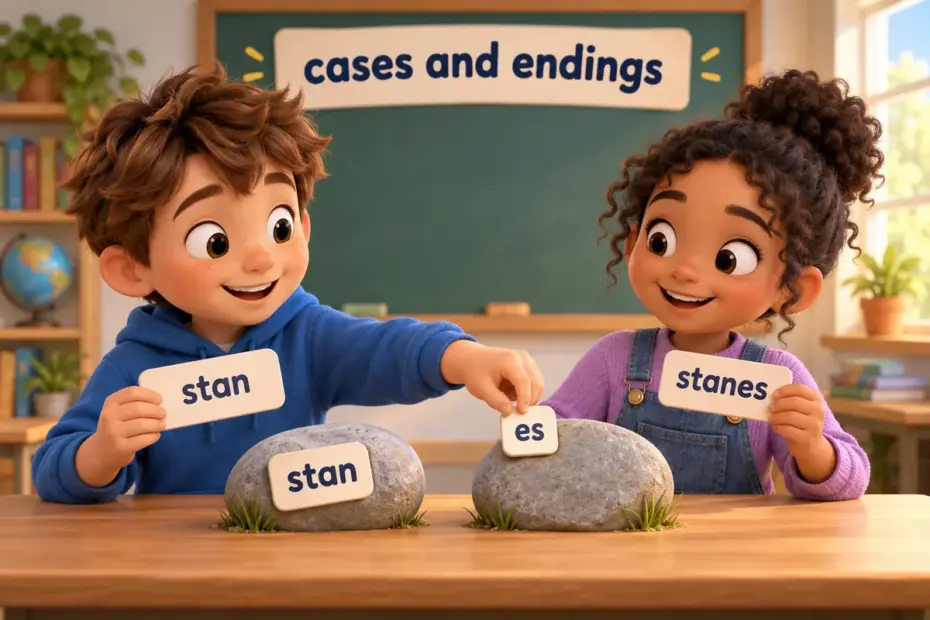
Old English grammar is the system of forms and endings used in the English spoken before about 1150, when the language was still an inflected Germanic tongue. A single noun such as stan, meaning stone, changed its shape for case and number, so the ending told a listener whether it was the subject, the object or the owner.
Case, gender and number sit at the centre of the system. Modern English keeps traces of all three, but Old English marked them on almost every noun, adjective and pronoun, which is why word order could move without changing the meaning.
| Case | Main job | Example with stan |
|---|---|---|
| Nominative | The subject of the clause | se stan (the stone) |
| Accusative | The direct object | thone stan (the stone) |
| Genitive | Possession or origin | thaes stanes (of the stone) |
| Dative | The indirect object or a tool | thaem stane (to the stone) |
Many Old English nouns also appeared in a fifth, seldom-used instrumental case, and a handful of fixed phrases kept it. Related material on plain describing words sits in adjectives for old, where the adjectives themselves come from this older stock.
A phrase such as as old as the hills sentence feels ancient, yet its grammar is modern beside the inflected system described here. The idiom borrows the idea of great age without any of the case endings that made the old language work.
How do Old English nouns and adjectives change?
Nouns and adjectives change their endings for case, number and gender, and the adjective usually copies the noun it describes.
| Form of stan | Number and case | Example sentence |
|---|---|---|
| stan | singular, nominative and accusative | Se stan is heard. (The stone is hard.) |
| stanes | singular, genitive | thaes stanes weard (the guardian of the stone) |
| stane | singular, dative | on thaem stane (on the stone) |
| stanas | plural, nominative and accusative | tha stanas (the stones) |
| stana | plural, genitive | thaera stana (of the stones) |
| stanum | plural, dative | mid stanum (with stones) |
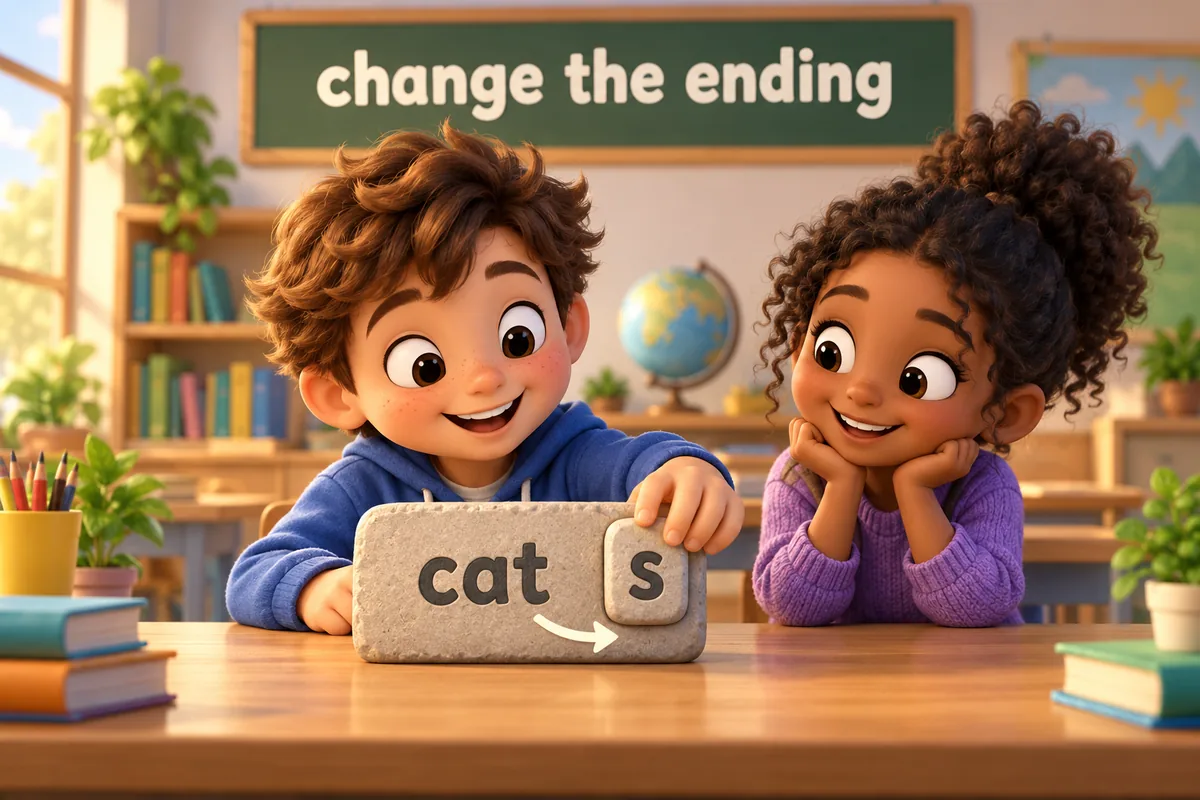
The ending -es marks the singular genitive, and -um marks the plural dative, which is the ancestor of the modern ending in words such as them. Grammatical gender is separate from meaning, so a word can be feminine or neuter whatever it names.
The adjective follows the noun it describes, taking one set of endings when it stands alone and a shorter set when a demonstrative points the way. That split between strong and weak adjective forms is one of the clearest marks of the older grammar, and it has no close parallel in modern English.
Old English grammar across contexts
The older forms survive in place names, poetry and borrowed phrases, and the context shows where each one still appears.
| Context | Example | Why this works |
|---|---|---|
| Place names | brugge, burh and ham sit inside modern town names. | Old noun stems survive in fixed names. |
| Poetry | Nu sculon herigean heofonrices Weard. (Now we must praise the guardian of the heavenly kingdom.) | A line from Caedmon’s Hymn. |
| Pronouns | ic, thu, he, heo, hit | The system behind modern I, you, he, she, it. |
| Verb forms | singan, sang, sungon | A strong verb changes its vowel. |
| Weak verbs | lufian, lufode, lufod | A weak verb adds a dental ending. |
| Negation | ic ne can (I cannot) | The particle ne marks the negative. |
| No article | se cyning (the king) | A demonstrative did the work of the. |
| Word order | tha he ham com (when he came home) | A subordinate clause keeps the verb late. |
Which features should you learn first?
A beginner meets the biggest differences in a fixed order, and the table below ranks them by how often they change a sentence.
| Feature | Modern English | Old English |
|---|---|---|
| Nouns | few endings | case and gender endings |
| Articles | a, an and the | no article; a demonstrative instead |
| Adjectives | compare with -er and -est | endings agree with the noun |
| Verbs | regular and irregular | strong and weak classes |
| Word order | fixed subject first | flexible, verb second or last |
An old-fashioned turn of phrase can linger in modern speech, and old fashioned sentence shows how some of these forms survive as idioms. A phrase that sounds odd today often carries an older grammar inside it.
Word forms and grammar of the pronouns
Personal pronouns kept more case forms than nouns, and they still shape the modern set.
| Person | Nominative | Accusative | Genitive |
|---|---|---|---|
| First singular | ic | me | min |
| Second singular | thu | the | thin |
| Third masculine | he | hine | his |
| Third feminine | heo | hie | hire |
| Third neuter | hit | hit | his |
| First plural | we | us | ure |
Old English also had a dual number for exactly two people, so wit meant we two and git meant you two. That form has gone, leaving only the singular and plural sets in modern English.
The genitive forms survive in a handful of fixed phrases, and the old dative left traces in the pronouns him and them. Seeing the full set side by side makes the modern table look almost bare, which is the clearest measure of how much the language simplified.
Common mistakes with Old English grammar
The errors come from reading the old language with modern habits, and each has a clear fix.
Mistake 1: relying on word order. Incorrect: Treat the Old English object as if it always follows the verb. Correct: Read the ending, because case shows the object wherever it sits. Rule: endings, not position, mark the job.
Mistake 2: expecting an article. Incorrect: Look for the word the before an Old English noun. Correct: Look for se, seo or thaet, which did that work. Rule: Old English had no separate article.
Mistake 3: tying gender to meaning. Incorrect: Assume a word about a woman is feminine. Correct: Learn each noun’s gender with the word. Rule: grammatical gender is a property of the word, not the thing.
Mistake 4: calling every verb irregular. Incorrect: Group all Old English verbs as one irregular set. Correct: Sort them into strong and weak classes. Rule: strong verbs change vowel; weak verbs add a dental ending.
Mistake 5: dropping the adjective ending. Incorrect: Leave an Old English adjective unchanged before its noun. Correct: Match the adjective ending to the noun. Rule: an adjective agrees in case, number and gender.
Practice with Old English grammar
Complete each item, then read the reason to confirm the feature.
- Fill in the blank: The case that marks possession is the ________ . (genitive / dative)
- Fill in the blank: The plural dative ending of stan is stane + ________ . (um / as)
- Choose the better word: A verb that changes its vowel is (strong / weak).
- Correct the error: Old English nouns always keep one ending for every case.
- Build a sentence: name two ways Old English showed the object of a verb.
- Spot the register: which fits a grammar note, se stan, or the stone?
Answers
- genitive. Possession and origin are marked by the genitive case.
- um. The plural dative of stan is stanum, so the ending is -um.
- strong. Strong verbs change the vowel of the stem.
- Old English nouns change their endings for each case. Endings carry the meaning.
- Sample: The noun took the accusative ending, or the dative showed the object. Case marked it either way.
- Se stan. An Old English grammar note uses the older demonstrative form.

The bottom line
Old English grammar marks case, gender and number on almost every word, so endings carry the meaning that word order carries today. Learn the four main cases first, then the strong and weak verb classes, and the older sentences begin to open up. The article-free noun phrase and the loose word order follow from the same principle.
Frequently asked questions about Old English grammar
Did Old English have the words a, an and the?
No, Old English had no separate article. The demonstratives se, seo and thaet, which pointed at something known, did the work of the modern word the. An indefinite sense was left unmarked, so a bare noun could mean a thing or the thing depending on context.
How many cases did Old English nouns take?
Old English nouns took four main cases, the nominative, accusative, genitive and dative, with a vestigial fifth instrumental case in a few fixed phrases. Each case showed a different job, from subject to object to possession. The endings changed with gender and number as well.
What is the difference between strong and weak verbs?
Strong verbs form the past tense by changing the vowel of the stem, as singan becomes sang, while weak verbs add a dental ending, as lufian becomes lufode. The two classes run through the whole language. Modern irregular verbs are mostly the old strong verbs, worn down by time.
Why was Old English word order so flexible?
Word order was flexible because the endings, not the position, showed which word did what. A speaker could move the object without confusion, since its case ending travelled with it. Main clauses still tended to put the verb second, and subordinate clauses kept it late.