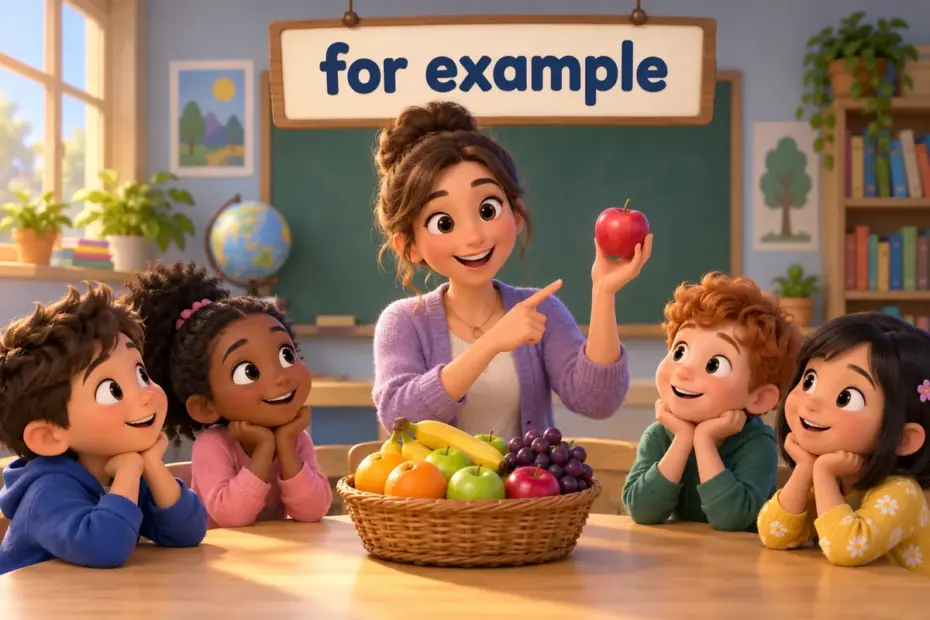
Other ways to say for example include for instance, such as and namely, and the right one depends on the shape of the sentence. For example introduces a single case that proves a general point, so each alternative keeps that job while changing the tone. A formal essay often prefers for instance, while a quick list prefers such as.
Other ways to say for example at a glance
- For instance is the closest and most formal alternative.
- Such as fits a list of items, not a full clause.
- Namely introduces the exact item, not just a sample.
- E.g. is short and suits notes rather than formal prose.
- The commonest error is following such as with a colon.
What are other ways to say for example?
Other ways to say for example are signposts that introduce a case, and they differ in formality and in what may follow. A plain restatement test appears in that is to say in a sentence, and a common spoken frame appears in people say that in a sentence. The table lists twelve options with the job each one does.
| Phrase | Use | Example |
|---|---|---|
| for example | neutral, general | Some fruits, for example apples, are sweet. |
| for instance | formal, slightly literary | Some cities, for instance Lisbon, are hilly. |
| such as | a list of items | Citrus fruits such as lemons are sour. |
| e.g. | notes and informal writing | Bring a pen (e.g. a ballpoint). |
| namely | the exact item | One student, namely Ada, won. |
| to illustrate | showing with evidence | To illustrate, take the first case. |
| by way of example | formal and wordy | By way of example, consider the choir. |
| in particular | singling one out | Metals, in particular iron, rust. |
| including | a non-exhaustive list | Tools including a saw are needed. |
| as an illustration | an essay signpost | As an illustration, imagine a queue. |
| case in point | emphasis on one case | Case in point: the empty library. |
| that is to say | restating clearly | The mean, that is to say the average. |
The phrase sets a reader’s expectation, so such as promises a list of items and for example promises a case that can be dropped without breaking the sentence. Namely is stricter, because it points to the only correct item.
How do you use a for example phrase in a sentence?
The alternatives attach to a sentence in a few fixed ways, and the punctuation follows the phrase rather than the writer’s taste. A related expression appears in to say the least in a sentence.
| Pattern | Example | What it signals |
|---|---|---|
| phrase + comma + clause | For example, the test failed. | a full example follows |
| phrase + noun list | such as apples and pears | items within a category |
| phrase + colon | For instance: the first attempt. | a formal lead-in |
| sentence, phrase + noun | One metal, namely zinc, is soft. | the exact item named |
| parenthetical e.g. | a fruit (e.g. a pear) | a quick aside |
A comma normally follows for example and for instance at the start of a clause, while such as and including take no comma before the list. Getting the punctuation right is what makes the signpost invisible to the reader.

Other ways to say for example across contexts
The signposts appear in essays, reports, textbooks and talk, and the setting sets the level of formality.
| Context | Example sentence | Why this works |
|---|---|---|
| Academic essay | For instance, the second trial showed the same result. | formal and clear |
| Business report | Two teams, namely sales and support, will merge. | precise and neutral |
| Textbook | Some gases, such as oxygen, support burning. | simple and familiar |
| Lab notes | Add a catalyst (e.g. platinum). | compact and technical |
| Presentation | Case in point, the last quarter beat every forecast. | emphatic and spoken |
| News article | Several ports, including Dover, closed early. | neutral and factual |
| Lecture | To illustrate, imagine a falling object. | shows with an image |
| A few items, for example the invoice, are missing. | polite and specific | |
| Manual | Use a soft cloth, for instance a cotton rag. | practical and clear |
| Conversation | Take fruit, for example a ripe peach. | easy and natural |
A textbook keeps to such as, a report prefers namely for exact names, and a lecture reaches for to illustrate, so the setting quietly selects the signpost.
Which for example phrase should you use?
The choice turns on the shape of what follows and on the register, and a look at one more set phrase shows how a plain phrase can do a lot of work, as in ways and means in a sentence.
| Situation | Better choice | Why |
|---|---|---|
| A full clause follows | for example | the phrase can take a complete sentence |
| A short item list follows | such as | the phrase introduces items only |
| Only one item is possible | namely | the word points to the exact item |
| Quick notes | e.g. | the short form is compact |
| A formal essay | for instance | the phrase suits careful prose |
| A spoken emphasis | case in point | the phrase stresses one example |
A useful test is to remove the example and see if the sentence still stands, which it does with for example and such as but not with namely. That difference is why namely must name the only correct item.
Word forms and grammar of the signposts
The signposts include adverbs, prepositions and a Latin abbreviation, and each keeps its own punctuation.
| Form | Part of speech | Example |
|---|---|---|
| for example | adverbial phrase | For example, it rained. |
| such as | prepositional phrase | fruits such as pears |
| namely | adverb | one item, namely zinc |
| e.g. | abbreviation | a tool (e.g. a saw) |
| including | preposition | cities including Rome |
| that is to say | adverbial phrase | the sum, that is to say the total |
Because these forms differ in part of speech, they attach to a sentence differently, so a preposition such as including joins a noun while an adverb such as namely can stand between commas.
How formal is each signpost?
The signposts line up from plain to formal, and matching the rung to the setting keeps a sentence smooth.
| Formality | Phrase | Good for |
|---|---|---|
| plain | for example | any setting |
| formal | for instance | essays and reports |
| compact | e.g. | notes and tables |
| exact | namely | the only possible item |
| emphatic | case in point | one strong example |
| factual | including | a neutral list |
A short note keeps e.g., an essay prefers for instance, and a spoken remark reaches for case in point, so formality is the second test after the shape of what follows.
Common mistakes with the signposts
Mistake 1: a colon after such as. Incorrect: Citrus fruits such as: lemons. Correct: Citrus fruits such as lemons. Rule: such as introduces a list and takes no colon.
Mistake 2: e.g. in formal prose. Incorrect: Many metals, e.g. iron, are hard. Correct: Many metals, for example iron, are hard. Rule: e.g. suits notes, and formal prose prefers for example.
Mistake 3: doubling the signpost. Incorrect: For example, such as apples. Correct: For example, apples are sweet. Rule: one signpost is enough.
Mistake 4: trailing etc. after such as. Incorrect: Tools such as a saw, etc. Correct: Tools such as a saw and a plane. Rule: such as already implies a partial list, so etc. is redundant.
Mistake 5: namely for a partial list. Incorrect: Several poets, namely Keats, are read. Correct: Several poets, for example Keats, are read. Rule: namely names a complete or exact list, not one member of many.
Practice using the signposts
- Fill in the blank: Citrus fruits ___ lemons are sour.
- Choose the better phrase: In a formal essay, use (e.g. / for instance).
- Correct the error: Tools such as: a hammer, are useful.
- Build a sentence: use namely to name one exact winner.
- Spot the register: which suits lab notes, (a) for instance, or (b) e.g.?
- Fill in the blank: A phrase that stresses one example is case in ___.
Answers
- such as, because the phrase introduces a list of items.
- for instance, because formal prose avoids the short form e.g.
- Tools such as a hammer are useful; such as takes no colon.
- One student, namely Ada, won the prize.
- (b), because e.g. is the compact form for notes.
- point, because case in point stresses a single example.
The bottom line
Other ways to say for example range from the neutral for example to the formal for instance, and the shape of what follows decides which fits. Such as introduces a list of items, while namely names the exact item and cannot offer a sample. Match the phrase to the sentence and the punctuation will follow.
Frequently asked questions about the signposts
Is for instance the same as for example?
The two are close in meaning, and for instance is slightly more formal and literary than for example. Either can introduce a full clause after a comma. For instance suits an essay or a report, while for example works well in almost every setting.
When should I use such as instead of for example?
Use such as when a short list of items follows, as in fruits such as lemons. Use for example when a complete case or clause follows, as in for example, the test failed. The test is the shape of what comes next.
Is e.g. acceptable in formal writing?
E.g. is compact and suits notes, tables and parentheses, but careful prose usually spells out for example. The abbreviation stands for a Latin phrase and can look abrupt in a full sentence. In a formal essay, for example is the safer choice.
What is the difference between namely and for example?
Namely names the exact or complete item, so it cannot introduce one of many. For example introduces a sample that stands for a wider group. If the list is partial, use for example, and if it is exact, use namely.