
Pagan in a sentence can be a noun naming a person, as in “The speaker described herself as a pagan,” or an adjective modifying a noun, as in “The essay discusses pagan beliefs.” Identify the historical or contemporary context, use the person’s preferred label, and avoid treating the word as a synonym for every non-Christian religion.
Pagan at a glance
- Pagan can function as a noun or an adjective.
- The plural noun is pagans.
- The related noun paganism names a religious category or outlook.
- Historical and contemporary uses require different context.
- Some older uses are derogatory; respectful wording identifies the intended sense.

What does pagan mean in current usage?
Pagan can refer to a person practicing a contemporary form of paganism, or historically to an adherent of a polytheistic religion. As an adjective, the word describes something associated with pagans or paganism. A historical essay and a present-day interview therefore need different clues around the same term.
Merriam-Webster’s pagan entry distinguishes contemporary, historical, and older potentially offensive senses. Its usage labels matter: a meaning recorded in a dictionary is not automatically a respectful label to apply to another person. In writing about living people, use self-identification or a clearly attributed description.
The Pagan Federation’s introduction describes a diversity of modern Pagan traditions and says its examples are not exhaustive. That diversity is a reason to specify the community or source you mean. Do not infer an individual’s exact practices from the broad label alone.
| Grammatical role | Original example | What the word does |
|---|---|---|
| Singular noun | The interviewee identifies as a pagan. | Names a person’s stated identity |
| Plural noun | The panel included pagans from several communities. | Names more than one person |
| Adjective | The catalog describes pagan imagery. | Modifies imagery |
| Related abstract noun | The seminar examined modern paganism. | Names the broader subject |
| Attributed historical label | The chronicler called the villagers pagans. | Reports someone else’s terminology |
How do you use pagan as a noun or adjective?
Use singular noun pagan with an appropriate determiner when the sentence requires one: “A pagan joined the discussion.” Use adjective pagan before the thing being described: “A pagan perspective shaped the discussion.” The extra noun changes the grammatical role and the focus.
- “The researcher interviewed a pagan about her own experiences.”
- “Several pagans contributed personal accounts to the collection.”
- “The lecturer compared pagan and Christian imagery in the manuscript.”
- “The exhibition label explains how the author uses the term pagan.”
- “The student’s paper focuses on contemporary pagan literature.”
These are language examples, not reports of particular interviews, exhibitions, or studies. Their wording supplies a context and avoids claiming that every person in the category shares the same belief. A sentence about a specific historical object still needs evidence for its actual classification.

Historical labels and respectful descriptions
Specify the period, community, or source when a broad religious label could obscure the subject. “The author discusses pagan worship in ancient Rome” gives more context than “People practiced pagan worship.” For a narrower subject, the community’s own name may be more informative than the umbrella label.
Reporting a label is different from endorsing it. “The missionary described the community as pagan” identifies who used the word. “The community was pagan” makes the writer responsible for that classification. When analyzing a historical document, attribution lets readers distinguish the source’s viewpoint from your own description.
Do not use pagan as shorthand for uncivilized, immoral, or ignorant. Those judgments are neither grammatical requirements nor reliable explanations of religious identity. If a quoted source uses the term disparagingly, explain that usage in the surrounding analysis rather than adopting the insult in your own narration.
Common mistakes when using pagan in a sentence
One common mistake is treating pagan as a universal label for everyone outside Christianity. Another is presenting all pagans as followers of one uniform belief system. The word’s history and its current use are broader and more context-sensitive than either shortcut suggests.
The older examples retained below include sweeping statements about Indian traditions and about particular rituals. Those lines are sentence examples, not sufficient evidence that a whole population or religion accepts the label. For factual writing, identify the specific tradition, consult an appropriate source, and avoid assigning people an identity they have not claimed.
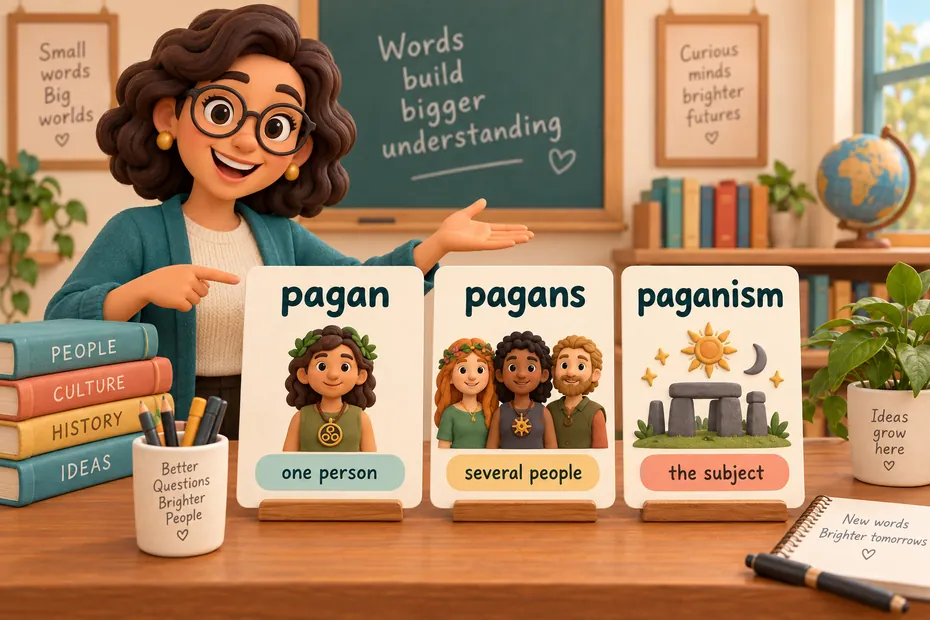
Keep pagan, pagans, and paganism distinct. Write “Two pagans spoke” when you mean two people, and “The talk introduced paganism” when you mean the subject. “Two paganisms spoke” confuses an abstract category with the people doing the speaking.
Capitalization can reflect house style and community preference. Merriam-Webster presents the dictionary headword in lowercase, while the Pagan Federation capitalizes Pagan in its own writing. Follow the publication’s style consistently and retain capitalization in proper organizational names, such as Pagan Federation.
Frequently asked questions about pagan
Is pagan the same as atheist?
No. The labels are not interchangeable in ordinary descriptions of religious identity. Some historical dictionary senses overlap with nonreligion, but the contemporary sense discussed here concerns paganism. Describe what the person actually says about their beliefs rather than replacing one label with another because both appear in a thesaurus.
Can pagan describe an object?
Yes, as an adjective: “The museum label identifies a pagan symbol on the vessel.” The sentence structure is valid, but the identification requires evidence in a real catalog. Grammar tells you where the adjective belongs; it does not establish the religious meaning of an unfamiliar design.
What is the possessive form?
For one person, use pagan’s: “The pagan’s account appears in the appendix.” For several people, use pagans’: “The pagans’ accounts appear together.” A plain plural does not need an apostrophe. Choose the form according to whether you mean more than one person or possession.
How do I write a neutral classroom example?
Use a clear grammatical pattern and a modest, attributed statement: “The speaker identifies as a pagan” or “The article explains pagan terminology.” Avoid imaginary claims about everyone’s rituals or values. A good example of pagan in a sentence teaches the word’s role while respecting the people being described.
Curious about paganism? Paganism is a spiritual belief system that celebrates nature, multiple deities, and the interconnectedness of all living beings. It encompasses a diverse range of traditions, including Wicca, Druidry, and Heathenry, each with its own unique practices and rituals.
One common practice among pagans is the casting of spells, which involves setting intentions and harnessing energy to manifest desired outcomes. Rituals often involve honoring the cycles of nature, such as the phases of the moon or changing seasons. Paganism emphasizes personal autonomy, connection with the earth, and respect for all beings, making it a fulfilling path for those seeking a spiritual connection outside of traditional organized religions.
7 Examples Of Pagan Used In a Sentence For Kids
- Pagan festivals celebrate nature and seasons.
- People who follow ancient traditions are called pagans.
- Some pagan symbols include the sun and moon.
- Many pagan rituals involve dances and songs.
- Pagan beliefs vary around the world.
- In India, there are many different pagan traditions.
- Pagan prayers are often offered to nature spirits.
14 Sentences with Pagan Examples
- Pagan rituals are believed to be part of ancient Indian culture and traditions.
- Many college students are interested in studying the history and origins of pagan religions.
- Some college students choose to practice pagan rituals as a way to connect with nature.
- Exploring the significance of pagan festivals can be a fascinating research topic for students.
- Pagan art and symbolism often play a prominent role in Indian literature and mythology.
- Learning about different pagan deities can provide insights into diverse cultural beliefs and practices.
- Ancient Indian texts contain references to various pagan rituals and ceremonies.
- College clubs dedicated to studying and celebrating pagan traditions have become popular among students.
- Understanding the role of pagan beliefs in shaping Indian history is essential for students of archaeology.
- Incorporating elements of pagan spirituality into modern-day practices is a growing trend among college youth.
- Pagan philosophy emphasizes the importance of harmony with nature and the interconnectedness of all living beings.
- Some students choose to explore pagan spirituality as a form of personal growth and self-discovery.
- Studying the influence of pagan traditions on Indian art and architecture can provide valuable insights for art history students.
- Many college libraries offer resources on pagan religions for students interested in conducting research or deepening their knowledge.
How To Use Pagan in Sentences?
To use the word Pagan in a sentence, you can follow these simple steps. First, identify the context in which you want to use the word Pagan. For example, if you are talking about ancient religious practices or beliefs that are not part of the main world religions like Christianity or Islam, you can use the word Pagan.
Next, construct a sentence where Pagan is used appropriately. For example, “The ancient civilization practiced Pagan rituals to honor nature and the changing seasons.” In this sentence, Pagan is used to describe the religious practices of a particular group that worships nature.
It’s important to remember that Pagan is often used to describe pre-Christian religions or practices, so make sure the context of your sentence aligns with this definition. Additionally, be respectful when using the word Pagan as it is a term that holds significance for many individuals who identify with non-Abrahamic belief systems.
By following these guidelines, you can effectively incorporate the word Pagan into your writing or conversations in a thoughtful and appropriate manner.
Conclusion
In conclusion, the examples of sentences with the keyword “pagan” demonstrate its use in describing beliefs, practices, or objects associated with non-Christian religions, particularly those of ancient or indigenous cultures. These sentences illustrate how the term can be applied to signify a wide range of rituals, traditions, and symbols that are outside the realm of monotheistic faiths. Whether referencing historical paganism, modern neo-paganism, or ancient artifacts with pagan motifs, these sentences showcase the versatility of the term in discussing spiritual diversity and cultural heritage.
Overall, the various examples of sentences with the keyword “pagan” highlight the significance of understanding and respecting diverse religious beliefs and practices. By acknowledging the importance of paganism in shaping human history and culture, we can foster greater tolerance, acceptance, and appreciation for the rich tapestry of spiritual traditions that exist beyond mainstream religions.



