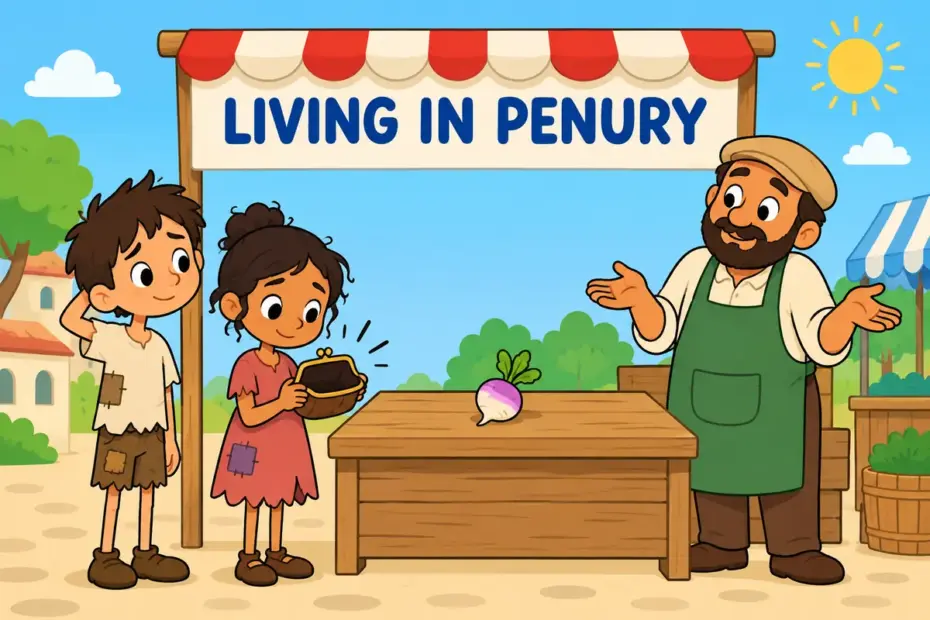
Penury means extreme poverty, the state of lacking the basic means to live. To use penury in a sentence, place the noun after a verb such as live, fall or reduce, as in “The family lived in penury for a decade.” Penury is uncountable and belongs to formal, historical and literary writing.
Penury at a glance
- Penury is a noun meaning extreme poverty or a severe lack of resources.
- It is uncountable, so it has no plural and rarely takes an article.
- The dominant pattern is the prepositional phrase in penury.
- Penury sits in formal, literary and historical writing rather than casual speech.
- The verbs that most often precede it are live, fall, reduce and leave.
- The commonest error is reading penury as penalty, a word with a different meaning.
What does penury mean?
Penury is a noun meaning extreme poverty, the condition of having far too little money for the necessities of life. The Cambridge entry for penury records that core sense and also a rarer one: a severe shortage of something, as in a penury of trained nurses. Both senses share the idea of not having enough of what is needed.
| Sense | Plain meaning | Example sentence |
|---|---|---|
| Extreme poverty | Having far too little money to live on | The widow died in penury. |
| Severe shortage | A scarcity of something needed | A penury of clean water slowed the recovery. |
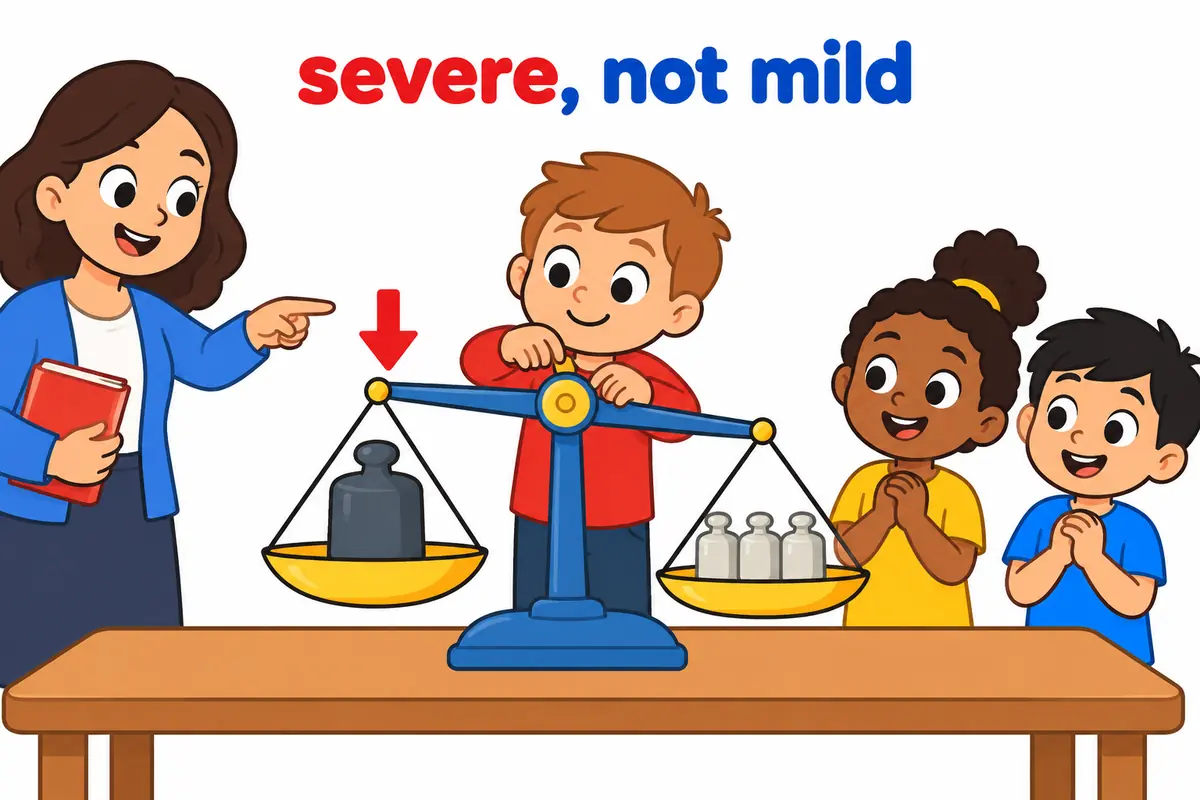
One limitation is worth stating plainly. Penury describes a severe and usually lasting lack, so it is the wrong word for a short tight month; a temporary shortfall is a shortage, not penury. The noun also never means misery in general, and its closest formal synonym, indigence, carries the same weight without the everyday tone of poverty.
How do you use penury in a sentence?
Penury nearly always appears inside a prepositional phrase or after a verb of change, because the noun names a state rather than an object. Four patterns cover almost every real sentence, and the uncountable form keeps the focus on the condition instead of on countable coins.
| Pattern | Example | What it signals |
|---|---|---|
| in penury | The painter died in penury. | A lasting state of poverty; the fixed adverbial phrase. |
| live / die / fall into + penury | The family fell into penury after the mill closed. | A verb of change plus the state entered. |
| reduce / leave + someone + to penury | Medical bills reduced the owners to penury. | Names the cause that pushed people into poverty. |
| a penury of + noun | A penury of funds closed the clinic. | The rarer shortage sense, and the only countable-looking use. |
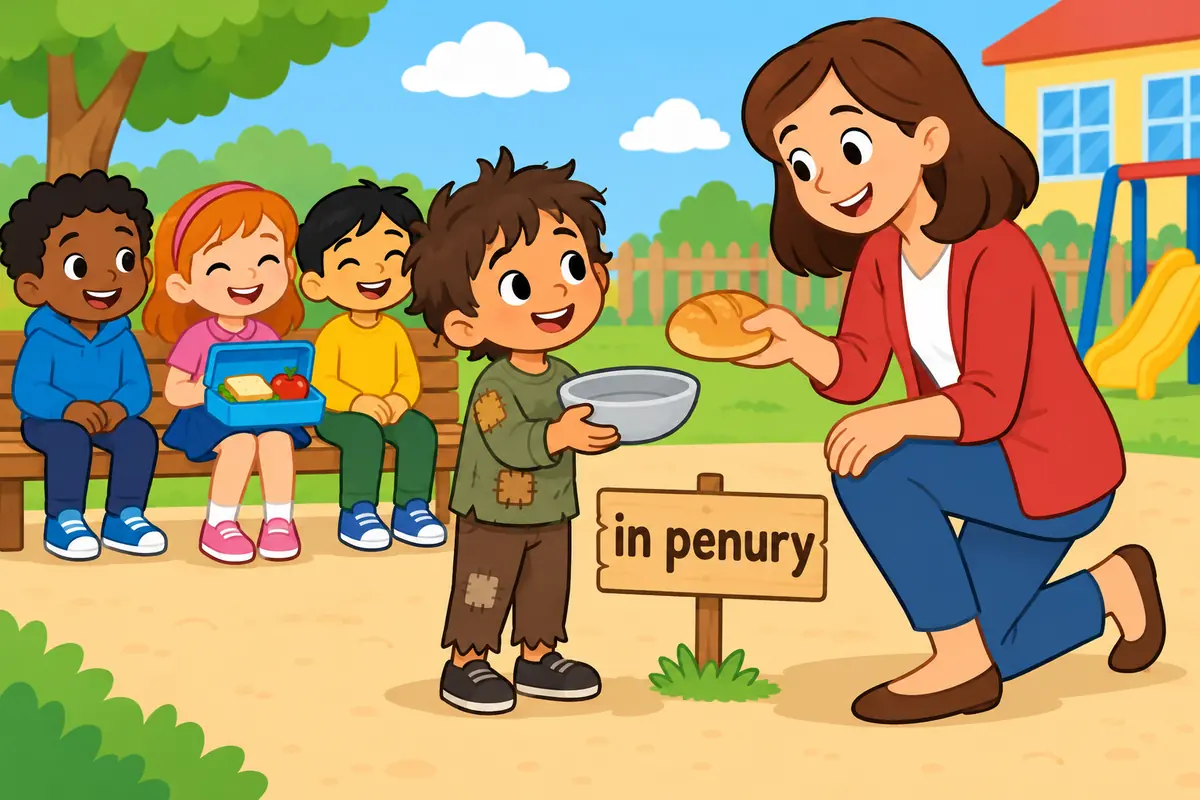
The practitioner rule is simple: if you can replace the noun with deep poverty, penury fits, and if you can replace it with a shortage, you are using the rarer sense.
Penury in a sentence: examples across contexts
Penury changes register more than it changes meaning. The nine sentences below hold the same noun while moving from a classroom to a charity report, and each one names what is missing.
| Context | Example sentence | Why this works |
|---|---|---|
| Classroom | The story ends with the inventor dying in penury. | A familiar plot draws the meaning from the outcome, not a gloss. |
| Workplace email | The fund was created to keep retired staff out of penury. | Ties the word to a practical purpose a colleague recognises. |
| News report | The report found thousands of pensioners living in penury. | A named group supplies the concrete subject reporting demands. |
| Historical writing | After the enclosure acts, many cottagers sank into penury. | Places the noun in a period and a cause, which history prose needs. |
| Biography | For all his fame, the composer spent his last years in penury. | The contrast between fame and poverty carries the sense. |
| Charity writing | A single illness can push a household from comfort into penury. | Shows the movement into the state, which donors respond to. |
| Academic prose | The data link rural penury to the collapse of local credit. | Uses the noun as a variable and pairs it with a measurable cause. |
| Literature essay | Dickens uses penury to expose how thin the safety net was. | Treats the word as a device as well as a fact. |
| Conversation | He joked that the new tax would leave them all in penury. | The exaggeration reads as a joke precisely because penury is an extreme. |
Only the last sentence uses the word lightly, and that lightness works because every reader knows penury is an extreme.
Penury vs poverty
Penury and poverty describe the same family of hardship but sit at different points on a scale. poverty covers a broad range from relative hardship to absolute need, while penury names the severe end, where the basics themselves are missing. destitution is the closest synonym for that extreme.
| Attribute | penury | poverty |
|---|---|---|
| Core meaning | Extreme, usually lasting poverty | A broad lack of money or goods |
| Intensity | Severe | Mild to severe |
| Countable | No, uncountable | No, uncountable |
| Typical register | Formal, literary, historical | Neutral, everyday to formal |
| Usual companion | in penury | in poverty, below the poverty line |
| What it implies | Loss or ruin, an ending | A condition, often measured |
Verdict: reach for poverty when you need a neutral, measurable term, and choose penury only when you want the severe, final weight that hardship alone does not carry.
Word forms and grammar of penury
Penury itself does not inflect, but its adjective is common and carries a second meaning that trips up learners. The table lists the real forms and the invented ones to avoid.
| Form | Part of speech | Example |
|---|---|---|
| penury | noun, uncountable | Penury forced the school to close. |
| penurious | adjective, means extremely poor | A penurious family shared one room. |
| penurious | adjective, second sense: stingy | His penurious habits surprised his friends. |
| penuriously | adverb | The office was penuriously furnished. |
| penuriousness | noun | Critics blamed the penuriousness of the budget. |
| a penury | non-standard | Write penury, never a penury, for the poverty sense. |
The second sense of penurious is the trap: it can mean stingy as well as extremely poor, so context has to decide. When the subject is a person who hoards, the adjective points at meanness, not need.
Common mistakes with penury
- Incorrect:
The fine left him in a penury.Correct: The fine left him in penury. Rule: Penury is uncountable, so the poverty sense takes no article. - Incorrect:
The delay caused a penury.Correct: The delay caused a shortage. Rule: Penury describes severe, lasting poverty; a temporary shortfall is a shortage. - Incorrect:
She was penury after the shop failed.Correct: She was penurious after the shop failed. Rule: Penury is the noun; the adjective is penurious. - Incorrect:
He paid the penury on time.Correct: He paid the penalty on time. Rule: Penury and penalty differ by one letter and share no meaning. - Incorrect:
The charity fought penury on the streets.Correct: The charity fought poverty on the streets. Rule: Use the neutral term for a broad campaign, and reserve penury for the extreme.
Practice using penury
Work through the six items, then check the reasoning rather than only the answer.
- Fill the gap: After the factory closed, the whole town slid into ______.
- Choose the better word: The grant was aimed at families in (penury / hardship)?
- Correct the error: The storm left the village in a penury.
- Build a sentence: use reduce … to penury about a hospital and its debts.
- Spot the register: which belongs in a history essay — the tenants were penurious, or the tenants were totally broke?
- Rewrite with the noun: The once wealthy merchant became penurious. Use penury instead.
Answers
- penury — the town entered a severe, lasting state of poverty.
- hardship — the point is difficulty, not the extreme of penury.
- The storm left the village in penury — the uncountable noun drops the article.
- Model answer: Mounting debts reduced the hospital to penury.
- The tenants were penurious — a history essay prefers the formal adjective over broke.
- The once wealthy merchant ended his days in penury — the noun replaces the adjective.
The bottom line
Use penury in a sentence when the lack is severe and lasting, and keep it uncountable in the fixed phrase in penury. The two nuances that decide most sentences are these: penury is the extreme end of poverty, so it is the wrong word for a passing shortfall, and its adjective penurious has a second, stingy sense that context must settle. The exact focus phrase, penury in a sentence, is best tested by asking whether deep poverty fits and shortage does not.
Frequently asked questions about penury
Is penury a countable noun?
Penury is uncountable in its main sense, so you write in penury, not in a penury, and it has no plural. The only countable-looking use is the rare pattern a penury of something, which names a shortage rather than poverty. For every ordinary sentence about being poor, treat the noun as uncountable and leave the article out.
What is the difference between penury and poverty?
Penury is extreme, often lasting poverty, while poverty is a broad term covering everything from relative hardship to absolute need. A family on a low income lives in poverty; a family with no food or shelter lives in penury. Choose poverty for neutral or measured writing, and penury when the severity and the sense of ruin matter.
Is penurious the same as penury?
Penurious is the adjective built from penury, so the two belong to the same family. Penurious usually means extremely poor, as in a penurious household, but it also carries a second sense of stingy, as in penurious habits. Context decides which sense is meant, so check whether the person lacks money or refuses to spend it.
Can penury mean a shortage of something?
Yes, though that sense is rarer. In the pattern a penury of plus a noun, the word names a severe shortage rather than poverty, as in a penury of skilled staff. The shared idea is not enough of what is needed. When you mean a shortage, adding the noun after of makes the meaning clear and keeps the sentence natural.
Have you ever heard of the term “penury”? Penury refers to extreme poverty or destitution, often characterized by a lack of basic necessities like food, shelter, and clothing. It describes a state of severe deprivation and insufficiency in one’s standard of living.
In literature, penury is frequently used to depict the harsh realities faced by individuals or communities enduring poverty. Authors vividly illustrate the struggles, hardships, and suffering that accompany a life marked by penury. Through these portrayals, readers gain insight into the profound impact that economic deprivation can have on individuals and society as a whole.
7 Examples Of Penury Used In a Sentence For Kids
- It is important to help those in penury.
- We can donate food to the people facing penury.
- Let’s make sure no one goes through penury.
- We can share our toys with children in penury.
- Let’s bring smiles to faces affected by penury.
- We can give clothes to those experiencing penury.
- Be kind and help those struggling with penury.
14 Sentences with Penury Examples
- Penury forced many college students to take up part-time jobs to support themselves.
- The rising cost of education in India has left some students on the verge of penury.
- Due to penury, some students are unable to afford basic necessities like textbooks and stationery.
- The fear of penury often leads students to choose practical careers over their passions.
- Despite facing penury, many students still strive to excel academically.
- The burden of penury can affect a student’s mental health and overall well-being.
- Some students resort to borrowing money to avoid falling into penury.
- Scholarships and financial aid can help alleviate the effects of penury among college students.
- The issue of penury among students is often overlooked in academic institutions.
- Student organizations can play a crucial role in raising awareness about penury on campus.
- The government should implement policies to address the widespread issue of penury among college students.
- Living in penury can hinder a student’s ability to focus on their studies and succeed in college.
- The lack of affordable housing options contributes to the cycle of penury among students.
- It is essential for colleges to provide resources and support for students experiencing penury.
How To Use Penury in Sentences?
To use the word Penury in a sentence, you can follow these simple steps. First, identify a situation where the concept of extreme poverty or destitution is relevant. For example, “The family’s penury was evident in their threadbare clothing and empty cupboards.” In this case, the word penury is used to describe the state of severe poverty that the family is experiencing.
Next, ensure that the sentence flows naturally and is grammatically correct. Avoid using overly complex language that might confuse the meaning of the word. You could say, “She found herself in a state of penury after losing her job and falling behind on her bills.” Here, the word is integrated smoothly into the sentence to convey the idea of financial hardship.
Finally, consider the context in which you are using the word penury. It is important to ensure that the sentence accurately reflects the definition and conveys the intended meaning to the reader. With practice, you will become more comfortable incorporating new vocabulary into your writing and speech.
By following these steps, you can effectively use the word penury in a sentence to enhance your communication skills and expand your vocabulary.
Conclusion
In conclusion, penury, or extreme poverty, is a condition that affects many individuals and communities around the world. It is characterized by a lack of basic necessities such as food, shelter, and healthcare, leading to significant suffering and hardship for those experiencing it. Penury can result from a variety of factors including unemployment, low wages, and limited access to resources.
Efforts to alleviate penury involve social welfare programs, economic policies, and community initiatives aimed at providing support and opportunities for those in need. By addressing the root causes of poverty and promoting equity and social justice, societies can work towards reducing penury and improving the well-being of all individuals. It is crucial for governments, organizations, and individuals to collaborate in combatting penury and creating a more just and prosperous society for everyone.