
Perfunctory means done as a matter of routine, quickly and without real interest or care. To use perfunctory in a sentence, place it before the noun it describes: “a perfunctory nod.” The adjective judges the manner of an action, not the person, so the same task can be warm or mechanical.
Perfunctory at a glance
- Perfunctory is an adjective; its adverb is perfunctorily and its noun is perfunctoriness.
- It almost always sits directly before the noun it describes, as in a perfunctory check.
- The usual nouns are glance, nod, reply, handshake, inspection and apology.
- Perfunctory belongs to formal and written English; in speech people say rushed or half-hearted.
- The commonest error is treating perfunctory as a synonym of careless, which implies harm.
What does perfunctory mean?
Perfunctory is an adjective meaning done quickly and without real care, interest or effort, as a duty. The Cambridge entry for perfunctory defines it as done quickly, without taking care or interest. The judgement is about engagement, not outcome.
| Sense | Plain meaning | Example sentence |
|---|---|---|
| Routine and mechanical | Done because it must be done, not because anyone cares | The clerk gave the form a perfunctory glance and stamped it. |
| Superficial | Enough to satisfy a rule, with no depth | A perfunctory apology ended the meeting. |
| Minimal effort | The smallest acceptable action | The inspection was perfunctory, so a loose cable went unnoticed. |
One limitation is worth stating plainly. Perfunctory is not the same as careless or negligent. A perfunctory job can be completed correctly; the criticism is that it was done without engagement. Where real harm follows from neglect, careless mistake or negligent is the precise word.
How do you use perfunctory in a sentence?
The adjective attaches to a noun that names the action being judged. Even a routine task can be described this way. Five patterns cover almost every natural sentence.
| Pattern | Example | What it signals |
|---|---|---|
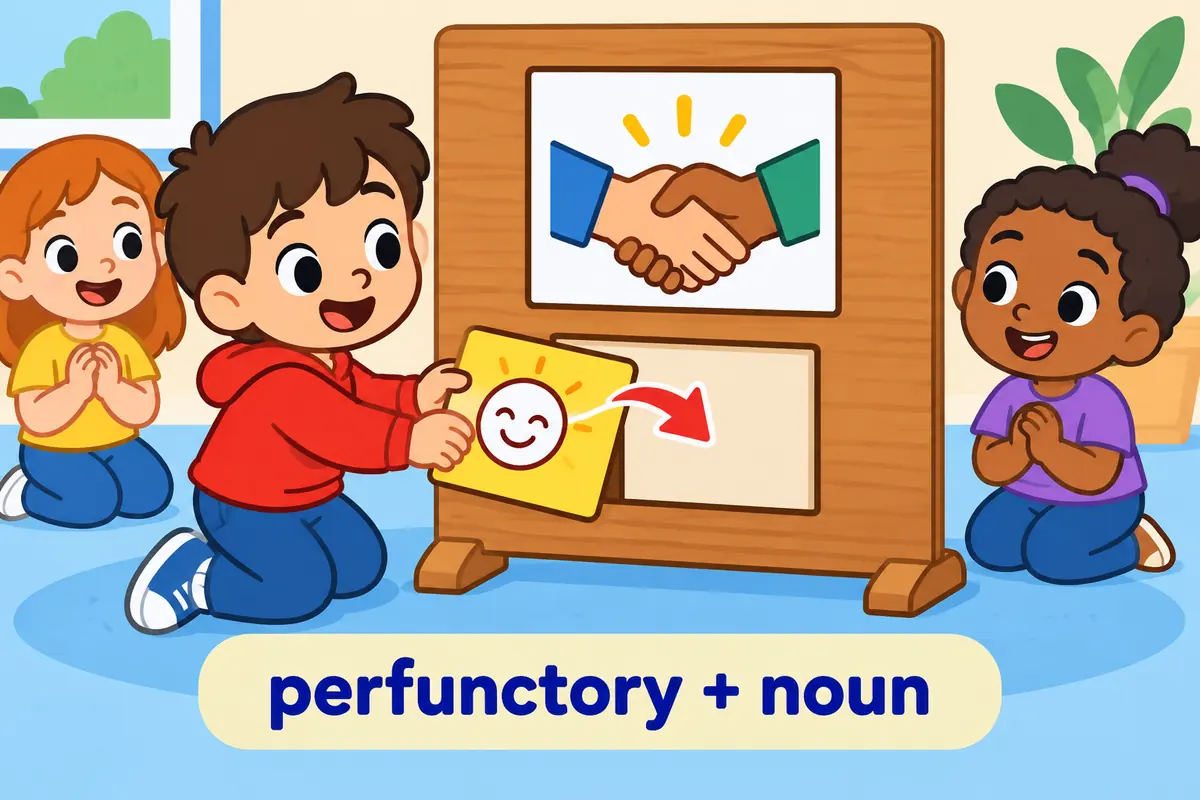
| perfunctory + noun | a perfunctory handshake | The default pattern; the noun carries the action being judged. |
| a perfunctory + noun + at/of + object | a perfunctory glance at the figures | The noun keeps its own preposition, not the adjective. |
| in a perfunctory way | She answered in a perfunctory way. | Used when no single noun suits the action. |
| perfunctory and + adjective | a perfunctory and joyless ceremony | Pairs the judgement with a second descriptor. |
| the perfunctoriness of + noun | the perfunctoriness of the review | The noun form keeps the abstract quality. |
A perfunctory act is close to a token gesture, done to satisfy a rule rather than a person.
Perfunctory in a sentence: examples across contexts
The word changes register more than meaning. These sentences move from a classroom to a safety report, and each one names the action being judged.
| Context | Example sentence | Why this works |
|---|---|---|
| Classroom | The monitor gave the desks a perfunctory wipe before the bell. | Shows a routine act judged as too quick. |
| Workplace email | A perfunctory reply usually answers the question and nothing more. | Fits the common noun-reply collocation. |
| News report | The minister offered a perfunctory apology, then moved to the next item. | Names the public act and its hollowness. |
| Safety report | The check was perfunctory but technically complete. | Separates indifference from a breach of duty. |
| Customer service | The technician gave the engine a perfunctory inspection. | Shows the word applied to a paid service. |
| Academic writing | A perfunctory literature review weakens the whole paper. | Uses the word to judge scholarly effort. |
| Sports | A perfunctory warm-up left the team flat in the first half. | Applies the adjective to preparation. |
| Conversation | He asked about my weekend in a perfunctory way. | The in-a-perfunctory-way pattern suits speech. |
Notice that only the last sentence uses the first person. That asymmetry is a reliable signal of where this word lives.
Perfunctory vs cursory
Perfunctory and cursory both criticise an action, and they are not interchangeable. A cursory glance is quick and covers the surface; a perfunctory act is done only because it is expected.
| Attribute | perfunctory | cursory |
|---|---|---|
| Core meaning | Done without care or interest | Done quickly, with little attention to detail |
| What it judges | Whether the person cared | How thorough the look or read was |
| Typical nouns | handshake, nod, reply, apology | glance, read, check, examination |
| Implied criticism | Indifference | Haste |
| Can be acceptable | No; the word always judges | Sometimes, when speed is the point |
Verdict: choose cursory for a quick look that stays on the surface, and perfunctory for an act performed only because routine demands it. A superficial effort stops at the surface, while a perfunctory one stops at the minimum.
Word forms and grammar of perfunctory
Perfunctory inflects like any long adjective, and its adverb perfunctorily is the form learners forget. The table also lists the noun, which is what most mistakes actually need.
| Form | Part of speech | Example |
|---|---|---|
| perfunctory | adjective | a perfunctory reply |
| perfunctorily | adverb | She nodded perfunctorily. |
| perfunctoriness | noun | the perfunctoriness of the ceremony |
| more perfunctory | comparative | His second attempt was more perfunctory than the first. |
| most perfunctory | superlative | the most perfunctory of gestures |
Common mistakes with perfunctory
- Incorrect:
She gave a perfunctory and careless answer.Correct: She gave a perfunctory answer. Rule: Perfunctory already means without care; careless adds blame for harm and is not a synonym. - Incorrect:
The perfunctory was obvious.Correct: The perfunctoriness was obvious. Rule: Perfunctory is an adjective; the quality itself is the noun perfunctoriness. - Incorrect:
He spoke perfunctory to the crowd.Correct: He spoke perfunctorily to the crowd. Rule: Use the adverb to modify a verb, not the adjective. - Incorrect:
a perfunctory of the documentsCorrect: a perfunctory review of the documents. Rule: The adjective must attach to a noun and cannot stand alone before of. - Incorrect:
He was perfunctory about the meeting.Correct: His remarks about the meeting were perfunctory. Rule: The adjective describes an action or thing, not a person’s state.
Practice using perfunctory
Work through the six items, then check the reasoning rather than only the answer.
- Fill the gap: The guard made a ______ check of the gate and waved the van through.
- Choose the better word: The editor read the draft in a (perfunctory / cursory) ten seconds and passed it on.
- Correct the error: She apologised perfunctory and left.
- Build a sentence: use a perfunctory nod about greeting a neighbour in a hurry.
- Spot the register: which belongs in a formal report — the inspection was perfunctory, or the guy barely bothered?
- Rewrite with the noun: The handshake was perfunctory. Use perfunctoriness instead.
Answers
- perfunctory — the check is the action being judged, and quick and careless is the point.
- cursory — ten seconds describes how thorough the read was, not whether the editor cared.
- She apologised perfunctorily and left — a verb needs the adverb form.
- Model answer: He gave the neighbour a perfunctory nod and hurried past.
- The inspection was perfunctory — a report names the act, not a casual judgement of a person.
- The perfunctoriness of the handshake was obvious — the noun name the quality.
The bottom line
Use perfunctory in a sentence to judge an action done only because routine demands it, and place it directly before the noun: a perfunctory check. The two nuances that decide most sentences are that the word criticises indifference rather than poor work, and that its adverb is perfunctorily. Where real harm follows from neglect, choose negligent instead.

Frequently asked questions about perfunctory
Is perfunctory a negative word?
Perfunctory almost always carries criticism, because it says the action was performed without real care or interest. A perfunctory greeting lands as cold, and a perfunctory safety check sounds careless even when it was technically complete. The word can occasionally be neutral in a legal or technical report, but a reader will still hear the disapproval.
What part of speech is perfunctory?
Perfunctory is an adjective, so it describes a noun such as reply, glance or nod. Its adverb is perfunctorily, used when you want to modify a verb, as in she nodded perfunctorily. Its noun is perfunctoriness, which names the quality itself and is the form most learners overlook.
What is the adverb form of perfunctory?
The adverb is perfunctorily, spelled with -ily at the end. Use it after a verb: the clerk stamped the form perfunctorily. A common error is to write the adjective there instead, as in the clerk stamped the form perfunctory, which leaves the sentence ungrammatical because an adjective cannot modify a verb.
Can a person be perfunctory?
Usually not, and the sentence reads better when the action is the subject. Write his reply was perfunctory rather than he was perfunctory. The adjective judges what someone did, not the person as a whole, so attaching it to a task or remark keeps the meaning clear and natural.
Have you ever encountered someone going through the motions, doing something in a mechanical and superficial way? This type of action, lacking in genuine interest or enthusiasm, can be described as perfunctory. The word “perfunctory” is often used to characterize tasks or interactions that are done out of obligation rather than genuine commitment.
In essence, a perfunctory action may fulfill the requirements on the surface but lacks the genuine care, attention, or effort that one would expect. It denotes a sense of indifference or lack of investment in the task at hand.
7 Examples Of Perfunctory Used In a Sentence For Kids
- Perfunctory means doing something quickly and without much effort.
- We should always try our best and not just complete tasks in a perfunctory manner.
- It’s important to pay attention and not be perfunctory when we are learning new things.
- Let’s make sure we understand our lessons well instead of just giving perfunctory answers.
- We should show enthusiasm and not just have a perfunctory attitude towards our studies.
- Remember, it’s better to ask questions and learn than to be perfunctory in our approach.
- By being curious and engaged, we can avoid being perfunctory in our actions.
14 Sentences with Perfunctory Examples
- Perfunctory attendance is often taken during lectures, so make sure you don’t miss any classes.
- It’s important to avoid perfunctory studying for exams if you want to excel in your academic career.
- Perfunctory group projects can lead to conflict among team members, so make sure to contribute actively.
- Submitting a perfunctory assignment can result in a poor grade, so put in the effort required.
- Engaging in perfunctory extracurricular activities won’t help you develop new skills or interests.
- A perfunctory internship can hinder your chances of securing a job offer after graduation.
- Perfunctory participation in college events may cause you to miss out on networking opportunities.
- It’s essential to avoid perfunctory communication with professors if you need academic assistance.
- Attending job fairs with a perfunctory attitude will not help you make a strong impression on recruiters.
- Writing a perfunctory application for scholarships may result in your application being overlooked.
- Engaging in perfunctory social interactions can prevent you from forming meaningful relationships with your peers.
- A perfunctory approach to time management can lead to missed deadlines and increased stress.
- Employing a perfunctory strategy for exam preparation will not help you retain information in the long term.
- Taking a perfunctory approach to mental health can have negative consequences on your overall well-being.
How To Use Perfunctory in Sentences?
Perfunctory means carried out with a minimum of effort or reflection. It suggests that something is done as a routine or duty, without much enthusiasm or attention to detail.
To use perfunctory in a sentence, you can say:
- Perfunctory greetings were exchanged between the coworkers as they passed each other in the hallway.
- The chef’s plating of the dish seemed perfunctory, lacking the usual care and precision.
- The teacher gave a perfunctory explanation of the topic, leaving the students confused and unengaged.
- The apology felt perfunctory, without genuine remorse or sincerity behind it.
When incorporating perfunctory into a sentence, remember that it often implies a lack of interest or effort. It is usually used to describe actions or behaviors that are done out of obligation rather than genuine interest. Using this word can help convey a sense of indifference or indifference in a situation.
Remember that using perfunctory effectively in a sentence can help enhance your writing by adding nuance and depth to your descriptions. Experiment with incorporating this word into your writing to see how it can help you convey specific tones and meanings.
Conclusion
In this discussion, it is evident that perfunctory actions or statements are characterized by their lack of genuine effort or attention to detail. Whether it’s a perfunctory apology, a perfunctory handshake, or a perfunctory meeting, these behaviors can come across as insincere or dismissive. Individuals should aim to avoid engaging in perfunctory behaviors to maintain genuine and meaningful interactions with others.
By being mindful of the way we communicate and interact with others, we can strive to avoid falling into the trap of perfunctory gestures. Genuine engagement, active listening, and thoughtful responses are key to fostering authentic connections and relationships. Ultimately, by avoiding perfunctory behaviors, we can cultivate more meaningful and fulfilling interactions in both personal and professional settings.


