
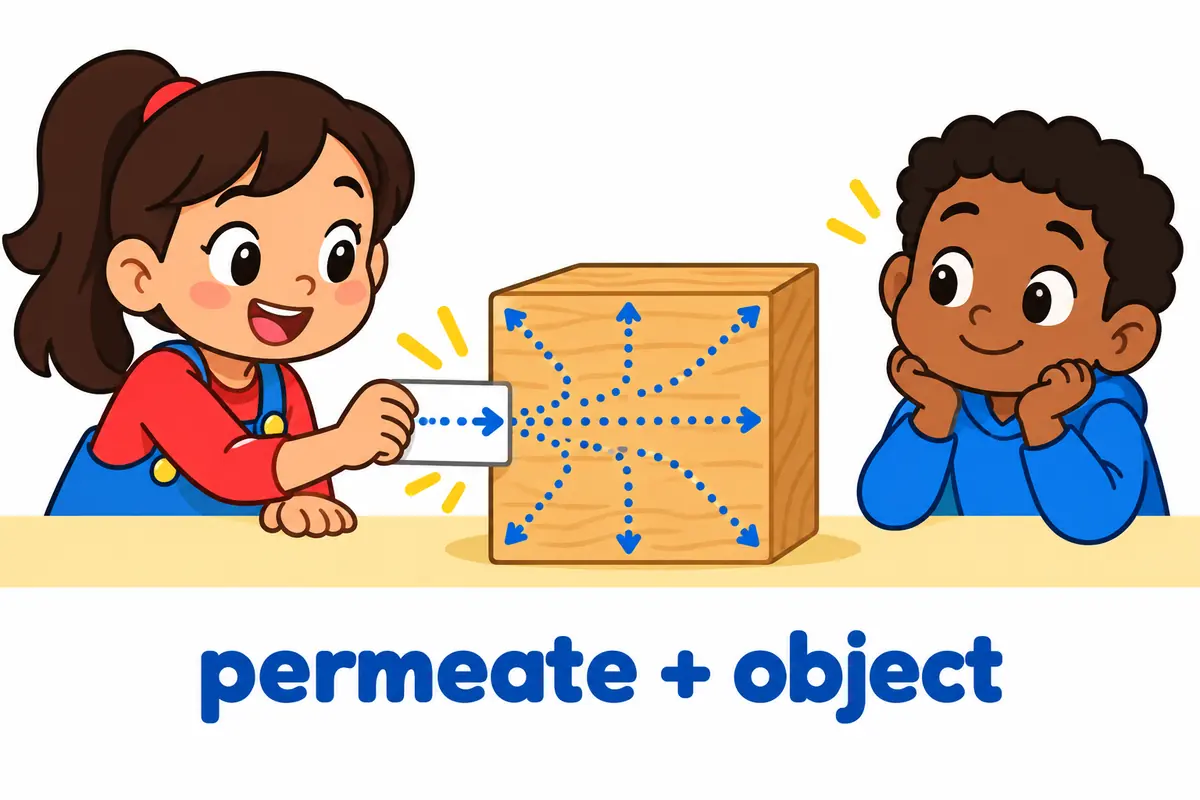
Permeate means to spread through every part of something, or to pass into and fill it. To use permeate in a sentence, put the thing that spreads in the subject and the thing it fills in the object: “The smell of bread permeated the whole house.” The verb is transitive, so it normally needs no preposition after it.
Permeate at a glance
- Permeate is a verb; its forms are permeates, permeated, permeating, permeation and the rare permeative.
- It is transitive, so the filled thing is the direct object, with no through after the verb.
- The two senses are a substance spreading through a material and an idea or feeling filling a place.
- Liquids, smells, light, ideas and moods all work as subjects.
- The commonest error is adding through or into where the object already supplies the target.
What does permeate mean?
Permeate is a verb meaning to pass through the full extent of something, or to become present throughout it. The Cambridge entry for permeate records the physical sense and the figurative sense, and the figurative one is now the more frequent in writing about culture, mood and ideas. Neither sense means to break a surface at a single point.
| Sense | Plain meaning | Example sentence |
|---|---|---|
| Physical spread | A liquid or gas fills every part of a material | Salt water permeated the wooden hull. |
| Smell or light | A scent or glow fills a space | Smoke permeated the upstairs rooms. |
| Figurative spread | An idea or mood fills a group or work | Doubt permeated the whole campaign. |
The physical and figurative senses share one shape, which is why the same verb suits a sponge and a novel. What they do not share is a single-point entry: if the action happens only at the surface, another verb is needed.
How do you use permeate in a sentence?
Permeate takes a direct object, and its passive form with with is common in descriptions of mood. The patterns below show the two routes and the participle that follows.
| Pattern | Example | What it signals |
|---|---|---|
| subject + permeate + object | Rain permeated the soil. | the default transitive use, no preposition |
| subject + permeate + place | Music permeated the hall. | the figurative sense filling a space |
| be + permeated with + noun | The room was permeated with smoke. | a state already reached, passive with with |
| permeate + throughout + noun | Hope permeated throughout the team. | an emphatic, slightly formal variation |
| permeating + noun | a permeating calm | an ongoing quality, common in description |
Permeate in a sentence: examples across contexts
| Context | Example sentence | Why this works |
|---|---|---|
| Classroom | A quiet focus permeated the exam hall. | Mood fills the whole space, not one corner. |
| Workplace email | Uncertainty permeated every team after the merger. | Names a feeling that reached all groups. |
| News report | Smoke from the fire permeated nearby flats. | A physical substance filling a space. |
| Food writing | Garlic and thyme permeated the slow-cooked stew. | Flavours spread through the whole dish. |
| Science writing | Groundwater permeated the porous rock layer. | A liquid moving through an entire material. |
| Literary criticism | A sense of loss permeates the final chapter. | An idea runs through a whole work. |
| Conversation | The smell of fresh paint had permeated the flat. | Everyday use of the passive with with omitted. |
| Sports report | Confidence permeated the squad before kick-off. | A mood shared across a whole group. |
Permeate vs imbue
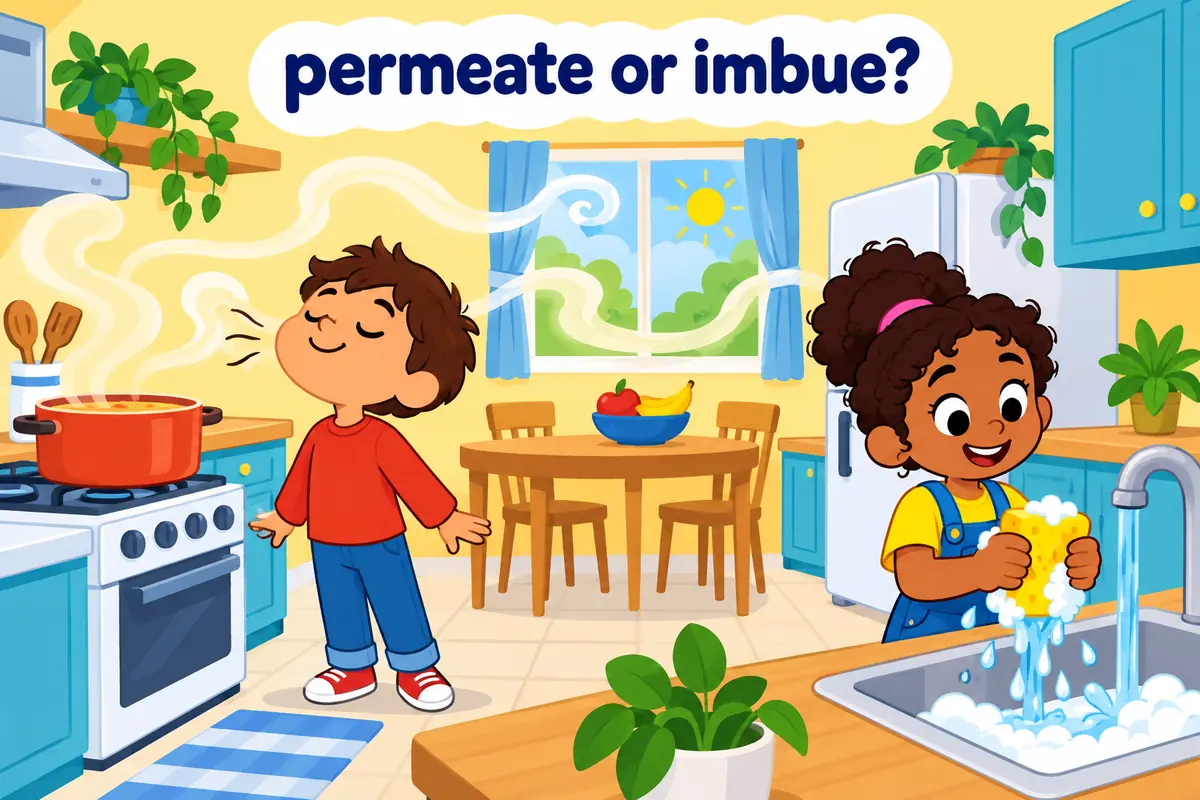
Permeate and imbue both describe something spreading, but permeate says a substance or mood passes through a thing, while imbue says a thing is filled with a quality. When a quality rather than a substance fills something, imbue is the more precise verb. A sponge soaked until no dry fibre remains is saturated rather than merely permeated. A needle penetrates a surface at one point, while a dye permeates the whole fabric. A gas diffuses through a room, spreading outward until it fills the space, and a pale light that spreads evenly across a room suffuses it.
| Feature | Permeate | Imbue |
|---|---|---|
| Core sense | Spread through every part | Fill a thing with a quality |
| Typical subject | Smell, liquid, idea, mood | An influence or a feeling |
| Typical object | A room, material or work | A person, object or work |
| Preposition | None needed; with in the passive | Always imbue something with something |
| What it implies | Saturation throughout | A quality instilled into the whole |
Use permeate for what spreads and imbue for what is poured into a thing, because only imbue keeps the quality alive in a with-phrase.
Word forms and grammar of permeate
Permeate has a full verb family, and one look-alike adjective that describes materials rather than actions. The table keeps the forms straight.
| Form | Part of speech | Example |
|---|---|---|
| permeate | base verb | Water permeates the sand. |
| permeates | third person singular | Light permeates the thin curtain. |
| permeated | past and participle | The hall was permeated with incense. |
| permeating | present participle | a slow permeating warmth |
| permeation | noun | the permeation of dye through cloth |
| permeative | adjective, technical | a highly permeative membrane |
| permeable | adjective, different sense | a permeable rock layer |
The past participle permeated describes a state that has already been reached, and the rare adjective permeative appears in technical writing about materials. Permeable describes a material that lets things pass through it, so it belongs to the thing being entered, not the thing doing the entering. Permeation is the process noun and appears mostly in technical and formal writing.
Common mistakes with permeate
- Incorrect: The smell permeated through the room.Correct: The smell permeated the room.Rule: permeate is transitive, so the object follows directly without through.
- Incorrect: The idea permeated to the students.Correct: The idea permeated the student body.Rule: the filled group is the direct object, so no to is needed.
- Incorrect: The porous rock is very permeate.Correct: The porous rock is very permeable.Rule: the adjective for a material is permeable, not permeate.
- Incorrect: Rumours were permeated the office.Correct: Rumours permeated the office.Rule: the active verb needs no auxiliary; only the passive takes were.
- Incorrect: The dye permeated on the fabric.Correct: The dye permeated the fabric.Rule: the verb takes a direct object rather than a prepositional phrase.
Practice using permeate
- Fill in the blank: The scent of pine ______ the cabin.
- Choose the better word: The mentor (permeated / imbued) the team with confidence.
- Correct the error: Cold air permeated through the damp walls.
- Build a sentence: use permeate with an idea filling a workplace.
- Spot the register: which sentence suits a science report? (a) Water got into the rock. (b) Water permeated the porous layer.
- Fill in the blank: A feeling of calm ______ the whole room after the news.
Answers
- permeated — the transitive verb takes the cabin as its object.
- imbued — a quality is instilled with the with-phrase.
- Cold air permeated the old walls. — drop through because the object follows directly.
- Scepticism permeated the office after the announcement. — the idea fills the workplace as object.
- (b) — permeated is the precise technical verb.
- permeated — the mood fills every part of the room.
The bottom line
Permeate in a sentence describes something spreading through every part of a thing, from a smell filling a kitchen to an idea filling a movement. Keep the verb transitive, so the filled thing is the object and no through is needed, and reserve permeated with for the passive. When a quality is poured into something rather than passing through it, imbue is the more exact choice.
Frequently asked questions about permeate
What is the noun form of permeate?
The noun is permeation, which names the process of spreading through a material or group. It is common in technical writing about liquids and gases, and in formal prose about ideas. The everyday language usually keeps the verb and says that something permeated a place rather than naming the permeation itself.
Which preposition usually follows permeate?
In the active voice, none: permeate takes a direct object, as in the smell permeated the kitchen. In the passive voice, with introduces what fills the space, as in the room was permeated with smoke. The preposition throughout appears in emphatic or formal writing, as in joy permeated throughout the crowd.
Is permeate commonly passive?
The passive with with is very common for smells, moods and ideas, because the interesting thing is the filled space rather than the source. The room was permeated with smoke and the campaign was permeated with doubt both put the space first. In the active voice the spreading thing leads, which suits direct description.
How is permeate pronounced?
Permeate is said with three beats, with the stress on the first, roughly PUR-mee-ate. The last beat is a full vowel, so the ending sounds like the word ate rather than a weak syllable. Keeping that final vowel clear separates the verb from the adjective permeable, which ends with a softer sound.
Permeate means to spread through a place, substance, or group and become present throughout it. In “The smell permeated the hallway,” an odor moves through the space; in “Trust permeates the story,” an idea appears across the whole work. The formal verb can be transitive or intransitive, depending on its sentence pattern.
Key facts at a glance
- Permeate means to spread through something and become present throughout it.
- It can describe a liquid, gas, smell, light, idea, feeling, or influence.
- The verb is often transitive: a smell permeates a room.
- It can also appear with prepositions such as through or into.
- Permeate is more formal than spread or fill in many everyday sentences.
What does permeate mean in a sentence?
Permeate means to pass or spread through a material, place, or larger whole until it is present in many or all parts. The Cambridge Dictionary uses the verb for both a smell filling a building and dissatisfaction spreading through society, so it has physical and figurative uses.
Example: “The aroma of bread permeated the kitchen.” The room is the direct object; the sentence suggests the aroma spread through it, not merely that someone noticed a smell at one point.
How do you use permeate as a verb?
The most direct pattern is subject + permeate + object: “Sunlight permeated the room.” Another pattern adds a preposition to name the material or direction: “Water permeated through the soil” or “Moisture permeated into the wood.” In figurative writing, an attitude or quality can permeate a team, conversation, or novel.
| Pattern | Example | Meaning |
|---|---|---|
| Permeate + place | The scent permeated the hallway. | Spread through a space |
| Permeate through + material | Rainwater permeated through the fabric. | Passed through a physical barrier |
| Permeate into + material | Oil permeated into the unfinished wood. | Entered and spread within a substance |
| Quality + permeate + group/work | Curiosity permeates the documentary. | Appears across an abstract whole |

When is permeate better than spread, seep, or pervade?
Use permeate when something passes through a medium or becomes widespread throughout a larger whole. Spread is the broad everyday choice; seep suggests slow movement through a small opening; pervade is a formal near-synonym often used for a quality, feeling, or atmosphere.
- Permeate: “The smoke permeated the curtains.”
- Spread: “The news spread across the neighborhood.”
- Seep: “Water seeped under the door.”
- Pervade: “A quiet tension pervaded the room.”
A useful choice is to ask what is moving and through what. If a substance enters a barrier, seep or permeate may work; if an idea or mood is present across many parts, permeate or pervade is more precise than simply “go everywhere.”
What grammar mistakes should you avoid?
Permeate already carries the idea of spreading through, so the phrase “permeated throughout every part” can be unnecessarily repetitive. Prefer “The odor permeated the house” or “The odor spread throughout the house.” Also keep the subject clear: a smell or liquid permeates something; an abstract quality can permeate a work or group.
Permeate is a standard English verb, not a special linguistic process in which a single word spreads through a sentence. Its forms are permeates, permeated, and permeating. In school writing, use a specific subject and object instead of saying “the word permeated the sentence” unless that is literally the intended meaning.

Permeate in a sentence: conclusion
Permeate in a sentence is strongest when the thing spreading and the medium are both clear: “The cedar scent permeated the closet.” Use the verb for physical movement or a quality present across a larger whole, and choose spread, seep, or pervade when that word states the action more exactly.
Frequently asked questions
What does permeate mean?
Permeate means to spread through a place, substance, or group and become present throughout it. A smell can permeate a room, water can permeate soil, and an idea can permeate a story. The verb is formal and works for both physical and figurative meanings.
Is permeate transitive or intransitive?
Permeate can be transitive or intransitive. In “The odor permeated the room,” the room is the object. In a phrase such as “water permeated through the soil,” a preposition identifies the medium. Choose the construction that makes the path and affected material clear.
What is the difference between permeate and seep?
Permeate emphasizes spreading through a medium or becoming present throughout a whole. Seep usually suggests slow movement through a small opening or porous barrier, as with water under a door. They can overlap, but seep focuses more on gradual leakage and permeate on distribution.
Can an idea permeate a story?
Yes. Permeate has a figurative sense: an idea, feeling, or influence can be present across many parts of a story, conversation, or organization. “A theme of forgiveness permeates the novel” means the theme recurs throughout the work, not just in one scene.
Have you ever wondered how a single word can seep through and spread its influence throughout an entire sentence? This process of diffusion and saturation, where a word spreads through and influences the entire context, is known as “permeate” in linguistic terms.
When a word permeates a sentence, it infiltrates every part of the text, merging seamlessly with its surroundings to impart meaning and significance. This linguistic phenomenon showcases the interconnected nature of language and how each word holds the power to shape and enhance the overall message conveyed.
7 Examples Of Permeate Used In a Sentence For Kids
- Permeate means to spread or move through something.
- I can smell the delicious cookies as their aroma begins to permeate the kitchen.
- The sweet scent of flowers can permeate the air in the garden.
- When we water the plants, the soil helps the water to permeate through and reach the roots.
- Colors can permeate when we mix them together to create new ones.
- The sound of birds chirping can permeate through the trees on a sunny morning.
- The sun’s rays can permeate through the clouds on a clear day.
14 Sentences with Permeate Examples
- Permeate your study materials with sticky notes for quick reference during exam time.
- The aroma of freshly brewed coffee began to permeate the library, energizing the students.
- It is important to let positivity permeate your thoughts to have a successful college experience.
- The sound of laughter and chatter seemed to permeate the campus during festivals.
- As the monsoon rains arrived, the musty smell of dampness began to permeate the hostels.
- Permeate your presentations with relevant data and statistics to make them more impactful.
- The spirit of competition seemed to permeate the air during sports tournaments.
- The excitement of upcoming college events started to permeate through social media platforms.
- The aroma of freshly baked bread began to permeate the cafeteria during breakfast hours.
- Permeate your group projects with effective communication to ensure success.
- The feeling of camaraderie began to permeate the student council meetings.
- The trend of sustainable living is starting to permeate college campuses across India.
- The importance of time management should permeate every aspect of a college student’s life.
- The sense of achievement and pride started to permeate the graduating seniors as they prepared for their convocation ceremony.
How To Use Permeate in Sentences?
Permeate means to spread throughout or pass through a substance. When using this word in a sentence, it is important to consider the context in which it is being used.
To use Permeate in a sentence, follow these steps:
-
Determine the meaning of Permeate in the sentence. Is it being used to describe something spreading throughout an area or passing through a material?
-
Identify the subject and verb in the sentence. The subject will be the person, place, or thing that is performing the action, and the verb will describe the action being taken.
-
Insert Permeate into your sentence in the appropriate location. Make sure it fits grammatically and makes sense within the context of the sentence.
For example, you could say: “The smell of freshly baked bread began to permeate the entire house.” In this sentence, the smell of the bread is spreading throughout the house, so the word permeate is used to describe this process.
By following these steps and paying attention to the context in which Permeate is being used, you can effectively incorporate it into your writing to convey the intended meaning.
Conclusion
In conclusion, the keyword “permeate” was effectively integrated into various sentences throughout this article to highlight its use and meaning. These sentences demonstrated how the word can be used to convey the idea of spreading or diffusing through something, whether it be a substance permeating a material or an idea permeating a community. By showcasing different contexts in which “permeate” can be employed, a clearer understanding of its versatile application was achieved.
Through the use of sentences with “permeate,” readers were able to grasp the concept of gradual penetration and diffusion in a straightforward manner. This word proved to be a powerful tool in illustrating the process of something spreading throughout a given medium, thus enhancing comprehension and facilitating a deeper connection to the topic at hand.


