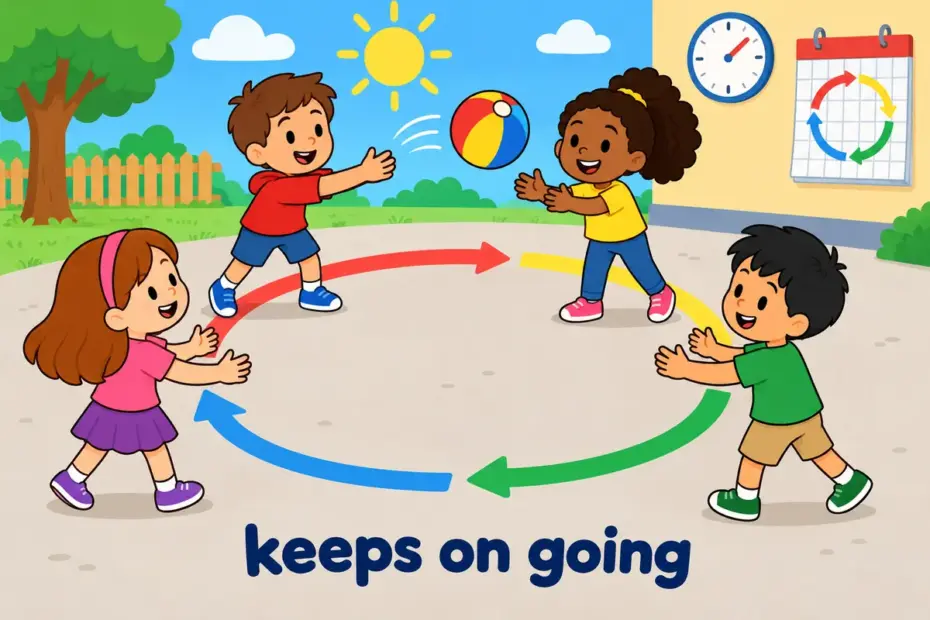
Perpetuate means to make something continue, especially a situation, belief or practice that might otherwise fade. To use perpetuate in a sentence, name what is being kept alive: “The policy perpetuated a cycle of debt” or “rumours perpetuate old divisions.” The verb is transitive and slightly formal.
Perpetuate at a glance
- Perpetuate is a transitive verb meaning to cause something to continue.
- Its forms are perpetuates, perpetuated, perpetuating and the noun perpetuation.
- The usual subjects are policies, stories, groups and systems.
- Perpetuate suits academic, journalistic and public writing more than chat.
- The commonest error is confusing it with perpetrate, which means commit a crime.
What does perpetuate mean?
Perpetuate is a transitive verb meaning to keep something going, often long after it should have stopped. The Cambridge entry for perpetuate records the continue sense and the related noun perpetuation. The word judges nothing on its own: it is critical when the object is poverty, a myth or a feud, and approving when the object is a tradition or a memory worth keeping. The plain verb continue carries no blame, but perpetuate often hints that the pattern could and should have been stopped. The table separates the senses.
| Sense | Plain meaning | Example sentence |
|---|---|---|
| Keep a situation going | Cause a condition to continue | The law perpetuated the shortage for years. |
| Keep a belief alive | Repeat a claim until it lasts | The legend perpetuated a false story about the king. |
| Preserve a memory | Honour someone by continuing their work | The prize perpetuates her name. |
One honest limitation belongs here. Perpetuate does not mean worsen or create. A rumour can perpetuate a division that already exists, but it cannot invent the division, so the word should not be asked to carry the idea of starting trouble.
How do you use perpetuate in a sentence?
Perpetuate always takes an object, and the object is whatever is being kept alive. The subject is the person, rule or story doing the keeping. Reflexive and passive uses are both common in academic writing, where the focus falls on the system rather than on any individual.
| Pattern | Example | What it signals |
|---|---|---|
| perpetuate + a situation | Bad rules perpetuate inequality. | The standard critical use. |
| perpetuate + a belief | Old films perpetuated the myth. | Keeping an idea in circulation. |
| be perpetuated by | The custom was perpetuated by schoolbooks. | Passive focus on the source. |
| perpetuate + itself | The system perpetuates itself. | Reflexive use, common in analysis. |
| perpetuate + a memory or name | The fund perpetuates his memory. | The approving, memorial sense. |
The practitioner test is simple: perpetuate means keep an existing thing going; where the effort is routine upkeep rather than survival, maintain is often the better verb.
Perpetuate in a sentence: examples across contexts
Perpetuate moves easily from criticism to praise because the object, not the verb, sets the tone. The nine sentences below move from a classroom to a charity fund, and several are close to prolong, which lengthens something rather than preserving it.
| Context | Example sentence | Why this works |
|---|---|---|
| Classroom | Teasing can perpetuate a nickname a child hates. | Shows how small acts keep a pattern alive. |
| Workplace | The old rota perpetuated an unfair split of weekends. | An institutional habit as the subject. |
| News report | Analysts say the subsidy perpetuates overproduction. | Policy critique in a measured tone. |
| Academic writing | These textbooks perpetuate a one-sided version of events. | Formal claim about the spread of ideas. |
| Conversation | Silence only perpetuates the problem. | Short, direct use in speech. |
| Legal writing | The clause perpetuated the monopoly for another decade. | Names a fixed term and a clear outcome. |
| Culture | The festival perpetuates a tradition older than the town. | The approving sense of keeping heritage. |
| Science communication | A single study can perpetuate a myth for years. | Shows an information loop at work. |
| Charity | The fund perpetuates her name and her work. | Memorial use that keeps a person’s legacy. |
Only the memorial sentence uses perpetuate without any hint of criticism, which confirms that the word borrows its moral colour from whatever it is asked to keep going.
Perpetuate vs perpetrate
Perpetuate and perpetrate differ by three letters and mean entirely different things. Perpetuate means keep something going; perpetrate means carry out a crime or harmful act. The table sets out the contrast.
| Attribute | perpetuate | perpetrate |
|---|---|---|
| Core meaning | Cause something to continue | Carry out a crime or harmful act |
| Typical object | A situation, belief, tradition, cycle | A crime, fraud, hoax, assault |
| Connotation | Often critical but never criminal | Criminal or morally serious |
| Register | Formal, academic and public | Formal, legal and journalistic |
| Usual subject | A policy, a group, a story | A person or an organised group |
| Spelling signal | Ends in -uate | Ends in -trate |
Verdict: use perpetuate for anything that is kept alive, whether good or bad, and perpetrate only for crimes and wrongdoing; the endings -uate and -trate are the quickest way to tell them apart.
Word forms and grammar of perpetuate
Perpetuate inflects regularly, and its noun perpetuation is the form academics use most. The table also lists the related adjective and the fixed phrase in perpetuity.
| Form | Part of speech | Example |
|---|---|---|
| perpetuate | verb, base form | Silence will only perpetuate the rumour. |
| perpetuates | verb, third person singular | The rota perpetuates an old unfairness. |
| perpetuated | verb, past and past participle | The story perpetuated a false legend. |
| perpetuating | verb, present participle | They are perpetuating a damaging cycle. |
| perpetuation | noun | The perpetuation of the myth did real harm. |
| perpetual | adjective, related form | She lived in perpetual fear of debt. |
The forms perpetration and perpetrator belong to perpetrate, not to perpetuate, so keep the two families apart when you proofread.
Common mistakes with perpetuate
- Incorrect:
The gang perpetuated a robbery.Correct: The gang perpetrated a robbery. Rule: Crimes are perpetrated; situations and beliefs are perpetuated. - Incorrect:
The rumour was perpetrated by the press.Correct: The rumour was perpetuated by the press. Rule: Perpetuate means keep alive, which fits a rumour far better than commit. - Incorrect:
The policy perpetuated.Correct: The policy perpetuated the shortage. Rule: Perpetuate is transitive, so it cannot stand without an object. - Incorrect:
The law perpetuated to poverty.Correct: The law perpetuated poverty. Rule: Perpetuate takes a direct object, never the preposition to. - Incorrect:
They perpetuated a fraud on the council.Correct: They perpetrated a fraud on the council. Rule: Fraud is a harmful act, so it belongs with perpetrate. - Incorrect:
The team perpetuated the task quickly.Correct: The team completed the task quickly. Rule: Perpetuate means keep going, not finish or perform.
Practice using perpetuate
Work through the six items, then read the reasons rather than only the answers.
- Fill the gap: Leaving the rule in place will only ______ the unfairness.
- Choose the better word: The fraudster (perpetuated / perpetrated) a series of scams.
- Correct the error: The custom was perpetrated by the village for centuries.
- Build a sentence: use be perpetuated by about a myth and old textbooks.
- Spot the register: which belongs in an academic paper — the rule perpetuates inequality, or the rule keeps being unfair?
- Rewrite with the noun: The festival perpetuates an old tradition. Use perpetuation instead.
Answers
- perpetuate — the rule keeps the unfairness going.
- perpetrated — a scam is a harmful act, so it takes perpetrate.
- The custom was perpetuated by the village for centuries — a tradition is kept alive, not committed.
- Model answer: The myth was perpetuated by old textbooks for decades.
- The rule perpetuates inequality — an academic paper keeps the subject specific and avoids the vague passive keeps being unfair.
- The festival is a perpetuation of an old tradition — the noun names the keeping alive and takes of.
The bottom line
Use perpetuate in a sentence when a policy, story, habit or system keeps something going, and give the verb an object naming whatever is being kept alive. Two nuances decide most sentences: perpetuate is not the criminal verb perpetrate, and its tone comes entirely from what it preserves. When the meaning is were living longer or lasting longer, the object changes, not the verb.
Frequently asked questions about perpetuate
Is perpetuate always negative?
Not always, but it leans negative when the thing being kept alive is a problem, such as poverty, a myth or a feud. It is neutral or positive when the object is worth preserving, as in a scholarship that perpetuates a scientist’s memory. The word itself judges nothing; the object decides the tone.
What is the noun form of perpetuate?
The noun is perpetuation, meaning the act of keeping something going, as in the perpetuation of a stereotype. It is uncountable in this sense. The related noun perpetuity appears in the fixed phrase in perpetuity, meaning forever, and the adjective perpetual describes something continuous or unending.
Can perpetuate describe something positive?
Yes. While the verb often appears in criticism, it can just as easily keep a good thing alive. A trust perpetuates a family’s generosity, and a festival perpetuates a local tradition. The meaning is simply to cause something to continue, so the moral weight comes entirely from what is being continued.
Is perpetuate a formal word?
Perpetuate belongs to formal and semi-formal writing. Academics, journalists and campaigners use it when they discuss cycles, myths and traditions, as in policies that perpetuate disadvantage. In conversation people often say keep going or keep alive instead, and perpetuate can sound stiff or preachy in casual speech.
Do you ever find yourself wondering how certain beliefs or behaviors continue to endure? The concept of “perpetuate” is the key to understanding this phenomenon.
To perpetuate something means to cause it to continue indefinitely. This can involve actions, thoughts, traditions, or beliefs that are sustained and passed on over time.
7 Examples Of Perpetuate Used In a Sentence For Kids
- Perpetuate means to continue something for a long time.
- We should not perpetuate violence or mean behavior towards others.
- It is important to perpetuate acts of kindness and love in our daily lives.
- We can perpetuate good habits by practicing them every day.
- Let’s work together to perpetuate a clean and healthy environment.
- By sharing stories and traditions, we help perpetuate our culture.
- Remember to always perpetuate positivity and spread happiness wherever you go.
14 Sentences with Perpetuate Examples
- Perpetuate the cycle of knowledge by sharing study materials with your classmates.
- College gossip can perpetuate unnecessary drama among students.
- Avoid negative stereotypes that can perpetuate bias and discrimination on campus.
- By volunteering at charity events, you can help perpetuate a culture of giving back.
- Engaging in healthy habits like exercise and proper nutrition can help perpetuate a balanced lifestyle.
- Encouraging open communication within student organizations can perpetuate a sense of unity and teamwork.
- Participating in cultural exchange programs can perpetuate a sense of global awareness among students.
- Perpetuate a positive academic environment by supporting your peers in their educational pursuits.
- Attending career workshops can perpetuate professional growth and development among students.
- Embracing diversity can perpetuate a climate of inclusivity on college campuses.
- Promoting mental health awareness can perpetuate a supportive community for students facing emotional challenges.
- Creating sustainable practices on campus can perpetuate environmental consciousness among students.
- Perpetuate a tradition of academic excellence by striving for personal growth and success.
- Building strong relationships with professors can perpetuate opportunities for mentorship and guidance in your academic journey.
How To Use Perpetuate in Sentences?
Perpetuate means to make something continue indefinitely or to prolong the existence of something. When using the word “perpetuate” in a sentence, it is important to ensure that the context in which the word is used is clear.
Here is a simple guide on how to use perpetuate in a sentence for beginners:
-
Identify the situation in which you want to use the word perpetuate. Make sure that you understand the meaning of the word and how it can be applied in a sentence.
-
Start your sentence with a subject followed by an action involving perpetuate. For example, “The company’s outdated policies only serve to perpetuate inefficiency.”
-
Make sure that the verb form of the word perpetuate is used correctly. The correct form is “perpetuate” in present tense, “perpetuated” in past tense, and “perpetuating” in present participle.
-
Ensure that the sentence conveys the idea of causing something to continue or to be upheld. For example, “Her actions inadvertently perpetuated the cycle of poverty in the community.”
-
Practice using perpetuate in different sentences to become more comfortable with its usage. This will help you to effectively incorporate the word into your everyday vocabulary.
Conclusion
In conclusion, the sentences presented here demonstrate how language can perpetuate beliefs, stereotypes, and misinformation. Whether through subtle implications or overt statements, the words we use have the power to reinforce harmful ideas and attitudes. It is important to be mindful of the language we employ, as it can perpetuate harmful narratives and contribute to societal inequalities and injustices.
By recognizing the impact of our words and striving to use language that promotes understanding, inclusivity, and empathy, we can work towards breaking the cycle of perpetuation. Through conscious language choices, we can contribute to a more equitable and compassionate society where harmful stereotypes and biases are challenged rather than perpetuated.


