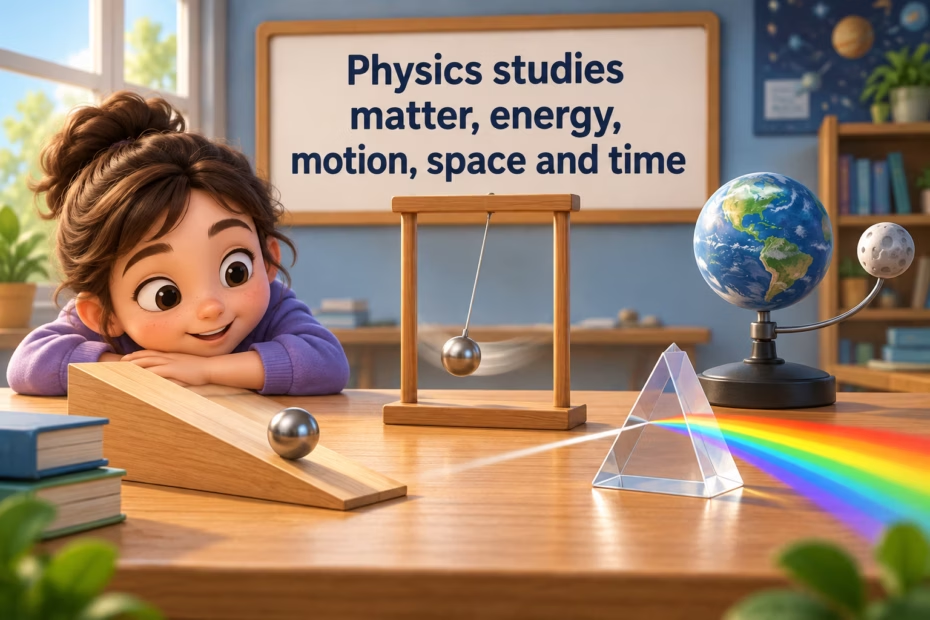
Physics in a sentence usually names the academic field that studies matter, energy, space, time, motion, and their interactions. Because physics names a discipline, it normally takes a singular verb: “Physics explains how a dropped ball accelerates.” Use physics for the field, physical for a property, and physicist for a researcher.
Quick answer: how do you use physics in a sentence?
- Physics is a singular noun naming a science; write “Physics is fascinating,” not “Physics are fascinating.”
- The field studies matter, energy, space, time, motion, and how physical systems interact.
- Use physical before a noun (“physical force”) and physicist for a person who studies physics.
- Use numbers and units together when a sentence reports a measurement: “The cart moved at 0.5 m/s.”
- In Newton’s second law, net force, mass, and acceleration are related by F = ma; the vector form keeps their directions in view.
- Scientific models simplify a system so a question can be tested; a model is not the system itself.

What does physics mean in a sentence?
Physics means the science that investigates matter, energy, space, time, and their interactions. OpenStax describes physics as one of the most fundamental sciences because its principles help explain patterns that also matter in chemistry, biology, engineering, and astronomy. A sentence with the word can define the field, describe a course, or name a concept being studied.
For example, “Physics explains why a satellite stays in orbit” uses the word to identify a field of study. “She is taking physics this semester” describes a class. “The physics of a collision depends on the objects’ motion and forces” points to principles applied to a particular event. These are different contexts, but the noun still names the discipline or its principles.
In ordinary academic use, physics is a mass noun: it does not normally take an indefinite article and does not become plural when several topics are discussed. Say “I study physics” or “The physics is complex.” For multiple branches, write “the branches of physics” or “several physics topics,” rather than “physicss.”
Physics, physical, and physicist: which word fits?
The three related words do different grammatical jobs. Choose the noun physics for the discipline, the adjective physical to describe something connected with the body or material world, and the noun physicist for a scientist who studies physics. They are related in meaning, but they are not interchangeable.
| Word | Part of speech | Use | Example sentence |
|---|---|---|---|
| physics | noun | The academic field or its principles | Physics connects measurements with mathematical models. |
| physical | adjective | Describes a material system, force, property, or activity | The experiment measures a physical change in the spring. |
| physicist | noun | A person whose work or study is in physics | The physicist compared the model with the measured results. |
| physically | adverb | Describes how something occurs in a material or bodily way | The two carts physically touched during the collision. |
Expert tip: “Physical” is broader than “physics-related.” A physical examination concerns the body; a physical quantity such as mass or speed is measured in science. Name the intended sense when the context could be unclear.
How can you write an accurate physics sentence?
A strong physics sentence names what is being studied, states a relation or observation, and includes the conditions that make the statement true. A sentence can remain readable without turning into an equation, but measurements need units and cause-and-effect claims need the right physical quantities.
- Name the object or system. “A 2-kilogram cart” gives the reader a concrete subject; “it” alone can make an explanation hard to follow.
- Choose the physical quantity. State whether the sentence concerns speed, velocity, acceleration, force, mass, energy, or another measured property.
- Use a precise verb. “Accelerated,” “reflected,” “transferred,” and “was measured” say more than “did something.”
- Add a value and unit when available. “The cart traveled 2.0 m in 4.0 s” is measurable; “the cart traveled quickly” is a qualitative description.
- Check the conditions and direction. Say whether friction is ignored, whether a force is net, and which direction matters when the claim depends on those details.
- Compare the sentence with evidence. A model or equation helps organize an explanation, but observations and experiments show whether it fits the situation.
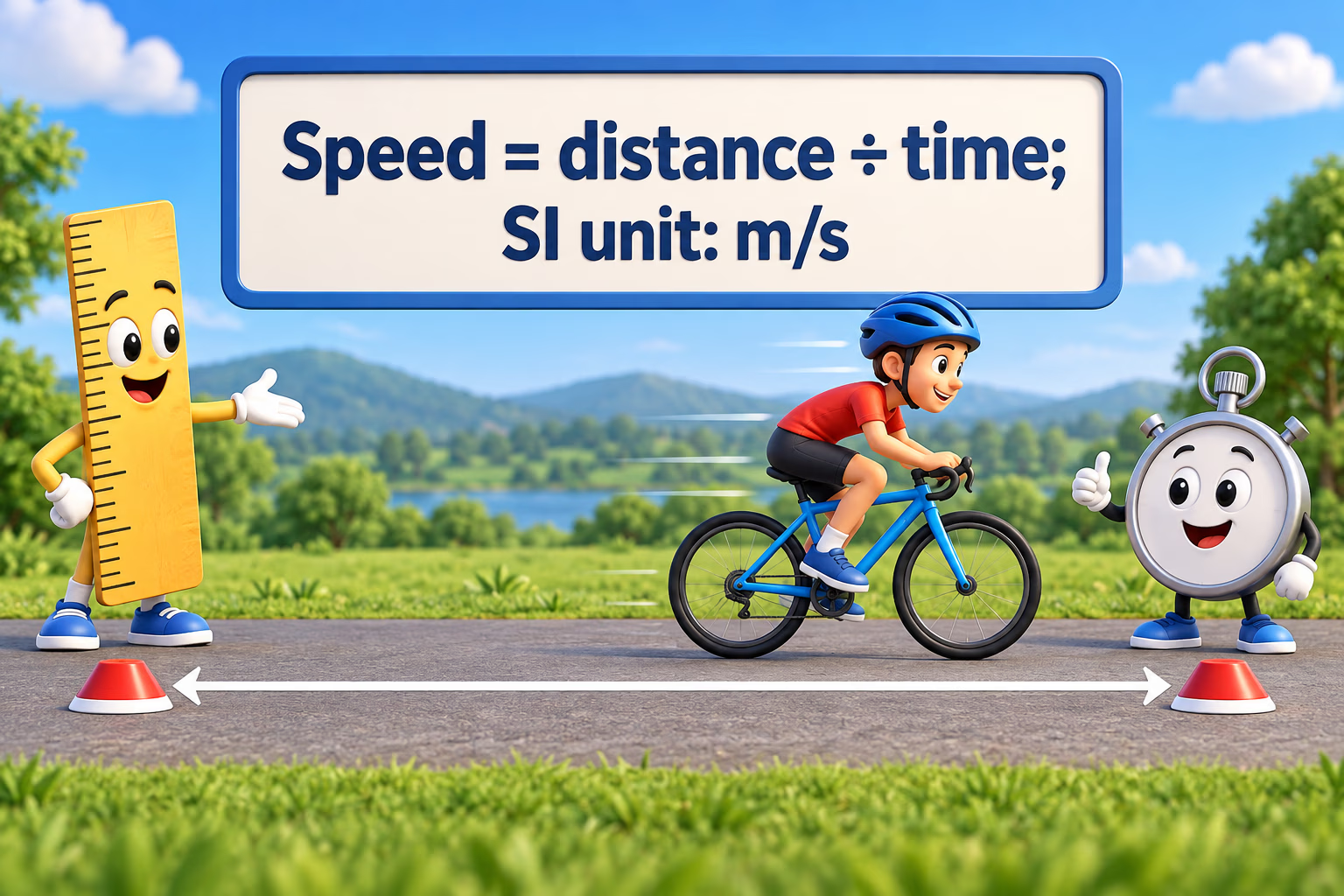
For instance: “The cart traveled 2.0 m in 4.0 s, so its average speed was 0.50 m/s.” The arithmetic is distance divided by elapsed time, and each measurement keeps its unit. In a different example, “A 2 kg cart with a net force of 6 N accelerates at 3 m/s²” follows the relationship between net force, mass, and acceleration.
How do physics terms and units improve sentence examples?
Units make a physics sentence specific enough to check. The International System of Units (SI) includes the meter (m), kilogram (kg), and second (s) among its base units; derived units combine base units. For example, speed uses meters per second (m/s), force uses newtons (N), and energy uses joules (J).
Mass and force are related but different. Mass describes an object’s inertia and is measured in kilograms; force is an interaction that can change motion and is measured in newtons. Therefore, write “the object has a mass of 2 kg” and “the net force is 6 N,” not “the object weighs 2 kg” when you mean mass. Everyday speech often blurs these terms, while a physics sentence benefits from keeping them separate.
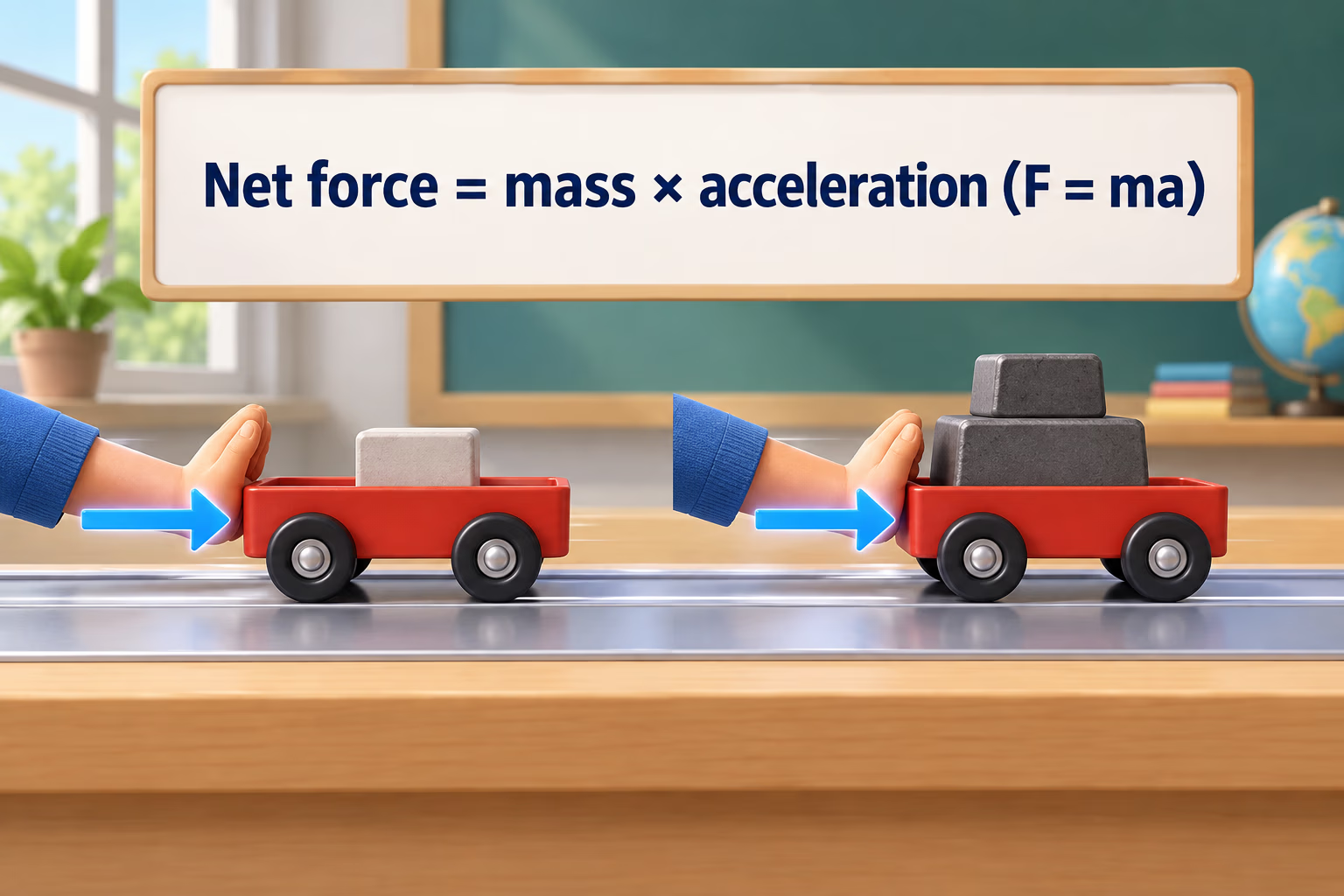
Newton’s second law is often written as Fnet = ma: the net force on an object equals its mass multiplied by its acceleration. The equation applies to the object being analyzed, and acceleration points in the direction of the net force. In more complete vector notation, the direction of each vector matters; the familiar scalar equation is a useful introductory shorthand.
Newton’s third law needs a different sentence pattern: “The rocket pushes exhaust backward, and the exhaust pushes the rocket forward.” The two forces are equal in magnitude and opposite in direction, but they act on different objects. Saying simply “the forces cancel” would be misleading because forces on different objects do not cancel in the free-body diagram of one object.
What measurement details belong in a physics example?
Include the measured quantity, its value, its unit, and the relevant time or conditions. OpenStax emphasizes that measurement results have uncertainty and that accuracy, precision, and significant figures communicate different things. A sentence should not claim more precision than the measuring tool or data support.
For example, “The table is 1.20 m long” communicates a different measurement precision than “The table is about 1 m long.” If repeated trials produce slightly different times, report the measurement procedure or uncertainty instead of pretending every trial gives an identical number. A measured value describes the result; a theoretical prediction describes what a model expects under stated assumptions.
Speed also differs from velocity: speed gives rate of distance traveled, while velocity includes direction of displacement. A runner can complete one lap and finish where they started; the runner’s average speed is positive, but average velocity over that full lap is zero because net displacement is zero. This distinction makes “physics explains the runner’s velocity” more precise only when direction and displacement matter.
Why do physicists use models and experiments?
Physicists use models to represent systems that are too small, distant, fast, slow, or complex to inspect directly. A model can be a diagram, a physical object, a mathematical equation, or a computer simulation. Each model leaves out detail so it can focus on a question; evidence helps determine where the simplification works and where it stops being useful.
For example, a school-level orbit diagram can show that gravity changes a planet’s motion, but a flat sketch does not reproduce every feature of a real solar system. Similarly, a frictionless ramp problem helps isolate energy and motion, even though real ramps have friction. An accurate sentence makes the assumption visible: “In the simplified model, friction is ignored,” rather than claiming that friction does not exist.

OpenStax describes science as a process that can include observation, testable hypotheses, experiments, analysis, and conclusions. This does not mean every research project follows one rigid sequence. It does mean a useful physics claim can be checked against observations or measurements, and explanations can be revised when new evidence exposes a limit.
Common mistakes in sentences about physics
- Using a plural verb with the discipline: write “Physics is a science,” because the name of the field is singular in this construction.
- Leaving out units: “The car traveled at 20” is incomplete; “20 m/s” or “20 km/h” states a speed and its scale.
- Confusing mass and weight: mass is measured in kilograms; weight is a gravitational force, measured in newtons.
- Calling every force “gravity”: gravity is one interaction. Contact forces, friction, tension, and electromagnetic forces also appear in physical systems.
- Using a law as a cause by itself: a law describes a regular relationship; the sentence should still name the interacting system and relevant conditions.
- Treating a model as the real system: say “the model predicts” or “the diagram represents,” not “the model proves” a claim on its own.
Expert tip: A useful sentence often states a result and its scope together: “With air resistance neglected, the model predicts…” That short condition tells the reader when the result may need correction.
Physics in a sentence: examples that teach
The examples below use the word physics naturally while showing a definition, a class, an application, or a research setting. They also model the difference between a broad statement and a claim tied to evidence.
- Physics explains why a moving bicycle slows when its brakes create friction.
- Our physics class measured how far a toy car traveled in five seconds.
- The physicist used a computer model to compare a predicted orbit with observations.
- Physics connects the motion of a dropped ball with the forces acting on it.
- In the experiment, the students recorded mass in kilograms and force in newtons.
- The report describes the physics of sound by comparing vibration frequency and pitch.
These sentences do not need formulas to be scientific. They identify an object, concept, or action in a way that invites a clear follow-up question: Which force? What was measured? Under what conditions? When a number is added, the unit and precision should match the evidence.
Frequently Asked Questions About Physics in a Sentence
Is physics singular or plural?
Physics is singular when it names the academic discipline, so write “Physics is difficult” or “Physics explains motion.” The final -s is part of the word, not a plural ending in this use. To refer to multiple topics, write “physics topics” or “branches of physics,” not “physicss.”
Should I write “physics” with a capital letter?
Use lowercase physics in an ordinary sentence: “I enjoy physics.” Capitalize it at the beginning of a sentence or in an official course title, such as “Physics 101,” when that is the institution’s formal name. Do not capitalize the field throughout a paragraph just because it is a science.
What is the difference between physics and physical science?
Physics is a discipline focused on matter, energy, space, time, and interactions. Physical science is a broader educational label that often includes physics and chemistry and may include Earth or space science, depending on the curriculum. The scope varies by school, so check the course description when the label matters.
How do I include an equation in a sentence?
Name the quantities before or after the equation and explain what the symbols mean. For example: “The net force is 6 N, and the 2 kg cart accelerates at 3 m/s², consistent with Fnet = ma.” Use units, define unfamiliar symbols, and state assumptions such as negligible friction.
Does every physics sentence need a formula?
No. A clear qualitative sentence can describe an observation, such as “The magnet pulled the iron clip closer.” A formula is useful when the relationship is central to the explanation or a value is calculated. The sentence should stay understandable and should not imply that an equation alone proves a claim.
Further reading
- OpenStax: Physics—Definitions and Applications
- OpenStax: Scientific Methods and Models
- OpenStax: Physical Quantities and SI Units
- NASA Glenn: Newton’s Laws of Motion
- NIST: Defining the International System of Units
Conclusion: write a clear physics sentence
Physics in a sentence can define the field, describe a class, or explain a measurable interaction. Keep the noun singular, distinguish it from physical and physicist, attach units to measurements, and state the assumptions behind a model. Precise examples make the science easier to understand and easier to verify.
Original 21 physics sentence examples
Physics is the branch of science that deals with the study of matter, energy, motion, and the interactions between them. It seeks to understand the fundamental principles that govern the universe and how objects behave in various conditions.
In physics, researchers explore the laws and theories that explain the natural world, from the behavior of particles at the atomic level to the movements of galaxies in outer space. By conducting experiments, analyzing data, and developing mathematical models, physicists are able to provide insights into the workings of the physical world.
7 Examples Of Physics Used In a Sentence For Kids
- Physics helps us understand how things move.
- We can learn about light and sound in physics.
- Physics teaches us about different forces.
- We can do fun experiments in physics class.
- Learning physics can be exciting and interesting.
- Physics helps us learn about the world around us.
- We can explore the laws of nature through physics.
14 Sentences with Physics Examples
- Students majoring in physics need to have a strong foundation in mathematics.
- Understanding the principles of physics is essential for engineering students.
- The laboratory experiments in physics help students apply theoretical concepts to real-world scenarios.
- Physics students often collaborate on projects and research papers to deepen their understanding of the subject.
- The study of physics requires critical thinking skills and problem-solving abilities.
- Professors in the physics department conduct regular seminars and workshops to keep students updated on the latest research.
- Physics textbooks provide valuable resources for students to delve deeper into specific topics.
- Graduate students in physics are often involved in cutting-edge research that pushes the boundaries of scientific knowledge.
- Advanced courses in physics cover topics such as quantum mechanics and astrophysics.
- Physics students can take electives in related fields like astronomy or geophysics to broaden their knowledge base.
- The study of physics can lead to a variety of career options, including research, teaching, and technology development.
- Many colleges offer scholarships and grants for physics students pursuing further studies.
- Physics students can participate in national and international conferences to present their research findings.
- Student organizations like the Physics Club provide a platform for like-minded individuals to engage in academic discussions and extracurricular activities.
How To Use Physics in Sentences?
Physics is the study of nature and how objects interact with one another. When writing a sentence using physics, it is important to remember to incorporate scientific principles accurately. Begin by selecting a concept from physics that you want to describe in your sentence, such as motion, energy, or force.
Next, ensure that your sentence includes a clear subject, verb, and object. For example, “The ball (subject) fell (verb) due to gravity (object).” This sentence demonstrates the concept of gravity, a fundamental principle in physics.
It is also crucial to use the appropriate units of measurement when necessary. For instance, instead of saying “The car is moving fast,” you could say “The car is traveling at 30 meters per second.” This provides a specific measurement of the car’s speed, which adds precision to your sentence.
Additionally, consider using scientific notation or formulas in your sentence to convey complex physics concepts. For example, “The force (subject) applied to the object (object) can be calculated using F=ma (formula).” This sentence introduces the formula for calculating force in a clear and concise manner.
By following these guidelines, you can effectively incorporate physics terminology and principles into your sentences with accuracy and clarity.
Conclusion
In conclusion, exploring sentences with physics showcases the wide range of applications and concepts within the field. From describing the laws of motion to discussing the principles of energy and gravity, these sentences illustrate how physics permeates various aspects of our daily lives. Understanding such sentences not only deepens our comprehension of the natural world but also highlights the fundamental role that physics plays in shaping our technological advancements and scientific discoveries.
By delving into sentences with physics, we gain insight into the profound influence this scientific discipline has on our understanding of the universe. Whether we are pondering the behavior of subatomic particles or marveling at the wonders of the cosmos, physics continues to push the boundaries of human knowledge and exploration. Through the lens of these sentences, we appreciate the beauty and complexity of the laws that govern the physical world, inspiring us to further investigate and appreciate the intricacies of the universe around us.


