Platitude means a remark that is true but so familiar and overused that it adds nothing. To use platitude in a sentence, name the empty saying and often the moment it fails to meet: “The speech was a string of platitudes about hard work.” The noun is countable and usually appears in critical writing.
Platitude at a glance
- Platitude is a countable noun; its plural is platitudes and its adjective is platitudinous.
- It names a true but worn remark that informs nobody.
- The usual verbs are utter, repeat, mouth and recite; the usual pattern is a string of platitudes.
- Platitude belongs to criticism, commentary and formal complaint rather than neutral description.
- The commonest error is treating platitude as a synonym for lie, when the remark is usually true.
What does platitude mean?
Platitude is a countable noun meaning a remark that is true but so overused and obvious that it carries no weight. The Cambridge entry for platitude records this sense, and the sting is in the word worn rather than false. A maxim can sound like wisdom; a platitude sounds like a greeting card.
| Sense | Plain meaning | Example sentence |
|---|---|---|
| Worn saying | An overused remark that sounds empty | Everything happens for a reason is a platitude. |
| Moral commonplace | A safe, conventional judgement | The speech was a string of platitudes. |
| Dull remark | A statement so obvious it informs nobody | He answered with a platitude about hard work. |
One limitation is worth stating plainly. A platitude is not a lie, and pointing one out can wound. The remark is usually true, and the speaker may mean it sincerely, so calling a condolence a platitude to the speaker’s face is an insult even when the description is accurate.
How do you use platitude in a sentence?
Make the empty remark the subject or the object, and put the speaker or the speech nearby. The noun is countable, so it needs an article or a plural.
| Pattern | Example | What it signals |
|---|---|---|
| platitude as subject | The platitude fooled nobody. | Names the empty remark directly. |
| utter or repeat + a platitude | The coach recited a platitude about effort. | Common verbs are utter, repeat, mouth and recite. |
| a string of platitudes | The speech was a string of platitudes. | The plural names a run of empty sayings. |
| platitude about + topic | He offered a platitude about teamwork. | Names the topic the empty remark covers. |
Platitude in a sentence: examples across contexts
Platitude changes force more than meaning. Where the point is the dullness itself, banality names the quality, but platitude names the single remark that shows it.
| Context | Example sentence | Why this works |
|---|---|---|
| Classroom | The essay opened with a platitude instead of an argument. | Criticism of student writing is a natural setting. |
| Workplace email | We need figures, not another platitude about teamwork. | Contrasts an empty remark with the evidence wanted. |
| News report | The mayor answered questions with a platitude about change. | Reporting evasive speech is a common use. |
| Political commentary | The manifesto was a collection of platitudes. | The plural signals a whole document of empty lines. |
| Literary criticism | The novel avoids platitudes by letting its characters disagree. | Praise by contrast is a reliable critical move. |
| Academic prose | A platitude in the abstract weakens the whole paper. | Formal writing warns against the fault. |
| Everyday conversation | He greeted the bad news with a platitude about silver linings. | Even in speech the word judges the remark as hollow. |
| Review writing | The film trades insight for platitudes about family. | Names the substitute the work reached for. |
Platitude vs truism
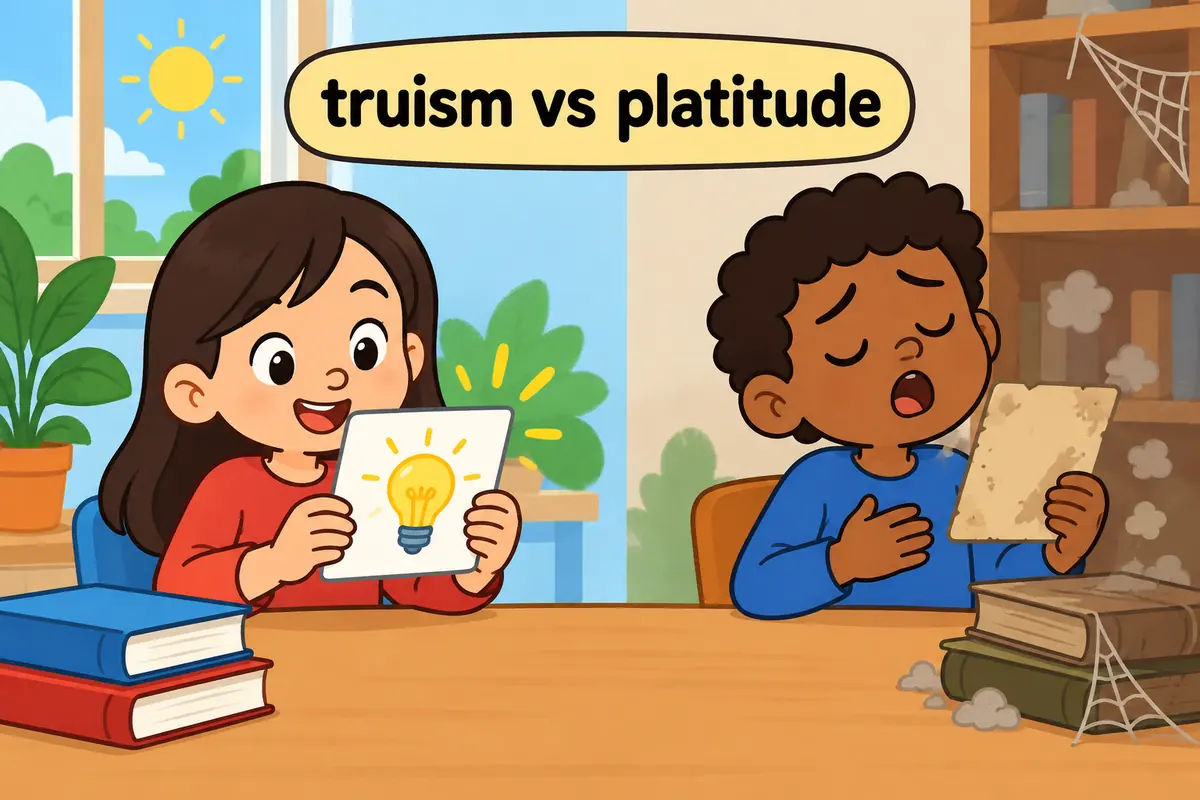
Platitude and truism are close, and the difference is usefulness. Both statements are true, but a truism can still carry weight the first time it is said, while a platitude has been said so often that the weight is gone.
| Attribute | platitude | truism |
|---|---|---|
| Truth value | True | True |
| Core fault | Worn and empty from overuse | Obvious, but not necessarily worn |
| Typical context | Speeches, condolences and slogans | Logic, argument and plain statement |
| Tone when used | Usually critical | Often neutral or explanatory |
| Effect on a reader | A sigh | A nod |
Verdict: use truism for an obvious truth that may still inform, and platitude when the truth has been repeated so often that only the emptiness is left.
Word forms and grammar of platitude
| Form | Part of speech | Example |
|---|---|---|
| platitude | noun, singular | That remark is a platitude. |
| platitudes | noun, plural | The speech was full of platitudes. |
| platitudinous | adjective | A platitudinous opening bored the panel. |
| platitudinously | adverb, rare | He spoke platitudinously about the future. |
| platitudinize | verb, rare | Politicians platitudinize when pressed. |
| platitudinarian | noun, rare | The critic called him a platitudinarian. |
The adjective platitudinous describes a speech made of nothing else, and it is far more common than the rare verb platitudinize.
A hackneyed phrase repeated often enough becomes a platitude, which is why the two words so often appear together.
Common mistakes with platitude
- Incorrect:
The report was full of platitudes, which were all untrue.Correct: The report was full of platitudes, which were all obvious. Rule: A platitude is true but worn; a false statement is not a platitude. - Incorrect:
He said a platitude.Correct: He uttered a platitude. Rule: Platitude is a noun, not a verb; use utter, repeat or recite. - Incorrect:
She platitudes about the weather.Correct: She offered a platitude about the weather. Rule: The noun needs a verb and an article, since it is countable. - Incorrect:
The platitude was insightful and fresh.Correct: The platitude was tired and familiar. Rule: A fresh, insightful remark cannot be a platitude by definition.
Practice using platitude
Work through the six items, then check the reasoning rather than only the answer.
- Fill the gap: The farewell card was full of ______ about following your dreams.
- Choose the better word: The book kept repeating (platitudes / details) about patience.
- Correct the error: His answer was a platitude that turned out to be false.
- Build a sentence: use a string of platitudes about a dull speech.
- Spot the register: which belongs in a film review — the script trades insight for platitudes, or the script says some really obvious stuff?
- Rewrite with the adjective: The speech was full of platitudes. Use platitudinous instead.
Answers
- platitudes — the plural fits a card repeating worn sayings about dreams.
- platitudes — the criticism is that the sayings are worn, not that they lack detail.
- His answer was a cliche that turned out to be false — a platitude is true, so the wrong word was the label.
- Model answer: The guest speaker delivered a string of platitudes and sat down to thin applause.
- The script trades insight for platitudes — a review is formal and avoids really obvious stuff.
- The speech was platitudinous — the adjective replaces the whole noun phrase.
The bottom line
Use platitude in a sentence when a remark is true but so worn that it informs nobody, and make the remark the subject or object. Two nuances decide most cases: the noun is countable, so it needs an article or a plural, and the fault is emptiness rather than falsehood. Where an obvious truth still carries weight, truism is the fairer word.
Frequently asked questions about platitude
Is platitude an insult?
Calling a remark a platitude is usually criticism, because it says the words are worn and add nothing. The speaker may still have meant well, so the word judges the saying rather than the person. Delivered to someone’s face, it lands as a put-down even when it is accurate.
What is the adjective form of platitude?
The adjective is platitudinous, meaning made of worn, empty sayings. A platitudinous speech is one long string of platitudes. The adverb platitudinously and the rare verb platitudinize also exist, but the adjective is the form you will meet most often outside a dictionary.
Is a platitude always false?
No, and this is the point most learners miss. A platitude is normally true, which is why it spread in the first place. Its fault is that repetition has drained it of force, so it informs nobody. A false statement is a lie or an error, never a platitude.
What is an example of a platitude?
Common examples include everything happens for a reason, time heals all wounds, and just be yourself. Each is true in a broad way, yet so familiar that it adds nothing to a difficult moment. That combination of truth and emptiness is what makes a phrase a platitude.
Are you tired of cliché and overused expressions in your writing? Enter the world of Platitudes. A platitude is a trite or banal statement that lacks originality or depth, often conveying obvious or predictable ideas.
In writing, platitudes can weaken the impact of your message and make your work seem uninspired. By recognizing and avoiding these common phrases, you can elevate the quality of your writing and create more engaging content.
7 Examples Of Platitude Used In a Sentence For Kids
- Platitude means a phrase that is used so often that it has lost its original meaning.
- Sometimes people say platitudes to try to be comforting, even though they may not always help.
- It is important to try to think of new ways to express our feelings instead of relying on platitudes.
- When someone is feeling sad, it is best to offer them a hug or a listening ear rather than a platitude.
- Saying a platitude like “everything happens for a reason” may not always make someone feel better.
- It is okay to not always know what to say, rather than resorting to platitudes.
- Using platitudes may sometimes make people feel like their emotions are not being truly understood.
14 Sentences with Platitude Examples
- Platitude is not enough to ace your exams, you need to put in sincere effort.
- Attending lectures without actively participating is simply indulging in platitudes.
- Don’t get stuck in the platitude of “I will start studying tomorrow”, start now.
- It’s important to move beyond platitudes and actually apply the knowledge you gain.
- Engaging in deep discussions with peers can help you move away from platitudes in your understanding.
- Simply memorizing platitudes won’t help you in building a strong academic foundation.
- Reflecting on your study habits can help you identify and overcome platitudes.
- Constantly pushing yourself out of your comfort zone is essential to avoid falling into platitudes.
- Joining study groups can help you gain new perspectives and break away from platitudes.
- Setting realistic goals and working consistently towards them is key to combating platitudes.
- Exploring different study techniques can help you break away from the platitude of one-size-fits-all methods.
- Striving for excellence rather than settling for platitudes can lead to significant growth.
- Actively seeking feedback from professors can help you avoid falling into platitudes in your assignments.
- Embracing challenges and setbacks instead of succumbing to platitudes is a mark of a resilient student.
How To Use Platitude in Sentences?
To use Platitude in a sentence, start by identifying a cliche or a general statement that lacks originality or depth. Then, incorporate the word Platitude into your sentence to emphasize that the statement is unoriginal or oversimplified. For example, “His speech was full of empty platitudes that failed to inspire the audience.”
Alternatively, you can use Platitude to describe a common saying or idea that is overused and lacks meaning. For instance, “She dismissed his apology as a mere platitude, as she had heard the same excuses before.”
When using Platitude in a sentence, make sure to provide context so that the meaning is clear to your audience. It is important to demonstrate through your sentence that the idea being expressed is shallow or hackneyed.
Remember that Platitude conveys a sense of shallowness and insincerity, so use it in situations where you want to highlight the lack of original thought or genuine feeling in a statement.
In summary, to use Platitude effectively in a sentence, identify a cliched or simplistic statement and incorporate the word to emphasize its lack of depth or originality.
Conclusion
In conclusion, a platitude is a statement that sounds wise or meaningful but lacks originality or depth. These cliché phrases are often used to convey an idea without thought or nuance, resulting in trite or unoriginal expressions. While platitude may offer temporary comfort or familiarity, they ultimately lack the power to truly inspire or provoke thought.
To avoid falling into the trap of using platitudes, it is important to strive for genuine and original expressions when communicating ideas or feelings. By seeking out fresh perspectives and authentic language, we can engage others more effectively and convey our thoughts with greater impact and sincerity.


