Have you ever come across a sentence that begins with “please note”? This phrase is often used to draw attention to important information or instructions. In writing, it serves as a signal to the reader to pay close attention to the following statement.
“Please note” is a useful tool for emphasizing key points or providing additional context in a text. It can help guide the reader’s focus and ensure they do not miss crucial details. By incorporating this phrase, writers can effectively highlight important information and improve clarity in their communication.
7 Examples Of Please Note Used In a Sentence For Kids
Please note that the sun rises in the east every morning.
Please note that cows give us milk which is good for our health.
Please note that we should always say “thank you” when someone helps us.
Please note that we must wash our hands before eating food.
Please note that we should always share our toys with our friends.
Please note that we must brush our teeth before going to bed.
Please note that we should always listen to our teachers in school.
14 Sentences with Please Note Examples
- Please note that the final exam schedule has been updated on the college website.
- Please note that all students must submit their assignment online by the deadline.
- Please note that the library will be closed for renovations next week.
- Please note that there will be a guest lecture by a renowned professor next Friday.
- Please note that the deadline for fee payments has been extended by one week.
- Please note that the cafeteria will have extended hours during the exam week.
- Please note that the college bus timings have been revised for the upcoming semester.
- Please note that the career counseling session has been rescheduled to next month.
- Please note that the dress code for the upcoming college event is formal.
- Please note that attendance is mandatory for all guest lectures organized by the college.
- Please note that the college will remain closed on the upcoming public holiday.
- Please note that the annual sports meet has been postponed to a later date.
- Please note that the college has introduced a new online portal for course registrations.
- Please note that the college canteen will be offering special discounts during the festive season.
How To Use Please Note in Sentences?
Please Note is used to draw attention to important information or instructions in a sentence. It is often placed before the key details to make sure they are noticed by the reader.
To use Please Note in a sentence, first, identify the crucial point that you want to emphasize. This could be a specific requirement, a significant detail, or an important reminder. For example, ” Please Note that the deadline for submitting your project is next Friday.”
Next, place Please Note at the beginning of the sentence to signal to the reader that what follows is essential. This helps to highlight the information and ensure that it is not overlooked. For instance, ” Please Note that all attendees are required to bring a valid form of identification to the event.”
Remember to use proper punctuation after Please Note, such as a comma, colon, or period, depending on the structure of your sentence. This will help to ensure that your message is clear and easy to understand. For example, ” Please Note: there is a change in the meeting venue.”
In summary, Please Note is a useful tool for drawing attention to important details in a sentence. By following these simple steps, you can effectively communicate key information and ensure that your message is noticed and understood by your audience.
Conclusion
In conclusion, “please note” is a useful phrase to draw attention to important information or instructions in written communication. It is commonly used to highlight key points or requests that need to be remembered or followed. By incorporating this phrase into sentences, the writer can effectively emphasize details that may be crucial for the reader’s understanding or compliance.
When crafting sentences with “please note,” it is important to be clear and concise to ensure the message is easily discernible. By utilizing this phrase appropriately, writers can enhance the clarity and impact of their communications, making it easier for the audience to grasp and act upon the highlighted information.

What does “please note” mean?
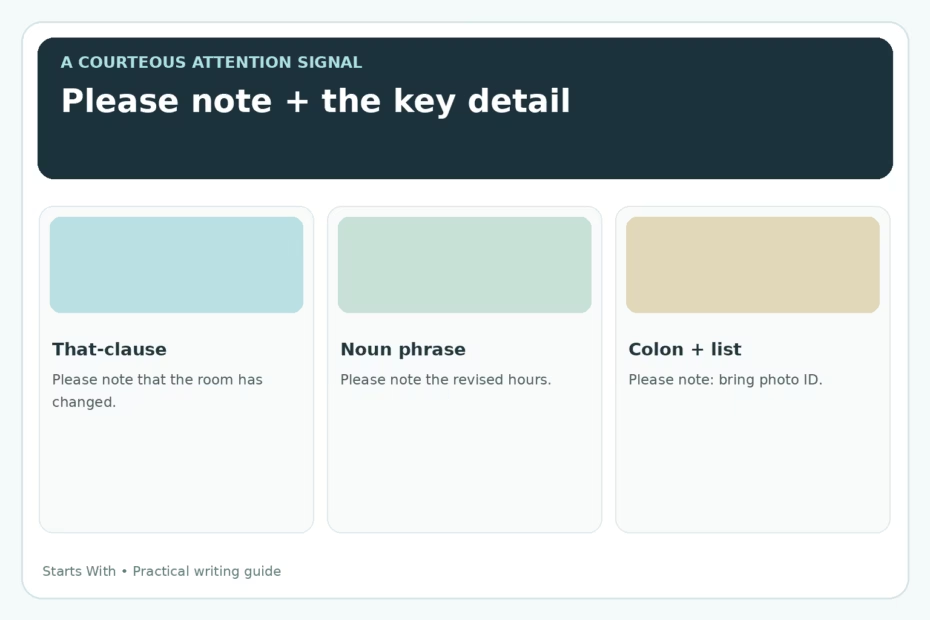
Please note is a polite instruction asking a reader to pay attention to information that follows. Here, note is an imperative verb: the understood subject is “you,” the reader. The verb can take a that-clause (“Please note that the room is closed”), or a noun phrase (“Please note the change”). Cambridge Dictionary records both this pattern and examples such as “Please note that we will be closed on Saturday” (Cambridge Dictionary, “note”). The wording marks something for attention; by itself, it does not prove that the information is unusually important or urgent.
How do you punctuate “please note”?
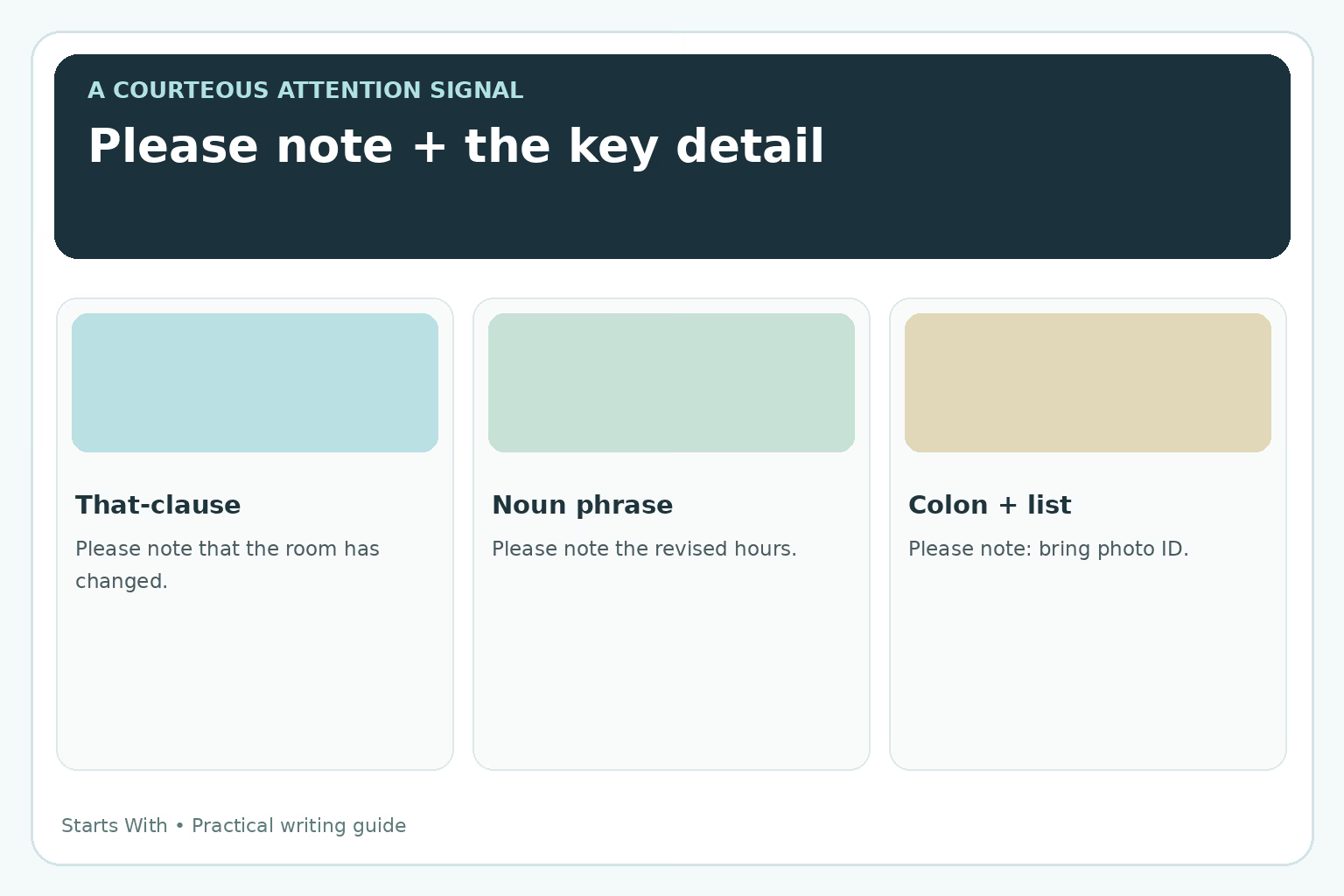
In the common pattern Please note that…, do not insert a comma between note and that: the that-clause completes the verb’s meaning. The same is true when a noun phrase follows directly: “Please note the revised opening hours.” Capitalize Please when it begins a sentence, and use lowercase in the middle of one: “The email says, ‘please note that the deadline changed.’”
A colon can introduce a list, label, or explanation after a complete lead-in: “Please note: the east entrance is closed.” A comma may appear when a writer treats please note as a brief introductory aside before a full clause (“Please note, the east entrance is closed”), but this punctuation is less consistent and can make the grammar harder to parse. For straightforward prose, prefer the clear please note that… construction or use a colon before a short announcement. Follow the style rules for the document if they specify a form.
When is “please note” appropriate?
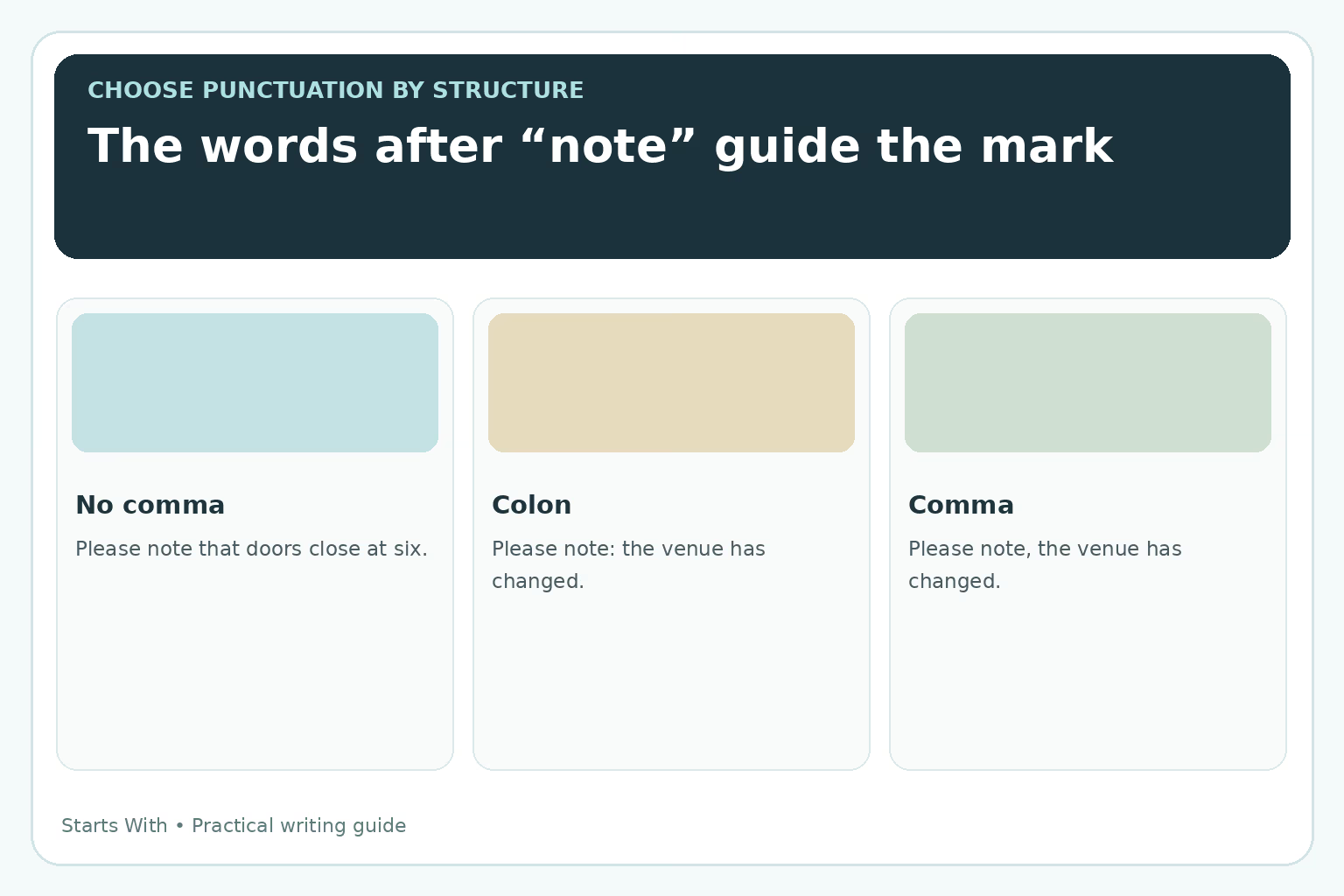
Use the phrase when a reader may overlook a practical detail, such as a deadline, changed location, eligibility rule, exception, or required next step. It often suits notices, instructions, policies, and business messages. The word please softens an imperative, but the sentence still directs the reader’s attention. Cambridge’s grammar guide explains that please can make an imperative sound less direct (Cambridge Grammar, “Imperative clauses”).
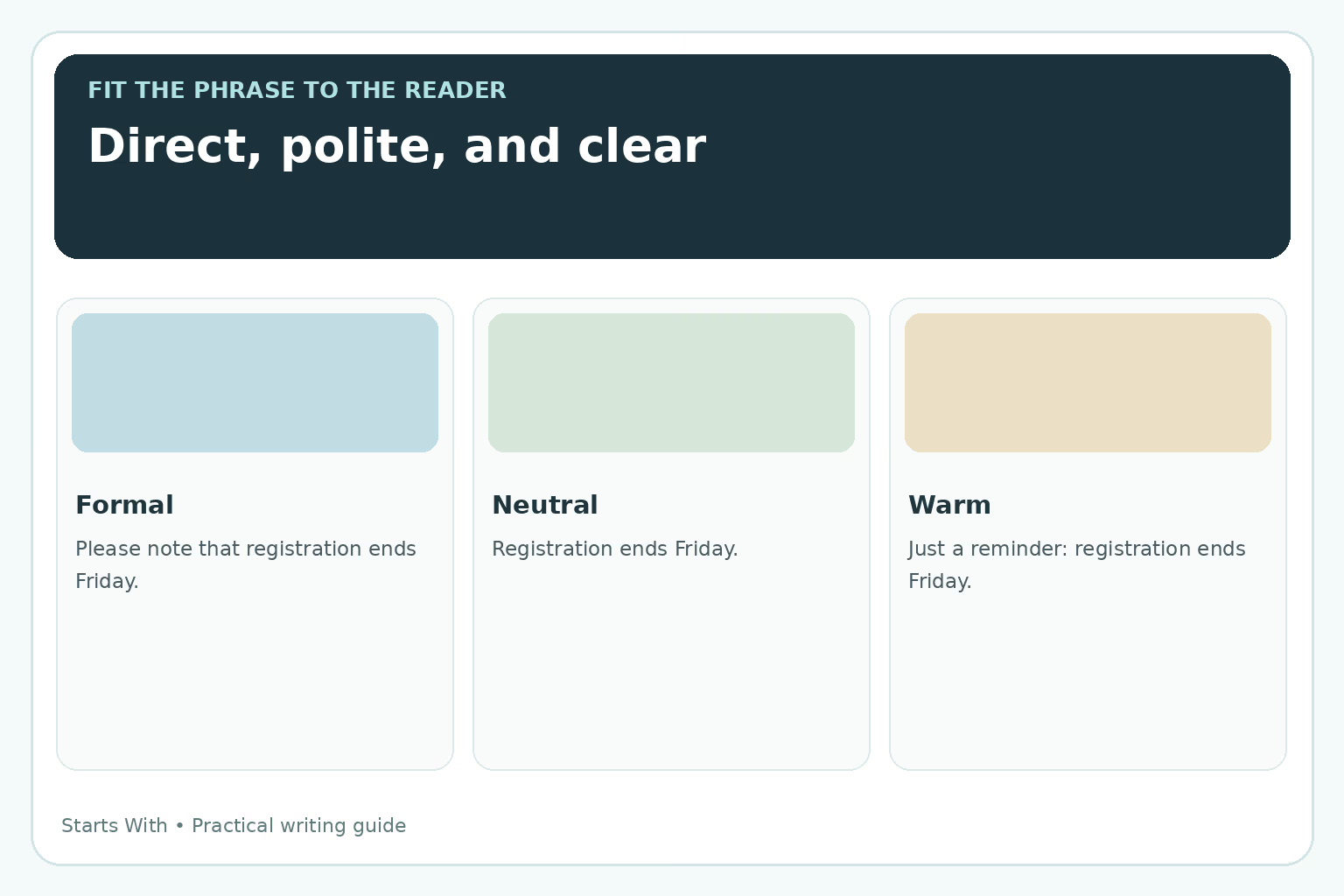
Consider the reader and the relationship. A short service notice can say, “Please note that the office closes at noon on Friday.” In a friendly reminder, “Just a reminder: the office closes at noon Friday” may sound more conversational. In an urgent safety instruction, state the action plainly rather than relying on an attention phrase: “Leave the building by the north exit now.” Purdue OWL recommends choosing tone for purpose and audience, and using emphasis with care so it remains meaningful (Purdue OWL, “Tone in Business Writing”).
Because repeated attention signals lose force, use please note selectively. If every paragraph begins with it, readers cannot tell which details deserve extra attention. Put the key information near the beginning, use concrete wording, and say what the reader should do and by when.
Clear alternatives to “please note”
You can often make a notice shorter by leading with the information itself. Choose an alternative that preserves the intended level of politeness and urgency:
- For a reminder: “A reminder: applications close on 30 June.”
- For a direct update: “The meeting has moved to Room 204.”
- For an action: “Please submit the signed form by Friday.”
- For a formal notice: “Be advised that the policy takes effect on 1 October.” This is formal and may sound stern.
- For an important exception: “Important: the west entrance is not accessible after 6 p.m.”
- For a softer message: “Just so you know, the schedule has changed.” This is conversational and may not suit a formal policy.
Do not swap phrases mechanically. Be aware can sound like a warning; kindly note may feel formal or stiff in some settings; and remember can imply that the reader has forgotten. A direct sentence is usually clearest when no special emphasis is needed.
Examples of “please note” in different situations
- Schedule: Please note that the first train leaves at 6:40 a.m. on Sundays.
- Deadline: Please note that completed applications must arrive by 30 June.
- Location: Please note the workshop will meet in the east wing, Room 12.
- Exception: Please note that the museum is closed on public holidays.
- Requirement: Please note that visitors must show photo identification at reception.
- Change: Please note that the return desk has moved beside the main entrance.
- Price: Please note that the listed fee does not include delivery.
- Availability: Please note that the blue model is temporarily out of stock.
- Instruction: Please note the serial number before contacting technical support.
- Meeting: Please note that the agenda has been shortened to allow time for questions.
- Travel: Please note that platform numbers may change; check the station display before boarding.
- School: Please note that permission forms are due in the office by Thursday.
How to make a “please note” sentence useful
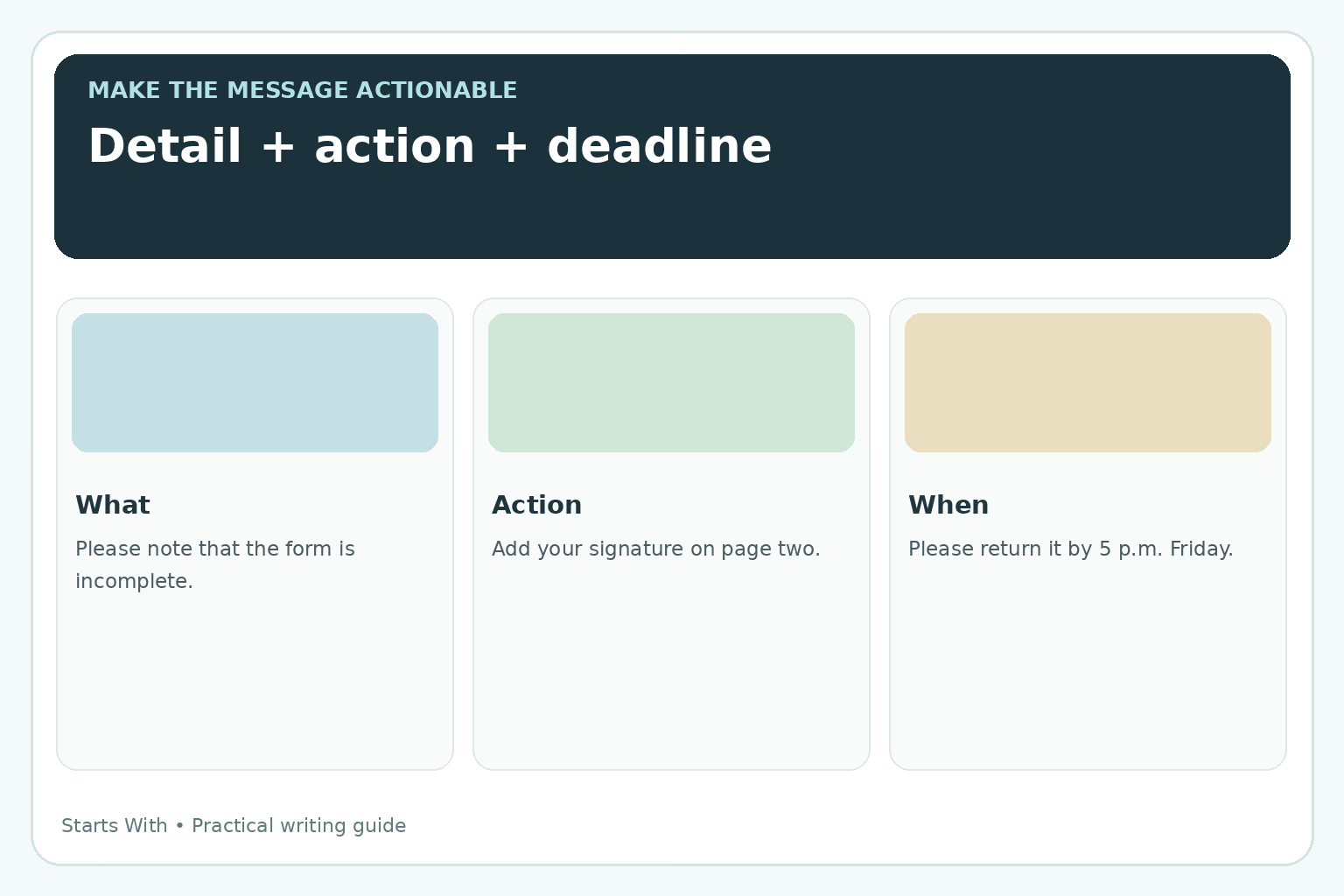
Give the reader the fact first, then add the action or consequence. Compare “Please note that there is a new policy” with “Please note that the new return policy begins on 1 July; items bought before that date follow the previous policy.” The second version names the policy, gives its effective date, and explains an exception. Keep the sentence proportionate: do not bury a simple reminder in a paragraph of background.
For instructions, specify who needs to act, what to do, and the deadline or location. “Please note that forms are due soon” leaves the key detail unclear. “Please note that staff must submit the travel form to Finance by 4 p.m. on 12 May” is actionable. If the information affects access, safety, cost, or eligibility, state the relevant limit directly and make the next step easy to find.
Frequently asked questions
Should there be a comma after “please note”?
Usually not in “Please note that the room has changed” or “Please note the new room number.” A colon is a clear option before a short announcement or list. Some writers use a comma when please note functions as a parenthetical opening, but the that-clause pattern avoids uncertainty.
Is “please note” polite?
It is generally courteous and formal, but it remains a directive. Its effect depends on context, repetition, and what follows. A specific, helpful notice sounds more considerate than a vague command to “please note” an unspecified point.
Is “please note” formal?
It is common in formal notices and workplace writing, and it can also appear in everyday messages. For a casual note, “Just a reminder” or a direct sentence may sound more natural.
Can a sentence start with “Please note that”?
Yes. It is a complete imperative clause with an understood subject (“you”) and a that-clause supplying the information to notice: “Please note that the library closes early today.”
What is another way to say “please note”?
Depending on the purpose, try “A reminder,” “Please remember,” “For your information,” or a direct statement such as “The office closes at noon.” Pick wording that fits the audience and makes the important fact clear.


