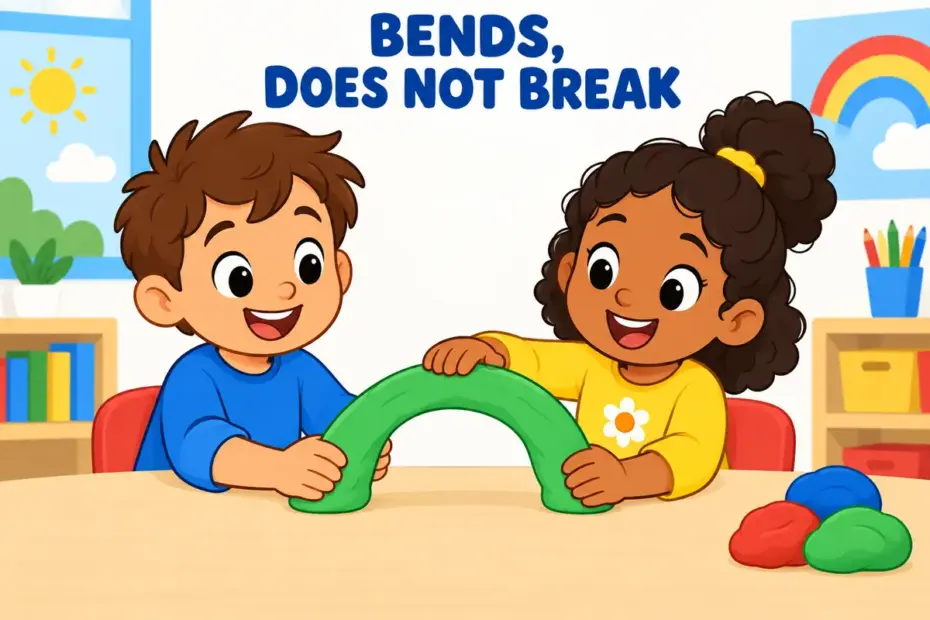
Pliable describes a material that bends easily without breaking, or a person who gives way readily to influence. To use pliable in a sentence, place it before the noun it describes, as in a pliable sheet of copper. The adjective needs a noun or a linking verb beside it, never an object.
Pliable at a glance
- Pliable is an adjective; its noun is pliability, and its near-doublet is the adjective pliant.
- The dominant pattern is pliable + noun: a pliable material, a pliable mind.
- The material sense is neutral; the personal sense usually hints that someone can be led.
- Common collocations are pliable clay, pliable leather, a pliable teenager and a pliable majority.
- The commonest learner error is swapping pliable for elastic, which springs back rather than staying bent.
What does pliable mean?
Pliable is an adjective meaning easily bent or shaped without breaking, and, of a person or system, easily influenced or persuaded. The Cambridge entry for pliable keeps those two senses side by side, and they behave differently: a pliable material is a fact of physics, while a pliable person is a judgement about willpower. Where the point is only that something can be reshaped, malleable is the closer word, because malleable stresses shaping under pressure rather than bending.
| Sense | Plain meaning | Example sentence |
|---|---|---|
| Physical | Bends or folds without cracking | Warm wax stays pliable in a child’s hands. |
| Personal | Easily influenced or persuaded | An inexperienced board proved pliable to the chair. |
| Systemic | Able to absorb change without breaking | The timetable is pliable enough for late arrivals. |
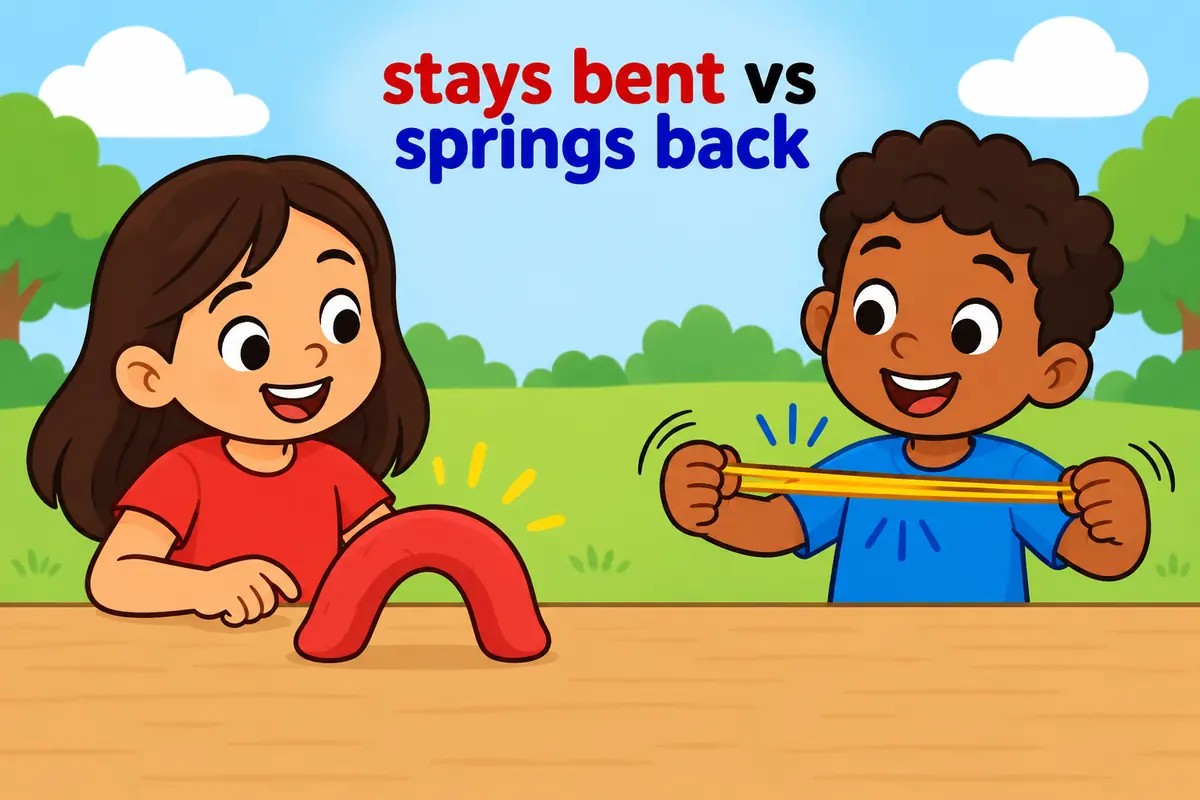
One honest limit: pliable says nothing about strength and nothing about recovery. A pliable branch yields under pressure and then stays where it was bent, while an elastic one returns to its old shape. Calling a colleague pliable rarely flatters, because it implies that other people can bend them at will.
How do you use pliable in a sentence?
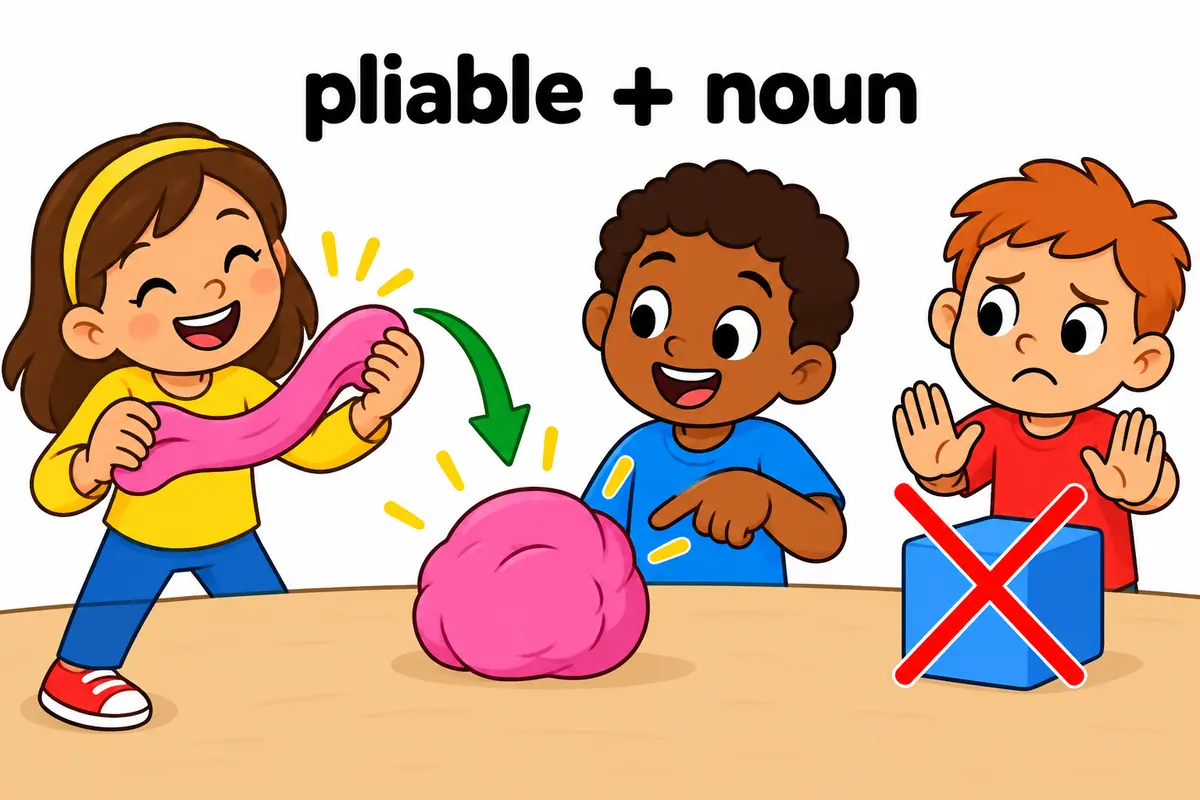
Pliable fills only two slots: it describes a noun directly, or it follows a linking verb such as be, feel, seem or become. It never takes a direct object, and it is not used as a verb.
| Pattern | Example | What it signals |
|---|---|---|
| pliable + noun | The pliable wire bent around the post. | An inherent quality of the thing named. |
| linking verb + pliable | The new garden hose felt pliable. | How something seemed when handled. |
| make + object + pliable | Warm the clay to make it pliable. | A caused change of state. |
| too / very + pliable | The committee proved too pliable. | Degree, usually as a criticism. |
| pliable + in | The rules are pliable in practice. | Where the flexibility shows itself. |
Pliable in a sentence: examples across contexts
Each row below puts pliable in a different register, from a science note to a political aside, with the reason the word fits.
| Context | Example sentence | Why this works |
|---|---|---|
| Classroom | The art teacher handed every child a pliable lump of clay. | The physical sense is concrete and easy to picture. |
| Workplace email | We need a pliable schedule that can absorb late changes. | Extends the word to a plan, not a person. |
| Science writing | The alloy stays pliable below forty degrees Celsius. | A measurable condition gives the claim precision. |
| Parenting | A pliable toddler will follow whichever adult is nearest. | The personal sense without open disapproval. |
| News report | Critics called the regulator too pliable to industry pressure. | too pliable is the standard form of the criticism. |
| Product review | The sole is pliable enough to fold into a suitcase. | Couples the adjective with a practical test. |
| Conversation | My grandmother’s hands are still surprisingly pliable. | The literal sense in a warm, personal frame. |
| History essay | The senate proved pliable in the emperor’s hands. | Links the word to the exercise of power. |
Pliable vs flexible
Flexible is the word readers reach for when they mean pliable, yet the two lean in different directions. Pliable is about yielding; flexible is about adapting. The table separates them.
| Attribute | Pliable | Flexible |
|---|---|---|
| Core meaning | Bends under pressure | Can be adapted or bent |
| What it stresses | Yielding to force | Adjusting to circumstances |
| Material use | pliable leather, pliable clay | flexible tubing, flexible screen |
| Personal use | Suggests someone easily led | Suggests someone open to change |
| Connotation | Often mildly negative | Usually positive |
| What it implies | Lack of a firm shape or will | Willingness to adapt |
Use flexible for plans, systems and people who adapt by choice, and reserve pliable for things that bend and for people who bend too easily. A rubber band is elastic, because it springs back to its original shape, which is the one thing pliable never promises.
Word forms and grammar of pliable
| Form | Part of speech | Example |
|---|---|---|
| pliable | adjective (base) | The putty is pliable straight from the tin. |
| more pliable / most pliable | comparative, superlative | Silk is more pliable than linen. |
| pliability | noun | Pliability makes the material easy to weave. |
| pliant | adjective (near-doublet) | A pliant reed bent without snapping. |
| pliably | adverb (rare) | The wire coiled pliably around the post. |
Its near-doublet pliant carries the same bendable sense with a slightly softer tone, and the two are freely interchangeable in material descriptions.
Common mistakes with pliable
- Incorrect:
The rubber band is very pliable.Correct: The rubber band is very elastic. Rubber returns to its shape, and that springing back is elasticity, not pliability. - Incorrect:
The dough was so pliable that it snapped.Correct: The dough was so pliable that it stretched. Snapping is brittleness, the opposite of bending without breaking. - Incorrect:
She showed great pliable under pressure.Correct: She showed great pliability under pressure. The noun form is pliability; pliable is only the adjective. - Incorrect:
Our pliable neighbour greets everyone.Correct: Our amiable neighbour greets everyone. The adjective amiable means friendly and shares only a sound with pliable. - Incorrect:
They approved a pliable business plan.Correct: They approved a viable business plan. Viable means able to succeed; pliable means able to bend.
Practice using pliable
Try each item before checking the answers below.
- Fill in the blank: She warmed the beeswax until it became ______.
- Choose the better word: The gymnast is remarkably (pliable / limber).
- Correct the error: The committee proved too pliable, so it survived every budget cut.
- Build a sentence: describe a young tree that bends in a storm but does not break.
- Spot the register: Which sentence belongs in a product review, and which in a legal memo? (a) The straps are pliable and fold flat. (b) The terms are pliable where the parties agree.
- Fill in the blank: A ______ material can be folded many times before it tears.
Answers
- Pliable. Beeswax softens and bends without breaking, which is the physical sense.
- Limber. Limber describes a body that moves freely; pliable points to bending, not agility.
- The committee proved too pliable, so it survived every budget cut is already correct. The trap is treating complaints that it bends as praise; the sentence means it yielded rather than held firm.
- A model answer: The young tree stayed pliable and bent to the ground in the storm.
- (a) belongs in the review, because it describes a product; (b) belongs in the memo, where pliable means negotiable.
- Pliable. The sentence tests whether you can supply the adjective before a noun.
The bottom line
Pliable is an adjective for anything that bends without breaking, and it carries a mild warning when applied to people who yield too readily. Keep the exact phrase pliable in a sentence close to a noun or a linking verb, and never give it an object. The distinction that repays attention is pliable against elastic: one stays bent, the other returns. For plans and systems that adapt by choice, flexible is usually the better word.
Frequently asked questions about pliable
Is pliable a positive or a negative word?
Pliable is neutral when it describes a substance such as clay, wax or leather, because bending is simply a useful property. It turns negative when it describes a person or an institution, because a pliable committee or official is one that surrenders to pressure instead of holding a position.
Can pliable describe a person?
Yes, and this is one of its two main senses. A pliable person is easily influenced or persuaded, so the word usually carries mild disapproval. If you want to praise someone for adjusting well, flexible or adaptable is safer, because those words credit a deliberate choice rather than weakness.
What is the difference between pliable and malleable?
Both mean easily shaped, but they stress different forces. Pliable suits something that bends or folds, such as a hose or a sheet of leather. Malleable suits something that can be hammered or pressed into a new form, so it fits metal, clay and, by extension, a mind that takes a new shape.
What is the noun form of pliable?
The noun is pliability, meaning the quality of being easily bent or influenced. Do not write pliableness, and do not use pliable itself as a noun. A sentence such as the pliability of the metal made it ideal for sculpture is the standard pattern.
Have you ever struggled to mold or shape something because it was too stiff or rigid? That’s where the term “pliable” comes into play. Pliable refers to something that is easily bent, shaped, or altered without breaking or losing its original form.
In everyday life, being pliable can come in handy when working with materials like clay or dough, where flexibility is essential for creating intricate designs. Additionally, having a pliable attitude can help navigate through challenges and adapt to different situations with ease.
7 Examples Of Pliable Used In a Sentence For Kids
- Pliable clay can be shaped into anything you want.
- We can make colorful shapes with pliable playdough.
- The balloon animal was made from pliable balloons.
- The soft dough was so pliable to work with.
- Can you make a paper boat with pliable paper?
- We can bend and twist this pliable wire easily.
- The rubber band is very pliable and stretches easily.
14 Sentences with Pliable Examples
- Pliable study schedules are essential for managing academic workload effectively.
- It’s important to stay mentally pliable when adapting to new learning environments.
- Finding a pliable balance between social life and studies is key to maintaining overall well-being in college.
- Having a pliable mindset can help you navigate through various challenges during your college experience.
- Utilizing pliable study materials can make it easier to grasp complex concepts.
- Developing pliable communication skills is crucial for effective group projects and presentations.
- Being pliable in your approach to problem-solving can lead to innovative solutions.
- Students often benefit from using pliable study techniques to cater to their individual learning styles.
- Participating in extracurricular activities can help students develop pliable leadership skills.
- Maintaining a pliable attitude towards feedback can contribute to personal growth and improvement.
- Pliable time management is key to juggling coursework, internships, and personal commitments.
- Using pliable organizational tools can help students stay on top of deadlines and assignments.
- Students who are open to pliable perspectives and ideas tend to have a more enriching college experience.
- Cultivating a pliable mindset towards failure can lead to resilience and learning from setbacks.
How To Use Pliable in Sentences?
To use Pliable in a sentence, simply follow these steps:
-
Identify the appropriate context: Pliable means easily bent or flexible. It can be used in various contexts such as describing materials, people, or situations that are easily influenced or adaptable.
-
Choose the right placement: Pliable is an adjective, so it is used to describe nouns. Make sure to place it before the noun you want to describe to convey the intended meaning clearly.
-
Construct your sentence: Incorporate Pliable into your sentence to describe the flexibility or adaptability of the subject. For example, “The clay was so pliable that the sculptor could easily mold it into various shapes.”
-
Ensure proper punctuation: Remember to punctuate your sentence properly to convey the meaning effectively.
-
Consider synonyms: If you’re looking to vary your vocabulary, consider using synonyms of Pliable such as flexible, supple, or easily influenced in your sentence.
-
Practice using Pliable in different sentences to become more comfortable incorporating it into your writing.
By following these simple steps, you can effectively use Pliable in your sentences to convey the desired meaning and enhance your communication skills.
Conclusion
In conclusion, the word “pliable” describes something that is easily bent, shaped, or molded without breaking. When referring to materials, such as metals or clay, their pliability is essential for crafting various objects. For instance, a pliable clay can be shaped effortlessly into intricate sculptures, while a pliable metal can be molded into various forms for different applications. Understanding the pliability of materials is crucial in many industries, including art, construction, and manufacturing, where flexibility and ease of manipulation are key factors in creating quality products.
Moreover, the term “pliable” can extend beyond physical objects to describe people’s attitudes or behavior. In this context, someone who is pliable can adapt easily to different situations or be open to new ideas, making them more versatile and responsive in different environments. Overall, whether in reference to materials or individuals, being pliable signifies an ability to be flexible, adaptable, and resilient.


