
Politic vs politick: judgment versus political activity
Politic usually describes a prudent, tactful, or expedient choice; politick is a verb meaning to engage in political activity or campaigning. Write “Waiting was the politic course” when evaluating a decision. Write “Candidates politick before an election” when describing what they do. The useful distinction is grammatical as well as semantic.
A qualification prevents an overly rigid rule: some dictionaries also record politic as a variant verb. For everyday writing, politick makes the action meaning unmistakable, while politic remains the familiar adjective. The difference should be explained as a practical usage distinction rather than a claim that the verb spelling politic can never occur.

Key facts and quick comparison
- Politic commonly functions as an adjective describing a sensible or diplomatic choice.
- Politick names political action, including campaigning or seeking support.
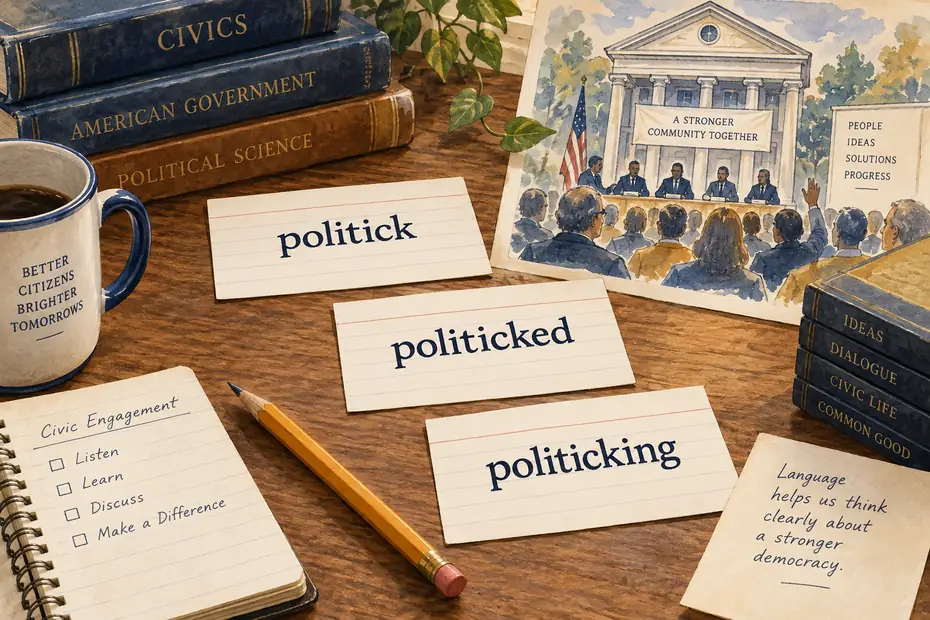
- The forms politicked and politicking retain the k.
- A politic action does not necessarily involve government or elections.
- Political is the usual adjective when you simply mean related to politics.
| Word | Typical role | Original example | Meaning test |
|---|---|---|---|
| politic | Adjective | A politic pause avoided an argument. | Prudent or tactful |
| politick | Verb | The candidates politick at local events. | Engage in political activity |
| politicking | Verb form or activity noun | She was politicking for support. | Seeking influence or backing |
| political | Adjective | The report covers political donations. | Related to politics |
When is a decision politic?
A decision is politic when it shows practical judgment, tact, or an awareness of consequences. Merriam-Webster’s politic entry records prudent and expedient senses. The adjective evaluates the way an action is chosen, so it can apply to business, family disputes, negotiations, and other situations outside formal politics.
“It was politic to thank both teams” describes the wisdom of avoiding a slight. “A politic answer kept the discussion moving” describes a strategically chosen reply. Neither original example requires a party, politician, or election. Replacing politic with political would change the intended description from judgment to subject matter.
Collins’s politic entry marks the common adjective as formal and also records shrewd or crafty senses. Politic therefore does not automatically praise someone’s moral character. Context can make the word approving, neutral, or suspicious of calculation. If that ambiguity is unwanted, choose “tactful,” “prudent,” or “self-serving” according to the meaning you actually intend.

What does it mean to politick?
To politick is to take part in political activity, often through campaigning, persuasion, or efforts to gain backing. Merriam-Webster’s politick entry treats the word as a verb. Collins’s politick entry likewise connects it with political activity rather than merely describing a wise choice.
Use an action-shaped sentence: “The hopefuls politick throughout the district.” In “The hopefuls are politicking throughout the district,” the added ending places the activity in progress. In “They politicked throughout the district,” the action is in the past. These are original examples illustrating the same verb family.
The term can sound more informal or pointed than “campaign.” If a report requires a precise account, specify the action: meeting voters, lobbying colleagues, negotiating endorsements, or seeking votes. Those alternatives tell readers what happened rather than leaving all political maneuvering under one broad label.
How do you choose by sentence structure?
Choose politic when the word describes a noun or follows a linking verb as a description. Choose politick when the sentence needs an action verb. This grammatical test works better than asking whether the topic involves politics, because a political discussion can contain both words.
- Identify the intended meaning: sensible judgment or political activity.
- Try “prudent” in the same position. If it fits, politic is likely the adjective you need.
- Try “campaign” or “seek political support.” If that fits, politick is the clearest action spelling.
- Check tense: politicks, politicked, or politicking.
- If the meaning is simply related to politics, consider political instead.
For example, “The representative made a politic concession while politicking for support” contains both meanings. Politic modifies concession; politicking describes an activity. The sentence is grammatical, though a clearer revision might replace one of the similar-looking words to reduce the reader’s effort.
Common mistakes and a short practice check
Don’t write “a politick reply” when you mean a tactful reply. Don’t assume that “a politic reply” means a reply about politics. Finally, don’t simplify the spelling rule so aggressively that a dictionary’s recorded variant verb politic becomes an alleged impossibility.
Complete these original examples: “It seemed ___ to postpone the vote”; “They continued to ___ for the nomination”; “The discussion concerned ___ reform.” The clearest answers are politic, politick, and political. The first evaluates a choice, the second names an activity, and the third identifies a subject area.
For politic vs politick, decide whether your sentence evaluates judgment or reports action. That distinction usually settles the spelling before pronunciation or historical meanings become relevant.
FAQ: politic and politick
Does politic mean polite?
Not exactly. A politic response may be polite because courtesy serves a practical purpose, but politic emphasizes judgment, tact, or expediency. Polite directly describes manners. A courteous response can be polite without being especially strategic, and a strategic choice can be politic without involving courtesy.
Is politicking always an insult?
No. Politicking can describe political activity without condemning it, although context may make the word sound critical of maneuvering or self-interest. If neutrality matters, name the activity more specifically. “Seeking endorsements” or “meeting constituents” gives readers a clearer description of the action involved.
Why is there a k in politicked?
The standard forms of politick keep its final k when adding endings: politicked and politicking. Remember the word family together rather than rebuilding the spelling from the adjective politic. This provides a straightforward proofreading check when a sentence describes completed or continuing political activity.
Can politic appear outside politics?
Yes. The prudent or tactful meaning applies wherever people weigh consequences and choose a sensible course. A politic workplace concession or a politic family compromise can fit the adjective. If the sentence instead describes electioneering or political maneuvering, the verb politick communicates that different meaning.
Have you ever found yourself confused about when to use “politic” versus “politick”? Well, fear not, because in this text, I’ll provide you with a clear understanding of how to use these words appropriately. As an expert in language and communication, I’ve encountered this common dilemma many times. Understanding the subtle differences between “politic” and “politick” is crucial for effective communication, whether you’re writing an essay, giving a speech, or engaging in a political discussion. So, let’s immerse and unravel the mysteries behind these two words, ensuring that you never stumble over their usage again.
Key Takeaways
- “Politic” is an adjective that describes being prudent, shrewd, or tactful in handling practical matters, while “politick” is a verb that means to engage in political activity or strategize for political gain.
- “Politic” focuses on characteristics or traits, while “politick” indicates an action or behavior.
- “Politic” refers to wise or strategic actions or decisions, while “politick” emphasizes actively engaging in political activities for gaining influence or power.
- These two words should not be used interchangeably, as they have distinct meanings and can lead to confusion and miscommunication if used incorrectly.
- Understanding the definitions and correct usages of “politic” and “politick” is essential for effective communication in politics, public affairs, or any political discussion.
What is the difference between “politic” and “politick”?
When it comes to the words “politic” and “politick,” there is often confusion about their meanings and usage. Understanding the subtle differences between these terms is crucial for effective communication. So, let’s immerse and unravel the mysteries behind these words!
Definition of “Politic”
The word “politic” is commonly used as an adjective and refers to being prudent, shrewd, or tactful in handling practical matters. It is often associated with politics and describes actions or decisions that are based on practical considerations rather than personal beliefs or emotions.
For example:
- Being diplomatic in negotiations is a politic move.
- She made a politic decision to focus on bipartisan issues.
Definition of “Politick”
On the other hand, “politick” is a verb that means to engage in political activity or strategize for political gain. It implies an active involvement in politics and seeking influence or power through political means.
For example:
- He chose to politick by attending multiple campaign events.
- They politicked relentlessly to gain the support of their constituents.
Key Differences
Now that we have defined both words, let’s explore the key differences between “politic” and “politick”:
- Parts of Speech:
- “Politic” is an adjective, describing a characteristic or trait.
- “Politick” is a verb, indicating an action or behavior.
- Meaning:
- “Politic” focuses on being prudent, tactful, or practical in handling matters.
- “Politick” emphasizes actively engaging in political activities for gaining influence or power.
- Usage:
- “Politic” is used to describe actions or decisions that are wise or strategic.
- “Politick” is used to describe the act of engaging in political activities or strategies.
Remember, these words have distinct meanings and should not be used interchangeably. Using “politic” instead of “politick” or vice versa can lead to confusion and miscommunication.
Understanding the definitions of “politic” and “politick”
When it comes to the words “politic” and “politick,” it’s important to understand their definitions and how they should be used appropriately. Let’s investigate into the meanings of these two words and explore the key differences between them.
What is the definition of “politic”?
The word “politic” is an adjective that describes being prudent, shrewd, or tactful in handling practical matters, especially in the area of politics or public affairs. It refers to the ability to make prudent decisions and navigate sensitive situations with diplomacy and foresight.
What is the definition of “politick”?
On the other hand, “politick” is a verb that means to engage in political activity or strategize for political gain. It involves actively participating in political affairs, such as campaigning, lobbying, or networking, with the intention of achieving specific political objectives.
The Key Differences between “Politic” and “Politick”
While both words relate to politics, there are distinct differences between them. Here’s a breakdown of the key differences:
- Part of speech: “Politic” is an adjective, used to describe a quality or characteristic, while “politick” is a verb, indicating an action or activity.
- Meaning: “Politic” refers to being prudent and tactful in practical matters, while “politick” specifically refers to engaging in political activities.
- Usage: “Politic” is used to describe someone’s approach or behavior in handling practical matters, whereas “politick” is used to describe the actual act of engaging in political activities.
It’s important to note that these words should not be used interchangeably, as this can lead to confusion and miscommunication. Understanding the subtle differences between “politic” and “politick” will enable you to use them appropriately and effectively in your communication.
By grasping the distinct meanings and nuances of these words, you’ll be better equipped to express yourself accurately and effectively when discussing political matters. So, let’s investigate deeper into their usage and explore some examples to further enhance our understanding.
Examples of how to use “politic” correctly
As we investigate deeper into the usage of the word “politic,” it’s important to provide some examples to help illustrate its correct usage. Understanding how this word is used in context can help us differentiate it from “politick” and use it appropriately in our own writing and conversations.
Here are some examples of how to use “politic” correctly:
- “She made a politic decision by choosing not to engage in the controversial debate.” In this example, “politic” is used as an adjective to describe a wise and tactful decision. It emphasizes the individual’s prudent choice to avoid getting involved in a contentious discussion.
- “The CEO’s politic handling of the sensitive situation prevented further damage to the company’s reputation.” Here, “politic” serves as an adjective to describe the CEO’s shrewd and strategic management of a delicate matter. It highlights their ability to navigate the situation with tact and discretion.
- “It is politic for politicians to consider the potential consequences of their actions before making major policy decisions.” In this sentence, “politic” is used as an adjective to emphasize the importance of politicians being prudent and thoughtful in their decision-making process. It suggests that they should carefully weigh the potential outcomes and impacts of their actions.
- “He presented his argument in a politic manner, appealing to both sides with well-reasoned points.” Here, “politic” is used to describe the tactful and diplomatic approach taken by the speaker. It highlights their ability to address each side of the argument with care and respect, eventually enhancing the effectiveness of their message.
By examining these examples, we can clearly see how “politic” is used as an adjective to describe prudence, shrewdness, and tact in various situations. It is important to note that “politic” is not a verb like “politick.” Understanding the distinction between these two words will help ensure accurate and effective communication.
Continue reading to explore more examples and gain a comprehensive understanding of how to differentiate between “politic” and “politick” in various contexts.
Examples of how to use “politick” correctly
Now that we have a solid understanding of the difference between “politic” and “politick,” let’s explore some examples of how to use “politick” correctly in various contexts.
Example 1: Political Campaign
During a political campaign, candidates must “politick” to gain support and win over voters. This involves engaging in strategic communication, networking, and connecting with the community. By politicking effectively, candidates can leave a lasting impression and increase their chances of success.
Example 2: Corporate Lobbying
In the corporate world, it’s not uncommon for companies to hire professionals who specialize in “politicking” to influence government policies and decisions that can impact their businesses. These individuals use their knowledge of regulatory processes and engage in persuasive tactics to advocate on behalf of their organizations.
Example 3: Negotiations
Negotiations often require individuals to “politick” to achieve their desired outcomes. This can involve finding common ground, building alliances, and skillfully exploring delicate conversations to secure favorable deals. By employing strategic politicking, negotiators can build rapport and reach mutually beneficial agreements.
Example 4: Diplomatic Relations
When it comes to international diplomacy, diplomats must possess strong politicking skills. They engage in intricate negotiations, manage complex relationships, and work towards building alliances between nations. Effective politicking among diplomats can lead to improved diplomatic relations and successful resolutions to global challenges.
Through these examples, it becomes evident that “politick” refers to the strategic efforts individuals employ in political, corporate, and diplomatic contexts to achieve their goals. It’s important to note that “politick” is primarily used as a verb, signaling an active engagement in political maneuvering and tactful communication.
Remember, mastering the appropriate usage of “politick” can greatly enhance your communication skills in professional settings. Let’s continue exploring more examples to solidify our understanding of these commonly confused words.
Common mistakes to avoid when using “politic” and “politick”
When it comes to using the words “politic” and “politick,” it’s important to be aware of common mistakes that people often make. By avoiding these errors, you can communicate your thoughts and ideas more effectively. Here are a few key areas to watch out for:
1. Confusing the Definitions
One common mistake is misunderstanding the difference between “politic” and “politick.” Remember, “politic” is an adjective that describes prudence, shrewdness, and tact in various situations. On the other hand, “politick” is a verb that refers to the strategic efforts individuals employ in political, corporate, and diplomatic contexts to achieve their goals.
2. Incorrect Usage of “Politic”
Another mistake is using “politic” incorrectly. Avoid using it as a verb or as a synonym for “politick.” Instead, use “politic” to describe someone who is prudent, shrewd, or tactful in their actions or decisions. For example, “It’s politic to avoid controversial topics at the dinner table.”
3. Misusing “Politick”
Similarly, misusing “politick” is a common error. Remember, “politick” is a verb that specifically refers to engaging in strategic efforts in political, corporate, or diplomatic contexts to achieve one’s goals. For example, “He was politicking during the campaign to win over undecided voters.”
4. Using the Wrong Form
Another mistake to avoid is using the wrong form of these words. Keep in mind that “politic” is an adjective, so don’t use it as a noun or adverb. Similarly, “politick” is a verb, so don’t use it as an adjective or a noun.
5. Ignoring Context
Finally, it’s crucial to consider the context in which you are using these words. While “politic” focuses on individual qualities, “politick” emphasizes strategic efforts in political or diplomatic settings. By understanding the nuances of each word, you can use them appropriately and effectively convey your intended meaning.
Remember, mastering the appropriate usage of “politic” and “politick” can enhance your communication skills in professional settings. By avoiding these common mistakes, you’ll be well on your way to confidently and accurately using these commonly confused words.
Conclusion
Mastering the appropriate usage of “politic” and “politick” is crucial for effective communication in professional settings. Throughout this article, we have explored the definitions and correct usage of these words, providing examples to illustrate their proper application.
“Politic” is an adjective that describes prudence, shrewdness, and tact. It is used to convey the ability to navigate various situations with skill and sensitivity. On the other hand, “politick” is a verb that refers to the strategic efforts individuals employ to achieve their goals in political, corporate, and diplomatic contexts.
By understanding the distinctions between these words, we can avoid common mistakes and ensure our communication is clear and precise. Confusing their definitions, using them incorrectly, using the wrong form, or ignoring context can lead to misunderstandings and undermine our credibility.
So, whether we are discussing political campaigns, corporate lobbying, negotiations, or diplomatic relations, using “politic” and “politick” appropriately will enhance our communication skills and enable us to convey our messages effectively.
Remember, mastering the correct usage of these words is an essential tool in our professional arsenal.
Frequently Asked Questions
Q: What is the article about?
The article addresses the confusion between the words “politic” and “politick,” explaining their definitions and usage. It provides examples of correct usage for both words and highlights their roles as an adjective and a verb, respectively.
Q: How should “politic” be used?
“Politic” should be used as an adjective to describe prudence, shrewdness, and tact in various situations. It can be used to characterize individuals or actions.
Q: In what contexts can “politick” be used?
“Politick” can be used in various contexts such as political campaigns, corporate lobbying, negotiations, and diplomatic relations. It refers to strategic efforts employed to achieve goals in political, corporate, and diplomatic settings.
Q: What are some common mistakes to avoid?
Common mistakes include confusing the definitions of “politic” and “politick,” using them incorrectly, using the wrong form, and ignoring context. It is important to understand the nuance and appropriate usage of these words.
Q: Why is mastering the usage of “politick” important?
Mastering the appropriate usage of “politick” enhances communication skills in professional settings. It allows individuals to effectively navigate political, corporate, and diplomatic environments and achieve their goals. Avoiding common mistakes ensures clear and accurate communication.


