
Pond in a Sentence: Examples and Prepositions
Pond is a countable noun for a relatively small area of water, often still and sometimes artificially made. “There is a pond behind the house” introduces one; “The pond reflects the trees” describes a particular one. The regular plural is ponds: “Two ponds lie beside the path.”
Corrections to the older examples: “Pond has ducks swimming in it” needs an article in ordinary prose: “The pond has ducks swimming in it.” Pond is a singular form, but the noun also has a plural. The swimming-practice and fish-feeding examples are fictional language illustrations rather than recommendations: activities at a real pond depend on its conditions and local rules.
- Use a pond for an unspecified pond and the pond for an identified pond.
- Use pond with a singular verb and ponds with a plural verb.
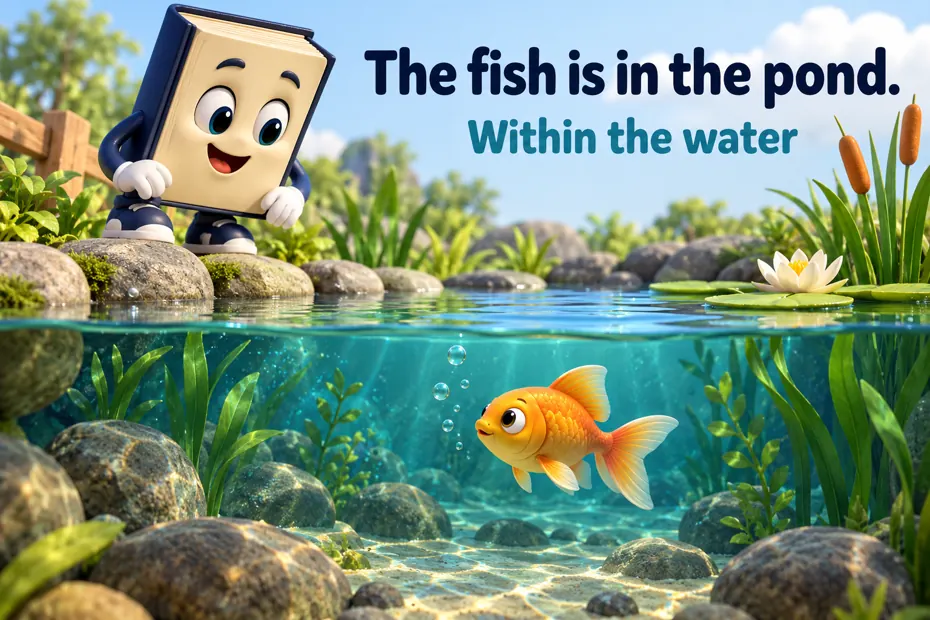
- In the pond concerns the water or the area within it.
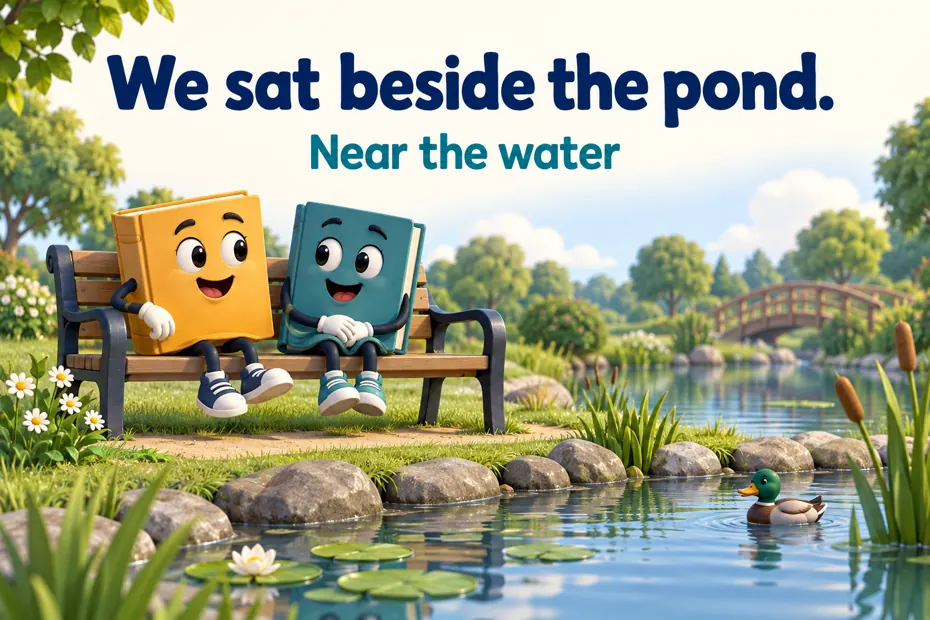
- By the pond and beside the pond concern a nearby location.

How do you choose in, on, or by the pond?
Choose the preposition according to the relationship you want to describe. A fish swims in the pond, a leaf floats on the pond, and a bench stands by the pond. In can also describe ducks swimming within the pond’s area, while on draws attention to their position on the water’s surface.
| Preposition | Original example | Focus |
|---|---|---|
| In | Small fish swam in the pond. | Within the water. |
| On | A leaf floated on the pond. | The surface. |
| By or beside | We sat beside the pond. | A nearby position. |
| Across | Ripples spread across the pond. | Movement over the surface. |
| Around | A path runs around the pond. | The surrounding edge or perimeter. |
Do not choose a preposition simply because it appeared in another example. “The children stood in the pond” means they were within it, probably in the water. “The children stood by the pond” places them nearby. A single word changes the scene, so decide where the subject is before writing the sentence.
How do articles and verb agreement work?
As an ordinary singular count noun, pond generally needs a determiner, such as a, the, this, or our. Write “A pond is near the entrance,” rather than “Pond is near the entrance.” A plural noun can appear without an article in a general statement: “Ponds vary in size and surroundings.”
Compare “This pond has a small island” with “These ponds have small islands.” The noun, determiner, and verb all reflect number. The same distinction applies in the past: “The pond was frozen” versus “The ponds were frozen.” Frozen describes a condition in the example rather than something true of every pond.
For location, “There is a pond in the garden” introduces one body of water. “There are two ponds in the garden” introduces two. Avoid matching the verb to the nearby word garden; the relevant noun after there is pond or ponds.
What does pond mean in figurative expressions?
In informal speech, the pond can refer humorously to the Atlantic Ocean, especially in discussions involving Britain or Europe and the United States. “Her publisher is across the pond” uses that figurative meaning. It does not describe a literal small body of water, so the surrounding geographical context is important.
For a garden scene, “across the pond” may instead mean on the opposite side of an actual pond. “The shed stood across the pond from the bench” makes the literal relationship clear. If your reader could confuse the two meanings, name the country or describe the far bank explicitly.
Frequently asked questions
Is there an exact size separating a pond from a lake?
Ordinary dictionary definitions describe a pond as smaller than a lake, but they do not establish one universal numerical boundary for every place and purpose. For a vocabulary sentence, use the locally identified term. For a scientific report, state the classification criteria used rather than inventing a fixed cutoff from the everyday word.
Can a pond be artificial?
Yes. A garden pond can be made by people, while other ponds form naturally. “They built a small pond in the garden” clearly describes an artificial one. The word pond does not by itself tell the reader its origin, exact depth, water quality, or whether a particular species lives there.
What is a simple sentence for children?
“A frog sat beside the pond” is short and concrete. “Two ducks floated on the pond” adds a number and a surface relationship. Ask children to identify the noun and describe the location; they can then change beside to near or add an adjective such as small without changing the core sentence.
Should pond have a capital letter?
Capitalize pond at the beginning of a sentence or when it belongs to an official proper name. In “We walked around the pond,” the ordinary noun is lowercase. If a location’s official name contains Pond, follow that name’s spelling. Capital letters do not distinguish a pond’s physical size or type.
Source: Cambridge Dictionary’s pond entry covers the literal count noun and informal Atlantic expression. The grammar examples are original.

Have you ever wondered what a “pond” is? A pond is a small body of water, typically shallow and surrounded by land, that provides a habitat for various aquatic plants and animals.
Ponds are important ecosystems that support a variety of wildlife, including fish, frogs, ducks, and insects. They also play a crucial role in regulating water quality and supporting overall biodiversity.
7 Examples Of Pond Used In a Sentence For Kids
- Pond has ducks swimming in it.
- I saw a frog near the pond.
- The pond is filled with lotus flowers.
- Let’s feed the fish in the pond.
- We can skip stones in the pond.
- A family of ducks lives in the pond.
- The pond is a home for many creatures.
14 Sentences with Pond Examples
- During the biology field trip, we examined the ecosystem of the pond on campus.
- The students gathered near the edge of the pond to study the movement of the fish in the water.
- We often sit by the pond after classes to relax and enjoy the peaceful atmosphere.
- The professor conducted an experiment to test the pH levels of the pond water.
- A group of friends decided to have a picnic by the pond to unwind after exams.
- In the chemistry lab, we analyzed a water sample from the pond to identify the pollutants.
- The college has a sustainability club that regularly organizes clean-up drives around the pond.
- The yoga club held a morning session by the pond to embrace nature while practicing mindfulness.
- The environmental science class discussed the impact of urbanization on the local pond ecosystem.
- As part of their project, students measured the depth and temperature of the pond at different locations.
- The engineering students designed a filtration system to improve the water quality of the pond.
- There was a beautiful lotus blooming in the center of the pond, attracting many photographers.
- The swimming coach organized a practice session for the team at the college pond.
- Students often use the pond as a backdrop for their artistic sketches and paintings.
How To Use Pond in Sentences?
Pond is a noun that refers to a small body of still water. When using pond in a sentence, it is important to remember that it is a singular noun. Here is a guide on how to use pond in a sentence:
-
Subject-Verb Agreement: When using pond as the subject of a sentence, make sure the verb agrees with it. For example, “The pond reflects the trees beautifully.”
-
Articles: Use articles like “a” or “the” before pond to indicate whether you are referring to a specific pond or any pond in general. For example, “There is a pond behind my house” or “The pond in the park is teeming with fish.”
-
Adjectives: You can use adjectives to describe the pond and make your sentence more descriptive. For example, “The serene pond is surrounded by colorful flowers.”
-
Prepositions: When talking about the location of the pond, you can use prepositions like “in,” “on,” or “by.” For example, “The ducks are swimming in the pond.”
-
Context: Make sure the sentence is clear and provides enough context for the reader to understand how pond is being used. For example, “Despite its small size, the pond supports a diverse ecosystem.”
By following these guidelines, you can effectively use pond in a sentence and communicate your ideas clearly to others.
Conclusion
In conclusion, ponds are small bodies of water that support diverse ecosystems and provide habitats for various plants and animals. They play a crucial role in maintaining biodiversity and water quality in their surroundings. Examples of sentences with the keyword “pond” include: “The children enjoyed feeding the ducks by the pond” and “The frog croaked loudly at the edge of the pond.” Ponds also serve recreational purposes, such as fishing and boating, making them valuable natural resources for both wildlife and humans. Overall, ponds are valuable features in our environment that contribute to the health of ecosystems and provide opportunities for enjoyment and relaxation.


