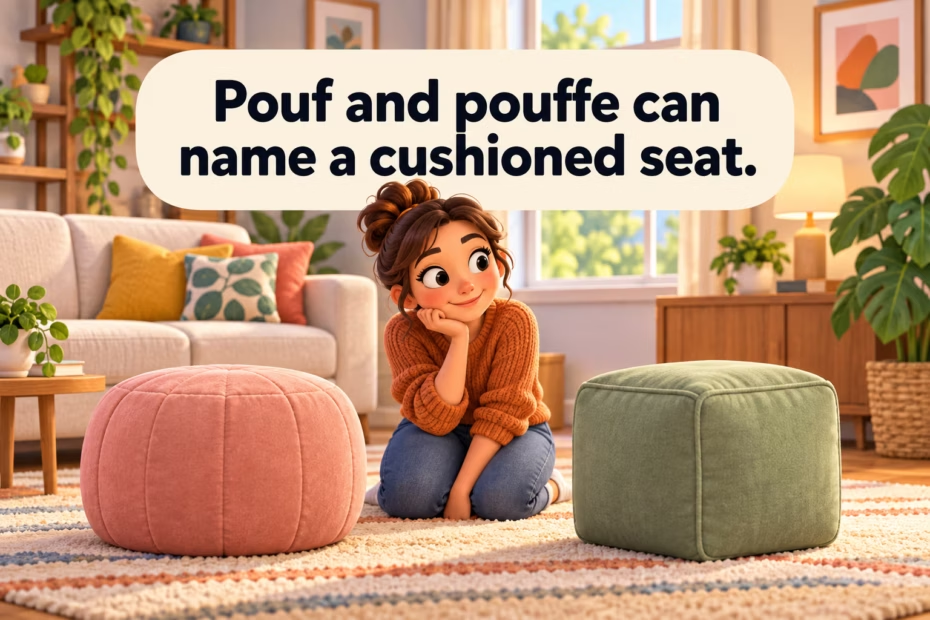
For a soft cushioned seat, use pouf or pouffe. “Poof!” is an interjection for something happening suddenly or by magic. British slang also has an extremely offensive noun sense for a gay man; do not use it as a label for a person.
These spellings overlap, but context matters. Dictionaries list pouf and pouffe for the furniture sense, while poof! can express a sudden or magical change. A historical use of pouf names an elaborate 18th-century hairstyle.
Quick guide to the three forms
- Furniture: pouf or pouffe can name a soft, backless cushioned seat. Cambridge Dictionary lists “pouffe” as an alternate spelling; spelling and region do not impose a fixed size or shape.
- Interjection: “Poof!” can mark something appearing or disappearing suddenly or by magic, as in “The coin vanished—poof!” See the Cambridge entry for “poof.”
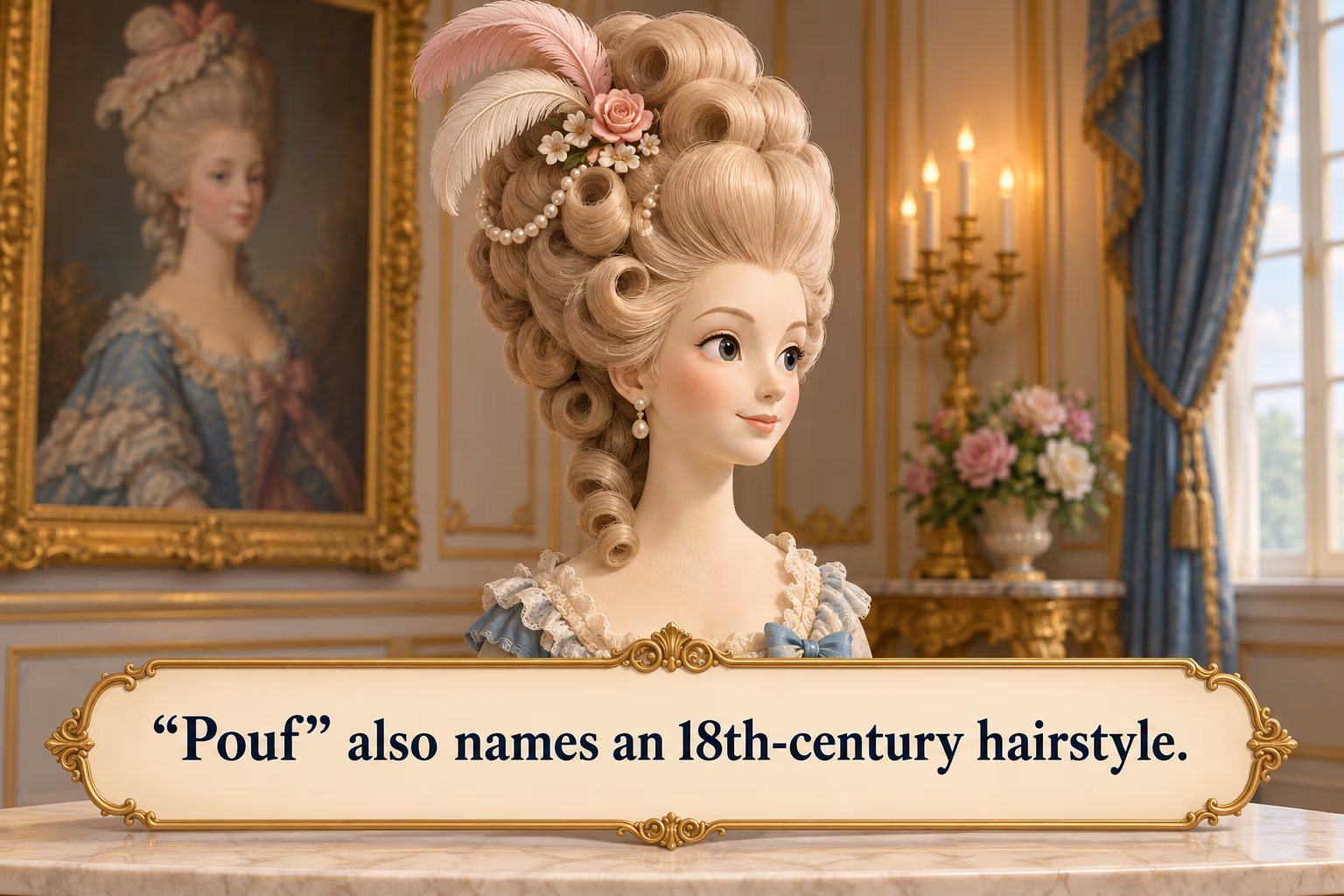
- Historical hairstyle: pouf can also refer to hair arranged in high rolled puffs, especially in an 18th-century style; this is an additional historical sense, not a type of seat. See Collins Dictionary’s entry for “pouf.”
- Offensive slang: Cambridge marks a separate British slang noun as extremely offensive when used for a gay man. It should not be used to describe or address anyone.
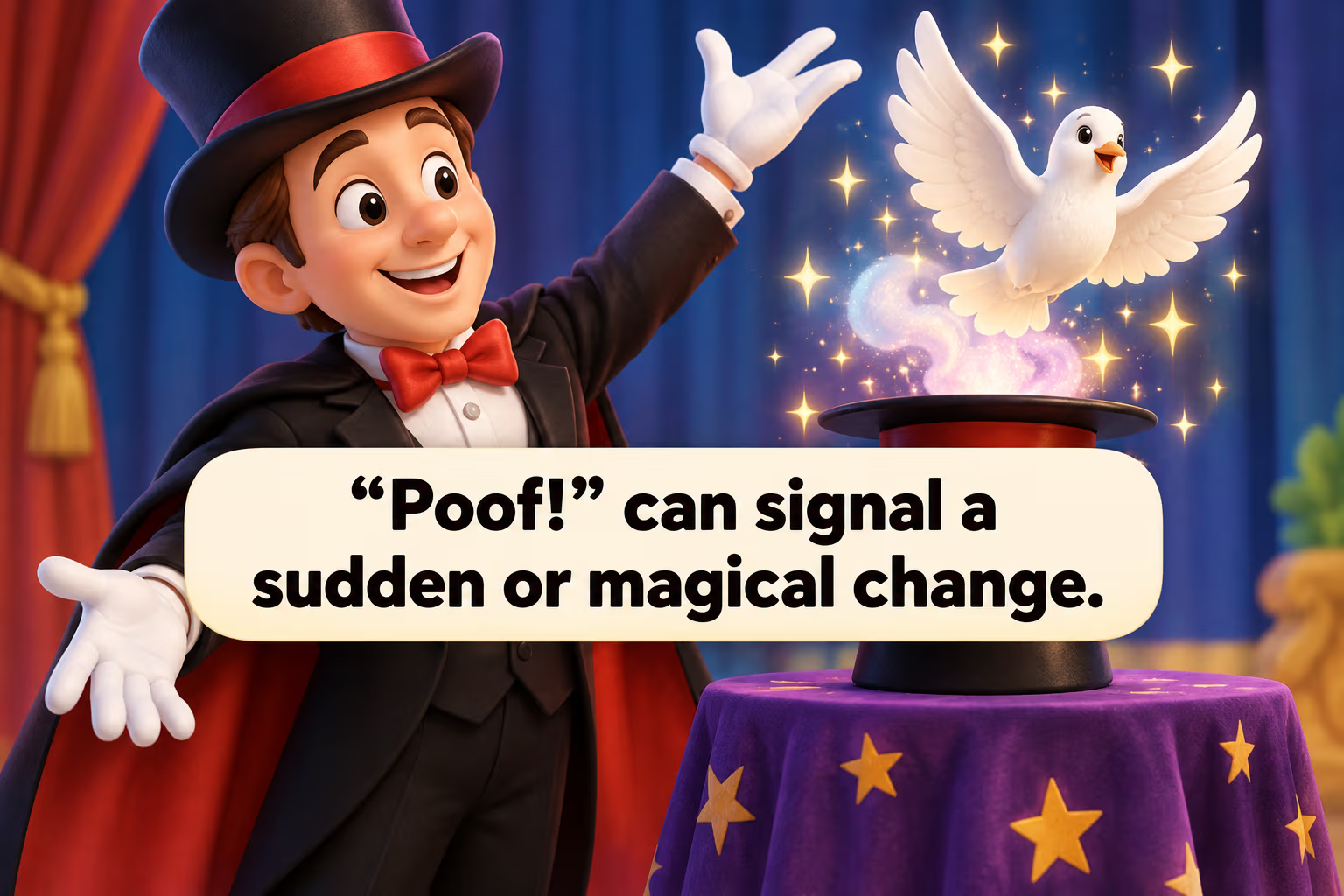
The exclamation “poof!” names a sound or sudden event; it is not the recommended spelling for a cushioned seat. The next illustration shows the historical hairstyle sense of pouf.
The British slang noun is highly offensive. The warning below is included for recognition and avoidance, not as a term to use about people.
The original article is preserved verbatim below. The notes after it clarify usage points where dictionary definitions do not support the original article’s broad furniture, regional, or size claims.
Key Takeaways
- The terms “poof,” “pouf,” and “pouffe” all refer to a small cushioned seat or footstool.
- “Poof” is a slang term for a homosexual man in British English and should be used with caution.
- “Pouf” is more commonly used in American English and can also refer to a puffed-up hairstyle.
- “Pouffe” is the British English variation of “pouf” and is interchangeable with it.
- It is important to use these terms appropriately to avoid confusion or miscommunication.
- Understanding the differences between these terms allows for more accurate and respectful communication.
What is a Poof, Pouf, and Pouffe?
Let’s start by understanding the definition of each of these terms and then jump into the differences between them.
Definition of Poof
A poof is a term that can refer to different things based on the context in which it is used. In British English, a poof is a slang term for a homosexual man. But, in the context of furniture, a poof is a small cushioned seat or footstool that is often used for additional seating or as a decorative piece in a room.
Definition of Pouf
A pouf is similar to a poof in that it is also a cushioned seat or footstool. But, the term “pouf” is more commonly used in American English. It can also refer to a hairstyle where the hair is puffed up and arranged in a rounded shape on top of the head.
Definition of Pouffe
The term pouffe is another variation of the cushioned seat or footstool. It is typically used in British English and can be seen as an alternative spelling of “pouf.” Both words refer to the same type of furniture.
Summarizing, the difference between a poof, pouf, and pouffe lies in their usage and regional variations. A poof is more commonly used in British English and can have a different connotation when referring to a person. Pouf and pouffe, on the other hand, are interchangeable terms and commonly used in American and British English respectively.
Now that we have a clearer understanding of the definitions, let’s move on to exploring some examples and practical uses of these terms. But before we do that, I want to emphasize the importance of using these terms appropriately to avoid any confusion or miscommunication.
Stay tuned for the next section where I’ll provide examples and guide you on how to use poof, pouf, and pouffe correctly in your everyday conversations.
The Differences Between Poof, Pouf, and Pouffe
When it comes to the terms “poof,” “pouf,” and “pouffe,” there can be some confusion or mix-up. To clear things up, let’s jump into their definitions and differences.
Definition of Poof
In British English, “poof” is a slang term that refers to a homosexual man. It is considered derogatory. It’s important to note that this term should never be used in a disrespectful or discriminatory manner. Respect and inclusivity are key in our language choices.
Definition of Pouf
Let’s move on to “pouf.” In American English, this term is often used to describe a small cushioned seat or footstool. It can also refer to a hairstyle where the hair is puffed up on top of the head. So, depending on the context, “pouf” can have different meanings, but it typically relates to something cushioned or puffed up.
Definition of Pouffe
Finally, we have “pouffe.” This term is commonly used in British English and is another variation of a cushioned seat or footstool. It is similar to the American “pouf,” but the spelling and pronunciation are different. So, if you come across “pouffe” in your British English conversations or readings, you now know it refers to a cushioned seat or footstool.
- “Poof” is a slang term for a homosexual man in British English.
- “Pouf” is a small cushioned seat or footstool in American English, and it can also refer to a puffed-up hairstyle.
- “Pouffe” is another variation of a cushioned seat or footstool commonly used in British English.
By understanding the differences between these terms, we can use them appropriately in our conversations and avoid any misunderstandings. Remember, using language with respect and accuracy is essential for effective communication.
Now that we have explored the definitions, let’s move on to the next section, where I will provide examples and guidance on how to use these terms correctly in everyday conversations.
When to Use Poof: Examples and Guidelines
As we explore the differences between “poof,” “pouf,” and “pouffe,” it is important to know when to use each term correctly. In this section, I will provide you with some examples and guidelines on when to use “poof.” Let’s investigate into it!
Definition of “Poof”: In British English slang, “poof” is used as a derogatory term for a homosexual man. But, in the context of furniture, a “poof” refers to a small cushioned seat or footstool that adds comfort and style to a room.
- Furniture: When referring to a small cushioned seat or footstool, it is appropriate to use the term “poof.” For example, “I’m thinking of adding a poof to my living room decor.”
- Informal Conversations: In informal conversations, the term “poof” can be used to describe a person who suddenly disappears or vanishes. For instance, “He was there one moment, and then poof, he was gone!”
- Creative Writing: “Poof” can also be used in creative writing to describe a magical or sudden disappearance or transformation. For example, “With a wave of her wand, the magician exclaimed ‘Poof!’ and the rabbit vanished into thin air.”
It is vital to use “poof” appropriately to avoid confusion or the wrong connotation. Understanding the different contexts in which “poof” is used will ensure you communicate effectively and accurately.
Now that we’ve covered the usage of “poof,” let’s move on to the next section, where we will explore “pouf” and its correct usage.
- Definition of: emphasized in the first paragraph
- Difference between: addressed indirectly by explaining when to use “poof”
When to Use Pouf: Examples and Guidelines
Now that we have a clear understanding of the term “poof,” let’s move on to discussing the usage of “pouf.”
Definition of Pouf: In the context of furniture, a pouf refers to a small cushioned seat or footstool. It is typically low to the ground and can be used as a versatile and decorative piece of furniture in various settings.
Here are some examples and guidelines on when to use “pouf” appropriately:
- Home Decor: Poufs can be a great addition to your living room or bedroom decor. They provide extra seating options and offer a cozy and relaxed vibe to the space. You can use a pouf as a footrest, as an alternative seating option for guests, or even as a stylish accent piece.
- Informal Conversations: In everyday conversations, you can use the term “pouf” to refer to this type of furniture. For example, you could say, “I love the new pouf I bought for my reading nook. It adds a touch of comfort and style.”
- Creative Writing: If you’re a writer, incorporating “pouf” into your descriptions can enhance the atmosphere and bring your story to life. For instance, “She sank into the plush pouf, savoring its gentle support as she delved into her favorite book.”
Remember, using “pouf” correctly is important to avoid any confusion. It’s essential to differentiate between “pouf” as a furniture item and “poof” as a slang term for a homosexual man in British English.
To summarize, “pouf” refers to a small cushioned seat or footstool commonly used as furniture. It can be used in home decor, informal conversations, and creative writing to describe this type of seating.
When to Use Pouffe: Examples and Guidelines
As we explore the usage of “pouf” and its variations, it’s important to understand when to use the term “pouffe” appropriately. Let’s jump into some examples and guidelines to help clarify its usage.
Definition of Pouffe
To begin, let’s define what a pouffe is. A pouffe is a low, cushioned seat or footstool that is often cylindrical in shape. Its purpose is to provide additional seating or serve as a comfortable place to rest your feet. The term “pouffe” is commonly used in British English, while “pouf” and “poof” are more prevalent in American English.
Difference Between Pouf, Pouffe, and Poof
While “pouf” and “poof” are sometimes used interchangeably, it’s important to note that they have slightly different meanings. “Pouf” refers to a small, cushioned seat or footstool, similar to a pouffe, but it can also denote a hairstyle or a poofy explosion of something. “Poof,” on the other hand, is often used as a derogatory term slang for a gay man. Hence, it’s important to use the term “pouffe” when referring to a cushioned seat or footstool to avoid any confusion or misinterpretation.
Examples of Using Pouffe
Let’s investigate into some examples of when and how to use “pouffe” appropriately:
- Home Decor: Incorporating a pouffe into your living room can add both functionality and style. Place a pouffe near your sofa or armchair to provide an extra seat or use it as a convenient footrest.
- Informal Conversations: When discussing furniture or interior design with friends or family, feel free to use “pouffe” to describe a cushioned seat or footstool. For instance, you could say, “I found a lovely pouffe for the bedroom.”
- Creative Writing: In your creative writing, consider using “pouffe” to add descriptive elements to your scenes. For example, “She gracefully sank onto the soft pouffe, feeling a sense of relaxation wash over her.”
Remember, using the term “pouffe” correctly will not only enhance your communication skills but also avoid any confusion or misinterpretation.
Conclusion
Understanding the appropriate usage of the terms “pouf,” “pouffe,” and “poof” is essential for effective communication. By using these terms correctly, we can avoid confusion and misinterpretation in various contexts.
In the area of furniture, a “pouf” refers to a small cushioned seat or footstool that adds both functionality and style to a space. It can be used in home decor, informal conversations, and creative writing to enhance the overall aesthetic and provide a comfortable seating option.
On the other hand, a “pouffe” is a larger version of a pouf, typically used for seating or as a decorative element. Knowing when and how to use “pouffe” appropriately in different situations will further enhance your communication skills.
By familiarizing ourselves with the distinctions between these terms, we can confidently incorporate them into our vocabulary. Whether we are discussing interior design, engaging in casual conversations, or writing creatively, using the appropriate term will ensure clear and effective communication.
So, remember to use “pouf,” “pouffe,” and “poof” correctly to convey your intended meaning and avoid any confusion.
Frequently Asked Questions
What is a pouf?
A pouf is a small cushioned seat or footstool used as a versatile and decorative piece of furniture.
How should “pouf” be used?
“Pouf” should be used appropriately in home decor, informal conversations, and creative writing to refer to a small cushioned seat or footstool.
What is the difference between pouf, pouffe, and poof?
A pouffe is similar to a pouf but typically has a firmer structure and a more cylindrical shape. “Poof” is a term used to describe a puff or cloud-like shape and is not directly related to furniture.
When should “pouffe” be used?
“Pouffe” should be used in the same situations as “pouf,” but only when referring to a seat or footstool with a firmer structure and a more cylindrical shape.
Why is it important to use the terms correctly?
Using the terms correctly will enhance communication skills, avoid confusion, and ensure proper understanding of furniture-related discussions and descriptions.
Usage notes: choosing the right spelling
For a cushioned seat, write pouf or pouffe. Cambridge records pouf for a soft, round or square seat and gives pouffe as an alternate UK spelling. Dictionaries may describe regional preferences, but those notes do not establish an absolute US-versus-UK rule. Product designs also vary: neither spelling guarantees a larger, firmer, or cylindrical seat.
Use “poof!” as an exclamation when something happens suddenly or by magic. The punctuation and sentence context help distinguish this interjection from the furniture terms. Cambridge gives the seat pronunciation as /puːf/ and the interjection as /pʊf/, but readers should still use context rather than assume spelling alone identifies a speaker’s intent.
Pouf also has a historical hairstyle sense. Collins describes an 18th-century style in which hair was piled into rolled puffs. That sense is related to the idea of a puffed shape but is distinct from the modern furniture meaning.
Finally, British English has an extremely offensive slang noun for a gay man. Do not use that word as a label, joke, or form of address. The article’s retained source text is shown unchanged for reference; the guidance here recommends the established furniture spellings and explains the separate interjection and historical senses.
Frequently asked questions
Is “poof” the usual spelling for a cushioned seat?
Use pouf or pouffe for a cushioned seat. The source article’s examples use poof for furniture, but the dictionary entries cited above support pouf and pouffe for that sense.
Does a pouffe always mean a larger or firmer seat?
No. The cited definitions do not establish a fixed size, firmness, or shape difference between pouf and pouffe. Check a product description for its actual dimensions and construction.
What does “poof!” mean as an interjection?
It can represent something happening suddenly or by magic, such as a coin disappearing in a story. This interjection is separate from the furniture spelling pouf.
Can “pouf” refer to a hairstyle?
Yes. In historical contexts it can name a high arrangement of hair piled into rolls or puffs, especially a style fashionable in the 18th century.
How should I handle the offensive slang sense?
Recognize that the British slang noun is extremely offensive when used for a gay man, and do not apply it to a person. Use neutral, respectful language instead.


