
Pore over means to read or study something with long, close attention. To use pore over in a sentence, place the object straight after the phrase: “She pored over the contract for an hour.” The verb is inseparable, so you never write pore the contract over, and it is not pour, which moves liquid.
Pore over at a glance
- Pore over is an inseparable phrasal verb; its forms are pores over, pored over and poring over.
- It always takes an object, usually something written or detailed such as a book, map or report.
- The object follows the whole phrase, so the two words are never split.
- The verb implies effort and a stretch of time, not a quick look.
- The noun pore, meaning a tiny opening in skin, is unrelated but spelled the same.
- The commonest error is writing pour over, which describes liquid, not reading.
What does pore over mean?
Pore over is a phrasal verb meaning to read or examine something with steady, close attention over a period of time. The Cambridge entry for pore over records the study sense and the inseparable pattern. To scrutinize something is more forensic and suspicious; pored over can be absorbed and neutral.
| Sense | Plain meaning | Example sentence |
|---|---|---|
| Read closely | Work through a text with full attention | She pored over the contract for an hour. |
| Study intently | Examine detail such as maps or figures | They pored over the charts until midnight. |
Pore over does not mean read quickly or skim. It implies effort and time, so it is the wrong verb for glancing at a menu or skimming a headline; for those, read, scan or skim fit better. The past tense is pored over, spelled with the same pore as the noun for a skin opening.
How do you use pore over in a sentence?
Pore over is an inseparable phrasal verb, which means the particle over stays attached to the verb and the object follows the whole phrase. When the verb begins a clause, only the participle form changes.
| Pattern | Example | What it signals |
|---|---|---|
| pore over + object | She pored over the contract. | the object follows the whole phrase |
| pore over + long object | They pored over every line of the report. | the object still stays after over |
| not separable | Incorrect: |
the two words are never split |
| poring over (participle) | Poring over maps, he traced the route. | fronted participle clause |
| was poring over | He was poring over the figures. | continuous aspect for an ongoing study |
A near-synonym that also takes over is examine closely, but examine works for objects and wounds as well as texts, while pore over suggests reading or scanning for detail.

Pore over in a sentence: examples across contexts
Each example shows the phrase in a different setting, and the note explains what the study adds.
| Context | Example sentence | Why this works |
|---|---|---|
| Legal writing | The lawyer pored over the lease before advising. | Shows careful, unhurried reading. |
| Academic study | Students pored over the data for weeks. | Names a sustained period of effort. |
| Journalism | Reporters pored over thousands of pages of records. | Emphasises scale and detail. |
| Home conversation | He pored over the recipe before cooking. | Light, everyday close reading. |
| Navigation | They pored over the map by torchlight. | Uses the study-of-detail sense. |
| Finance | Analysts pored over the accounts before investing. | Links close reading to a decision. |
| Editing | She pored over every draft looking for errors. | Continuous attention over time. |
| Historical writing | Historians pored over letters and diaries. | Evokes slow, absorbed research. |
| Exam revision | He pored over his notes the night before. | Implies pressure and focus together. |
When the reading is quick and casual rather than close, peruse is often the better choice, though careful writers note that peruse itself is divided between reading carefully and reading lightly.
Pore over vs pour over
The two phrases sound identical, which is exactly why they are confused. The spelling follows the meaning, and the meanings are far apart.
| Attribute | Pore over | Pour over |
|---|---|---|
| Core meaning | Study something closely | Tip liquid onto something |
| Typical object | A book, map or report | Sauce, water or syrup |
| Effort implied | Long, careful attention | None; a physical action |
| Part of speech | Phrasal verb of reading | Verb plus preposition of movement |
| Memory hook | Pore matches a tiny opening you look through | Pour matches a jug and a stream |
Use pore over for reading and pour over for liquids; the noun pore, a tiny opening in the skin, gives the reading word its spelling and its sense of looking through something narrow.
When the reading is eager and quick rather than painstaking, people devour a novel in a night, while pore over stays with effort and time.
Word forms and grammar of pore over
Only the verb part changes, and over never inflects.
| Form | Part of speech | Example |
|---|---|---|
| pore over | base phrasal verb | They pore over the rules each term. |
| pores over | third-person singular | She pores over the small print. |
| pored over | past and past participle | He pored over the figures all night. |
| poring over | present participle | Poring over old letters, she lost track of time. |
| pore | noun (unrelated) | A pore in the skin releases oil. |
To keep the meaning of reading, learners often find it easier to study the material rather than risk the homophone; both need time and attention, but study carries no spelling trap.
Common mistakes with pore over
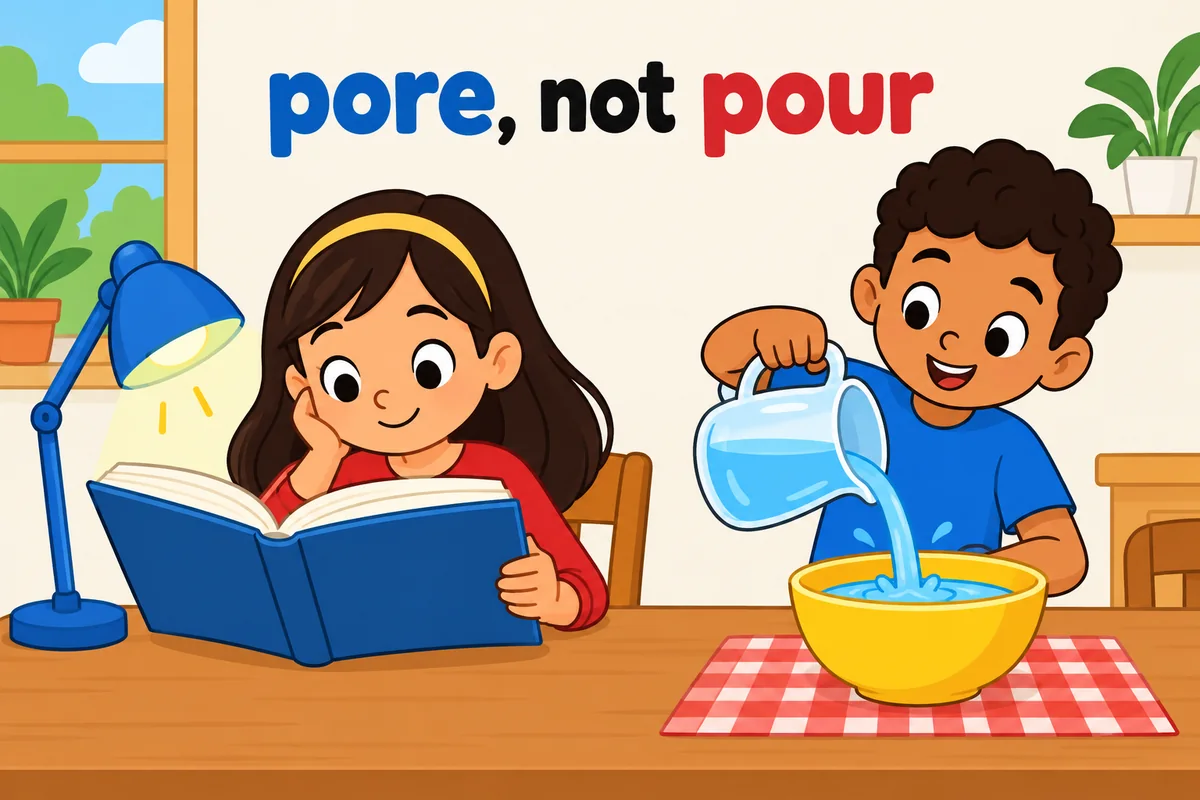
Writing pour instead of pore. Incorrect: She poured over the report. Correct: She pored over the report. Rule: pour moves liquid, pore means to read closely.
Splitting the inseparable verb. Incorrect: She pored the report over. Correct: She pored over the report. Rule: the object follows the whole phrase, because pore over is inseparable.
Using it for a quick glance. Incorrect: He pored over the headline for a second. Correct: He glanced at the headline. Rule: pore over needs sustained attention and time.
Using a bare object after the verb. Incorrect: The accountant pored the accounts. Correct: The accountant pored over the accounts. Rule: the phrase needs over before the thing studied.
Confusing it with peruse at speed. Incorrect: Guests pored over the menu and ordered in a minute. Correct: Guests skimmed the menu and ordered in a minute. To study the numbers in depth instead, analyze them is the clearer verb.
Practice using pore over
Six exercises test the spelling, separability and time sense. Write your answers first.
- Fill in the blank: The editor ______ the manuscript all weekend.
- Choose the better spelling: She poured over the map. / She pored over the map.
- Correct the error: He pored the contract over before signing.
- Build a sentence using pore over about studying for an exam.
- Spot the register: which works in a formal report? (a) The team pored over the records. (b) The team pored the records over.
- Fill in the blank: ______ over the small print, she noticed a hidden fee.
Answers
- pored. The past tense of pore keeps the same spelling as the verb.
- She pored over the map. Pore over means study closely, while pour describes liquid.
- He pored over the contract before signing. The inseparable verb keeps over next to pore.
- One good answer: I pored over my notes the night before the exam. Over stays attached and the object follows.
- (a). The formal report keeps the correct, inseparable phrase; the second splits the verb.
- Poring. The fronted participle clause needs the -ing form, and it keeps the reading sense.
The bottom line
To use pore over in a sentence, keep the two words together and let the object follow them. The phrase means to read or study with close, sustained attention, so it resists a quick glance. Its spelling follows the noun pore, a tiny opening, and never the liquid verb pour. Remember those two points and the common errors disappear.
Frequently asked questions about pore over
Is it pore over or pour over?
Pore over means to read or study something closely, as in she pored over the report. Pour over means to tip liquid onto something, as in he poured sauce over the rice. They sound the same, so check whether the action involves reading or liquid.
Is pore over separable?
No. Pore over is inseparable, so the object follows the whole phrase, as in they pored over the map. You never split it to say pore the map over. This is different from separable phrasal verbs such as freak out, where the object can move inside the verb.
What is the past tense of pore over?
The past tense is pored over, and the past participle is also pored over. The present participle is poring over, which drops nothing from the stem. Only the verb part changes; over stays the same in every form, and the past tense keeps the same pore spelling as the base verb.
Does pore over mean the same as skim?
No, the two are almost opposites. Pore over means to read with long, close attention, while skim means to read quickly for the main idea. If you glance at a headline, you skim it; if you study every line of a contract, you pore over it.
Do you ever find yourself meticulously scrutinizing every detail in a text or document? This act of examining something very carefully and thoroughly is what we refer to as “pore over.”
When you pore over a piece of writing, you are immersing yourself in it, paying close attention to each word, sentence, and paragraph. This level of scrutiny allows you to fully understand and digest the content, making sure you grasp all the nuances and details it has to offer.
7 Examples Of Pore Over Used In a Sentence For Kids
- Pore over your colorful picture book.
- Pore over the beautiful flowers in your garden.
- Pore over the letters in the alphabet chart.
- Pore over the shapes in your geometry book.
- Pore over the numbers on your counting chart.
- Pore over the animals in your favorite storybook.
- Pore over the colors of the rainbow in your painting.
14 Sentences with Pore Over Examples
- Pore over your textbooks to prepare for the upcoming exams.
- Make sure to pore over the lecture notes before the class discussion.
- It’s essential to pore over research articles for your thesis.
- Set aside time to pore over your lab results to analyze them thoroughly.
- Don’t forget to pore over past exam papers to understand the question patterns.
- Spend some time to pore over your assignment guidelines to ensure you meet all the requirements.
- Take the time to pore over your class schedule to avoid missing any important sessions.
- Pore over your notes from the last lecture to refresh your memory.
- Before writing your essay, pore over the relevant literature for a better understanding of the topic.
- As a science student, it’s crucial to pore over complex equations to grasp the concept fully.
- Pore over the library archives for valuable information for your research project.
- Allocate time to pore over the course syllabus to plan out your study schedule.
- Make it a habit to pore over your study group’s notes for collaborative learning.
- Pore over the online resources provided by the faculty to enhance your understanding of the subject.
How To Use Pore Over in Sentences?
To use Pore Over in a sentence, start by identifying the material or information you are going to examine carefully. For example, “I need to Pore Over this report before the meeting.” In this sentence, the phrase “Pore Over” emphasizes the idea of conducting a thorough and detailed examination or analysis of the report.
When using “Pore Over,” consider the context of the sentence to ensure it fits naturally. You can Pore Over a book, document, data, research paper, contract, or any other written material that requires careful scrutiny. Here’s another example sentence for clarification: “She Pored Over the map to find the best route for their road trip.”
Remember to pay attention to the verb tense when incorporating Pore Over into your sentence. Whether in the past, present, or future tense, the phrase can be easily modified to suit the narrative. For instance, “He is planning to Pore Over the budget figures this weekend” or “They Pored Over old family photos during the reunion.”
In summary, when you use Pore Over in a sentence, you are highlighting the act of thoroughly examining or studying something in detail. By practicing with different contexts and verb tenses, you can effectively incorporate this phrase into your writing or conversations to convey the idea of careful scrutiny or analysis.
Conclusion
In conclusion, the phrase “pore over” is commonly used to describe the act of examining or studying something carefully and in detail. Whether it be research papers, contracts, or textbooks, people often pore over documents to fully understand their content. This term emphasizes the level of attention and focus required when thoroughly going through written material.
When we pore over information, we are immersing ourselves in its intricacies and nuances, ensuring that nothing escapes our scrutiny. By using this expression, individuals convey a sense of diligence and thoroughness in their approach to understanding complex texts. Overall, “pore over” serves as a vivid way to emphasize the meticulous nature of closely examining written material.


