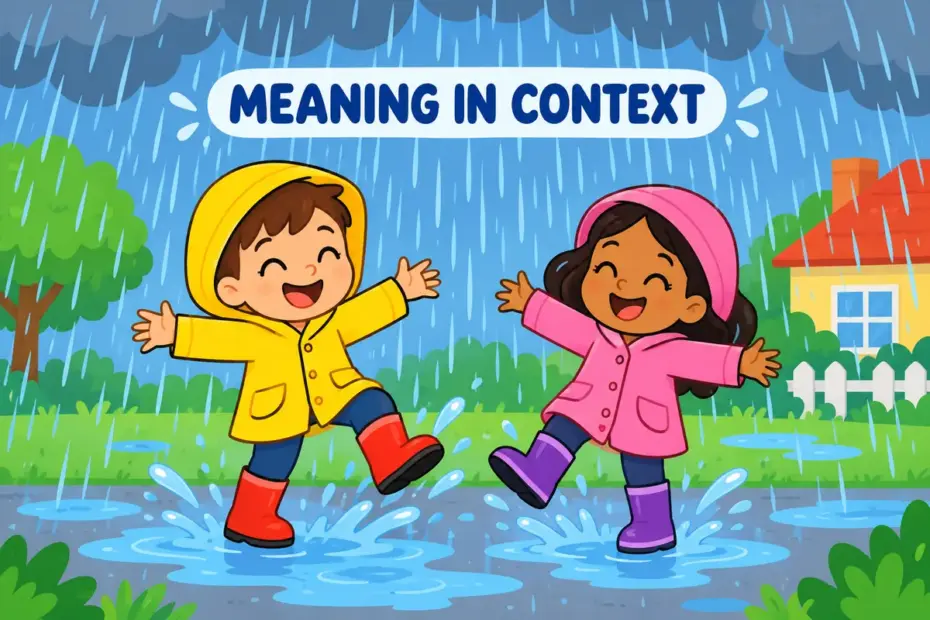
The phrase pour down in a sentence means rain heavily and continuously. Its grammar depends on the intended sense: rain + pour down. For example, “Rain poured down across the playground.” shows pour down in a natural, complete sentence with enough context to understand the expression.
Pour Down at a glance
- Part of speech: phrasal verb phrase with the base form pour down.
- Core meaning: Rain heavily and continuously.
- Grammar: rain + pour down is a common construction.
- Useful contrast: rain overlaps in meaning but does not fit every sentence.
- Common learner issue: selecting the right preposition or object for the intended sense.
What does pour down mean?
Pour Down is a phrasal verb meaning rain heavily and continuously. A common learner error is adding an object directly after the weather phrase: “The rain poured down the street” may be read as rain falling along the street, but “poured down on the street” clearly marks the surface. For a channel or route, “ran down the street” may be more exact.
| Sense | Plain meaning | Example |
|---|---|---|
| Heavy rain | Rain falls in a large, steady amount. | Rain poured down through the night. |
| Liquid moving down | A large quantity of liquid flows from a higher place. | Water poured down the steps after the pipe burst. |
The Cambridge Dictionary: pour down supports these core meanings and patterns. Nearby vocabulary includes cascade, deluge, and flood; each can express a related idea, but none automatically substitutes for every sense of pour down.
How do you use pour down in a sentence?
Pour Down takes different complements according to its meaning. These patterns show the particle or preposition’s job and whether a direct object is required. A common learner error is adding an object directly after the weather phrase: “The rain poured down the street” may be read as rain falling along the street, but “poured down on the street” clearly marks the surface. For a channel or route, “ran down the street” may be more exact.
| Pattern | Example | What it signals |
|---|---|---|
| rain + pour down | Rain poured down on the tents. | Rain is the subject; no object follows. |
| pour down on + place/person | Rain poured down on the cyclists. | On names what receives the rain. |
| water + pour down + from | Water poured down from the broken gutter. | From identifies the source of liquid. |
| be pouring down | It was pouring down when we left. | Progressive form describes ongoing heavy rain. |
It is not separable: keep the particle after the verb. The weather use is intransitive; rain is the subject, and on may introduce the affected surface. A liquid may also be the subject.

Pour Down in a sentence: examples across contexts
Each example gives enough surrounding detail to identify the sense. The subject, complement and preposition are part of the meaning, rather than decoration.
| Context | Example sentence | Why this works |
|---|---|---|
| Weather report | Rain poured down across the western hills before dawn. | The subject makes the weather sense unmistakable. |
| School | Rain poured down on the sports field, so the pupils moved indoors. | On marks the surface receiving the rain. |
| Conversation | It poured down all afternoon, and the garden path flooded. | The pronoun subject refers to the weather. |
| Travel note | Rain poured down as the bus crossed the bridge. | The clause gives a precise time relation. |
| Story | Water poured down the stairs after the upstairs tank split. | Water, rather than rain, signals literal liquid. |
| Work message | The storm poured down on the loading area during delivery. | The phrase describes weather affecting a location. |
| Garden | Rain poured down on the seedlings, so I emptied the trays. | A consequence explains why the rainfall matters. |
| Contrast | Rain fell lightly at breakfast, then poured down at noon. | The contrast shows the phrase implies a much heavier fall. |
Pour Down vs rain
Rain is a useful comparison because it overlaps with one sense of pour down, but its grammar or emphasis differs. Choose by asking what the sentence needs to communicate.
| Feature | pour down | rain |
|---|---|---|
| Core meaning | rain heavily and continuously | broader or adjacent meaning |
| Typical subject/object | rain + pour down | depends on the verb’s own pattern |
| Emphasis | the specific action or sense shown above | the related idea without the same nuance |
| Useful context | Weather report | general situations where the simpler word is enough |
| When to choose it | when the particle/preposition and context fit | when its plain meaning is the intended one |
Verdict: choose pour down when the sentence needs its specific pattern; choose rain when its broader or simpler meaning is intended.
Word forms and grammar of pour down
Use the form that matches the subject and time reference. Do not transfer the pattern of a related word automatically: the example in each row shows the form in a complete clause.
| Form | Use | Example |
|---|---|---|
| pour down | base form | Rain can pour down for hours. |
| pours down | third-person present | Rain pours down in summer storms. |
| poured down | past form | Rain poured down yesterday. |
| pouring down | present participle | It is pouring down now. |
Common mistakes with pour down
These errors arise when a learner treats the particle as a separate preposition or gives the verb an object pattern it does not take.
- Incorrect:
It poured down the umbrella.Correct: Rain poured down on the umbrella. Rule: The rain is the subject; on marks the surface affected. - Incorrect:
The rain poured heavily down.Correct: The rain poured down. Rule: Pour already suggests a heavy flow, so heavily is often redundant. - Incorrect:
It poured down the water from the roof.Correct: Water poured down from the roof. Rule: Name the liquid as subject when describing a literal flow. - Incorrect:
Rain pour down yesterday.Correct: Rain poured down yesterday. Rule: Use poured for a completed event in the past.
Practice using pour down
Complete each task by checking both meaning and grammar. The final two items ask for interpretation and revision, so more than one well-formed answer may be possible.
- Fill the gap: Rain poured down across the western hills before dawn.
- Choose the better word, pour down or rain: “Rain poured down on the sports field, so the pupils moved indoors.”
- Correct the error: “It poured down the umbrella.”
- Build a sentence that uses pour down on + place/person.
- Explain the meaning in this example: “It poured down all afternoon, and the garden path flooded.”
- Rewrite this sentence more precisely: “It happened.”
Answers
- Rain poured down across the western hills before dawn. — the context supplies the intended sense.
- pour down — the sentence follows the target phrase’s pattern.
- Rain poured down on the umbrella. — The rain is the subject; on marks the surface affected.
- Model: Rain poured down on the cyclists. — this uses the specified construction.
- The pronoun subject refers to the weather. — the subject and complement signal the sense.
- Model: Rain poured down across the playground. — the revised sentence names the subject and action.
The bottom line
Use pour down in a sentence when the subject and surrounding words support the intended meaning. The most useful distinction is a common learner error is adding an object directly after the weather phrase: “the rain poured down the street” may be read as rain falling along the street, but “poured down on the street” clearly marks the surface. If a simpler word communicates the point more clearly, prefer it.
Frequently asked questions about pour down
Does “pour down” always describe rain?
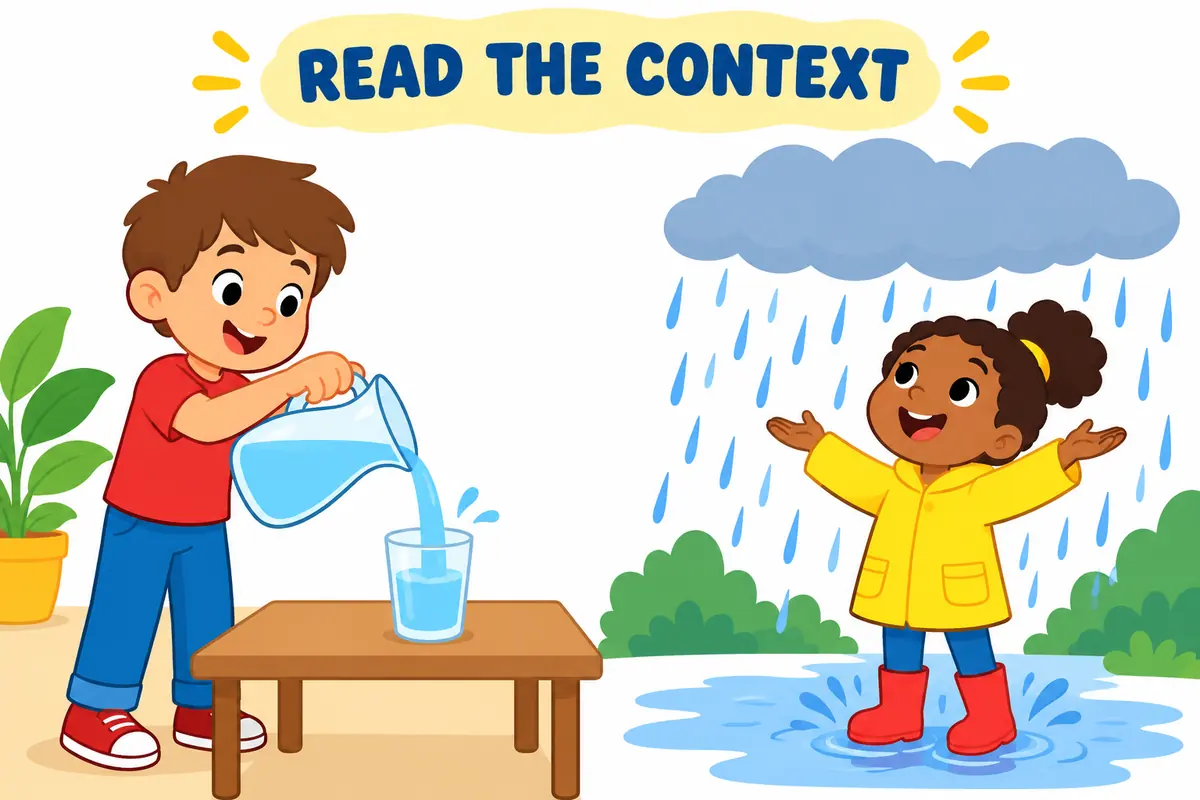
No. The phrase most often describes heavy rain, but it can describe a large amount of liquid moving down from a height. “Water poured down the steps” is literal, while “rain poured down” is the familiar weather use. The subject tells the reader which meaning is intended.
Is “pour down” transitive?
The weather use is intransitive: rain pours down, and no direct object follows. A place may be added with on, as in “rain poured down on the roof.” A literal liquid can also be the subject. Avoid treating the location as a direct object.
What is the difference between “pour down” and “pour”?
Pour can describe a person deliberately transferring liquid from a container, as in “pour the tea.” Pour down usually presents rain or liquid as a large downward flow. “Pour the rain” is not the ordinary weather construction; use “rain poured down.”
Can I say “it is pouring down”?
Yes. “It is pouring down” is a natural way to describe heavy rain happening now. The progressive form emphasizes ongoing weather. For one completed period, use a past form such as “It poured down all morning.” In ordinary weather talk, the phrase usually refers to rain.
Have you ever been caught in a sudden and heavy downpour? When rain comes pouring down in buckets, it can make everyday tasks challenging and leave you completely drenched.
“Pour down” is a phrasal verb that describes the action of rain falling heavily and continuously. This common expression is often used to vividly depict a heavy rainstorm or a sudden outpouring of water.
7 Examples Of Pour Down Used In a Sentence For Kids
- Raindrops pour down from the sky.
- The water will pour down from the tap.
- Milk will pour down from the bottle.
- Sand will pour down from the sieve.
- Yellow paint will pour down from the brush.
- The juice will pour down from the glass.
- Blue glitter will pour down from the jar.
14 Sentences with Pour Down Examples
- Pour down all your energy into studying for your upcoming exams.
- Don’t let the rain pour down on your parade, stay focused on your goals.
- Use your umbrella to shield yourself from the pouring down rain on your way to class.
- The professor’s words seemed to pour down on the students during the lecture.
- It’s important to stay motivated even when responsibilities pour down on you.
- The stress of assignments and projects can sometimes pour down on college students.
- Feeling overwhelmed by the workload can make it seem like deadlines are pouring down on you.
- Don’t let negative thoughts pour down on your self-confidence, stay positive.
- Finding a quiet spot to study can help you concentrate, even when distractions pour down around you.
- Sometimes, inspiration can pour down on you unexpectedly, so always be open to new ideas.
- The rain continued to pour down outside as students huddled in the library studying for exams.
- Procrastination can lead to a last-minute pouring down of stress when deadlines approach.
- Learning how to manage time effectively can help prevent tasks from pouring down on you all at once.
- When challenges pour down on you, remember that resilience is key to success in college.
How To Use Pour Down in Sentences?
Pour Down is a phrasal verb that means to rain heavily or pour with great force. When you want to describe heavy rain in a sentence, you can use this expression to convey that the rain is pouring down intensely.
For example:
– The rain began to pour down just as we were leaving the house.
– The storm caused the rain to pour down in sheets, making it hard to see.
To use Pour Down in a sentence, first, identify the subject (the rain) and the action (pour down). The subject can be the rain, snow, or any other substance that is falling heavily from the sky. Then, add the verb ‘pour down’ to indicate the intensity of the falling precipitation.
Keep in mind that Pour Down is used to emphasize the heaviness of the rain, so make sure to use it in situations where the rain is falling forcefully. Avoid using it for light drizzles or scattered showers.
In summary, when you want to describe heavy rain in your sentences, remember to use Pour Down to emphasize the intensity of the downpour. This phrasal verb will help you paint a vivid picture of the rainy conditions and add depth to your descriptions.
Conclusion
In conclusion, the phrase “pour down” is commonly used to describe heavy rain falling steadily from the sky. This expression vividly captures the image of rain pouring down in a continuous stream, creating a visual and sometimes audible impact. From sentences like “The rain began to pour down, flooding the streets” to “Dark clouds gathered overhead, threatening to pour down at any moment,” this phrase is frequently employed in describing weather conditions in a dramatic and descriptive manner.
Overall, “pour down” effectively conveys the intensity and persistency of rainfall in various contexts, allowing individuals to easily visualize and understand the atmospheric conditions being portrayed. It serves as a powerful descriptor in painting a vivid picture of heavy rain showers and adds depth to descriptions of weather-related scenes in writing and everyday conversation.


