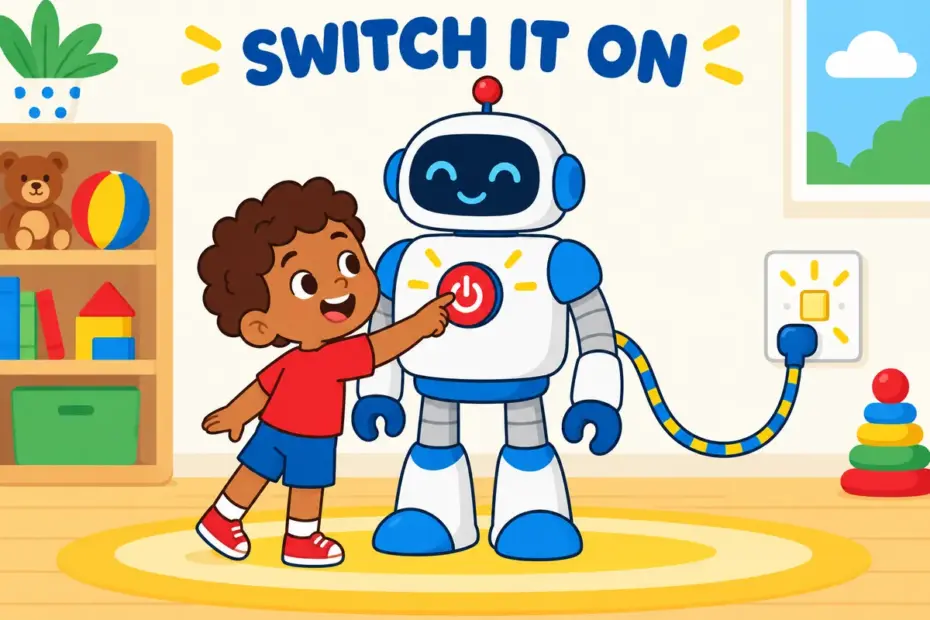
Power up means to switch on a device or supply it with electrical power. To use power up in a sentence, either keep the object after the phrase or split it: “She powered up the laptop” and “She powered it up” are both correct. The verb works transitively and intransitively.
Power up at a glance
- Power up is a separable phrasal verb meaning to switch on or supply with power.
- Its forms are powers up, powered up and powering up.
- It is transitive (power up the console) and intransitive (the console powered up).
- A pronoun object must sit between the verb and the particle: power it up.
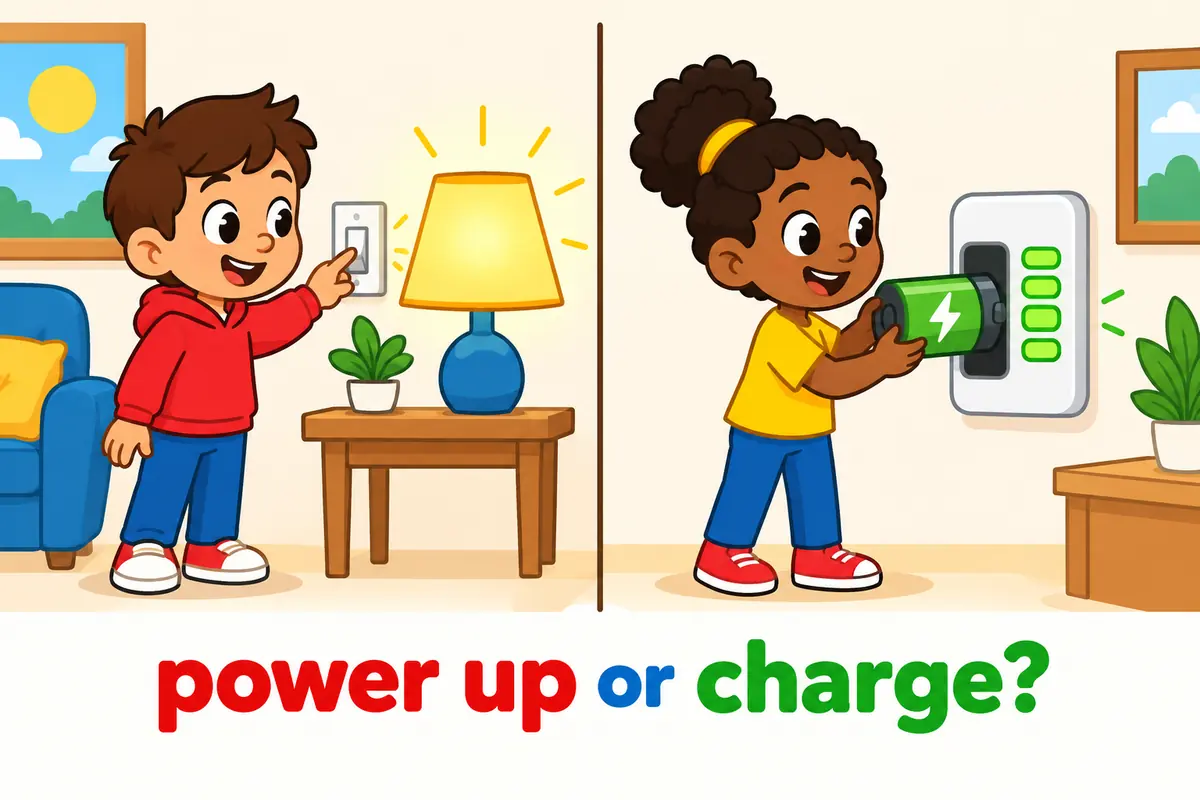
- The commonest error is confusing power up with charge, which stores energy rather than switching on.
What does power up mean?
Power up is a phrasal verb meaning to turn on a device or connect it to a supply of electricity, and by extension to make something stronger or ready to work. The Cambridge entry for power up records the electrical sense; the figurative and gaming senses grew from it. A child powers up a tablet by pressing its button; a coach says a pep talk powers up the team; a gamer grabs a power-up to gain an advantage. Where a machine becomes operative rather than merely receiving power, activate is the more formal choice.
| Sense | Plain meaning | Example sentence |
|---|---|---|
| Electrical | Switch on or supply power to a device | Power up the projector before the guests arrive. |
| Figurative | Make stronger, livelier or ready | The new signings powered up the whole squad. |
| Noun: power-up | A boost or bonus, especially in games | She collected a power-up that doubled her speed. |
One honest limit. Power up is not the same as recharge or charge. A device that is charging is storing energy, whether or not it is switched on; a device that powers up is switching on, whether or not its battery is full. Nor does power up mean repair: a broken machine will not power up no matter how long it is plugged in.
Register matters too. Power up belongs to technical help, games and sport, where it sounds brisk and modern. In a formal report, switch on or supply power reads more plainly.
How do you use power up in a sentence?
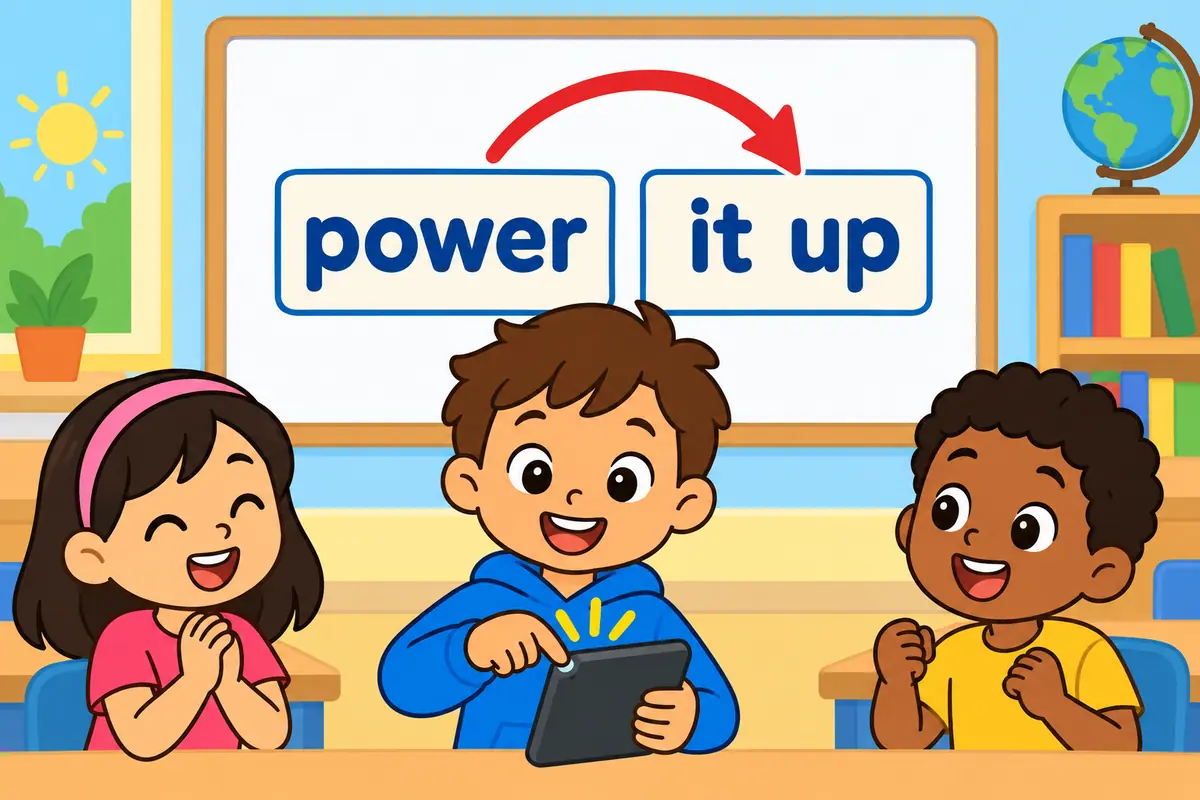
Power up is separable. The object may follow the particle, as in power up the printer, or come between verb and particle, as in power the printer up. A pronoun must go in the middle, so power it up is correct and power up it is not. The particle can also be left in place in a relative clause: the tablet that I powered up. As a phrasal verb of the same up family, back up behaves the same way with its object.
| Pattern | Example | What it signals |
|---|---|---|
| power up + object | Power up the computers before the lesson. | Neutral, particle after the verb |
| power + object + up | Power the computers up before the lesson. | Same meaning, object moved in |
| power + pronoun + up | Power them up one at a time. | The only correct place for a pronoun |
| power up (intransitive) | The screen powered up with a soft hum. | No object; the device is the subject |
| power + object + up + for + purpose | They powered the rig up for the broadcast. | Names the reason for switching on |
Power up in a sentence: examples across contexts
The examples below move from literal switching on to the figurative sense of giving something energy. Notice how often the object falls between power and up, and how the intransitive form lets the device itself be the subject.
| Context | Example sentence | Why this works |
|---|---|---|
| Classroom | Power up the tablets and open the reading app. | Direct instruction with the object after the verb. |
| Workplace email | Please power your laptop up before the call so it is ready. | Keeps the pronoun-free object in the middle. |
| Tech support | If the router does not power up, try another socket. | Uses the intransitive form for a fault. |
| Gaming | Collect the power-up on the left before the boss appears. | Uses the hyphenated noun for a bonus. |
| News report | Engineers powered the grid back up after the storm. | Shows the object between verb and particle. |
| Sports writing | A goal late in the half revived and powered up the crowd. | Figurative sense of renewed energy. |
| Stage management | The team powered the lights up one bank at a time. | Precise, sequential switching on. |
| Home conversation | Just start the console and let it power up on its own. | Contrasts starting with the powering process. |
| Aviation | Pilots power the aircraft up at least an hour before departure. | Formal use in a safety checklist. |
| Medical equipment | The nurse powered the monitor up and checked the reading. | Everyday professional use with an object. |
| Customer help | Unplug it, wait, then power it up again. | Pronoun correctly placed between verb and particle. |
| Logistics | The crew powered the scanners up at the loading bay. | Object sits between verb and particle in a work log. |
| Video call | Power your camera up before you join the meeting. | Instruction with the object in the middle. |
Power up vs charge
These two verbs sit side by side on every charger and every help page, and mixing them sends a reader to the wrong instruction.
| Attribute | Power up | Charge |
|---|---|---|
| Core meaning | Switch on or supply power | Put energy into a battery |
| What happens to energy | Energy flows to run the device now | Energy is stored for later |
| Device state | Turns on and becomes usable | May stay switched off |
| Typical object | computer, console, projector | battery, phone, electric car |
| Opposite action | Deactivate or shut down | Discharge or drain |
Verdict: to energize a device into action, power it up; to fill its battery, charge it. A tablet can charge all afternoon without ever powering up, and it can power up for a moment on a battery that is nearly flat.
Word forms and grammar of power up
| Form | Part of speech | Example |
|---|---|---|
| power up | phrasal verb, base | Power up the machine before use. |
| powers up | verb, third person singular | The laptop powers up in seconds. |
| powered up | verb, past and participle | They powered up the rig before dawn. |
| powering up | verb, present participle | The console is powering up now. |
| power-up (power-ups) | noun | He grabbed a power-up and kept running. |
The noun power-up is countable, so it takes a and a plural: a power-up, several power-ups. Writers who hyphenate the verb, as in power-up the console, create a common error, because the verb keeps a space.
Do not confuse the particle with the similar-looking verbs: to shut down is to switch off, and to power down is its near-synonym, the direct opposite of power up.
Common mistakes with power up
Incorrect: Power up it before the meeting. Correct: Power it up before the meeting. Rule: A pronoun object must sit between the verb and the particle.
Incorrect: I will charge the laptop so we can start work. Correct: I will power up the laptop so we can start work. Rule: Charge stores energy; power up switches the device on.
Incorrect: The battery needs to power up overnight. Correct: The battery needs to charge overnight. Rule: A battery is charged, not powered up; devices are powered up.
Incorrect: She powered up to the computer at nine. Correct: She powered up the computer at nine. Rule: Power up is transitive when it names a device, and it takes no to.
Incorrect: A power up doubled her score. Correct: A power-up doubled her score. Rule: The noun is hyphenated: a power-up, two power-ups.
Incorrect: The technician powered up the printer down. Correct: The technician powered the printer down. Rule: Power down means switch off, so it cannot combine with an up.
Practice using power up
- Fill in the blank: Please ___ the projector before the presentation begins.
- Choose the better word: I need to ___ my phone tonight, then ___ it in the morning. (charge / power up)
- Correct the error: Power up it and check the settings.
- Correct the error: The battery will power up in about two hours.
- Build a sentence: use power up with a pronoun object about a classroom set of tablets.
- Spot the register: which sentence belongs in a help guide – Just turn the thing on, or Power the unit up and wait for the light?
- Fill in the blank: The console ___ up with a bright logo and a chime.
- Build a sentence: use the noun power-up about a bonus in a game.
Answers
- power up – a direct instruction with the object after the verb.
- charge then power up – the first stores energy, the second switches on.
- Power it up and check the settings. – a pronoun goes between verb and particle.
- The battery will charge in about two hours. – batteries charge; devices power up.
- Power them up one row at a time and log each tablet in. – them sits in the middle.
- The second sentence – power up is precise and neutral for a help guide.
- powers – the third person singular keeps the particle with the verb.
- She found a hidden power-up behind the waterfall. – the hyphenated noun names a bonus.
The bottom line
Power up is a separable phrasal verb that means to switch on a device or supply it with power, and it works both with an object and without one. Keep a pronoun between the verb and the particle, and do not use it where charge is meant. Power up in a sentence is informal enough for help pages yet precise enough for a checklist.
Frequently asked questions about power up
Is power up one word or two?
The verb is always two words, as in power up the computer. The noun is hyphenated, as in a power-up in a game. So you power something up, and you collect a power-up. This follows the common English pattern where a phrasal verb opens up but its noun form closes with a hyphen.
Can you say power up it?
No. When the object is a pronoun, it must sit between the verb and the particle, so power it up is correct and power up it is not. With a full noun object either position works, giving power up the printer or power the printer up. Only the pronoun is fixed.
What is the past tense of power up?
The past tense and past participle are both powered up, as in they powered up the rig and the rig had powered up. The present participle is powering up. The verb follows the regular -ed pattern, and the particle stays after the object when there is one.
Is power up the same as charge?
No. Charge means to put energy into a battery so it can be used later, and the device may stay switched off. Power up means to switch the device on or supply it with running power. A phone can charge for an hour without powering up, and it can power up on a nearly empty battery.