
Pragmatic is an adjective meaning practical and sensible, based on what is likely to work rather than on theory or ideals. To use pragmatic in a sentence, apply it to a person, plan or decision: “They took a pragmatic view of the budget.” The word praises results over principle when a problem needs solving.
Pragmatic at a glance
- Pragmatic is an adjective; the adverb is pragmatically.
- It means practical and sensible, guided by what works.
- It usually comes before the noun: a pragmatic approach.
- The noun forms are pragmatism and pragmatist.
- The commonest confusion is treating pragmatic as a synonym for realistic or cynical.
What pragmatic means and when to choose it
Pragmatic is an adjective meaning practical and sensible, choosing what works over what theory or tradition prefers. The Cambridge entry for pragmatic gives this sense of dealing with problems in a practical way. It is close to realistic, but pragmatic stresses the method, not the estimate of what is possible. The word can sound faintly cold, because a pragmatic choice may set aside feelings or ideals.
| Sense | Plain meaning | Example sentence |
|---|---|---|
| Practical in method | Doing what works | She took a pragmatic route to the goal. |
| Guided by results | Judging by outcomes | The board wanted a pragmatic decision. |
| Free of ideology | Avoiding theory and dogma | His pragmatic reply ignored the slogan. |
One limitation is worth stating. Pragmatic is not a synonym for realistic, and it does not mean unprincipled. A realistic plan matches the facts; a pragmatic approach chooses the method that works. The word can imply that ideals were sacrificed, so describe a person as pragmatic only when that trade-off is intended, not when you mean warm or principled.
How do you use pragmatic in a sentence?
Pragmatic usually sits before a noun such as approach, view, solution or decision, and it can follow a linking verb, as in the plan was pragmatic. When you name the subject it faces, use about: pragmatic about the risks. A choice that is merely sensible can be called practical, but pragmatic adds the idea of setting a preference aside.
| Pattern | Example | What it signals |
|---|---|---|
| pragmatic + noun | a pragmatic solution | Directly labels the practical thing. |
| be + pragmatic | Her advice was pragmatic. | Describes an approach after a linking verb. |
| pragmatic about + noun | pragmatic about the deadline | Names the issue met with a practical attitude. |
| a pragmatic + person | a pragmatic manager | Characterises the person’s style. |
| pragmatically | Deal with it pragmatically. | Adverb for the manner of acting. |
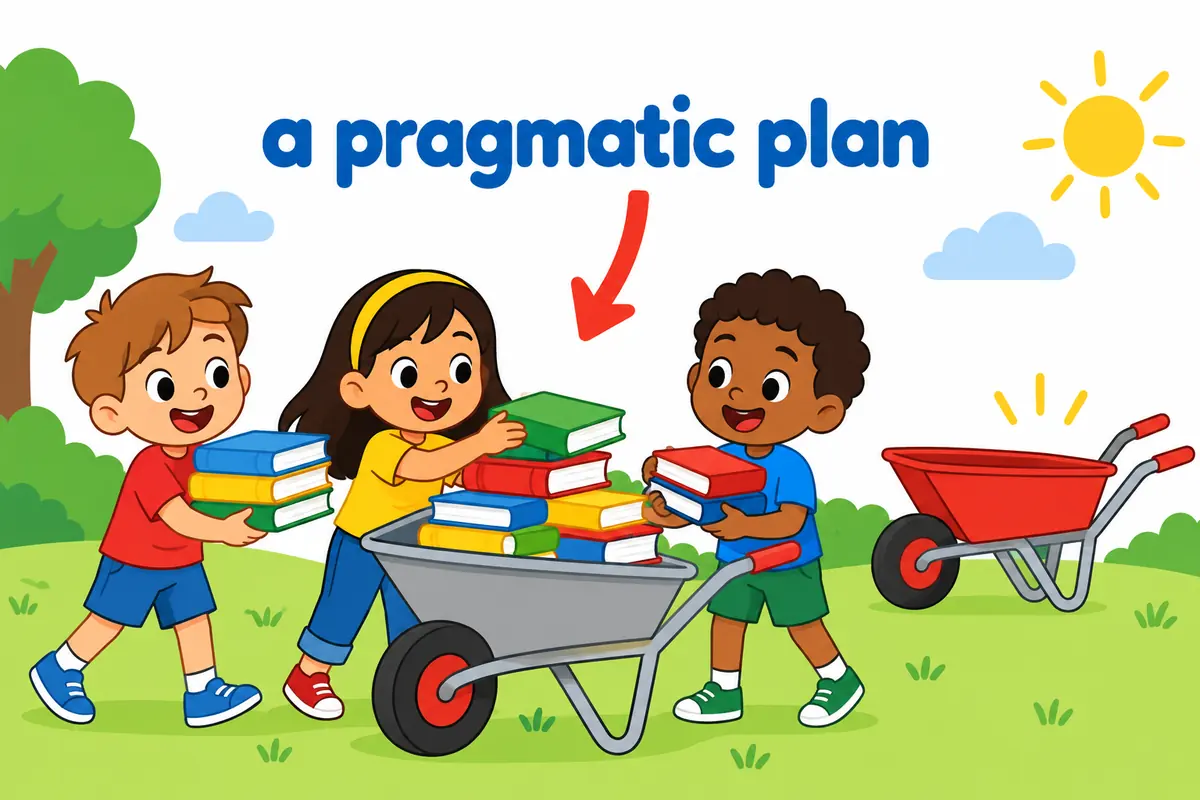
Pragmatic in a sentence: examples across contexts
These sentences show pragmatic attached to decisions, plans and people. A down-to-earth choice is warm and sensible; a pragmatic one is chosen because it works.
| Context | Example sentence | Why this works |
|---|---|---|
| Classroom | The teacher took a pragmatic approach and shortened the test. | A method chosen for what works in class. |
| Workplace email | We need a pragmatic plan that fits the budget. | A solution judged by practical fit. |
| News report | The mayor defended a pragmatic deal with the developers. | Reports a choice that set ideals aside. |
| Academic prose | The essay contrasts idealistic and pragmatic views of reform. | Uses the adjective in a formal contrast. |
| Sports writing | The coach made a pragmatic change at half time. | A decision based on results, not style. |
| Family talk | We were pragmatic and took the earlier train. | The linking verb pattern in speech. |
| Business review | Her pragmatic leadership steadied the company. | Characterises a person’s style. |
| Engineering report | A pragmatic fix kept the bridge open for a month. | A short-term solution that works. |
| Literary criticism | The hero trades his ideals for a pragmatic compromise. | Names the trade-off the word implies. |
Pragmatic or practical? Which to use
Pragmatic and practical are often confused because both mean roughly useful or sensible. Practical describes usefulness and hands-on value, while pragmatic describes a method chosen for results. The table shows where each word belongs.
| Attribute | pragmatic | practical |
|---|---|---|
| Meaning | Choosing what works | Connected to real use |
| Focus | Method and results | Usefulness of a thing |
| Typical noun | approach, view, deal | tool, advice, experience |
| Suggests ideals set aside | Often yes | No |
| Tone | Slightly cool or calculating | Neutral and warm |
Verdict: choose practical for usefulness and hands-on value, and pragmatic when the point is a sensible choice that may leave ideals behind.
Word forms and grammar of pragmatic
Pragmatic forms its adverb with -ally, and the noun family is busy: pragmatism names the outlook and pragmatist the person. A businesslike manner is close in tone, though it stresses efficiency rather than results. The table lists the forms and the misspelling learners produce.
| Form | Part of speech | Example |
|---|---|---|
| pragmatic | adjective | A pragmatic answer satisfied both sides. |
| pragmatically | adverb | She responded pragmatically to the delay. |
| pragmatism | noun | His pragmatism kept the talks alive. |
| pragmatist | noun, a person | As a pragmatist, she ignored the slogan. |
| pragmatics | noun, different field | Pragmatics studies meaning in context. |
| pragmaticly | non-standard spelling | Incorrect: handled pragmaticly. Correct: handled pragmatically. |
Common mistakes with pragmatic
- Incorrect:
She dealt with the problem pragmaticly.Correct: She dealt with the problem pragmatically. Rule: The adverb is formed with -ally, not -ly. - Incorrect:
He is pragmatic of the budget.Correct: He is pragmatic about the budget. Rule: The adjective pairs with about, not of. - Incorrect:
Her pragmatic ideals inspired everyone.Correct: Her noble ideals inspired everyone. Rule: Pragmatic means practical, so it clashes with ideals. - Incorrect:
That is a very pragmatic hammer.Correct: That is a very practical hammer. Rule: Tools and objects are practical; a pragmatic choice is a decision or method.
Practice using pragmatic
Work through the six items, then check the reasoning rather than only the key.
- Fill the gap: The committee made a ______ decision to delay the launch.
- Choose the better word: A folding chair is a (pragmatic / practical) choice for a small room.
- Correct the error: She dealt with the problem pragmaticly.
- Build a sentence: use pragmatic about about a tight deadline.
- Spot the register: which suits a business email — a pragmatic plan that works, or a really down-to-earth plan?
- Rewrite with the noun: He acted pragmatically and settled the case. Use pragmatism instead.
Answers
- pragmatic — the decision favours what works over what is ideal.
- practical — a useful object is practical; pragmatic describes choices and methods.
- She dealt with the problem pragmatically. — the adverb ends in -ally.
- Model answer: We must be pragmatic about the deadline and cut two features.
- A pragmatic plan that works. — a business email keeps the formal adjective.
- His pragmatism settled the case. — the noun names the outlook behind the action.
The bottom line
Use pragmatic in a sentence for a practical, results-first attitude, and keep it attached to the person, plan or decision that shows it. The two points that decide most sentences are that pragmatic pairs with about rather than of, and that it hints at ideals set aside, so practical is warmer when you simply mean useful. For the outlook itself, the noun is pragmatism.
Frequently asked questions about pragmatic
Does pragmatic have a negative meaning?
Sometimes. Pragmatic is neutral on its own, but it can carry a hint that ideals, feelings or principles were set aside for a practical result. A pragmatic deal may look cold to the people it disappoints. The word is not insulting, though, and it often signals good judgement.
What is the difference between pragmatic and practical?
Practical means useful or connected to real use, so it describes tools, advice and experience. Pragmatic means choosing what works, so it describes methods, decisions and people. A folding table is practical, while a manager who drops a pet project to hit a deadline is pragmatic.
What is the adverb of pragmatic?
The adverb is pragmatically, as in she answered pragmatically. A common spelling error adds -ly to the adjective to make pragmaticly, which is wrong; the ending is -ally. The related nouns are pragmatism, the outlook, and pragmatist, the person who holds it.
What is the opposite of pragmatic?
The most direct opposite is idealistic, describing somebody guided by ideals rather than results. Theoretical is another opposite when the contrast is with practical action, and quixotic mocks a hopelessly unrealistic plan. A pragmatic person asks what will work, while an idealistic one asks what is right.
Have you ever heard of the term “pragmatic” and wondered what it means? In simple terms, being pragmatic refers to taking a practical and realistic approach to solving problems or making decisions.
Often, being pragmatic means setting aside idealistic notions in favor of practicality and focusing on what works best in a given situation. It involves making decisions based on what will bring the most effective results rather than sticking strictly to theoretical or moral considerations.
Pragmatic describes an approach that is practical, sensible, and guided by the circumstances and likely results. A pragmatic person asks what can work in the situation at hand, then chooses a reasonable course of action. The word is an adjective: it modifies a person, decision, solution, policy, or approach.
What does pragmatic mean?
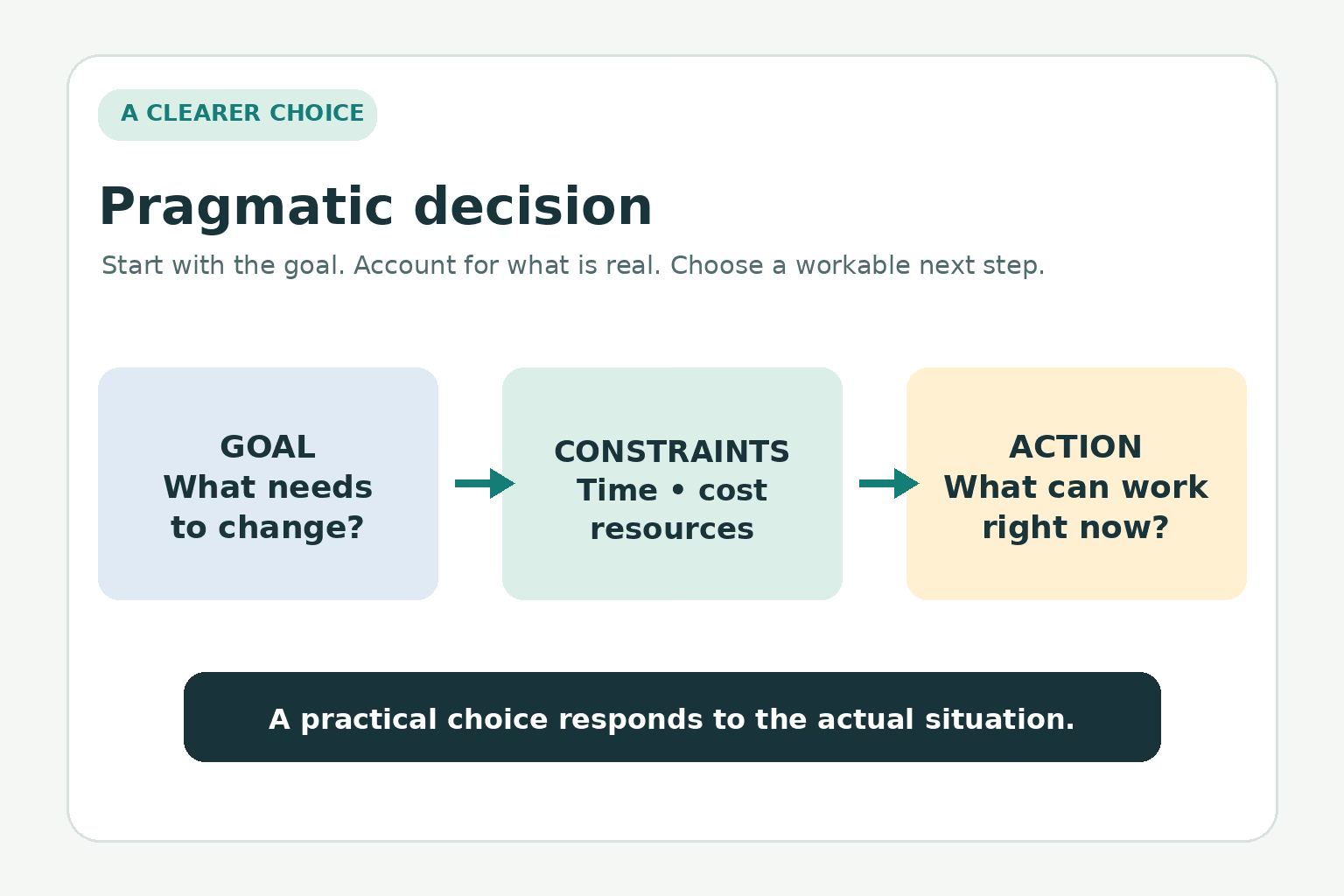
In everyday English, pragmatic means focused on what is workable in practice. It often describes someone who considers time, cost, available resources, and likely consequences before deciding. A pragmatic answer may be less ambitious than an ideal plan, but it is designed to solve the actual problem.
For example, if a class presentation is tomorrow and the group has little time, a pragmatic plan is to divide the remaining slides among the members and rehearse the most important sections. Rebuilding the entire presentation from scratch might be ideal under different conditions, but it may not be realistic now.
The word does not automatically mean selfish, unprincipled, or careless. A pragmatic choice can reflect ethical values; it simply takes practical conditions into account. The surrounding sentence tells readers whether the speaker views the choice positively, neutrally, or critically.
Pragmatic vs. practical
Practical usually emphasizes usefulness or suitability for real use. Pragmatic often emphasizes making a decision by weighing circumstances and likely outcomes. The words overlap, and in many sentences either one works, but pragmatic can highlight the reasoning behind a choice.
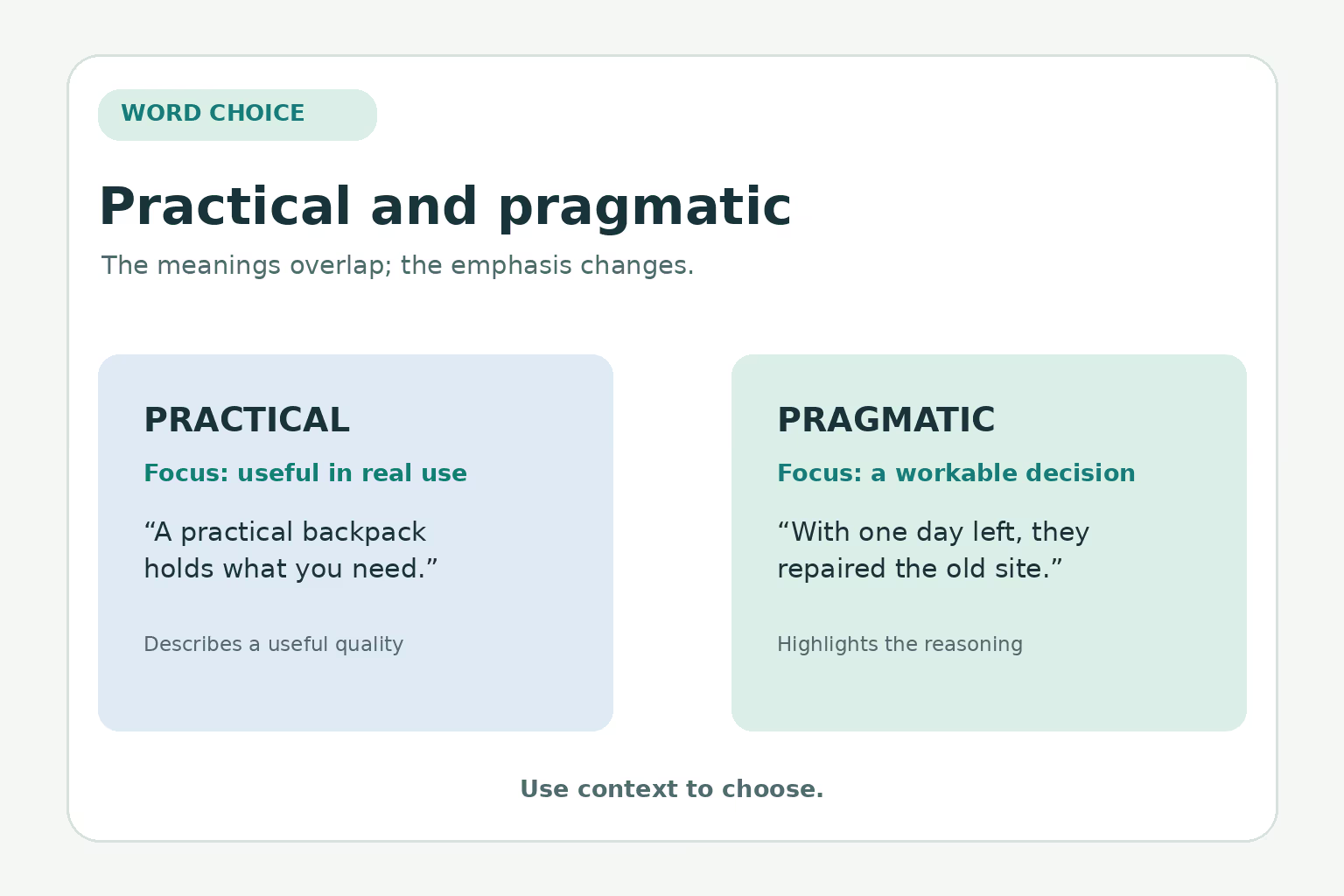
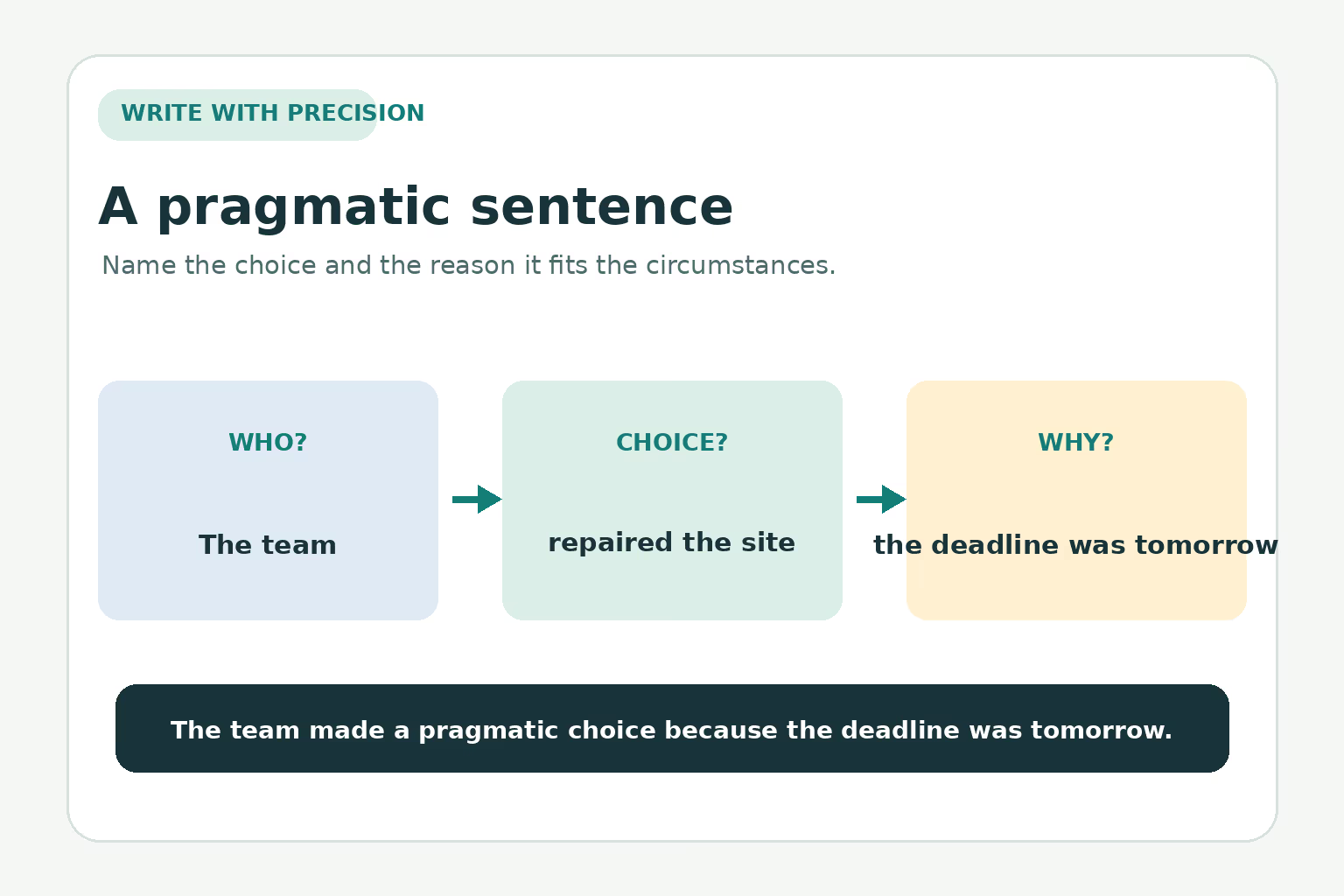
Practical example: “A practical backpack has padded straps and several compartments.” The sentence describes useful features. Pragmatic example: “Given the short deadline, the team made the pragmatic choice to repair the existing site.” This sentence emphasizes a decision shaped by time and available resources.
Compare pragmatic with idealistic as well. An idealistic plan is shaped by high principles or hopes; a pragmatic plan pays close attention to what can be achieved under present conditions. These approaches are not always opposites: a person can keep an ideal as a long-term goal and take pragmatic steps toward it.
How to use pragmatic in a sentence
Place pragmatic before a noun when you want to describe a practical quality: “They proposed a pragmatic solution.” It can also follow a linking verb: “Her response was pragmatic.” Common pairings include pragmatic approach, pragmatic decision, pragmatic solution, pragmatic compromise, and pragmatic policy.
A useful sentence pattern is: person or group + made a pragmatic choice + because of a real constraint or goal. Naming the reason helps readers see why the choice is pragmatic instead of leaving the adjective vague.
More pragmatic sentence examples
- With only one week before launch, the pragmatic team focused on fixing the checkout errors first.
- Her pragmatic budget left room for rent, food, savings, and an unexpected bill.
- The school took a pragmatic approach by offering the workshop online when the roads were unsafe.
- Rather than replace every chair, the office made the pragmatic decision to repair the sturdy ones.
- Our neighbor found a pragmatic way to water the garden during the restriction: she used collected rainwater.
- Because the original venue was unavailable, the organizers chose a pragmatic alternative near public transit.
- The proposal sounds pragmatic because it sets a goal, names the cost, and gives a realistic schedule.
- Although the ideal plan included a full renovation, the owner chose a pragmatic repair that made the kitchen safe.
- The mediator suggested a pragmatic compromise that addressed the deadline while leaving room for later discussion.
- He is pragmatic about job searches: he tailors each application and tracks the responses he receives.
Pragmatic, pragmatism, and pragmatics
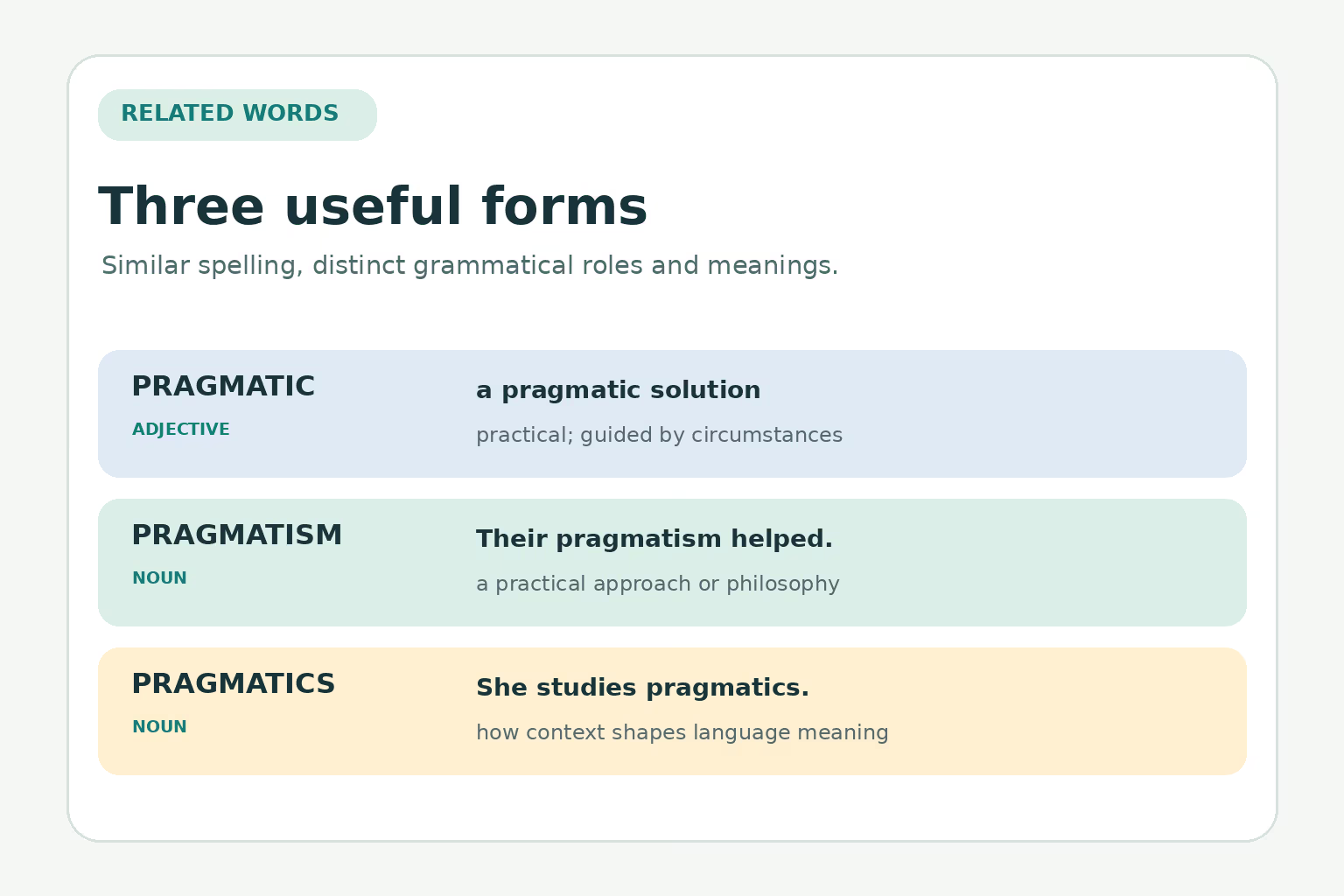
Pragmatic is an adjective: “a pragmatic decision.” Pragmatism is a noun for the habit or approach of dealing with situations in a practical way: “Their pragmatism helped the project recover.” It can also refer to a philosophical tradition, so context matters.
Pragmatics is a different-looking but related term used in linguistics. It names the study of how context, speaker intention, and the situation affect how language is understood. For example, the words “It’s cold in here” may be a simple observation in one setting and an indirect request to close a window in another. In this academic sense, pragmatic meaning concerns language use in context; it does not mean that the sentence itself is practical.
Common questions
Does pragmatic always have a positive meaning?
No. It can be approving, as in “a pragmatic solution,” or mildly critical if someone thinks a choice gives too much weight to immediate results. The word itself means practical or guided by the situation; the tone comes from context.
Is pragmatic the same as realistic?
The meanings overlap. Realistic emphasizes recognizing what is likely or possible, while pragmatic often emphasizes acting or deciding in light of those conditions. “A realistic estimate” focuses on the estimate; “a pragmatic decision” focuses on the choice.
What is the adverb form of pragmatic?
The adverb is pragmatically: “The council responded pragmatically by extending the deadline.” The noun form is pragmatism.
What is the opposite of pragmatic?
There is no single opposite in every context. Impractical means not suited to real use; idealistic emphasizes ideals over present constraints; and unrealistic means unlikely to work or happen. Choose the word that matches the contrast you intend.
For dictionary definitions and pronunciation, see Cambridge Dictionary’s entry for pragmatic and the Oxford Learner’s Dictionary entry. For the linguistics term, the Pragmatics & Discourse resource at Indiana University describes pragmatics as language use in context.

7 Examples Of Pragmatic Used In a Sentence For Kids
- Pragmatic means doing things that work well.
- It is pragmatic to think about how to solve a problem.
- Mom’s pragmatic solution was to pack extra snacks for the trip.
- Let’s be pragmatic and tidy up our toys after playtime.
- Dad’s pragmatic advice helped me finish my project on time.
- We can be pragmatic by making a plan before starting our homework.
- Being pragmatic means finding the best way to do things.
14 Sentences with Pragmatic Examples
- It’s pragmatic to start preparing for your exams early to avoid last-minute stress.
- Pragmatic time management is crucial for balancing academics and extracurricular activities.
- Being pragmatic about your expenses can help you save money during your college years.
- Forming a study group can be a pragmatic approach to comprehending difficult subjects.
- It’s pragmatic to seek guidance from professors when facing academic challenges.
- Utilizing campus resources such as the library and study rooms is pragmatic for productive studying.
- A pragmatic approach to internships can provide valuable work experience for your future career.
- Engaging in networking events is a pragmatic way to build connections in your field of interest.
- Keeping a pragmatic mindset can help you navigate through personal and academic setbacks.
- Staying organized and maintaining a planner is a pragmatic method for staying on top of deadlines.
- Incorporating regular exercise and healthy eating habits is pragmatic for overall well-being during college.
- Applying for scholarships and financial aid is a pragmatic strategy for managing college expenses.
- Setting realistic goals and breaking them down into smaller tasks is a pragmatic approach to achieving success in college.
- Participating in community service activities can be a pragmatic way to give back while gaining new skills and experiences.
How To Use Pragmatic in Sentences?
Pragmatic means practical or realistic. When using the word Pragmatic in a sentence, it is important to consider the context in which it is being used.
Here’s a guide on how to use Pragmatic in a sentence:
-
Identify the situation where a practical approach or realistic solution is required.
Example: “She took a pragmatic approach to solving the budget issue by cutting unnecessary expenses.” -
Ensure that the word Pragmatic accurately conveys the idea of being sensible and based on practical considerations.
Example: “In order to meet the deadline, the team decided to take a pragmatic approach to the project, focusing on the most important tasks first.” -
Use Pragmatic in sentences where a logical and efficient decision-making process is highlighted.
Example: “The manager’s pragmatic decision to outsource certain tasks led to increased productivity within the company.” -
Remember to use Pragmatic in a positive context, highlighting the value of practicality and realism in a given situation.
Example: “His pragmatic leadership style helped the team navigate through challenges and achieve their goals successfully.”
By following these guidelines, you can effectively incorporate the word Pragmatic into your sentences to convey a sense of practicality and efficiency.
Conclusion
In conclusion, sentences with pragmatic language aim to convey practical information and address real-life situations. By using words and phrases that are focused on achieving specific goals or outcomes, pragmatic sentences help individuals communicate effectively in various contexts. Whether it’s in a professional setting, everyday conversations, or problem-solving scenarios, pragmatic language plays a crucial role in promoting clear and efficient communication.
By understanding the importance of using pragmatic sentences, individuals can enhance their ability to express themselves clearly, navigate social interactions more effectively, and achieve successful communication outcomes. Practicing the art of crafting pragmatic sentences can lead to stronger relationships, clearer instructions, and better problem-solving skills in both personal and professional settings.


