Press on means to continue steadily despite difficulty, and it takes no object. To use press on in a sentence, put the subject before the verb and stop there: “The team pressed on through the storm.” The phrasal verb is intransitive, so nothing comes between press and on.
Press on at a glance
- Press on is an intransitive phrasal verb meaning to continue despite difficulty.
- Its forms are presses on, pressed on and pressing on; the particle never moves.
- The two words stay joined, so nothing can sit between press and on.
- It usually appears with a phrase such as through the rain, with the work or toward the goal.
- The commonest error is adding an object, as in pressed it on.
What does press on mean?
Press on is a phrasal verb meaning to continue doing something in a determined way even when it is hard. The Cambridge entry for press on records this sense of continuing, and the effort is always part of the meaning. It is easy to confuse with the ordinary verb press, which needs an object, and with the related phrase press for, which means to demand something.
| Sense | Plain meaning | Example sentence |
|---|---|---|
| press (push) | Push something firmly | Press the red button twice. |
| press on | Continue despite difficulty | They pressed on through the night. |
| press for | Demand or ask firmly | The staff pressed for a pay review. |
| press ahead | Continue quickly, more formal | The council pressed ahead with the plan. |
One limitation is worth stating plainly. Press on does not mean to finish or to succeed; it only means to keep going. A person can press on for hours and still fail, and a plainer verb such as continue the lesson is the better choice when no difficulty is involved.
How do you use press on in a sentence?
Because the verb is intransitive, the sentence ends at on unless a prepositional phrase follows. The particle on is fixed: it cannot move, and it cannot be separated from press, so there is nothing to place between the two words. The table below shows the frames that sound natural.
| Pattern | Example | What it signals |
|---|---|---|
| press on (no object) | The climbers pressed on through the wind. | The core intransitive frame. |
| press on with + noun | She pressed on with the report. | Names the task being continued. |
| press on + to / toward + place | They pressed on toward the next village. | Gives a direction for the effort. |
| presses / pressed / pressing on | He presses on regardless of the noise. | The two words stay joined in every tense. |
| be pressing on | We were pressing on when the light failed. | Continuous action already under way. |
Writers who want a more formal tone often choose proceed with the plan, which is transitive with with and sounds at home in minutes and reports. Where the difficulty is physical, some reach for endure the cold, and where the goal is ambitious they may strive for progress; press on is the warmer, more physical choice of the three.
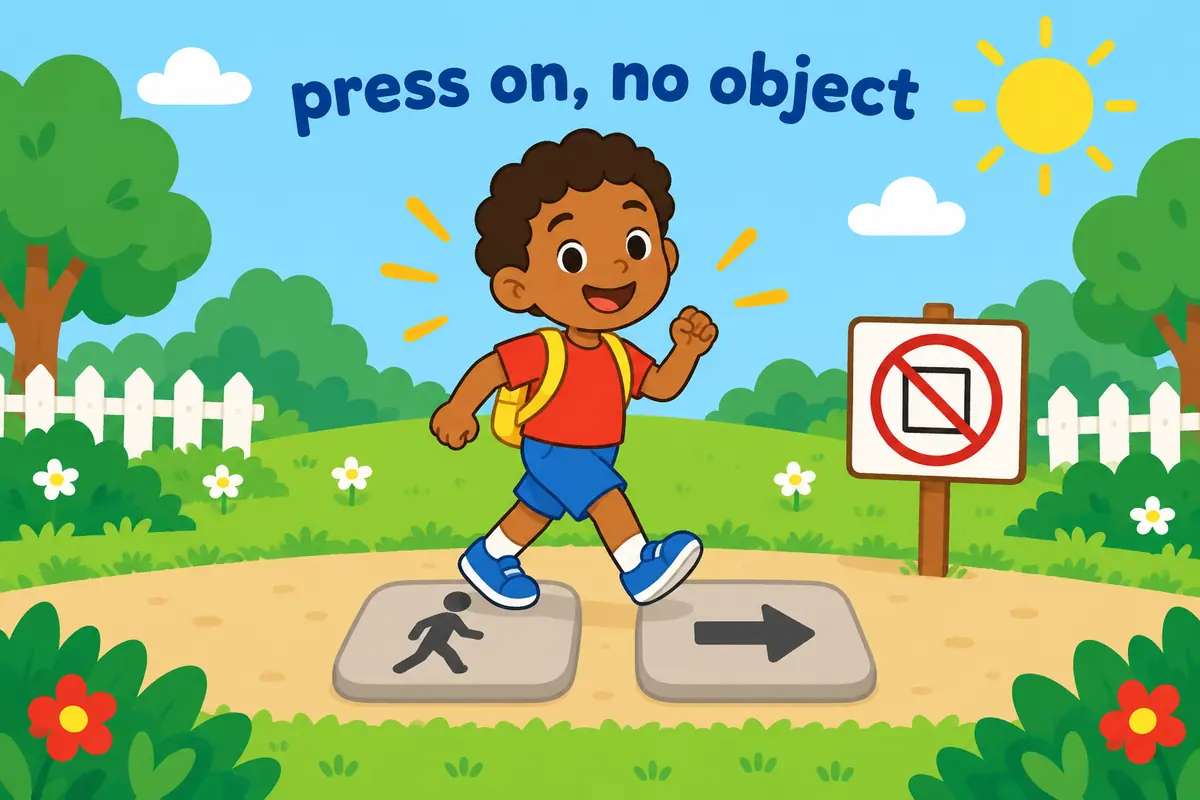
Press on in a sentence: examples across contexts
The verb keeps one meaning but moves easily between registers. The ten sentences below run from a pep talk to a news bulletin, and each one supplies the difficulty that makes pressing on worthwhile.
| Context | Example sentence | Why this works |
|---|---|---|
| Encouragement | We are nearly at the top, so press on for another ten minutes. | The imperative gives direct, friendly encouragement. |
| Workplace email | The design team pressed on with the survey despite the delay. | Names the task with with and the obstacle. |
| News report | Rescue crews pressed on through the night to reach the village. | Serious tone suits the effort and the time frame. |
| Sports writing | The runners pressed on as the rain turned the track to mud. | The worsening conditions justify the verb. |
| Travel memoir | We pressed on toward the pass, though our legs were heavy. | Direction plus fatigue fits the frame. |
| Academic prose | The researchers pressed on with the trial after the first setback. | With introduces the formal object of effort. |
| Motivational talk | When the plan looks hopeless, press on anyway. | The short clause makes the advice memorable. |
| Fiction | She pressed on along the dark corridor, counting the doors. | Adds a concrete action to the steady effort. |
| Business report | The firm pressed on with expansion even as costs rose. | Signals determination in a formal register. |
| Conversation | I told him to press on and not worry about the mess. | The plain verb fits casual speech. |
| Study advice | Press on with the revision even when a topic feels dull. | With names the task; the advice stays concrete. |
| Military history | The column pressed on through the rain and reached the bridge by dawn. | A serious register suits the effort and the deadline. |
| Volunteering | The clean-up crew pressed on until the last bag was filled. | Shows steady effort toward a clear finish. |
Press on vs carry on and persevere
Three expressions describe continuing, and the choice depends on the difficulty and the tone. carry on with the work is neutral and everyday; persevere through setbacks is formal and stresses patience; press on sits between them and suggests steady physical effort.
| Attribute | press on | carry on | persevere |
|---|---|---|---|
| Core meaning | Continue despite difficulty | Continue as before | Keep trying patiently |
| Difficulty implied | Always | Often none | Always, over time |
| Takes an object | No, but with may follow | Yes, with a task | No |
| Register | Neutral to serious | Neutral and casual | Formal |
| Typical subject | People, teams, crews | Anyone | A determined person |
Verdict: use press on when effort meets resistance, carry on for a plain instruction to keep going, and persevere when patience over a long stretch is the point.
Word forms and grammar of press on
The verb inflects on the first word only, so on never changes. Because the particle is fixed, the phrasal verb has no separable form, unlike a verb such as turn on. The table also separates the literal verb press, which is transitive, from the phrasal verb.
| Form | Part of speech | Example |
|---|---|---|
| press on | phrasal verb, base form | We must press on before dark. |
| presses on | phrasal verb, third person singular | She presses on without complaint. |
| pressed on | phrasal verb, past and past participle | They pressed on through the fog. |
| pressing on | phrasal verb, present participle | The crew is pressing on regardless. |
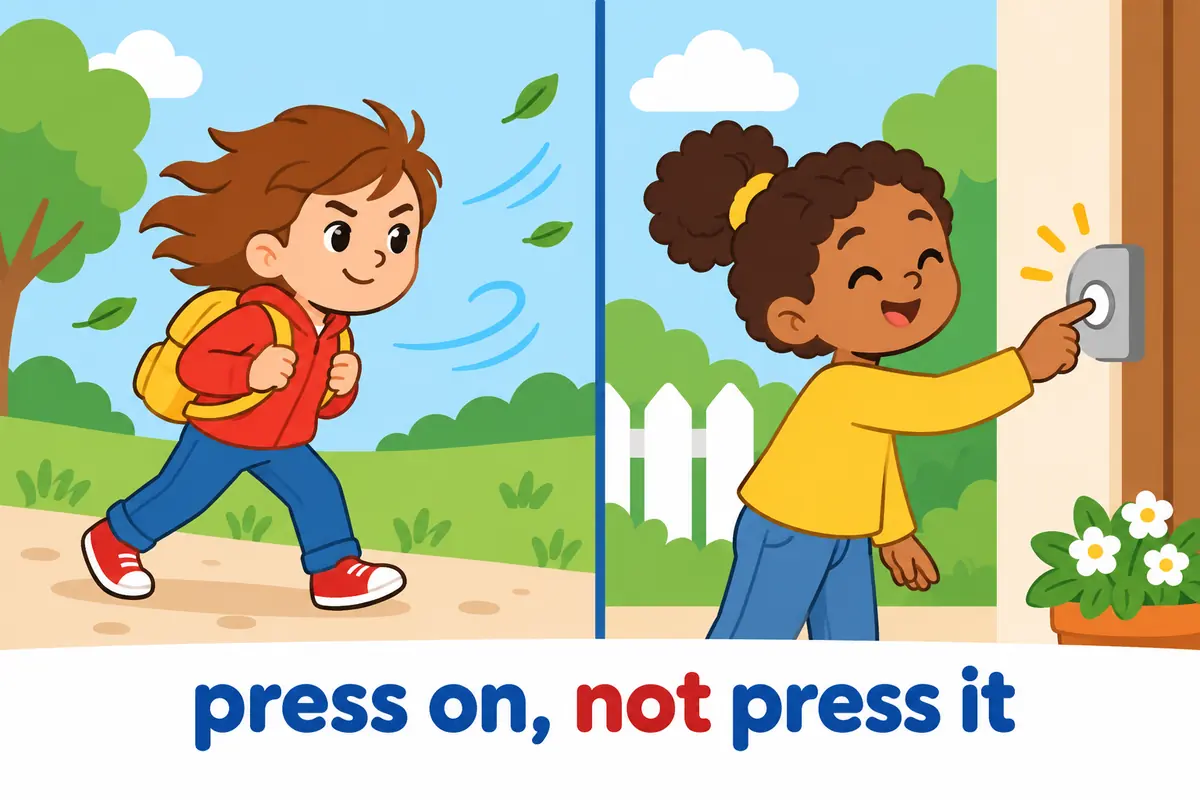
| press on (literal) | verb + preposition, different meaning | Press on the button to start. |
Stress falls on press, and the particle on is unstressed, which is why the two words sound like one unit in speech. That rhythm is a useful test: if on carries the emphasis, the sentence probably uses the literal verb and a preposition rather than the phrasal verb.
Common mistakes with press on
- Incorrect:
She pressed it on despite the warnings.Correct: She pressed on despite the warnings. Rule: Press on is intransitive, so nothing sits between press and on. - Incorrect:
They pressed on the team to hurry.Correct: They pressed the team to hurry. Rule: To push or urge someone is the plain verb press, which takes an object. - Incorrect:
We pressed on with.Correct: We pressed on with the work. Rule: The preposition with still needs a noun phrase after it. - Incorrect:
The hikers pressed on the mountain.Correct: The hikers pressed on toward the mountain. Rule: Use to or toward for a destination, not on. - Incorrect:
He pressed on hardly and kept going.Correct: He pressed on and kept going. Rule: Hardly means barely, which reverses the sense of determined effort.
Practice using press on
Work through the six items, then read the reasoning rather than only the answer.
- Fill the gap: The search party ______ through the snow until midnight.
- Choose the better word: The manager urged the staff to (press on / press on with) the audit despite the delay.
- Correct the error: They pressed the plan on even after the funding fell through.
- Build a sentence: use press on about a student finishing a long essay.
- Spot the register: which belongs in a news bulletin — crews pressed on through the night, or crews just kept going and stuff?
- Rewrite in the past tense: The climbers press on toward the summit.
- Fill the gap: The volunteers ______ with the clean-up long after sunset.
- Correct the error: He pressed on hardly until the job was finished.
Answers
- pressed on — the search party continues with no object after the verb.
- press on with — with names the audit, the task being continued.
- They pressed on with the plan — the two words stay joined and with carries the object.
- Model answer: She pressed on with the essay even when the argument became difficult.
- Crews pressed on through the night — a bulletin avoids slang such as stuff.
- The climbers pressed on toward the summit — only press changes in the past tense.
- pressed on — the crew continues with no object after the verb.
- He pressed on until the job was finished — hardly means barely and reverses the sense.
The bottom line
Use press on in a sentence when someone continues steadily through difficulty, and keep the two words joined because the verb takes no object. The two facts that decide most sentences are these: the particle on is fixed, so pressed it on is wrong, and the plain verb press is the transitive choice for pushing something. Where the effort is long and patient, persist in the attempt or persevere is the stronger word.
Frequently asked questions about press on
Is press on separable?
No. Press on is an intransitive phrasal verb, so the particle on is fixed and cannot be moved. There is no object to place between the two words, and a sentence such as they pressed it on is not correct. Contrast a separable verb like turn on, where turn the light on is fine.
Does press on take an object?
Press on itself takes no direct object. It can be followed by with plus a noun, as in press on with the work, or by a directional phrase such as toward the goal. The bare verb press does take an object, as in press the button, but that is a different sense.
What is the difference between press on and carry on?
Press on always implies resistance, so it suits wind, delay or fatigue. carry on with the task is neutral and can describe simply continuing something pleasant or routine. Choose press on when the effort costs something, and carry on for a plain instruction.
Can press on mean to push a button?
Only the plain verb press has that sense, and it needs an object: press the button, press the lever. Press on means to keep going and is never used for operating a control. The two look similar in writing but belong to different senses of press.