
Prestige in a Sentence: Meaning and Usage
Prestige is a noun meaning the respect, admiration, or standing that people associate with a person, organization, place, or achievement. It is usually connected with reputation, perceived quality, success, or position. Prestige describes how others regard something; it does not by itself prove that the thing is popular, wealthy, powerful, or objectively excellent.
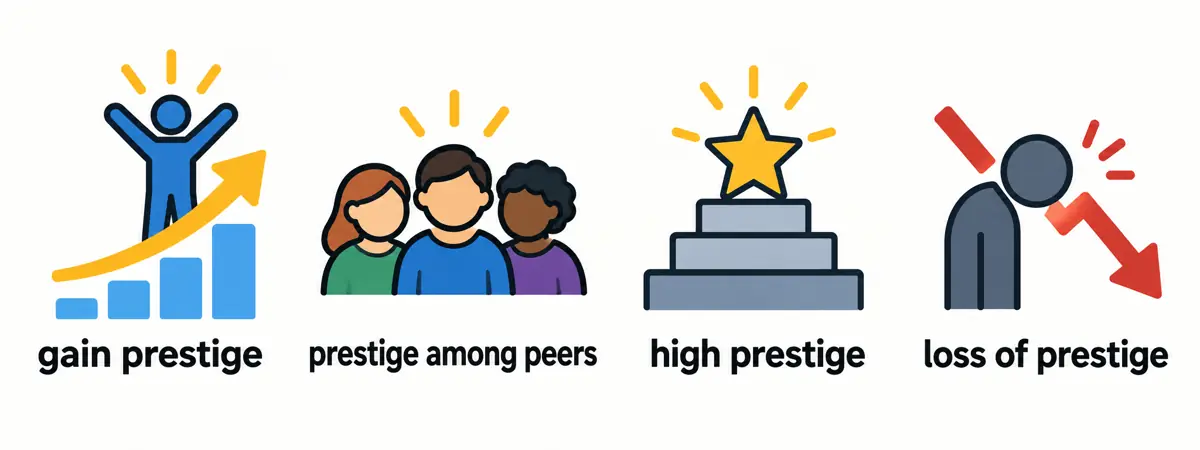

Use prestige as an uncountable noun: write “the award brought the project prestige,” “a role with considerable prestige,” or “the organization lost prestige.” Avoid “a prestige” when you mean one instance of respect. For one honor or distinction, use a countable noun such as honor, award, or distinction.
Common sentence patterns
| Pattern | Example sentence | What it expresses |
|---|---|---|
| gain, earn, or enjoy prestige | The neighborhood theater gained prestige after its productions received strong reviews. | Its standing increased or was recognized. |
| the prestige of | The prestige of the fellowship attracted applicants from several fields. | The regard associated with something. |
| prestige among, with, or within | The conservation award carries prestige among local historians. | The group whose regard is being described. |
| high, considerable, or little prestige | The title has considerable prestige within the profession. | The degree of public or group esteem. |
| lose or damage prestige | The institution lost prestige after it failed to address the documented problem. | A decline in reputation or standing. |
Prestige, prestigious, and popularity
Prestige is the noun: “The prize added prestige to the program.” Prestigious is the adjective: “She received a prestigious fellowship.” The adjective normally appears before a noun or after a linking verb. In compounds such as prestige brand or prestige job, prestige can modify a noun; that pattern does not make the noun countable.
Popularity means being liked or followed by many people, while prestige means being regarded with esteem. A small specialist society may have prestige among experts without being widely known. Fame means being widely known and does not necessarily imply respect. Choose the word that matches the point you intend to make.
More examples with prestige
- The museum’s careful conservation work earned it prestige among regional researchers.
- For the award, prestige mattered less to Nia than the chance to support new writers.
- The restaurant’s reputation brought prestige to the street, but neighbors also valued its affordable lunches.
- After the review, the panel’s decision lost some of its prestige with the public.
- He accepted a position with little prestige because it gave him the work experience he wanted.
These examples show that prestige can rise or fall and that a sentence can name whose opinion matters. To avoid presenting social status as an objective fact, attribute the judgment when appropriate: “widely regarded as prestigious,” “prestige among its members,” or “the award is considered prestigious by reviewers.”
Quick answers
Is “prestige” countable?
Usually no. It is an uncountable noun, so use “much prestige,” “high prestige,” or “a great deal of prestige,” rather than “a prestige.”
Is prestige the same as respect?
They overlap, but prestige often describes broader standing or esteem attached to a reputation, role, institution, or achievement. Respect can also describe how one person treats another.
What is the adjective form?
Prestigious is the usual adjective, as in “a prestigious scholarship.”
Can prestige be negative?
The word usually refers to favorable esteem, but a sentence can discuss losing or lacking prestige. It can also describe a status system without endorsing that system.
Have you ever wondered what the word “prestige” truly means? Prestige refers to the reputation, esteem, or influence associated with a person, institution, or place, often stemming from success, achievement, or societal status.
In society, prestige can open doors to opportunities, command respect, and distinguish individuals or organizations from others. The concept of prestige is embedded in various aspects of our lives, from careers and education to social circles and consumer choices.
7 Examples Of Prestige Used In a Sentence For Kids
- Prestige is a fancy word that means being very important.
- Teachers have a lot of prestige because they help us learn new things.
- It feels good to accomplish something and earn prestige from others.
- Our school has a lot of prestige because it is known for good quality education.
- People who work hard and are kind to others often gain prestige in their community.
- You can earn prestige by being honest and doing your best in everything you do.
- Prestige can come from being respectful and showing good manners to everyone.
14 Sentences with Prestige Examples
- Prestige plays a key role in determining the reputation of a college among students and parents.
- Academic achievements are often seen as a measure of a college’s prestige.
- Being associated with a college of high prestige can open up many opportunities for students in the future.
- Many students aspire to study at prestigious institutions in order to enhance their own prestige.
- Alumni of prestigious colleges often carry the prestige of their alma mater throughout their careers.
- Scholarships can be a great way for students to gain entry into prestigious colleges and enhance their prestige.
- Building a strong network within a prestigious college can help students maintain their prestige in their chosen field.
- Students often feel pressure to perform well in order to uphold the prestige of their college.
- Attending a college with a strong prestige can boost a student’s confidence and self-esteem.
- College rankings are often based on factors such as prestige, faculty quality, and infrastructure.
- Participating in extracurricular activities can help students enhance their prestige and stand out among their peers.
- Networking events and career fairs can provide students with valuable opportunities to build their prestige in the industry.
- Collaborating on research projects with prestigious professors can greatly enhance a student’s academic prestige.
- Presenting a research paper at a prestigious conference can significantly boost a student’s prestige in the academic community.
How To Use Prestige in Sentences?
To use the word “Prestige” in a sentence, start by understanding its meaning. Prestige refers to respect and admiration that someone or something receives based on their achievements, reputation, or success.
Begin your sentence by introducing the context in which you want to use the word. For example, “The prestigious university offered me a scholarship” highlights how the university is highly regarded for its academic excellence.
Another way to use “Prestige” is by describing an event or situation that conveys a sense of honor or high status. For instance, “Attending the prestigious awards ceremony was a dream come true” emphasizes the importance and exclusivity of the event.
You can also use “Prestige” to refer to a person’s reputation or standing within a particular community. For example, “She is known for her prestige in the fashion industry” indicates that she is highly respected and influential in that field.
In summary, when incorporating Prestige into your sentence, remember to consider its meaning as a symbol of honor, reputation, or high status. By using it appropriately, you can effectively convey a sense of admiration or respect for someone or something.
Conclusion
In conclusion, sentences with prestige are characterized by sophistication, elegance, and a sense of importance. They often reflect a high level of education, intelligence, and culture, conveying authority and respect. These sentences are crafted with precision and clarity, using refined language and complex structures to convey complex ideas and convey a sense of sophistication.
When using sentences with prestige, individuals are able to command attention, establish credibility, and showcase their knowledge and expertise. Whether in formal writing, public speaking, or everyday conversations, sentences with prestige can elevate the speaker’s perceived status and influence. Embracing such sentences can help to enhance communication, demonstrate professionalism, and leave a lasting impression on the audience.


