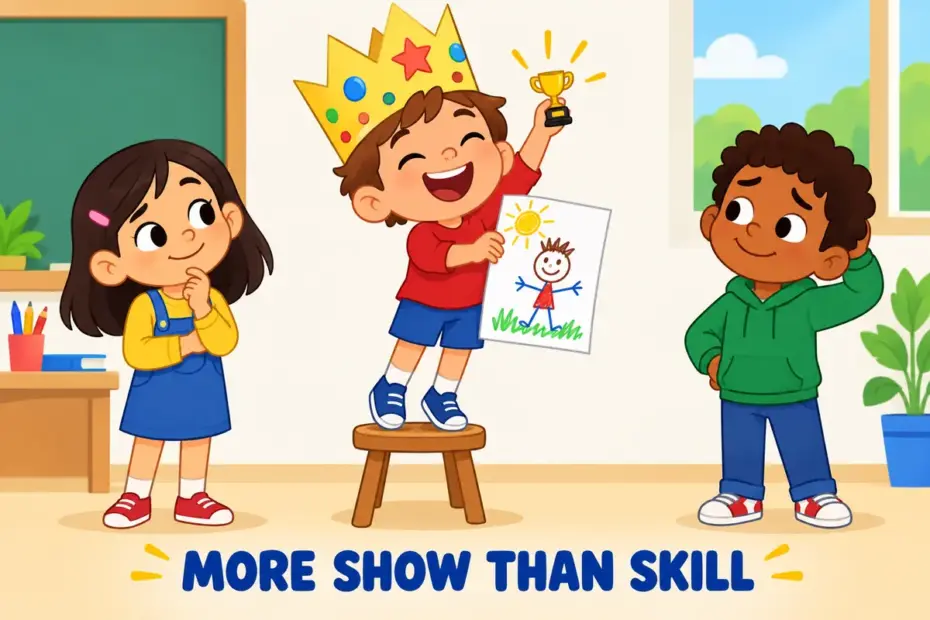
Pretentious describes someone or something that claims more importance, talent or culture than it really has. To use pretentious in a sentence, aim it at the gap between the claim and the substance: a pretentious film, a pretentious review, a pretentious compliment. The word is disapproving, so it works as a criticism rather than a neutral description.
Pretentious at a glance
- Pretentious is a disapproving adjective; its adverb is pretentiously and its noun is pretentiousness.
- The usual pattern is pretentious + noun: a pretentious film, a pretentious title.
- It also follows linking verbs, as in the speech sounded pretentious.
- It targets people, art, food, decor and writing that put on an air of importance.
- The commonest error is treating pretentious as a synonym for expensive, fancy or simply difficult.
What does pretentious mean?
Pretentious is a disapproving adjective meaning trying to appear more important, talented or cultured than one really is. The Cambridge entry for pretentious centres on the attempt to seem impressive, and that attempt is what the word punishes. A grand claim is grandiose when it reaches for scale, but pretentious when it reaches beyond the truth. The adjective applies to people and to the things they make, so a menu, a novel or a wine list can all be pretentious.
| Sense | Plain meaning | Example sentence |
|---|---|---|
| Person | Claims status or taste they lack | He is pretentious about the films he has never finished. |
| Object | Designed to seem more cultured than it is | The menu was pretentious and the portions were small. |
| Language | Written to sound learned rather than clear | A pretentious report hides a simple idea in long words. |
One honest limit: pretentious is a judgement about intent, and it is easy to misuse. A genuinely difficult book is not pretentious just because it is hard; the word lands only when the claim to importance visibly exceeds the substance. When the complaint is only that something is costly or ornate, expensive or showy is the fairer word.
How do you use pretentious in a sentence?
Pretentious describes a noun directly or follows a linking verb such as seem, sound or be. It can take about or in for the thing the person claims to know, but it never takes a direct object.
| Pattern | Example | What it signals |
|---|---|---|
| pretentious + noun | They published a pretentious review. | Direct criticism of the thing named. |
| linking verb + pretentious | The speech sounded pretentious. | A judgement about how it came across. |
| too / rather + pretentious | The decor is rather pretentious. | Degree, usually with dry disapproval. |
| pretentious about + topic | He is pretentious about opera. | Calls out a specific claimed expertise. |
| pretentious in + noun | She is pretentious in her tastes. | Locates the affectation in a field. |
Pretentious in a sentence: examples across contexts
Each row below uses pretentious in a different register, from a film review to a plain-speaking aside.
| Context | Example sentence | Why this works |
|---|---|---|
| Film review | The trilogy is pretentious rather than profound. | Sets the word against a genuine virtue. |
| Restaurant review | Pretentious descriptions cannot rescue a plain plate of pasta. | The menu, not the food, is the target. |
| Workplace email | Let us drop the pretentious jargon and say what we mean. | Turns the adjective into a practical request. |
| Academic writing | Reviewers found the essay pretentious and thinly sourced. | Pairs taste with evidence. |
| Conversation | He calls every wine pretentious unless it comes from his own shelf. | The first person shows the charge can be unfair. |
| Book blog | A pretentious narrator can still be funny if the author knows it. | Acknowledges deliberate use for effect. |
| Art criticism | The installation felt pretentious, all statement and no craft. | Names the missing substance directly. |
| Teacher feedback | Your conclusion sounds pretentious because it claims more than you proved. | Explains the gap in a teaching voice. |
Pretentious vs pompous
Pompous is the nearest confusable, because both words criticise an inflated self-image. They fault different things.
| Attribute | Pretentious | Pompous |
|---|---|---|
| Core meaning | Claims substance it lacks | Behaves with self-importance |
| What it criticises | The gap between claim and reality | The manner of speaking or behaving |
| Typical target | A film, menu, essay or poseur | A speech, ceremony or official |
| Source of the flaw | Pretending to be more than one is | Believing in one’s own importance |
| Register | Disapproving, conversational and critical | Disapproving, often formal |
| What it implies | The substance is missing | The dignity is inflated |
A pompous speaker is vain about their own stature, while a pretentious one borrows a stature they do not own. An ostentatious display is a third thing again: it shows off wealth rather than pretending to wisdom. The verdict: use pretentious for a false claim to importance, pompous for an inflated manner, and ostentatious for obvious wealth on show.
Word forms and grammar of pretentious
| Form | Part of speech | Example |
|---|---|---|
| pretentious | adjective (base) | The title is pretentious for a short poem. |
| more pretentious / most pretentious | comparative, superlative | That poster is more pretentious than the last. |
| pretentiously | adverb | The room was pretentiously named the salon. |
| pretentiousness | noun, quality | Reviewers mocked the pretentiousness of the script. |
| pretension | noun, the claim itself | The book has literary pretensions it cannot meet. |
| pretence | noun, false display | Her calm was a pretence of expertise. |
The noun pretension names the claim itself, often in the plural as literary pretensions. Do not confuse it with pretence, which means a false display or the act of pretending, and shares the root without the same frown.
Common mistakes with pretentious
- Incorrect:
The hotel was pretentious because it cost so much.Correct: The hotel was expensive because it cost so much. Price is not the fault pretentious describes; the word targets a false claim to class. - Incorrect:
She is very pretentious about her work.Correct: She is rather vain about her work. Vain fits ordinary self-regard, while pretentious needs a claim to culture or importance that the evidence does not support. - Incorrect:
His pretentious amused the room.Correct: His pretence amused the room. The noun for a false display is pretence, not the adjective pretentious. - Incorrect:
The film is pretensious.Correct: The film is pretentious. The adjective ends in -tious, not -sious. - Incorrect:
The lecture was pretentious, so it was wrong.Correct: The lecture was pretentious, so it was overstated. Pretentious criticises tone and claim, not factual accuracy.
Practice using pretentious
Answer each item, then check your wording against the reasons below.
- Fill in the blank: The gallery label was so ______ that it hid a simple idea.
- Choose the better word: The mayor gave a (pretentious / pompous) speech full of his own importance.
- Correct the error: The design shows a lot of pretentious.
- Build a sentence: a small cafe calls itself an atelier of taste.
- Spot the register: Which sentence belongs in a review, and which in a friendly note? (a) The script is pretentious and hollow. (b) That film tried a bit too hard to seem clever.
- Fill in the blank: The adverb formed from pretentious is ______.
Answers
- Pretentious. The label claims a depth the idea does not have, which is exactly the fault.
- Pompous. The speech is about the speaker’s own importance, not a borrowed claim to culture.
- The design shows a lot of pretention is wrong; write The design shows a lot of pretension. Pretension is the noun, and pretentious remains the adjective.
- A model answer: The small cafe is pretentious, calling itself an atelier of taste.
- (a) belongs in a review, where blunt criticism is expected; (b) belongs in a friendly note, which softens the same point.
- Pretentiously. The adverb usually modifies a verb such as named or described.
The bottom line
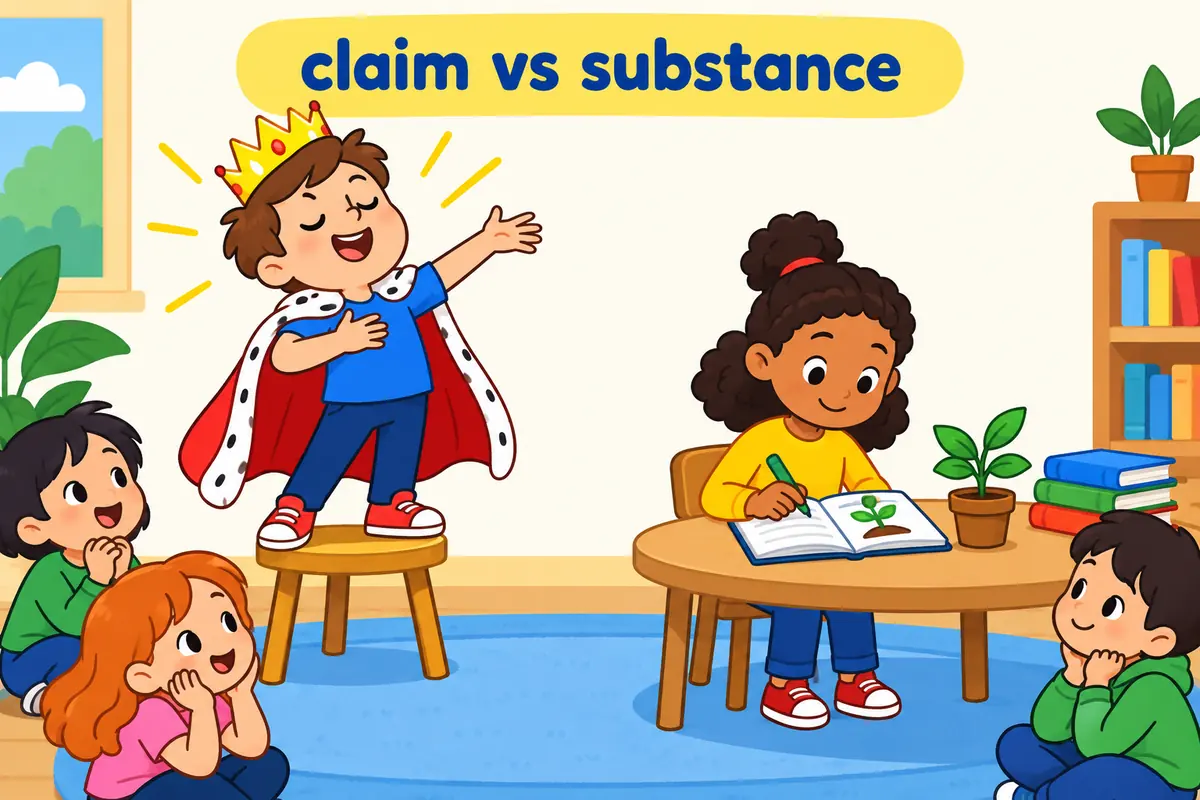
Pretentious is the disapproving adjective for people and things that claim more importance, talent or culture than they possess. Keep the exact phrase pretentious in a sentence pointed at that gap between claim and substance, not at expense or difficulty. The distinction that repays attention is pretentious against pompous: one pretends to a stature, the other is vain about its own. If the only complaint is showiness or cost, ostentatious and expensive are the honest words.
Frequently asked questions about pretentious
Is pretentious always an insult?
Almost always, because the adjective accuses someone of claiming importance or culture they do not have. It can be used lightly among friends, and a creator may apply it to their own work to signal self-awareness. Even then the word keeps its sting, so it rarely lands as neutral description.
Can a film or a restaurant be pretentious?
Yes. The adjective regularly describes art, food, decor and writing that try to look more cultured than they are. A restaurant with a grandiose menu and plain cooking is the standard example. The criticism falls on the borrowed air of importance rather than on the quality of the meal itself.
What is the difference between pretentious and ambitious?
Ambitious describes a large goal and carries no automatic criticism, because the aim may be matched by the effort. Pretentious adds a judgement that the claim outruns the substance, so it accuses the work of pretending to be more than it is. An ambitious project can fail honestly; a pretentious one has already overclaimed.
Does pretentious mean expensive?
No. Expensive describes price and pretentious describes a false claim to importance, and the two often keep company only by accident. A cheap restaurant can be pretentious, and a costly one can be plain and sincere. If cost is the real complaint, expensive or lavish says what you mean.
Have you ever come across someone who seemed to be trying too hard to impress others, perhaps by using grandiose language or name-dropping famous people? This behavior is typically known as being pretentious.
Pretentiousness involves an individual displaying an exaggerated sense of importance or talent in order to appear more sophisticated or knowledgeable than they actually are. It often comes across as insincere or disingenuous, as if the person is putting on a façade to garner admiration or respect from those around them.
7 Examples Of Pretentious Used In a Sentence For Kids
- The pretentious princess wore a shiny crown.
- The pretentious peacock showed off its colorful feathers.
- The pretentious elephant walked proudly with a golden anklet.
- The pretentious cat strutted around with a tiny top hat.
- The pretentious flower bloomed in the fanciest garden.
- The pretentious butterfly fluttered by with sparkling wings.
- The pretentious teddy bear wore a fancy bow tie.
14 Sentences with Pretentious Examples
- Many students in my class try to sound pretentious by using complex vocabulary without understanding the context.
- There is always that one student who shows off their pretentious collection of expensive gadgets in college.
- She always dresses in a pretentious manner, wearing designer clothes and accessories to every lecture.
- His constant name-dropping of famous people comes off as pretentious during group discussions.
- A pretentious attitude often leads to isolation rather than admiration among classmates.
- The use of big words in an attempt to appear pretentious can often backfire if used incorrectly.
- Some students join certain clubs just to be seen as pretentious and exclusive.
- The professor’s condescending tone made the lecture feel overly pretentious and inaccessible.
- The pretentious behavior of some students can be a major turn-off for those seeking genuine connections.
- She made a pretentious remark about only eating organic food while the rest of us grabbed takeout from the canteen.
- Trying to impress others by constantly discussing highbrow literature can come off as pretentious to some.
- The group of students sitting in the library whispering about their latest travel adventures sounded overly pretentious.
- The pretentious display of knowledge in a subject often leads to narrow-mindedness and arrogance.
- Some students adopt a pretentious persona as a defense mechanism to hide their insecurities.
How To Use Pretentious in Sentences?
Pretentious is an adjective used to describe someone or something that tries to impress others by claiming to be more important or cultured than they actually are. To use pretentious in a sentence, simply place it before a noun to convey this meaning clearly.
For example, you could say, “The party guests were put off by the host’s pretentious display of rare art pieces.” Here, the word pretentious is used to describe the host’s behavior as trying too hard to impress others.
When using pretentious in a sentence, make sure the context is appropriate to convey the intended meaning effectively. It is essential to use this word thoughtfully, as it can come across as judgmental or derogatory if used carelessly.
To enhance your understanding of pretentious, you can observe its usage in various contexts through reading books, articles, or watching movies. Pay attention to how the word is used and try incorporating it into your own sentences to become more comfortable with its meaning.
In summary, using pretentious in a sentence is a way to describe someone or something as trying too hard to appear more sophisticated or important than they actually are. Practice using this word in different contexts to improve your vocabulary and communication skills.
Conclusion
In conclusion, being pretentious involves trying to impress others by claiming knowledge or importance beyond one’s true abilities or understanding. Pretentious behavior is often marked by an air of superiority or self-importance that can come across as insincere or arrogant. Such behavior can alienate others and ultimately hinder genuine connections with those around you.
It is important to be authentic and humble in our interactions with others, as sincerity and genuine engagement are often more appreciated than pretentiousness. By staying true to oneself and being mindful of how our words and actions are perceived by others, we can foster more meaningful relationships and create a positive impact in both personal and professional settings.


