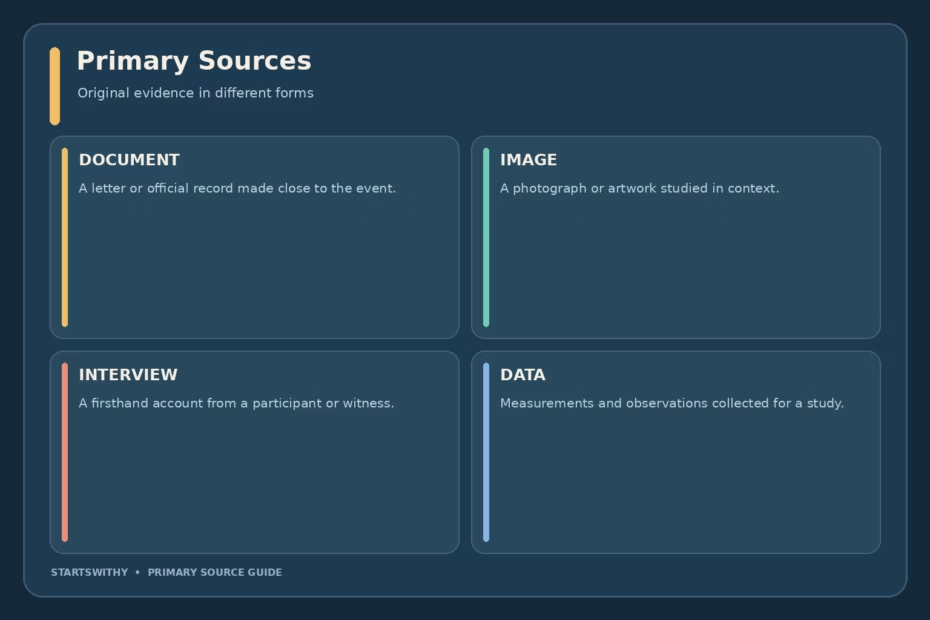
A primary source is an original record, object, or firsthand account used as evidence about a particular question. The phrase appears often in history and research writing, but the most useful examples show what makes an item primary and how to use the words naturally in a sentence. A diary, a photograph, a dataset, or a recorded interview may be a primary source when it provides direct evidence for the subject being studied.
What Does “Primary Source” Mean?
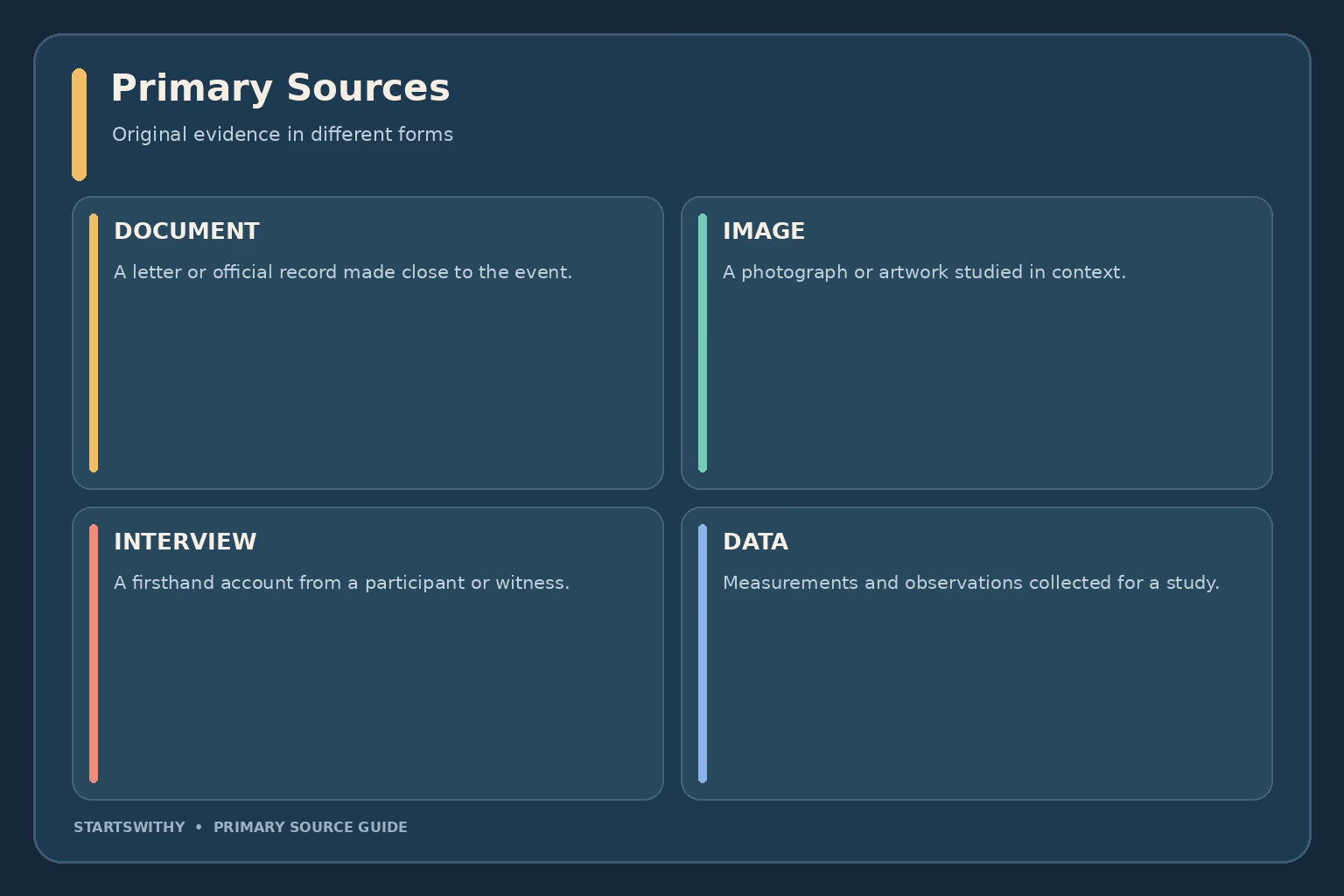
A primary source is evidence created by a participant, witness, researcher, institution, or other source close to the subject. It may record an event as it happened, preserve an original work, or present data collected directly for a study. The Library of Congress describes primary sources as original documents and objects from the time under study; Purdue OWL also includes firsthand accounts, personal correspondence, government records, art, literature, data, and some social media posts.
“Primary” does not mean that a source is automatically accurate, neutral, or more valuable than every other source. It describes the source’s relationship to a research question. A witness’s letter can be direct evidence of what that person believed and experienced, while still containing mistakes or a limited point of view. Researchers compare evidence and consider who created it, when, for whom, and why.
Primary Source vs. Secondary Source
A secondary source analyzes, explains, or interprets primary evidence. For example, a speech recorded during a campaign may be a primary source for studying the candidate’s language. A later article comparing that speech with other campaign materials is secondary for the same question. The categories can shift with the question: a newspaper article is secondary when it summarizes an earlier event, but it may be primary evidence for studying how that newspaper covered the event.
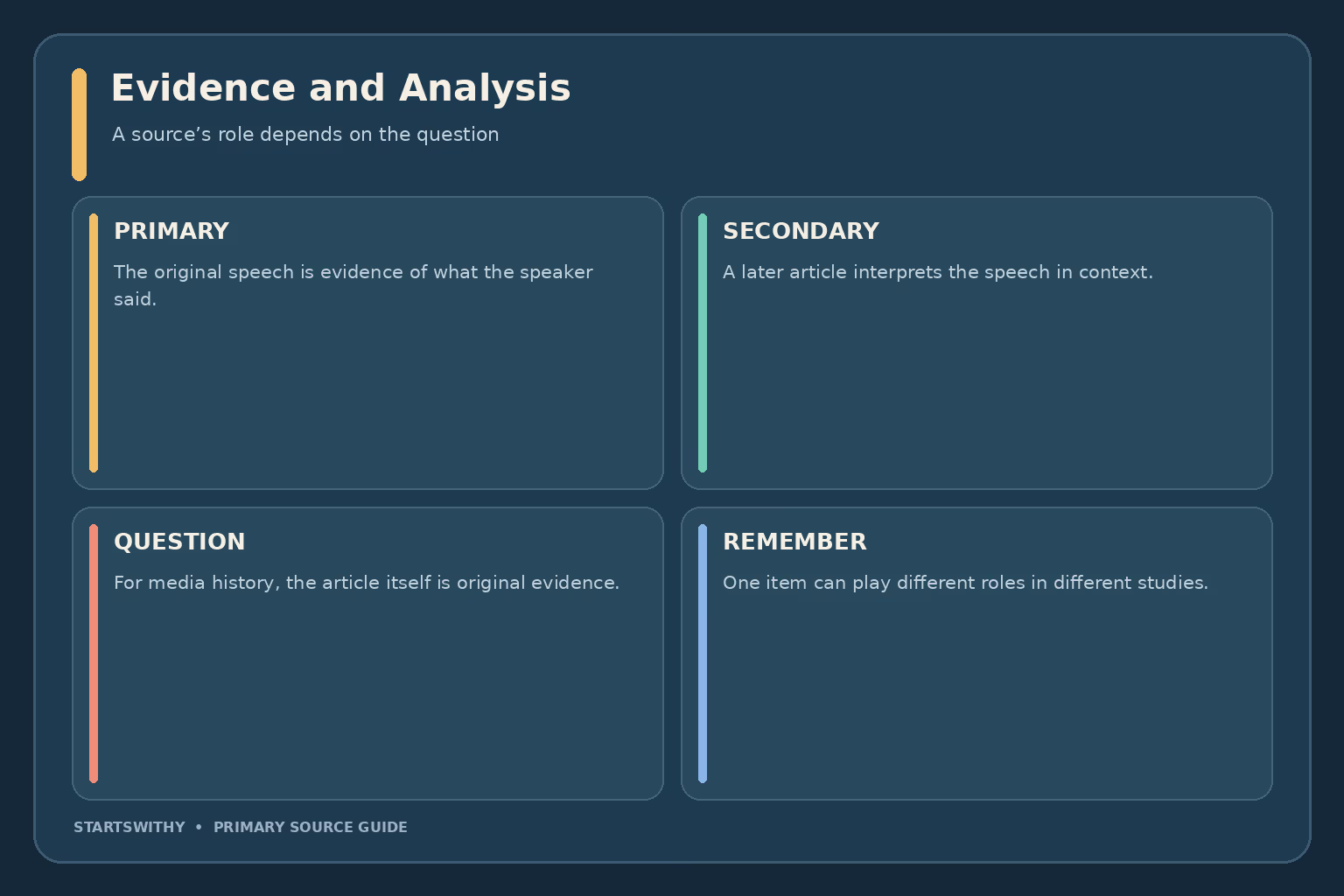
Primary and secondary sources can also be scholarly or popular. These are separate distinctions. An original research article may be a primary source for the study it reports and also a scholarly publication. A popular magazine story may be a primary source for research on media coverage, even though it is not a scholarly article.
Examples of Primary Sources in Different Subjects
- History: a letter written during a migration, a law from the period, or a photograph made at the event.
- Literature: the first edition of a novel, a writer’s manuscript, or a letter discussing the work.
- Science: measurements collected in an experiment, laboratory notes, or the original paper reporting the researchers’ results.
- Social science: interview recordings, survey responses, field notes, or a dataset gathered for the study.
- Art and media: a painting, film, broadcast, advertisement, or social post when the research is about that work or its original audience.
- Government and law: legislation, court records, official statistics, meeting minutes, or an agency’s original report.
These are starting points, not fixed labels. A textbook chapter about a historical letter is usually secondary for the history of the event. The textbook itself becomes primary evidence if the question is how schools explained that event in a particular decade.
How to Use “Primary Source” in a Sentence
Use primary source as a countable noun. Write a primary source for one item, the primary source for a particular item already identified, and primary sources for more than one. The phrase often appears with verbs such as analyze, cite, compare, consult, and interpret.
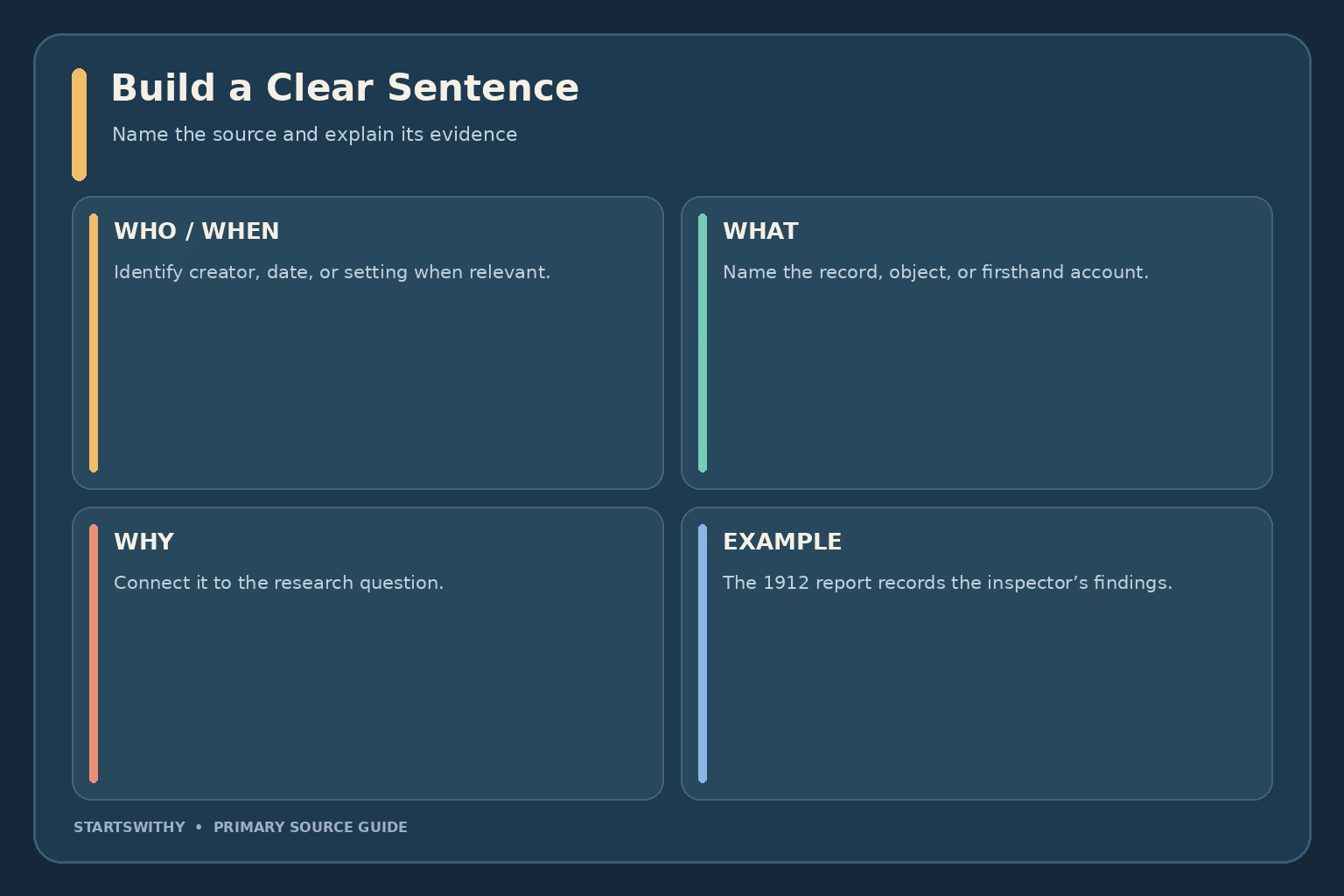
A clear research sentence usually does more than label an item. Identify the creator or date when relevant, name what the source records, and explain how that evidence relates to the claim. For example: “The 1912 factory inspection report is a primary source for the city’s workplace rules because it records the inspector’s findings that year.” This makes the source’s role clear instead of assuming the reader will infer it.
Sentence Examples with “Primary Source”
- The historian cited a primary source written by a witness to the parade.
- For her project, Maya analyzed a primary source: the original survey responses.
- The court transcript is a primary source for studying the trial’s testimony.
- Our teacher asked us to compare the photograph with a later account of the same event.
- Because it was recorded during the meeting, the audio file served as a primary source.
- The researcher treated the interview as a primary source about the participant’s own experience.
- We checked the letter’s date before citing it as a primary source.
- The original experiment data gave the team a primary source for its analysis.
- A campaign poster can be a primary source for research on political messaging.
- The student explained why the census table counted as a primary source for the population question.
- In the museum, visitors examined a primary source from the period being studied.
- The article is a secondary source on the battle but a primary source for research on newspaper coverage.
How to Decide Whether a Source Is Primary
Begin with the question you want to answer. Then ask who created the material, how close the creator was to the events or data, and whether the item gives direct evidence or interprets someone else’s evidence. A primary source for one project may not be primary for another. A modern documentary is a secondary account of a centuries-old event, but its footage and narration can be primary evidence for a study of documentary filmmaking.
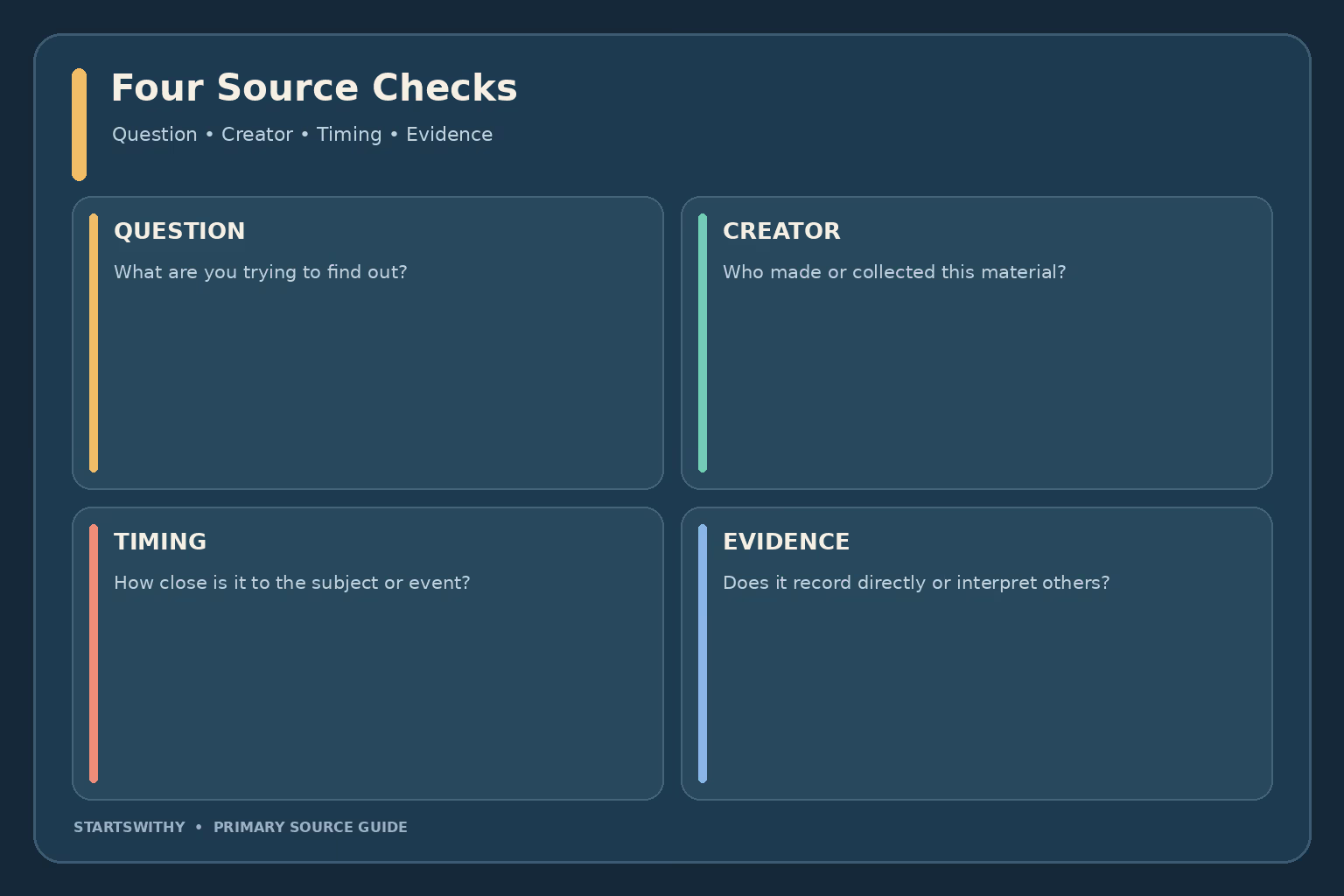
Next, examine the item’s origin and condition. Is it an original, a copy, a translation, or a transcription? A digital scan can give access to an original document, but its catalog record and image quality may affect what you can conclude. A translated letter can still provide evidence, though a study of the author’s exact word choice may require the original language. State those limits plainly and cite the version you actually consulted.
Finally, consider perspective and purpose. A diary may be firsthand but private; a government report may be official but shaped by the institution’s goals. Compare relevant accounts when possible, distinguish what the source directly says from your interpretation, and support quotations or paraphrases with accurate citations. Purdue OWL’s guide to primary and secondary sources notes that the type of source needed depends on the research question; the Library of Congress offers a primary source analysis tool for close examination. For a concise overview, see Purdue OWL’s explanation of primary and secondary sources.
Quick Writing Pattern
Try this structure when you introduce the phrase: [Creator or date]’s [item] is a primary source for [specific question] because it [records, documents, or reveals a specific kind of evidence]. For instance: “The 1968 oral-history interview is a primary source for the neighborhood’s history because it records one resident’s memories of the redevelopment.” This pattern identifies both the evidence and the reason it matters.
Frequently Asked Questions
Can a source be both primary and secondary?
Yes, depending on the question. A newspaper editorial is primary evidence for studying the newspaper’s position, while a historian may use it as one source among many when writing a later account of the event.
Is a primary source always reliable?
No. It offers direct evidence, but it may be incomplete, mistaken, biased, or created for a particular audience. Check its origin and compare it with other evidence.
Is an online source a primary source?
It can be. A digitized original document or a firsthand online post may be primary for a suitable question. A web page that summarizes other people’s findings is generally secondary for those findings.
What is the plural of “primary source”?
The plural is primary sources. Example: “The class compared three primary sources from the same decade.”

Primary sources are original materials that provide firsthand evidence or direct testimony regarding a topic or event. These sources offer a direct glimpse into the past, providing researchers with unfiltered access to historical information.
Common types of primary sources include documents, diaries, letters, photographs, and artifacts that offer a direct connection to the time period or event being studied. By analyzing primary sources, historians and researchers can gain a more authentic understanding of past events and people.
7 Examples Of Primary Source Used In a Sentence For Kids
- Our history book said that a primary source is something written or made at the same time as the event.
- A photograph taken during an important event is considered a primary source.
- A letter written by a soldier during a war is a primary source because it tells us about their experiences.
- An artifact like a coin from ancient times is a primary source that historians study to learn about the past.
- A painting created during a historical event can be a primary source for understanding what happened.
- An interview with someone who witnessed a special event can be a primary source of information.
- A diary entry from a famous person is a primary source that helps us learn about their life and thoughts.
14 Sentences with Primary Source Examples
- Primary source analysis is crucial for students studying history and anthropology.
- When writing a research paper, always make sure to cite your primary sources.
- It is important to use primary sources when studying the political history of India.
- Primary sources such as original documents and artifacts provide valuable information for research projects.
- Understanding how to evaluate the credibility of a primary source is a key skill for college students.
- Primary sources can give a firsthand account of events and perspectives, making them invaluable for research.
- Professors often encourage students to seek out primary sources to enhance the depth of their research.
- Primary sources allow students to engage with historical material in a direct and meaningful way.
- Working with primary sources can offer unique insights into the cultural practices of ancient civilizations.
- Utilizing primary sources can help students develop critical thinking and analytical skills.
- In classes focused on literature and art history, studying primary sources can provide context and a deeper understanding of the subject matter.
- Textbooks may summarize information, but primary sources offer firsthand evidence of historical events.
- Visiting archives and libraries can provide access to a wide range of primary sources for academic research.
- Documentaries and films can also serve as primary sources when studying media and communication in college.
How To Use Primary Source in Sentences?
Using Primary Source in a sentence is a crucial aspect of writing effectively and credibly. To incorporate a primary source into your writing, start by introducing the source and providing context for its relevance to your argument. For example, “According to the primary source from the 1800s, women were actively involved in the suffrage movement.”
Next, directly quote or paraphrase the information from the primary source within your sentence. Remember to properly cite the primary source to give credit to the original author. This can be done by including the author’s name, publication date, and any other relevant information depending on the citation style you are using.
It’s important to analyze and interpret the primary source within the context of your argument. Explain how the information from the primary source supports your thesis or contributes to the overall understanding of the topic. This demonstrates your ability to critically engage with the material and strengthens your argument.
In conclusion, using Primary Source in a sentence involves introducing the source, incorporating the information, citing the source, and analyzing its relevance to your argument. By following these steps, you can effectively integrate primary sources into your writing to support your ideas and enhance the credibility of your work.
Conclusion
In research, sentences with primary sources are essential for providing direct evidence and credibility to support arguments or claims. By incorporating quotes or data directly from original sources, such as research papers, interviews, or official documents, writers can strengthen the validity of their work and demonstrate a thorough understanding of the topic. These sentences serve as strong building blocks in constructing a well-supported and convincing argument that is grounded in reliable and authoritative information.
Furthermore, sentences with primary sources also help readers easily trace the origins of the information presented and evaluate the accuracy and reliability of the sources themselves. When crafting academic or research-based writing, using sentences with primary sources can enhance the credibility and persuasiveness of the work, fostering a deeper level of engagement with the reader and reinforcing the integrity of the author’s findings.


