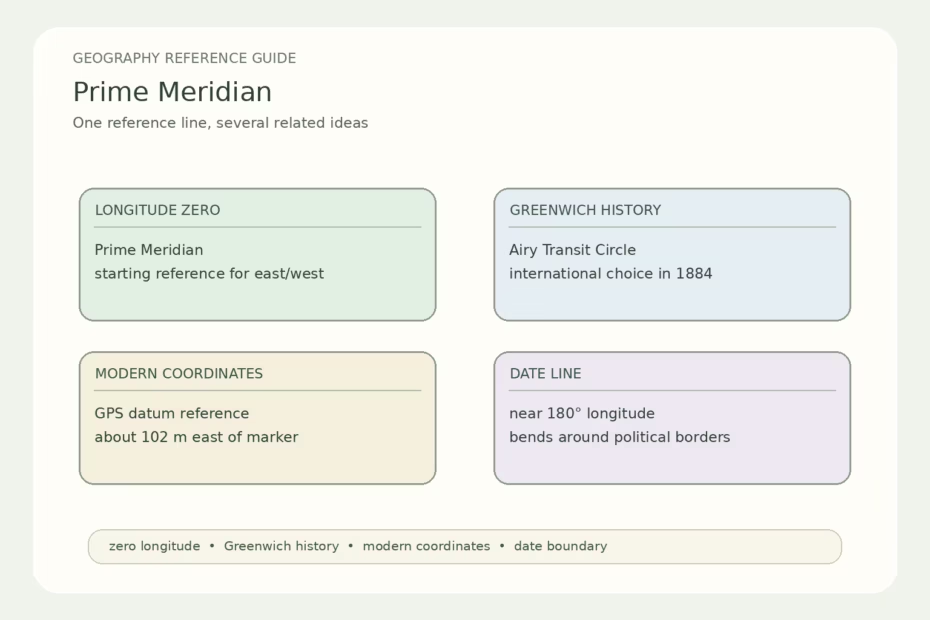
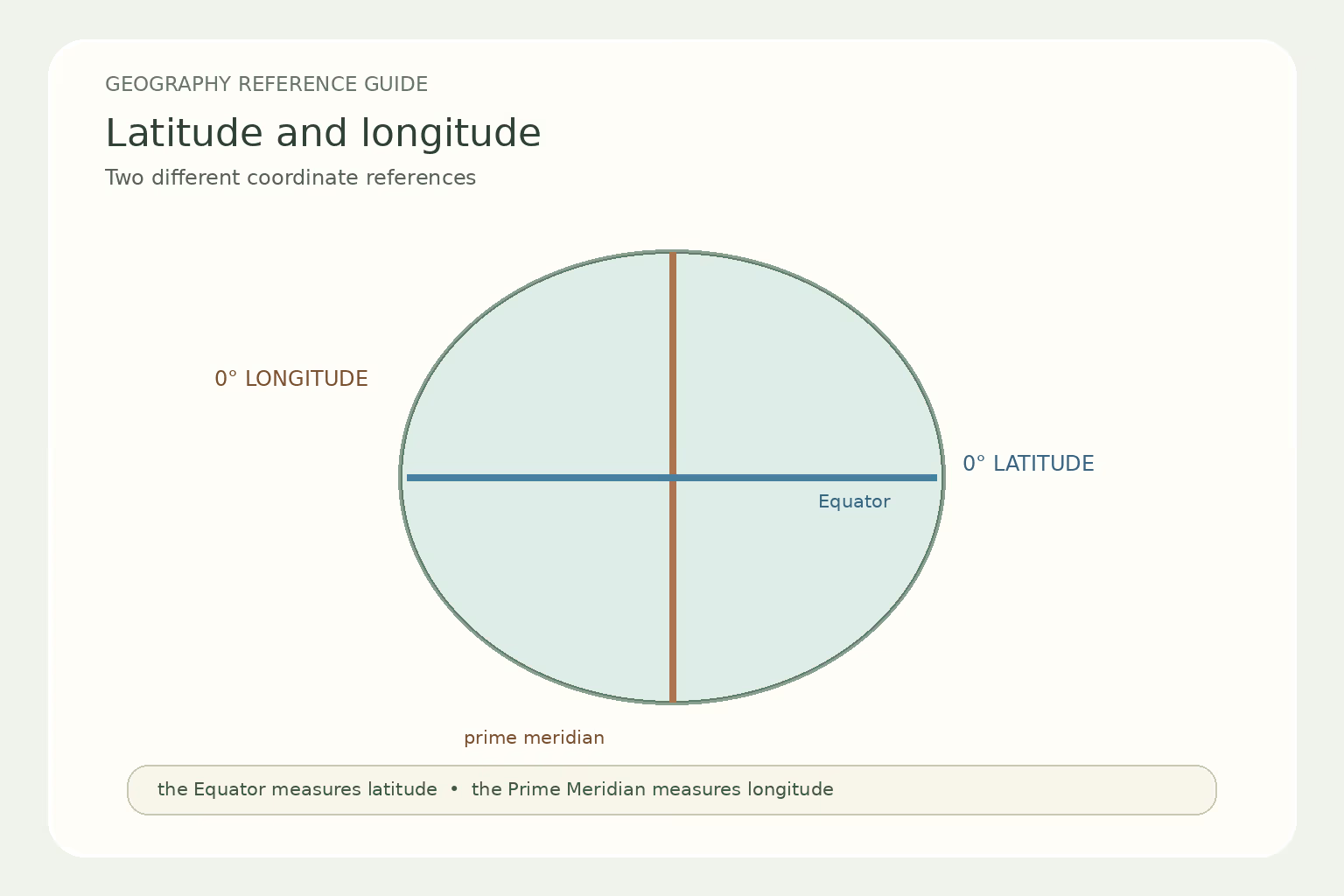
The prime meridian is the chosen zero-degree reference for longitude. It works like the starting line on a numbered globe: coordinates east and west are measured from it. The Equator is a different reference, at zero degrees latitude, and separates the Northern and Southern Hemispheres. Longitude and latitude together locate places on Earth (NOAA Ocean Service, longitude).

Greenwich and the historical choice
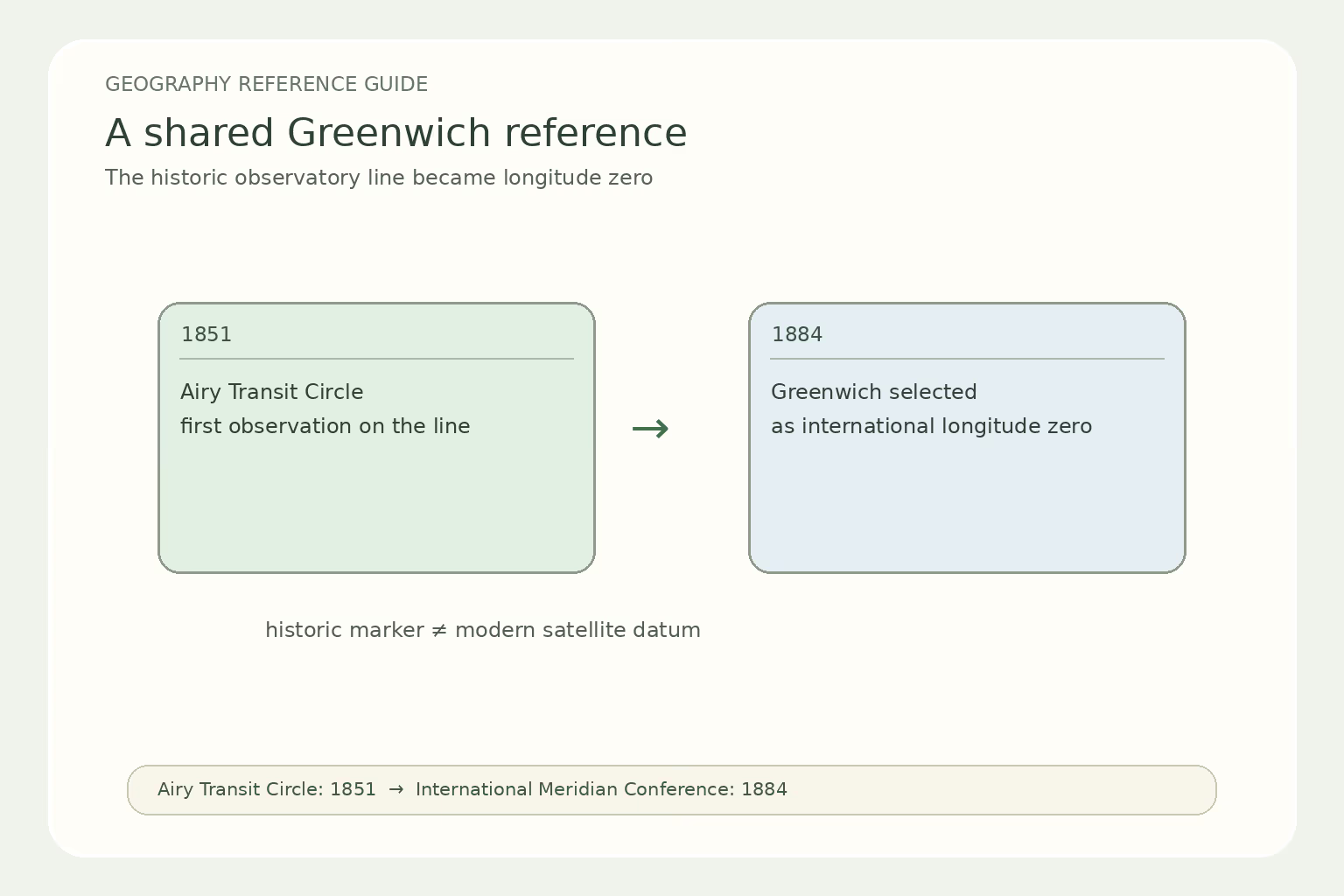
Today the familiar historic Prime Meridian runs through the Royal Observatory in Greenwich, London. The line is linked to the Airy Transit Circle, a telescope installed at the observatory in the nineteenth century. Its crosshairs supplied the Greenwich reference used by navigators and mapmakers. In 1884, delegates at the International Meridian Conference in Washington, D.C., selected the Greenwich meridian as the world’s prime meridian (Royal Museums Greenwich, Airy Transit Circle). Greenwich was already widely used on nautical charts and for timekeeping, which made a shared reference practical.
From Greenwich, the historic line travels south across Europe and Africa before reaching Antarctica. That geographic route is useful in a sentence such as “The Prime Meridian passes through Ghana.” For precision, say “the historic Greenwich meridian” when you mean the marked line at the observatory, especially when discussing modern satellite coordinates.
The historic line and modern GPS coordinates
On modern maps and GPS devices, zero longitude is based on a global geodetic reference system rather than the exact historic brass line in Greenwich. NOAA explains that the GPS zero-longitude reference lies about 102 metres east of the historic marker. This difference reflects how geodesy defines a coordinate framework for measuring the Earth; it does not mean the Observatory’s historic line was moved. So “stand on the Prime Meridian at Greenwich” describes the traditional visitor experience, while a technical statement about GPS should name the modern reference frame when that distinction matters.
Longitudes are angular measurements, not equal-width strips of land. Meridians converge at the poles, so the distance between neighbouring longitude lines changes with latitude. A point at 30° east is described as east of the prime meridian, but that number alone is not a distance in kilometres: its ground distance depends on how far north or south the point lies.
How the Prime Meridian relates to time
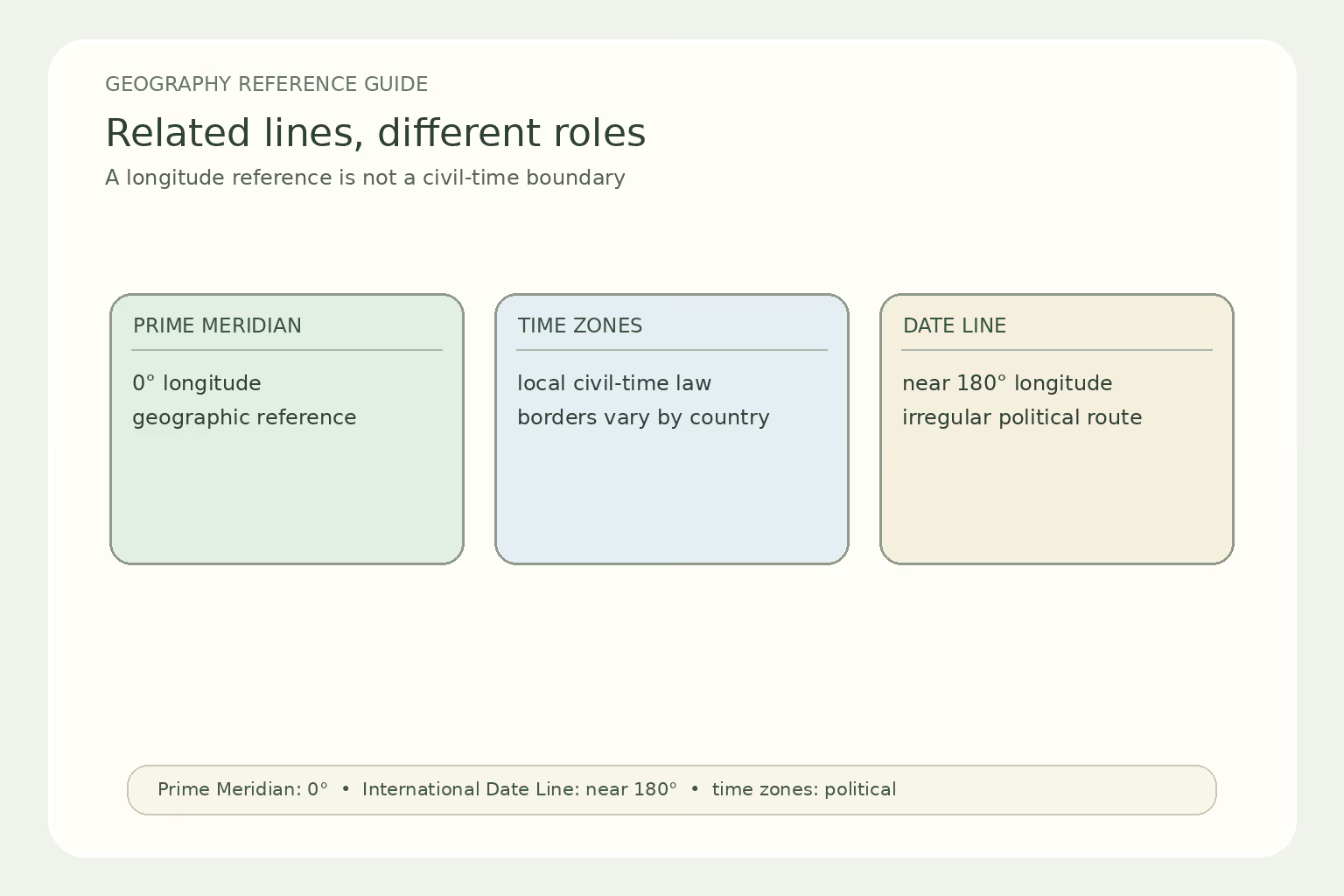
The Greenwich reference helped coordinate clocks and the system of time zones, but the meridian itself is not a time zone boundary. Local civil-time rules are set by governments, and time-zone borders often bend around political boundaries and communities. Greenwich Mean Time (GMT) is historically associated with Greenwich; modern international timekeeping uses Coordinated Universal Time (UTC), which is maintained using atomic clocks. A sentence that says “the Prime Meridian creates every time zone” overstates its role. More accurately, it provides a common longitude reference that supported standard timekeeping.
The International Date Line is also a separate convention. It roughly follows 180° longitude, opposite Greenwich, but it zigzags to avoid splitting countries and island groups across calendar dates. Crossing it can change the date, while crossing the Prime Meridian does not automatically do so. Longitude gives a geographic coordinate; civil clocks and calendar dates follow agreed rules.
Using “prime meridian” accurately in a sentence
- For longitude: “The ship’s position was recorded as 12 degrees west of the Prime Meridian.”
- For geography: “Ghana lies along the historic Greenwich meridian.”
- For classroom comparison: “The Equator measures latitude, while the Prime Meridian is the zero-degree reference for longitude.”
- For timekeeping: “The Greenwich meridian helped provide a shared reference for standard time.”
- For careful modern usage: “The GPS coordinate system’s zero longitude is east of the historic Greenwich marker.”
Capitalize Prime Meridian when naming the conventional Greenwich line, especially in a formal geography context. In a general description, prime meridian can be lower case because a prime meridian is any selected zero-longitude line; other planets can have their own reference meridians. Avoid saying that it divides Earth into perfectly equal eastern and western halves: it is a coordinate convention that, together with the opposite meridian, establishes east-west hemispheres on a globe.
These distinctions make a sentence more informative: identify whether you mean the zero-longitude reference, the marked historic Greenwich line, or a timekeeping convention. The context around the term tells readers which meaning is intended.
Have you ever wondered about the imaginary line that divides the Earth into the Eastern and Western Hemispheres? This line is known as the prime meridian, a significant marker used in geography and navigation.
The prime meridian is the line of longitude designated as 0 degrees, from which all other lines of longitude are measured. It runs from the North Pole to the South Pole, passing through Greenwich, England. This important reference point helps to establish time zones and define locations on Earth in terms of their east-west positioning.
7 Examples Of Prime Meridian Used In a Sentence For Kids
- The prime meridian is an imaginary line that divides the Earth into Eastern and Western hemispheres.
- India is located to the east of the prime meridian.
- The prime meridian passes through Greenwich in London, England.
- The prime meridian helps us determine different time zones around the world.
- When it is noon at the prime meridian, it is morning in India.
- The prime meridian is also known as the Greenwich Meridian.
- The prime meridian is an important line for understanding geography and navigation.
14 Sentences with Prime Meridian Examples
- The concept of the Prime Meridian is crucial for understanding global time zones.
- Are you aware of the significance of the Prime Meridian in determining Greenwich Mean Time (GMT)?
- Understanding the concept of the Prime Meridian is essential for grasping geographic coordinates in cartography.
- In geography class, we learned about the Prime Meridian as the starting point for measuring longitude.
- Did you know that the Prime Meridian passes through the Royal Observatory in Greenwich, London?
- Knowledge of the Prime Meridian is fundamental for accurately pinpointing locations on a map.
- The Prime Meridian plays a pivotal role in dividing the earth into Eastern and Western Hemispheres.
- When studying geography, it’s important to comprehend the role of the Prime Meridian in celestial navigation.
- The concept of the Prime Meridian is integral in understanding the international date line.
- Can you explain how the Prime Meridian influences timekeeping practices around the world?
- As college students, it’s beneficial to grasp the significance of the Prime Meridian in global positioning systems.
- The Prime Meridian serves as the reference point for measuring distances east and west of the Greenwich Meridian.
- Knowledge about the Prime Meridian is vital for interpreting longitude coordinates on a map accurately.
- Understanding the Prime Meridian aids in comprehending the concept of a universal standard time.
How To Use Prime Meridian in Sentences?
To use Prime Meridian in a sentence, you can follow these steps:
-
Understand the concept: The Prime Meridian is the imaginary line that represents 0 degrees longitude, which runs from the North Pole to the South Pole through Greenwich, London. It serves as the starting point for measuring longitude and dividing the Earth into Eastern and Western Hemispheres.
-
Identify the location: When mentioning the Prime Meridian in a sentence, make sure to specify its importance as the reference point for measuring distances east and west around the globe.
-
Include coordinates: You can include the Prime Meridian in a sentence by stating the specific degrees of longitude along with its direction (e.g., “The city of London is located at 0 degrees longitude, which marks the position of the Prime Meridian“).
-
Provide context: Try to include additional information to give more context to your sentence, such as how the Prime Meridian relates to time zones or navigation.
For example, you could say, “The Prime Meridian serves as the reference point for measuring longitudinal coordinates, with locations to the east being in the Eastern Hemisphere and those to the west in the Western Hemisphere.”
By following these steps, you can effectively incorporate the term Prime Meridian into your sentences with clarity and accuracy.
Conclusion
In conclusion, the Prime Meridian serves as the starting point for measuring longitude on Earth, dividing the globe into Eastern and Western Hemispheres. Sentences mentioning the Prime Meridian often refer to how locations are described in relation to this important line of longitude. For example, “London is located to the east of the Prime Meridian” or “The Prime Meridian passes through Greenwich, England.” These sentences help provide geospatial context and pinpoint precise locations based on their positions relative to this significant imaginary line.
Understanding and using sentences with the Prime Meridian can enhance geographical knowledge and improve communication when describing global coordinates. By acknowledging the Prime Meridian’s significance, individuals can easily convey the east-west positioning of locations on Earth, making it a fundamental reference point in geographical discussions and mapping activities.


