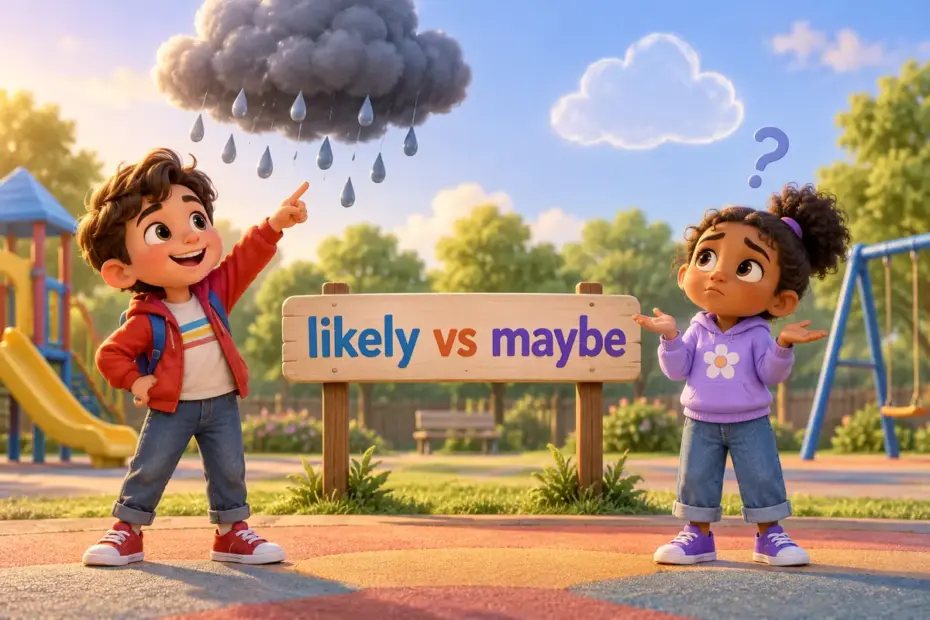
Probable vs possible both describe chance, but they rank it very differently. Probable means likely to happen because the evidence points that way, while possible means only that nothing rules it out. A probable shower usually arrives; a possible shower may never fall.
Probable vs possible at a glance
- Probable and possible are both adjectives about chance, and each has a matching adverb and noun.
- Probable means more likely than not, supported by evidence.
- Possible means there is some chance, however small.
- Possible is the weaker word and probable is the stronger one.
- The commonest error is using possible when the evidence already favours an outcome.
What does probable mean and what does possible mean?
Probable is an adjective meaning likely to be true or to happen, and possible is an adjective meaning able to happen or exist. The Cambridge entry for probable ties it to likelihood, while the Cambridge entry for possible ties it to bare chance. One line shows the gap: a probable result is the one the evidence favours, but a possible result is merely one of many that nothing has ruled out.
| Word | Sense | Plain meaning | Example |
|---|---|---|---|
| probable | adjective | Likely to be true or happen | A tie is the probable outcome. |
| possible | adjective | Able to happen or exist | Rain is possible tonight. |
| probably | adverb | Almost certainly | She will probably call. |
| possibly | adverb | Perhaps, but not certainly | He may possibly agree. |
| probability | noun | The measured chance of something | The probability of rain is low. |
| possibility | noun | One of the things that could happen | War is one possibility. |
The two words also differ in how they can be strengthened. Possible accepts a wide range of hedges, from barely possible to entirely possible, while probable resists them: very probable sounds odd because the word already claims more than half.
Probable vs possible: what is the difference?
The difference is the strength of the claim, and the evidence behind it. Probable says the scales already tilt towards an outcome, while possible says only that the outcome has not been excluded. A familiar pair such as abel vs able shows the same trap: two similar words carry very different weight.
| Test | Probable | Possible |
|---|---|---|
| Core meaning | likely on the evidence | not ruled out |
| Strength | more than half likely | any chance at all |
| Evidence needed | strong supporting evidence | no evidence required |
| Opposite idea | improbable | impossible |
| Typical partner | a probable cause or winner | a possible answer or risk |
| Memory hook | probable equals evidence leaning yes | possible equals merely allowed |
Choose probable when the evidence points to an outcome, and possible when you only mean that nothing rules it out.
Strengthening and weakening the words is a quick test. You can say quite possible, perfectly possible or hardly possible, but you would rarely say quite probable, because probable already sits above the midpoint.
How do you use probable and possible in a sentence?
The two words share some frames and split in others, and the frame is often the fastest test; to watch the stronger word behave, read probable in everyday sentences.
| Pattern | Example | What it signals |
|---|---|---|
| it is probable that | It is probable that the train will be late. | an evidence-based prediction |
| it is possible that | It is possible that she forgot. | a chance that is not ruled out |
| probable + noun | The probable winner is the champion. | the most likely candidate |
| possible + noun | We listed three possible routes. | a set of open options |
| as … as possible | Come as early as possible. | a fixed phrase for doing the most |
| probability of + -ing | The probability of winning is low. | a measured chance |
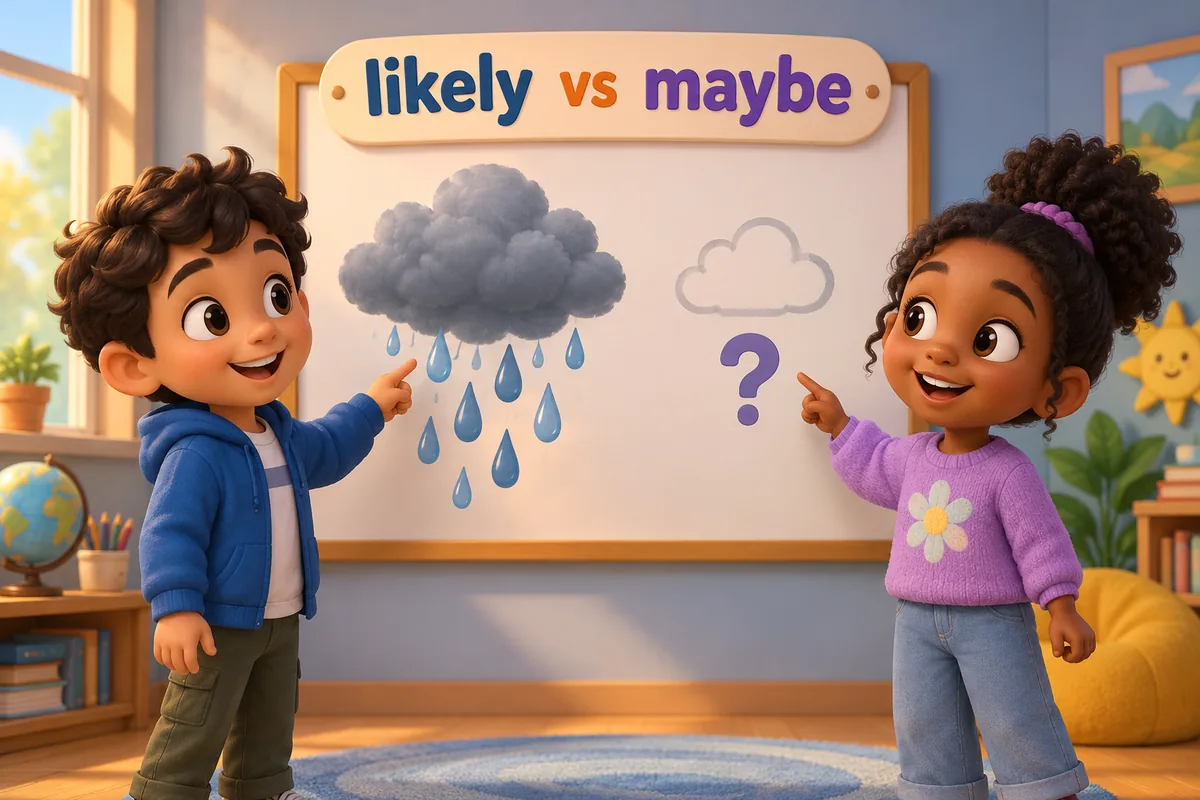
Probable and possible in a sentence: examples across contexts
Chance words appear in forecasts, diagnoses and plans, so register decides as much as meaning; more open frames sit in possible in everyday sentences.
| Context | Example sentence | Why this works |
|---|---|---|
| Classroom | It is probable that the test will cover two chapters. | evidence supports a prediction |
| Workplace email | A short delay is possible on Friday. | a chance is flagged, not predicted |
| News report | A second round of talks is probable. | probable reports a likely event |
| Weather writing | Heavy rain is possible overnight. | possible leaves the chance open |
| Medical note | A full recovery is probable with treatment. | probable reflects the odds |
| Everyday speech | It is possible I left the keys inside. | possible admits an option |
| Academic writing | The model treats error as possible at each step. | possible allows, does not predict |
| Sports reporting | A draw now looks probable. | probable ranks the likely result |
| Planning | We should prepare for every possible outcome. | possible collects the options |
| Science writing | A second signal is possible but unlikely. | possible pairs with unlikely |
Which should you use?
Match the word to how strongly the evidence supports the claim.
| Situation | Use | Example |
|---|---|---|
| A prediction you trust | probable | a probable shower |
| An outcome you cannot rule out | possible | a possible shower |
| The most likely winner | probable | the probable champion |
| A list of options | possible | possible routes |
Register changes little, but honesty changes everything. A weather writer who says rain is probable is making a claim about the odds, while one who says rain is possible is refusing to commit. Reporters and scientists keep the two apart for exactly this reason: possible protects them when an outcome fails, and probable commits them when the evidence is strong. Choosing the wrong one is not a slip of style but a change in meaning.
Word forms and grammar of probable and possible
| Form | Part of speech | Example |
|---|---|---|
| probable | adjective | a probable cause |
| improbable | adjective | an improbable win |
| probably | adverb | He probably knows. |
| probability | noun | the probability of success |
| possible | adjective | a possible delay |
| impossible | adjective | an impossible task |
| possibly | adverb | She possibly forgot. |
| possibility | noun | a real possibility |
A quiet trap sits in the negatives. Impossible means no chance at all, while improbable means only that the chance is small, so an improbable event can still happen. A related pair worth care is addition vs edition, where one letter carries the whole distinction.
Common mistakes with probable and possible
Mistake 1: possible when the evidence is strong. Incorrect: With all this proof, guilt is only possible. Correct: With all this proof, guilt is probable. Rule: use probable when the evidence tilts towards the outcome.
Mistake 2: probable with the noun chance. Incorrect: There is a probable chance of fog. Correct: There is a possible chance of fog, or fog is probable. Rule: chance belongs with possible; probable takes an outcome.
Mistake 3: probable with a to-infinitive. Incorrect: It is probable to rain. Correct: It is probable that it will rain. Rule: probable takes a that-clause, not a to-infinitive.
Mistake 4: possible with of. Incorrect: Snow is possible of falling. Correct: It is possible that snow will fall. Rule: possible takes that or to, never of.
Mistake 5: treating impossible and improbable as twins. Incorrect: An improbable event can never happen. Correct: An improbable event is unlikely but can still happen. Rule: improbable means small chance; impossible means no chance.
Practice using probable and possible
- Fill in the blank: Given the dark clouds, rain looks ___.
- Choose the better word: A (probable / possible) delivery on Tuesday is all we can promise.
- Correct the error: It is probable to snow tonight.
- Build a sentence: use as … as possible about arriving early.
- Fill in the blank: Every ___ cause of the fault has been checked.
- Spot the register: which line suits a cautious forecast, (a) Rain is probable, or (b) Rain is possible?
Answers
- probable, because the evidence points to rain.
- possible, because the delivery is only a chance, not a prediction.
- It is probable that it will snow tonight; probable takes a that-clause.
- Please arrive as early as possible.
- possible, because the sentence lists the options being checked.
- (b), because a cautious forecast refuses to commit.
The bottom line
The probable vs possible choice is really a choice about evidence. Probable claims that the odds favour an outcome, while possible claims only that the outcome has not been excluded. Use probable in forecasts and findings you trust, and save possible for options, hedges and open chances. Keep impossible and improbable apart too, because one shuts a door and the other only narrows it.
Frequently asked questions about probable and possible
Is probable stronger than possible?
Yes. Probable claims that an outcome is more likely than not, supported by evidence, while possible claims only that nothing rules it out. Every probable event is also possible, but a possible event may never reach the level of probable, so the two words sit at different points on the same scale.
Can possible ever mean the same as probable?
Not in careful writing. Possible is the weaker claim and covers any chance above zero, so a possible outcome can still be very unlikely. Probable reserves the stronger position for outcomes the evidence supports, and that gap is exactly why forecasters and reporters keep the words separate.
What is the difference between possibly and probably?
Possibly means perhaps, leaving the chance open, and probably means almost certainly, placing the outcome above the midpoint. They are the adverbs of possible and probable, so the same strength rule applies: possibly hedges, and probably commits to what the evidence suggests will happen.
Why do writers mix up probable and possible?
Because both words describe chance and both appear in the same frames, such as it is probable that and it is possible that. Only the strength differs, and that difference is invisible in the grammar, so the mix-up survives spell-check and only shows up when the odds really matter.