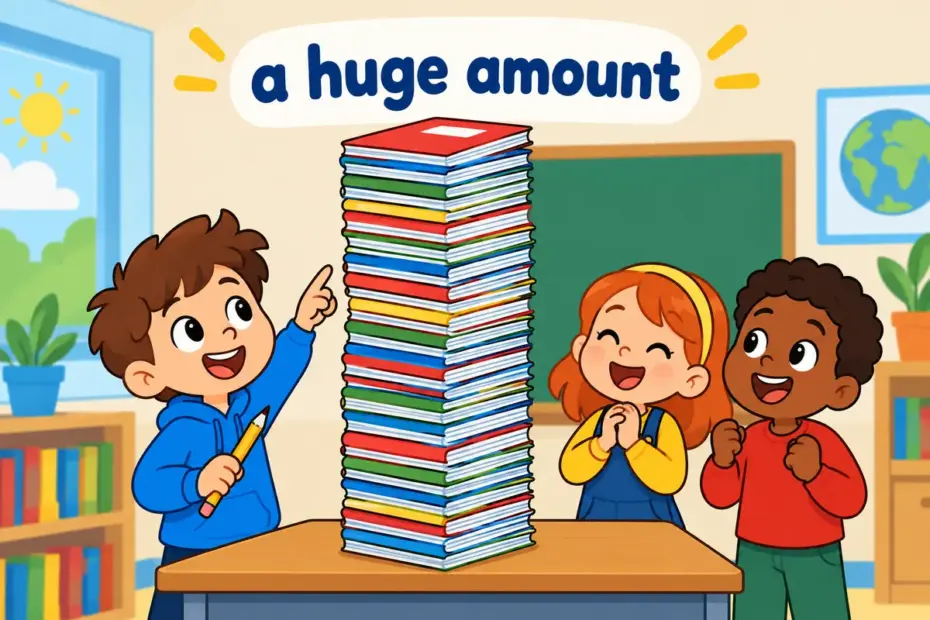
Prodigious is an adjective meaning remarkably great in size, amount or degree. To use prodigious in a sentence, place it before the quantity that impresses you: “She read a prodigious number of books over the summer.” The word measures output and extent rather than simple physical height, and it usually carries admiration.
Prodigious at a glance
- Prodigious is an adjective; its adverb is prodigiously and its rare noun is prodigiousness.
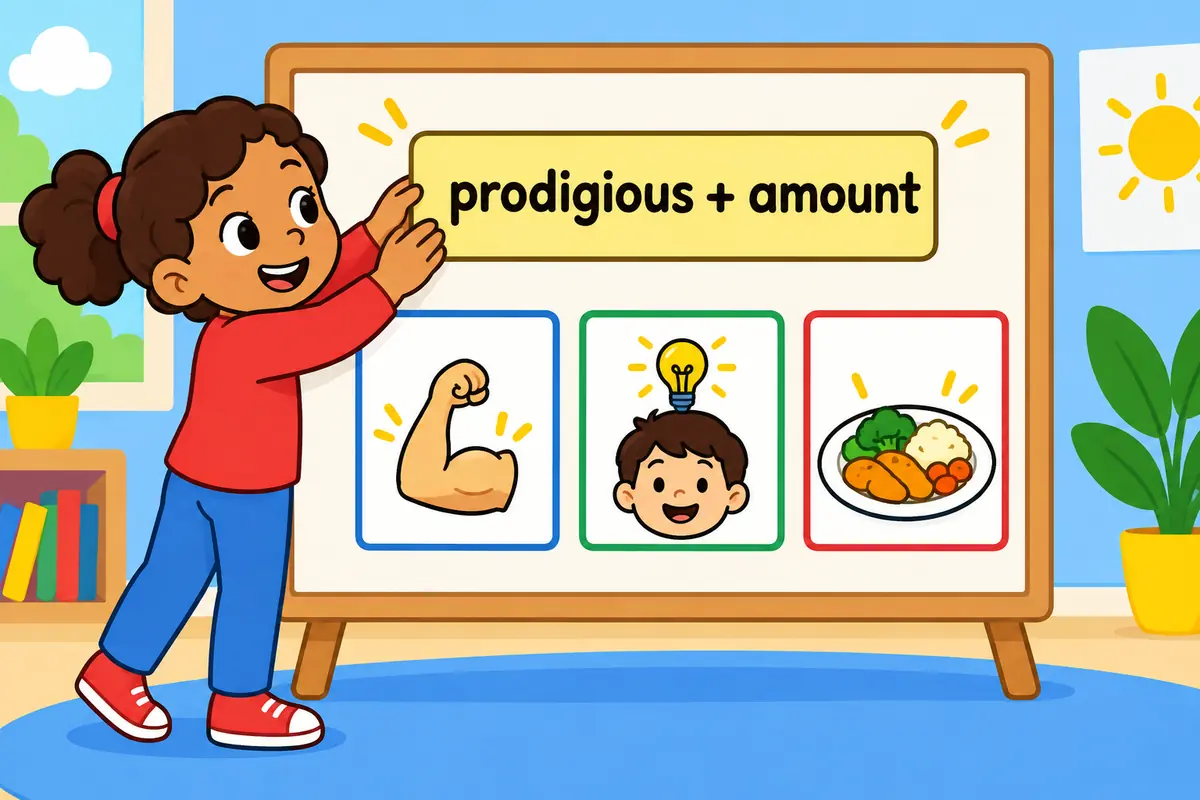
- The dominant pattern is prodigious + an abstract noun of amount, such as appetite, energy or output.
- It belongs to formal, literary and journalistic writing rather than casual speech.
- The usual collocations are prodigious amount, prodigious appetite, prodigious memory and prodigious talent.
- The commonest error is confusing prodigious with prodigal, which means wastefully extravagant.
What does prodigious mean?
Prodigious is an adjective meaning remarkably or impressively large in extent, amount or degree. The Cambridge entry for prodigious records this central sense, and the impression it conveys is astonishment rather than neutral measurement. Where a writer simply wants more size with no sense of wonder, immense or large does the job with less colour.
| Sense | Plain meaning | Example sentence |
|---|---|---|
| Great in amount or extent | Remarkably large in quantity or scale | The team spent a prodigious amount of time on the model. |
| Great in degree | Intensely strong or notable | She wrote with prodigious energy until midnight. |
| Extraordinary in ability | Impressive beyond the ordinary | His prodigious memory held every date in the chapter. |
One limitation matters more than any other. Prodigious does not mean talented at a young age; that is prodigy, a noun. A gifted child is a prodigy, and the child’s output may be described as prodigious, but the adjective never names the person. It also never means wasteful, which is the separate word prodigal.
How do you use prodigious in a sentence?
Prodigious works as an attributive adjective before a noun, and it almost always intensifies an abstract quality of amount. Four frames cover nearly every real sentence, and each one keeps the noun countable as a quantity rather than a physical object.
| Pattern | Example | What it signals |
|---|---|---|
| a prodigious amount / number of + noun | A prodigious number of volunteers signed up. | An impressive countable or mass quantity. |
| prodigious + abstract noun | He tackled the task with prodigious appetite. | Great degree, usually of effort or appetite. |
| prodigious + noun of ability | Her prodigious memory surprised the examiners. | Ability far beyond the ordinary. |
| prodigiously + verb | They worked prodigiously through the night. | Extreme manner, using the adverb. |
Prodigious in a sentence: examples across contexts
Prodigious changes its noun across registers but keeps its tone of astonishment. The eight sentences below move from the classroom to the news desk, and each one pairs the adjective with a quantity that a reader can weigh.
| Context | Example sentence | Why this works |
|---|---|---|
| Classroom | Maya read a prodigious number of books before the book week ended. | A countable number makes the size concrete for a young reader. |
| Workplace email | The audit demanded a prodigious amount of paperwork. | Pairs the adjective with a task, which suits a formal request. |
| News report | The rescue effort required prodigious coordination overnight. | Names an abstract demand rather than a physical object. |
| Sports writing | The keeper made a prodigious leap to tip the ball away. | Applies the adjective to a single impressive action. |
| Academic prose | The archive yielded a prodigious volume of letters. | Measures scholarly output, the adjective’s natural home. |
| Science writing | The telescope gathered a vast and prodigious set of readings. | Uses prodigious for degree after a plainer size word. |
| Conversation | Gran has a prodigious memory for old phone numbers. | Keeps the adjective in speech, where it survives naturally. |
| Literary criticism | The novel shows a colossal ambition and prodigious research. | Contrasts breadth with scholarly effort in one line. |
Prodigious vs prodigal
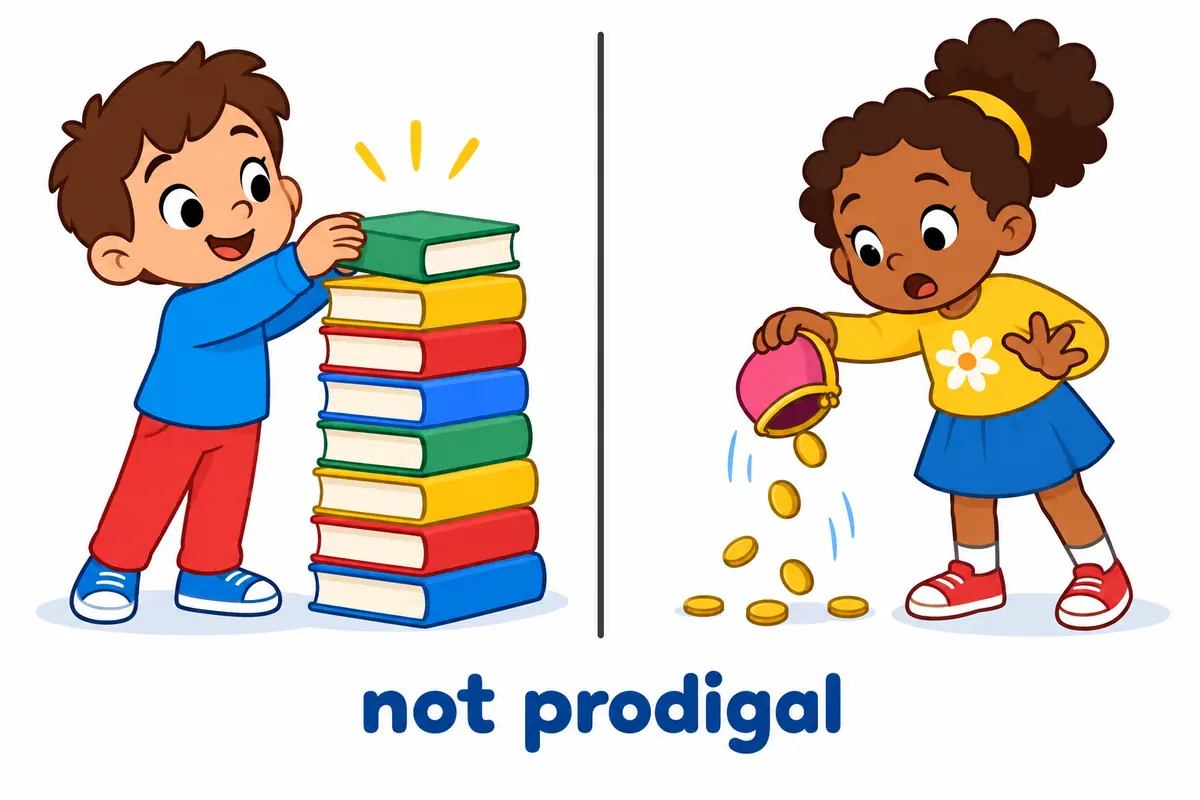
Prodigious and prodigal share a Latin root and a similar shape, so learners reach for the wrong one. The prodigal son wastes his inheritance, while a prodigious effort is simply enormous, and the two adjectives point in different directions.
| Attribute | prodigious | prodigal |
|---|---|---|
| Core meaning | Remarkably large in amount or degree | Wastefully extravagant |
| Tone | Admiring or astonished | Critical or regretful |
| Typical noun | Amount, energy, memory, output | Spending, son, lifestyle |
| Implies judgement | No; it marvels at scale | Yes; it blames excess |
| Register | Formal and literary | Formal and literary |
| Adverb | Prodigiously: to a great degree | Prodigally: wastefully |
Verdict: choose prodigious when the quantity astonishes you, and prodigal when the spending is reckless. A prodigal heir may still show prodigious talent, so the two words can stand in the same sentence without contradicting each other.
Word forms and grammar of prodigious
Prodigious inflects like any adjective and has a working adverb, but its noun family splits away in meaning. The table marks the forms learners wrongly build and the relatives that look like synonyms but are not.
| Form | Part of speech | Example |
|---|---|---|
| prodigious | adjective | The project needed a prodigious effort. |
| prodigiously | adverb | She worked prodigiously for three terms. |
| prodigiousness | noun, rare | The sheer prodigiousness of the output amazed them. |
| prodigy | noun — different meaning | The young prodigy played two instruments. |
| prodigality | noun — different meaning | His prodigality emptied the estate. |
| prodigals | non-standard as an adjective plural | Use prodigal sons, never prodigals as an adjective. |
Common mistakes with prodigious
Incorrect: The prodigious son wasted his inheritance. Correct: The prodigal son wasted his inheritance. Rule: Prodigal means wastefully extravagant, while prodigious means remarkably large.
Incorrect: He is a prodigious violinist. Correct: He is a prodigy on the violin. Rule: Prodigious describes an amount or degree; a gifted young performer is a prodigy.
Incorrect: The cathedral was prodigious. Correct: The cathedral was enormous. Rule: Prodigious intensifies abstract quantity, so plain bulk takes enormous or huge.
Incorrect: A prodigious amount of people came. Correct: A prodigious number of people came. Rule: Use number for count nouns and amount for mass nouns.
Incorrect: He worked prodigious hard. Correct: He worked prodigiously hard. Rule: An adverb, not the adjective, describes how a verb is performed.
Practice using prodigious
Work through the six items, then read the reasons rather than only the answers.
- Fill the gap: The volunteers put in a ______ amount of work over the weekend.
- Choose the better word: The (prodigious / prodigal) heir sold the family silver to fund parties.
- Correct the error: She is a prodigious at the piano.
- Build a sentence: use prodigious memory about a grandparent who knows every birthday.
- Spot the register: which belongs in a school report — Her output was prodigious, or She did, like, tons of work?
- Rewrite with the adverb: He practised with great energy. Use prodigiously instead.
Answers
- prodigious — the adjective intensifies amount, its most common partner noun.
- prodigal — reckless spending is the defining trait of prodigal, not prodigious.
- She is a prodigy at the piano — the noun names the person, while the adjective describes their output.
- Model answer: Grandad has a prodigious memory for every cousin’s birthday.
- Her output was prodigious — a report keeps formal vocabulary and avoids fillers.
- He practised prodigiously — the adverb modifies the verb practised.
The bottom line
Use prodigious in a sentence to intensify an amount, degree or output, and keep it before an abstract noun such as effort, memory or appetite. The two nuances that decide most sentences are these: prodigious measures quantity rather than physical bulk, so enormous is the safer word for a large object, and the adjective never names a gifted child, which is a prodigy. Where you mean wasteful, prodigal is the correct adjective.
Frequently asked questions about prodigious
Is prodigious a positive word?
Prodigious usually carries admiration, because it marvels at an impressive amount or degree. It can sound neutral in academic writing, where it measures output without emotion. The word is rarely insulting, but an ironic writer can use it to suggest that an amount is absurdly large rather than admirable.
What is the difference between prodigious and prodigal?
Prodigious means remarkably large in amount, degree or extent, as in a prodigious memory. Prodigal means wastefully extravagant, as in the prodigal son who squandered his inheritance. They share a Latin root and a similar shape, so the confusion is common, but only prodigal implies blame for waste.
Can prodigious describe a person?
Prodigious describes a person only through a quality, as in a prodigious talent or a prodigious worker. It never stands alone to mean a gifted child; that noun is prodigy. So a sentence such as she is a prodigious is incomplete, while she has prodigious talent is correct and natural.
How do you use prodigious in everyday speech?
In speech prodigious sounds bookish, so most people say a huge amount or an enormous memory. It survives naturally in set phrases about appetite, memory and energy, where its tone of wonder still fits. Reserve it for the amount you genuinely find astonishing, or the adjective loses its force.
Have you ever heard someone describe something as “prodigious” and wondered what it meant? In simple terms, when something is described as prodigious, it means it is exceptional or extraordinary in size, degree, or extent.
A prodigious individual possesses remarkable talent, intelligence, or skill that sets them apart from others. The word “prodigious” emphasizes the remarkable nature of something, highlighting its exceptional qualities.
7 Examples Of Prodigious Used In a Sentence For Kids
- Prodigious is a big word that means very, very big or special.
- The elephant has a prodigious memory and never forgets where it hides its food.
- The sun gives off a prodigious amount of light and heat every day.
- A prodigious athlete can run very fast and jump very high.
- The whale is a prodigious swimmer and can travel long distances in the ocean.
- A prodigious tree can grow very tall and provide shade for many animals.
- The farmer grew a prodigious pumpkin that won first prize at the agricultural fair.
14 Sentences with Prodigious Examples
- The college library boasts a prodigious collection of academic journals and research papers.
- The professor’s prodigious knowledge of literature never fails to impress his students.
- Students often struggle to keep up with the prodigious amount of reading assignments given each semester.
- The campus cafeteria offers a prodigious variety of food options to cater to different dietary preferences.
- The college’s annual fest attracted a prodigious crowd of students and visitors from various parts of the country.
- Many students were in awe of the prodigious talent displayed by their classmates during the drama competition.
- The college’s sports teams have a prodigious record of winning championships in various tournaments.
- Students were amazed by the prodigious artwork displayed at the campus art exhibition.
- The college’s computer lab is equipped with prodigious technology to support students’ programming projects.
- The guest speaker at the seminar had a prodigious ability to captivate the audience with her inspiring words.
- The student organization managed to raise a prodigious amount of funds for a charitable cause.
- Some students find it challenging to balance the prodigious workload of assignments and extracurricular activities.
- The college’s debate team has a prodigious reputation for winning national-level competitions.
- The professor’s prodigious memory for details never ceases to amaze his students.
How To Use Prodigious in Sentences?
Prodigious can be used in a sentence to describe something that is remarkably impressive or extraordinary.
Here are some examples of how to use prodigious in a sentence:
- “The young artist displayed a prodigious talent for painting, creating masterpieces at a very young age.”
- “Her prodigious memory allowed her to easily memorize long lists of facts and figures.”
- “The team’s prodigious effort and determination led them to win the championship for the fifth year in a row.”
- “He was known for his prodigious strength, able to lift heavy weights with ease.”
- “The scientist made a prodigious breakthrough in the field of biotechnology, revolutionizing the industry.”
When using prodigious in a sentence, it is important to make sure that the context of the sentence conveys something that is impressive, exceptional, or outstanding in some way. This word is often used to describe someone’s talent, ability, achievement, or effort that is notably remarkable.
To enhance your language and add depth to your communication, incorporating prodigious into your vocabulary can help you better articulate moments of excellence or extraordinary feats.
Conclusion
In conclusion, the prodigious talent displayed by individuals like Mozart and Einstein exemplifies extraordinary skill and ability. Their prodigious accomplishments in music, science, and various fields serve as inspiration for what can be achieved with dedication and talent. Despite facing challenges, these prodigious individuals persevered and made groundbreaking contributions in their respective domains, leaving a lasting impact on society.
By recognizing and celebrating prodigious talent, we can embrace and nurture exceptional abilities in individuals from all walks of life. It is important to encourage and support those with prodigious potential, fostering a culture that values and cultivates exceptional talent. Through continued acknowledgment and investment in prodigious individuals, we can create opportunities for further innovation and advancements in diverse fields.


