Public Policy in a Sentence: Meaning and 21 Examples
Public policy is a government’s or public institution’s course of decisions and actions for addressing matters that affect a community. Use the phrase as a subject (“Public policy shapes public services”) or object (“The class studies public policy”); use a public policy or public policies when counting particular policy choices. In running text, lowercase the phrase unless it begins a sentence or appears in a proper title.
- Meaning: public decisions and actions aimed at issues of shared concern.
- Common topics: health, education, transportation, housing, environment, and public safety.
- Grammar: “public policy” can refer to the field generally or to one countable policy; “policies” is the plural.
- Typical phrases: public policy on an issue; a policy to address a problem; implement or evaluate a policy.
- Important distinction: policy can include laws and regulations, but it is not limited to legislation.

What does “public policy” mean?
Public policy refers broadly to public decisions and actions used to address problems or guide services. American University’s School of Public Affairs summarizes it as government decisions, laws, and actions to solve problems or improve society. Depending on context, the phrase can mean one defined course of action or the academic field that studies how such choices are made.
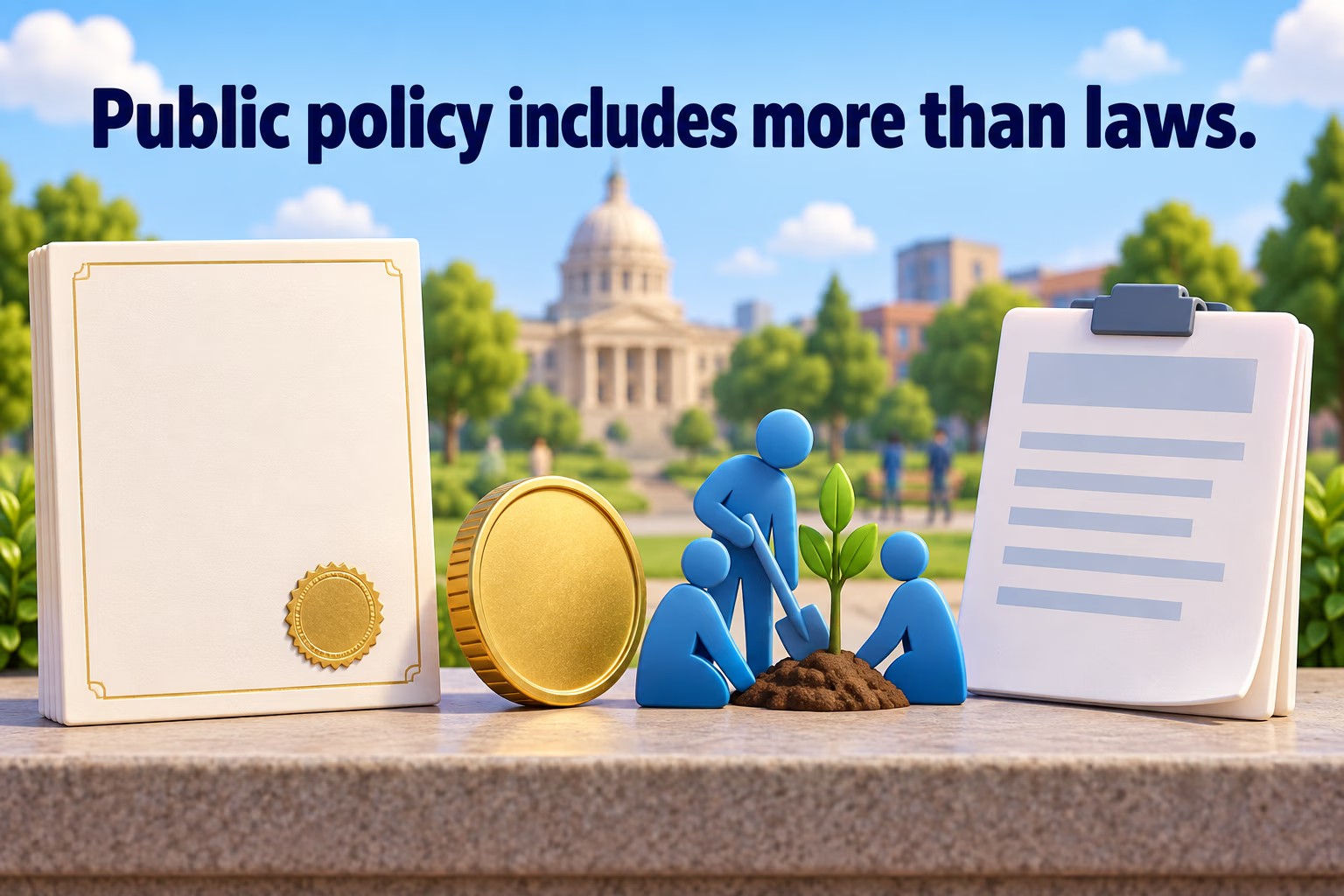
Public policy is broader than a single law. The National Academies describes policy tools that can include statutes, regulations, agency guidance, executive actions, and other official decisions. For a sentence about a particular legal requirement, name the law or regulation; for the larger government approach, public policy may be the better phrase.
Is “public policy” countable or uncountable?
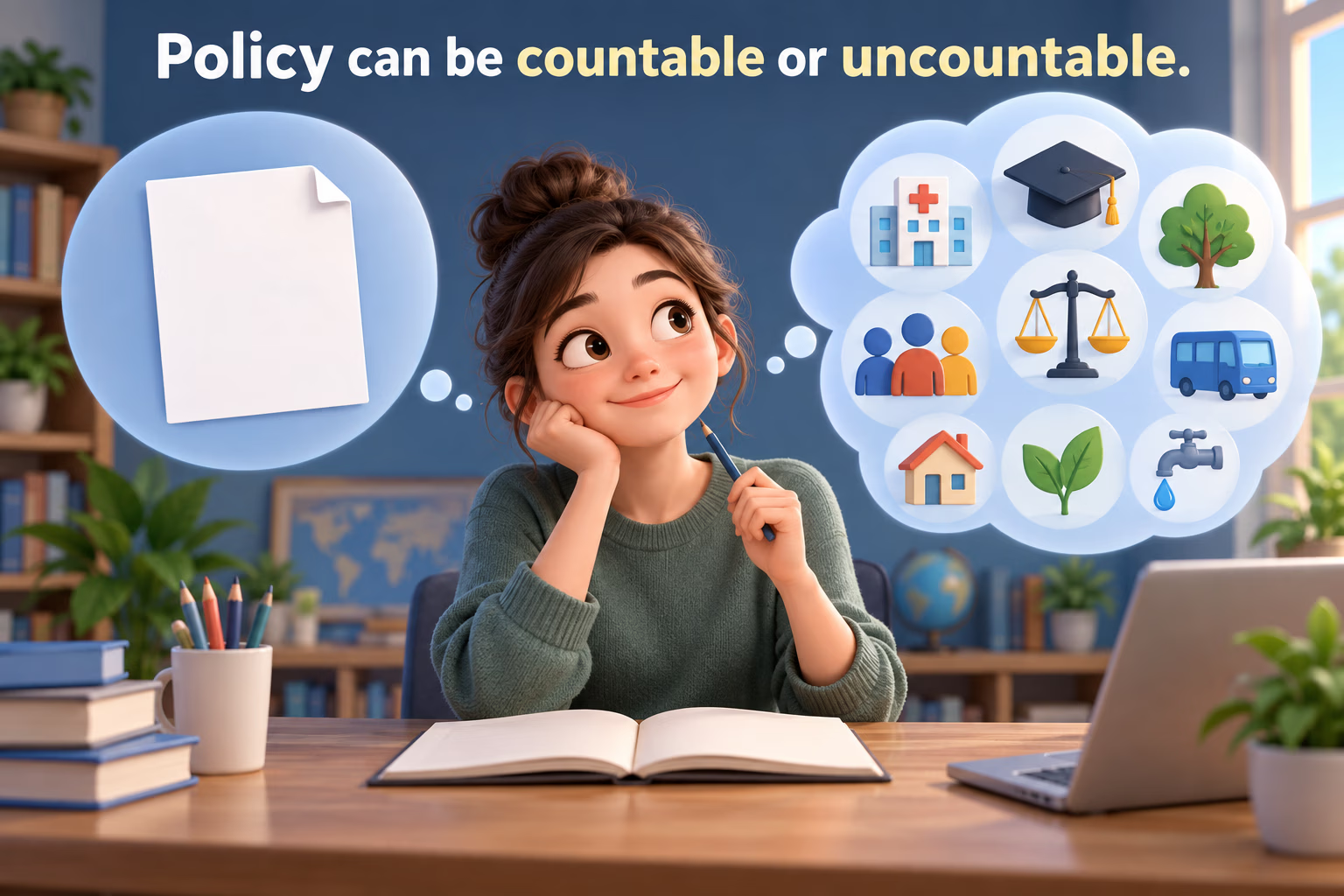
Both patterns are possible because policy can be countable or uncountable. The Oxford Advanced Learner’s Dictionary lists both uses: general policy or a field can be treated broadly, while a particular plan is countable.
| Form | Example sentence | Use |
|---|---|---|
| public policy + singular verb | Public policy affects how a city plans its bus service. | The broad field or approach is the subject. |
| a public policy | The council adopted a public policy on accessible meetings. | One specific course of action. |
| public policies + plural verb | Public policies shape how agencies deliver services. | Several distinct policies. |
| public policy on + topic | The report compares public policy on clean water. | Names the issue under discussion. |
| policy to + verb | The city proposed a policy to improve sidewalk access. | Explains a policy’s intended action. |
Choose the verb to match the grammatical subject: “Public policy is debated,” “a public policy was adopted,” and “public policies are evaluated.” The unmodified phrase is not automatically plural just because a topic affects many people.
How does a public policy move from problem to action?
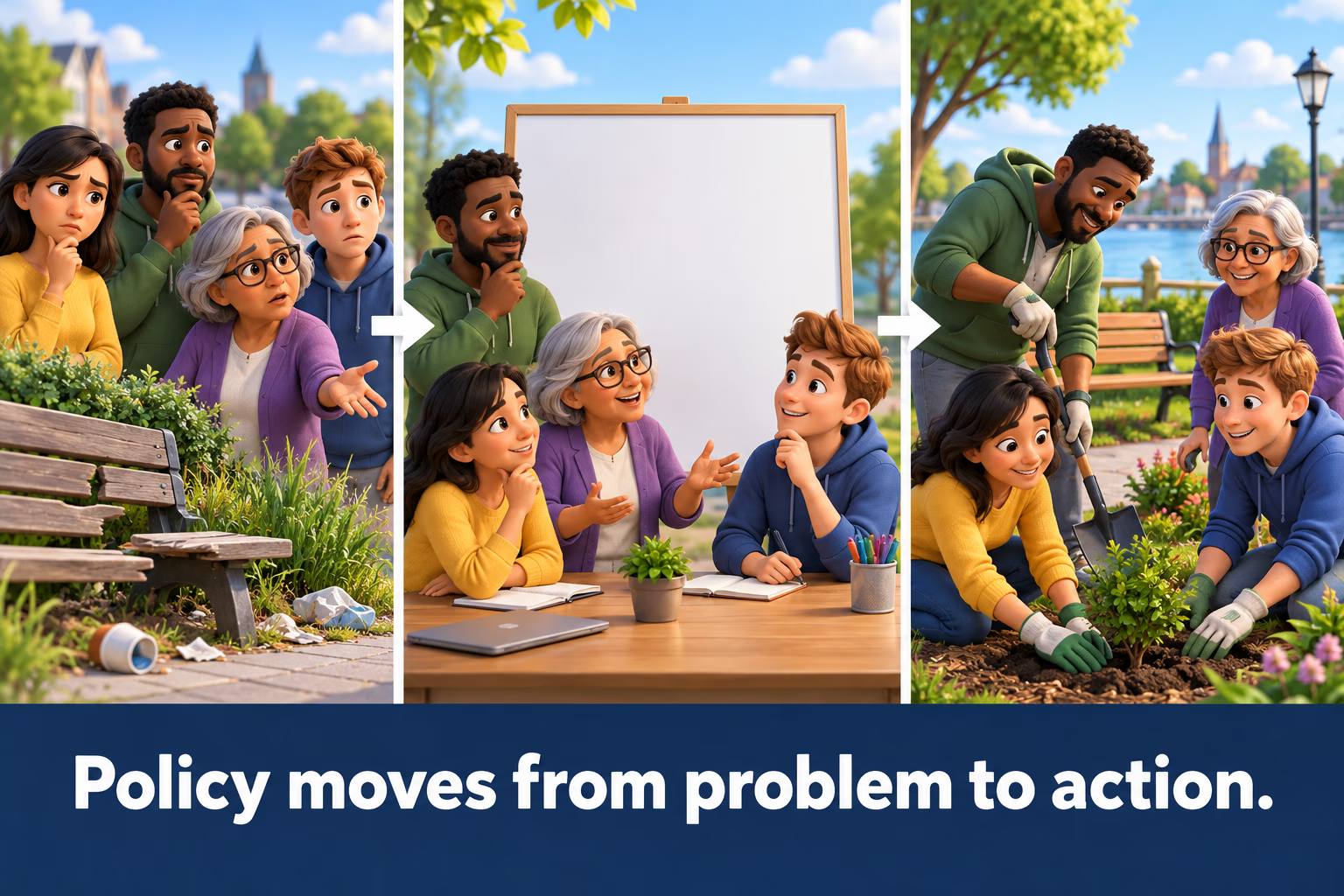
Policy work can involve identifying a problem, analyzing options, developing a strategy, securing enactment, and implementing the decision. The CDC Policy Process uses these domains for public health and treats stakeholder engagement and evaluation as activities that span the process.
- Identify: state the public problem precisely.
- Analyze: compare possible approaches and available evidence.
- Develop: define the proposed strategy and how it would work.
- Enact: follow the relevant approval or adoption process.
- Implement and evaluate: put the policy into practice and examine what happens.
This sequence is a useful way to explain a policy process, not a guarantee that every government decision follows a fixed, one-way path. The University of Plymouth notes that policy-making involves multiple stakeholders and is not linear; new evidence or implementation problems can send decision-makers back to earlier questions.
How is public policy different from a law?
A law is one possible policy instrument, while public policy describes a broader direction or set of public decisions. A policy may be carried out through legislation, regulations, funding, administrative guidance, public programs, or enforcement; a sentence should name the exact instrument when that detail matters.
- Policy: “The public policy prioritizes safer routes to school.”
- Law: “The new law requires drivers to stop at the marked crossing.”
- Implementation: “The city funded signs and crossing improvements to carry out the policy.”
How can you make a public-policy sentence specific?
- Name the policy topic: education, transportation, health, housing, or another public issue.
- Choose the scale or institution when known, such as a city, state, national government, or agency.
- Use a precise verb: propose, adopt, fund, implement, enforce, assess, or revise.
- Separate the intended goal from the measured result; a policy’s purpose does not prove that it achieved that outcome.
“Public policy improves education” is broad and sounds like a proven result. “The district’s attendance policy is intended to reduce missed class time” identifies the institution, policy, and aim without claiming the outcome was already measured.
Frequently asked questions about public policy in a sentence
Should I write “public policy is” or “public policy are”?
Use public policy is when the phrase refers broadly to the field or one policy approach. Use public policies are when you mean multiple distinct policies.
Can I write “a public policy”?
Yes. Use a public policy for one specific plan or course of action: “The agency adopted a public policy on record retention.” The general field is usually written without an article.
Is public policy the same as politics?
No. Politics includes competition, debate, and the processes through which public decisions are shaped. Public policy refers more specifically to the decisions, rules, priorities, and actions adopted or carried out by public institutions.
Does every public policy become a law?
No. A law can establish or authorize policy, but governments can also use regulations, funding, administrative guidance, programs, or implementation choices. Use law when you specifically mean a legally enacted statute.
What topics can public policy cover?
Public policy can address health, education, transportation, housing, the environment, safety, and other issues that affect communities. The phrase names a broad area; a clear sentence identifies the particular issue and the public action.
What verbs commonly go with public policy?
Writers commonly develop, adopt, implement, evaluate, revise, or debate public policy. For individual policies, propose a policy, enact a policy, fund a program, and enforce a rule identify different actions more precisely.
Context for the original examples below: They are preserved as examples of wording, not as universal claims about policy effects. Policies can distribute benefits and costs differently, and their goals or results may be disputed; do not assume every policy makes a community safer or benefits everyone. “Rules for everyone” is a simplification: public policy can include laws, programs, funding, administrative choices, and decisions about implementation. A teacher’s opinion alone does not define public policy. Treat stated goals as aims unless evidence shows what a policy achieved.
Public policy refers to the decisions and actions undertaken by a government to address issues and challenges facing society. These policies are designed to achieve specific goals and outcomes that benefit the public as a whole.
From healthcare to education, public policy plays a crucial role in shaping how resources are allocated, services are delivered, and rights are protected within a society. Understanding the intricacies of public policy allows citizens to actively participate in the democratic process and hold their governments accountable for the decisions made on their behalf.
7 Examples Of Public Policy Used In a Sentence For Kids
- Public policy is like rules for everyone to follow.
- We all need to know about public policy to be good citizens.
- Public policy helps keep our community safe and happy.
- Our leaders make decisions based on public policy.
- We should listen to our teachers when they talk about public policy.
- Let’s learn how public policy helps us live together nicely.
- We can all work together to make good public policy for everyone.
14 Sentences with Public Policy Examples
- Public policy plays a crucial role in shaping the education system in India.
- Understanding public policy is essential for students studying political science.
- College students can analyze the impact of public policy on economic development.
- Knowledge of public policy helps students evaluate the effectiveness of government programs.
- Students can engage in discussions about public policy to enhance their critical thinking skills.
- Public policy research can provide valuable insights for students interested in policymaking careers.
- College students can participate in public policy debates to broaden their perspectives.
- Analyzing the implications of public policy decisions is important for students pursuing law degrees.
- Students can study the role of public policy in addressing social inequalities in India.
- Understanding the historical context of public policy is crucial for students studying Indian democracy.
- College students can volunteer with organizations that advocate for specific public policies.
- Engaging in public policy internships can provide students with practical experience in the field.
- Students can write research papers on current public policy issues facing India.
- Debating the pros and cons of different public policies can help students develop strong argumentative skills.
How To Use Public Policy in Sentences?
Public Policy refers to the actions taken by governments to address issues of public concern and promote the well-being of society as a whole.
In a sentence, you can use Public Policy by incorporating it into discussions about how governments make decisions on issues such as healthcare, education, or environmental protection. For example, “The government’s new public policy on climate change aims to reduce carbon emissions and protect the environment for future generations.”
When writing or speaking about Public Policy, it is important to consider the goals and impacts of the policies being implemented. You can analyze the effectiveness of Public Policy by examining its intended outcomes and how well it addresses the needs of the public.
To effectively use Public Policy in a sentence, it is helpful to provide context and explain why a particular policy is important or relevant to the topic being discussed. This can help others understand the significance of government actions and their impact on society.
By understanding the concept of Public Policy and how it shapes the decisions made by governments, individuals can engage in informed discussions about social issues and advocate for policies that promote the common good.
Conclusion
In conclusion, sentences with public policy as the key term highlight the importance of governmental actions and decisions in shaping society. These sentences underscore the role of public policy in regulating various aspects of public life, such as healthcare, education, and the environment. They demonstrate how policies can impact communities, individuals, and the overall well-being of a nation.
Through examining sentences with public policy, it becomes evident that these policies play a crucial role in addressing societal challenges and promoting the common good. By analyzing such sentences, we gain insights into how public policies are formulated, implemented, and evaluated, ultimately influencing the social, economic, and political landscape of a country. Thus, understanding and engaging with public policy is essential for creating a more equitable and prosperous society for all.


