Pundit means a person who offers expert opinion to the public, especially on politics, culture or sport, and it usually carries a hint of the self-assured commentator: “A panel of pundits predicted the result.” To use pundit in a sentence, make the person the subject and pair the word with a field.
Pundit at a glance
- Pundit is a countable noun; its plural is pundits.
- The dominant pattern is a pundit on a topic, or a field adjective such as political pundit.
- It appears mostly in journalism, broadcasting and political writing.
- Common collocations include political pundit, TV pundit and a panel of pundits.
- The commonest error is treating pundit as a neutral synonym for expert, when it often hints at confident opinion.
What does pundit mean?
Pundit is a countable noun meaning a person who gives opinions or explanations to the public, usually because of specialist knowledge or a media platform. The Cambridge entry for pundit records both the expert sense and the media sense, and the two often overlap in the same person.
| Sense | Plain meaning | Example sentence |
|---|---|---|
| Media commentator | Someone paid to give opinions on air or in print | The pundit predicted a close election. |
| Recognised authority | A specialist the public turns to for judgement | She is a pundit on constitutional law. |
| Confident opinion-giver | A person whose assurances may outrun the evidence | The pundits were wrong about the outcome. |
| Historical: a learned person | A scholar respected for deep learning | Village pundits settled disputes over land. |
The word arrived in English from Hindi, where a pandit was a learned teacher, and that older sense of scholarship survives in the modern noun. The narrow, neutral term is expert, which claims knowledge rather than airtime. Where the person writes a regular opinion column, columnist is the precise job title, and where the role is judging works of art, the right word is critic.
Two limits matter. Pundit is not automatically an insult, but it does lean toward opinion delivered with confidence, so calling a careful researcher a pundit can sound faintly dismissive. The word also implies a public audience: a quiet specialist who never publishes is an expert or a specialist, not a pundit, because the public part is essential.
How do you use pundit in a sentence?
Pundit names a person, so it slots into the ordinary positions of a count noun, with a field or an on-phrase to say what the expertise covers.
| Pattern | Example | What it signals |
|---|---|---|
| a / the pundit + verb | The pundit predicted a landslide. | The person is the subject of the sentence. |
| pundit on + topic | She is a pundit on energy policy. | Names the specialism the person comments on. |
| field adjective + pundit | The political pundit stayed calm. | A single word locates the beat. |
| a panel / group of pundits | A panel of pundits debated the result. | Collective use, common in broadcasting. |
| be seen as a pundit | He is seen as a pundit, not a reporter. | Marks reputation and contrasts it with reporting. |

Pundit in a sentence: examples across contexts
The ten sentences below move pundit from a television studio into sport, business and ordinary talk, and every one keeps the public role visible.
| Context | Example sentence | Why this works |
|---|---|---|
| News report | The pundit forecast a hung parliament. | A public prediction is the classic pundit action. |
| Television | A panel of pundits reviewed the debate. | The collective phrase matches studio practice. |
| Sport | The football pundit explained the offside rule. | A field adjective locates the expertise. |
| Radio | The pundit spoke for ten minutes without a note. | Confident delivery is part of the word’s flavour. |
| Politics | Political pundits disagreed about the turnout. | The plural shows a whole commentating class. |
| Business | An economic pundit warned of slower growth. | The field adjective keeps the claim specific. |
| Classroom | The class played at being pundits for a day. | A playful use makes the media role concrete. |
| Social media | Self-appointed pundits filled the comment thread. | The modifier gently questions their authority. |
| Academic prose | The study compares pundits with peer-reviewed scholars. | It contrasts opinion with vetted knowledge. |
| Conversation | Do not ask me; I am no pundit. | The modest denial shows the word in everyday talk. |
Pundit vs expert
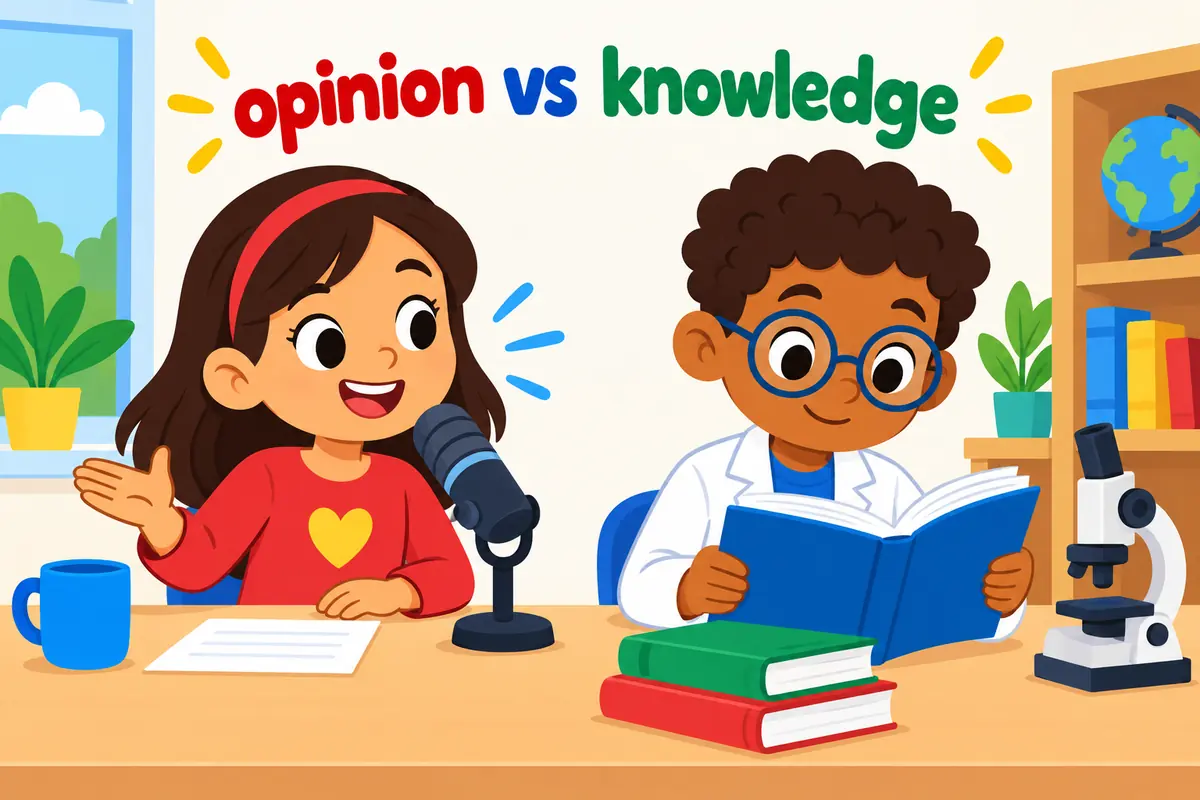
The distinction is between airtime and credentials. An expert has knowledge tested by training or research; a pundit has a platform for opinions. The two can be the same person, and often are, but the words stress different things, which is why a scientist can be an expert who is asked to play the pundit. Authority leans on recognised standing, and scholar leans on study, while pundit leans on the public performance of opinion.
| Attribute | pundit | expert |
|---|---|---|
| Basis of standing | A public platform | Tested knowledge or skill |
| Main activity | Giving opinions on air or in print | Applying deep knowledge |
| Audience | The general public | Whoever needs the answer |
| Connotation | Confident, sometimes glib | Reliable and neutral |
| Typical partner | a political pundit | a leading expert in the field |
| Register | Journalistic | General and professional |
Use pundit when a public opinion-giver is meant and a touch of scepticism is welcome, and use expert when the point is the depth of knowledge rather than the reach of the platform.
What is the pundit class?
The phrase pundit class is a mildly critical label for the group of commentators and analysts who appear regularly in newspapers, on television and online. Writers use it to name a profession as a bloc, as in the pundit class agreed that the race was over, often before the results arrived.
The related abstract noun is punditry, meaning the work or output of pundits, as in a week of nonstop election punditry. Both terms carry a note of scepticism about confident forecasting, and both belong to comment about the media rather than to neutral description. A sentence that uses them is usually observing the pundits, not joining them.
Word forms and grammar of pundit
| Form | Part of speech | Example |
|---|---|---|
| pundit | noun, singular | The pundit answered without hesitating. |
| pundits | noun, plural | The pundits had the story wrong. |
| punditry | noun, uncountable | The weekend was full of political punditry. |
| pundit class | noun phrase | The pundit class missed the mood. |
| punditocracy | noun, informal | The punditocracy set the agenda. |
| punditic | adjective, rare | His punditic tone annoyed the panel. |
The everyday forms are the singular and plural noun, and punditry is common in cultural comment. Punditocracy is informal and slightly mocking, and the adjective punditic appears only occasionally, so most writers avoid it. Building any of these on the verb is impossible, because pundit names a person or a body of work, never an action.
Common mistakes with pundit
- Incorrect:
She pundit the election on television.Correct: She was a pundit on television during the election. Pundit is a noun, so it cannot be used as a verb. - Incorrect:
He is an expert pundit of tax law.Correct: He is a pundit on tax law. The noun takes on before the field, and expert and pundit do not need stacking. - Incorrect:
The pundit was political.Correct: The political pundit was calm. The field adjective usually goes before the noun, not after the linking verb. - Incorrect:
She is a pundit.(when no public role is meant) Correct: She is an expert in her field. A private specialist is an expert, because pundit implies an audience. - Incorrect:
We listened to the pundits’ opinion.Correct: We listened to the pundits’ opinions. The plural noun takes a plural possessive. - Incorrect:
Two pundit agreed.Correct: Two pundits agreed. A count noun after a number must be plural.
Practice using pundit
- Fill in the blank: The ______ on the news desk predicted a close race.
- Fill in the blank: She became a well-known ______ on education policy.
- Choose the better word: The careful researcher who never speaks publicly is an (expert / pundit).
- Correct the error: The pundit on sport he explained the tactics.
- Correct the error: Three pundit disagreed live on air.
- Build a sentence: describe a television studio, using a panel of pundits.
- Spot the register: which fits a serious newspaper — “a political pundit” or “some loudmouth on TV”?
- Build a sentence: use the noun punditry to describe a week of election coverage.
Answers
- pundit. A person on a news desk giving opinions is the canonical subject.
- pundit. On names the field the public role covers.
- expert. Without a public platform, the accurate noun is expert.
- The sports pundit explained the tactics. Drop the extra pronoun and put the field before the noun.
- Three pundits disagreed live on air. The count noun must be plural after three.
- Sample: A panel of pundits debated the result until midnight.
- The first, because pundit is the neutral, professional term.
- Sample: The week of nonstop punditry tired even the presenters.
The bottom line
Pundit means a public opinion-giver, usually one with recognised knowledge of a field, and it sits naturally in journalism, broadcasting and political talk. Use it as a count noun with a field adjective or an on-phrase, and keep expert for the quieter claim of tested knowledge. The word carries a faint scepticism, so choose it deliberately when confident opinion, rather than settled fact, is what the sentence is about.
Frequently asked questions about pundit
Is pundit a formal or a casual word?
It sits in the middle. Pundit appears constantly in serious journalism and political writing, where it is neutral and precise, yet it also carries a faint edge of scepticism about confident opinion. In casual speech it can sound slightly knowing. The word is standard in both registers, though it almost always points to someone with a public platform.
What is the difference between a pundit and a commentator?
Commentator is the broader term and covers anyone who explains or discusses events on air, from sport to weather. Pundit is narrower and suggests recognised expertise plus opinion, often with a note of authority that the word commentator lacks. Every pundit is a commentator, but many commentators, such as a live reporter, are not pundits.
Where does the word pundit come from?
English borrowed pundit from Hindi, where pandit meant a learned person or teacher, and the word still recalls scholarship even in its media sense. That history explains why pundit can mean both a genuine authority and a television opinion-giver. The modern emphasis on public performance is a later development of a word that began with learning.
Can pundit be used as a verb?
No. Pundit is only a noun, so forms such as pundited or punditing are not standard English. When you need an action, use a phrase such as give an opinion, comment or speculate, and keep pundit for the person. The related noun punditry names the work itself, which is the closest the word family comes to an activity.