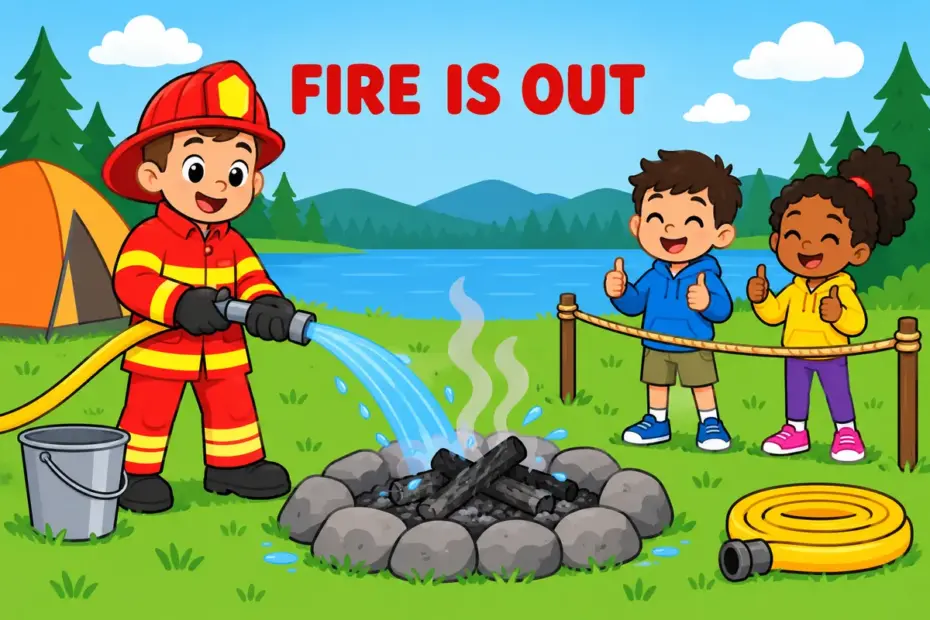
Put out in a sentence usually means to stop something burning or to inconvenience somebody, and the object that follows settles the meaning. You put out a candle, a fire or a light, but you are put out by a late change of plan. Because the verb is separable, the particle can sit on either side.
Put out at a glance
- Put out is a transitive phrasal verb, and the particle out can follow the object.
- Its commonest sense is to extinguish a fire, a flame or a light.
- It also means to inconvenience someone, usually in the passive be put out.
- It can mean to publish or broadcast, as in put out a new single.
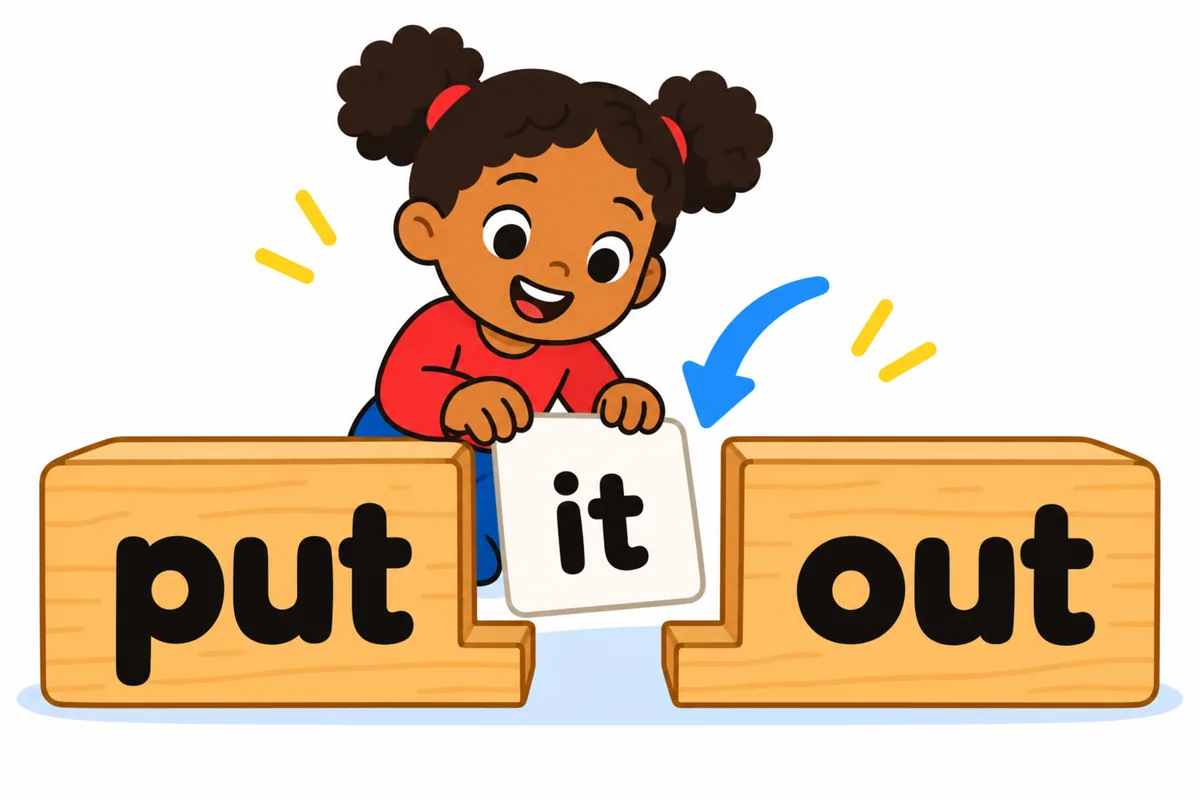
- A pronoun object must go between the parts: put it out, never put out it.
What does put out mean?
Put out is a phrasal verb meaning to stop something burning, to inconvenience someone, or to make something available to the public. The Cambridge entry for put out separates these senses, and the object in the sentence shows which one is meant: fires and lights are extinguished, while people are inconvenienced. When the meaning is simply to release a record or a statement, publish a report is the plainer verb a reader may prefer.
| Sense | Plain meaning | Example sentence |
|---|---|---|
| Extinguish | Stop a fire, flame or light burning | The crew put out the fire before midnight. |
| Inconvenience | Trouble or annoy someone, often in the passive | Would it put you out if I came an hour early? |
| Publish or broadcast | Release a record, message or programme | The band put out a new single in June. |
| Place outside | Put an object outdoors | Put out the rubbish before the van arrives. |
| Extend | Stretch out a hand or limb | He put out a hand to stop the swing door. |
One limitation is worth stating. Put out is informal when it means inconvenience, and it can sound abrupt. In a formal email, the passive we were put out by the delay is acceptable, but the plainer phrase the delay caused us trouble reads more naturally for most readers.
How do you use put out in a sentence?
Put out is transitive in the fire, rubbish and publish senses, so something must be put out. It is separable, which means a noun object may sit between the verb and the particle; the calm-down and inconvenience uses take no object at all. A pronoun object, however, must go in the middle.
| Pattern | Example | What it signals |
|---|---|---|
| put + object + out | The warden put the campfire out. | Separated form, common with short objects. |
| put out + object | The warden put out the campfire. | Joined form, standard in formal writing. |
| put it out | The candle is smoking; put it out. | A pronoun must sit between verb and particle. |
| be put out | We were put out by the sudden change. | Passive, reports being inconvenienced. |
| put out + object (publish) | The label put out three records. | Releases something to the public. |
| put yourself out | You need not put yourself out for us. | Reflexive use meaning trouble yourself. |
A useful rule of thumb: if you can replace the phrase with extinguish, you have the fire sense; if you can replace it with annoy, you have the inconvenience sense. The verb ignite a fire is its opposite, because it starts the burning that put out ends.
Put out in a sentence: examples across contexts
The verb keeps its shape while the setting changes from a kitchen to a news desk. These nine sentences show the senses in their natural registers.
| Context | Example sentence | Why this works |
|---|---|---|
| Household | Please put out the candles before you leave the room. | Everyday instruction with a concrete object. |
| News report | Firefighters put out the warehouse blaze within an hour. | The fire sense suits a factual report. |
| Workplace email | We were put out by the short notice, but we managed. | The passive reports inconvenience politely. |
| Music industry | The duo put out a surprise album in December. | The publish sense fits creative work. |
| Classroom | Put out the equipment tray before the experiment starts. | The place-outside sense in a clear command. |
| Conversation | He put out his hand and I shook it. | The extend sense is common in speech. |
| Safety notice | Never put out a chip-pan fire with water. | Imperative warning with a technical object. |
| Sports report | The manager put out a much younger side on Saturday. | A fixed sporting use meaning field a team. |
| Charity appeal | The group put out an urgent call for blankets. | The publish sense applied to a message. |
Put out vs extinguish
Put out and extinguish a fire overlap in meaning but not in tone. Put out is the phrase people actually say, while extinguish belongs to manuals and news reports. To douse the flames adds the method of pouring liquid, which neither of the other two requires.
| Attribute | put out | extinguish |
|---|---|---|
| Form | Phrasal verb, two words | Single verb |
| Register | Neutral to informal | Formal and technical |
| Typical object | A fire, candle, light or cigarette | A fire, a flame or a hope |
| Separable | Yes: put the fire out | No; it takes its object directly |
| Other senses | Inconvenience, publish, extend | Only the burning sense |
Verdict: choose put out for everyday speech and the extra senses, and extinguish when the writing is formal or technical and only the fire sense is needed.
Word forms and grammar of put out
Put is irregular, so its past tense is also put, and put out changes only by adding the particle. As a noun or adjective the phrase takes a hyphen. Its meaning separates it from other put verbs, such as put across an idea.
| Form | Part of speech | Example |
|---|---|---|
| put out | phrasal verb, base form | Put out the light when you go up. |
| put out | past tense and past participle | She put out the fire with a damp towel. |
| putting out | present participle | They are putting out the bins now. |
| put-out | adjective, hyphenated | She looked put-out by the question. |
| put-off | noun, different phrase | The rain was a put-off for the picnic. |
Keep the hyphen in the adjective put-out, because put out without a hyphen is always the verb.
Common mistakes with put out
- Incorrect:
The candle is smoking; put out it.Correct: The candle is smoking; put it out. Rule: a pronoun object must sit between the verb and the particle. - Incorrect:
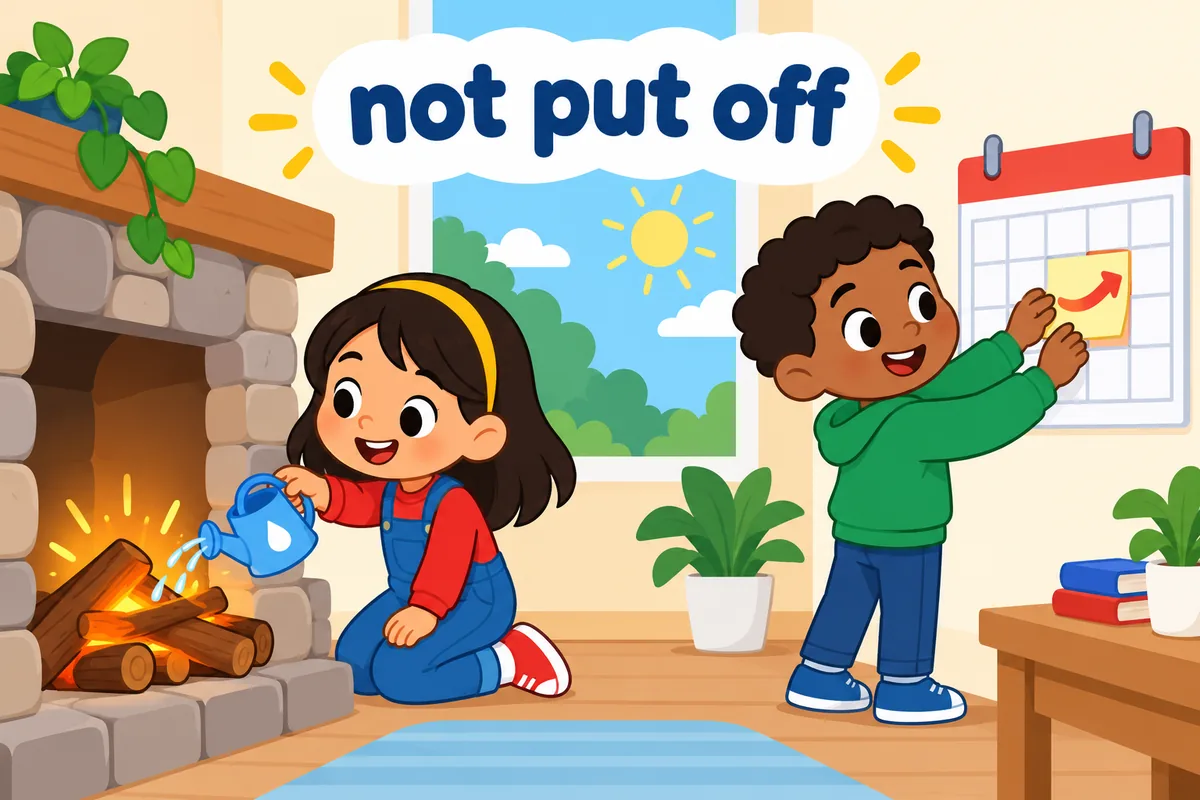
She put off the candles before bed.Correct: She put out the candles before bed. Rule: put off means postpone; put out means extinguish. - Incorrect:
He put out his hand out to say hello.Correct: He put out his hand to say hello. Rule: the particle appears once, not twice. - Incorrect:
We were put out from the late change.Correct: We were put out by the late change. Rule: the passive of inconvenience takes by, not from. - Incorrect:
Please put out me the new price list.Correct: Please put out the new price list for me. Rule: a pronoun indirect object does not split the verb and particle this way.
Practice using put out
Work through the six items, then read the reasons with the answers.
- Fill the gap: The wind kept blowing the match out, so she had to ______ it out again.
- Choose the better word: The meeting was (put out / put off) until Friday.
- Correct the error: Firefighters put out it before it spread.
- Build a sentence: use be put out about a friend arriving without warning.
- Spot the register: which belongs in a safety manual — extinguish the flame, or put the flame out?
- Rewrite with the pronoun: Put out the lamp. Replace the lamp with it.
Answers
- put — put out it is wrong, and the separated form put it out is required.
- put off — the meeting was postponed, so put out would be the wrong sense.
- Firefighters put it out before it spread — the pronoun goes between verb and particle.
- Model answer: We were put out when our friend arrived without warning at dinner time.
- Extinguish the flame — a manual prefers the formal single verb.
- Put it out — a pronoun object always sits in the middle.
The bottom line
Keep put out in a sentence tied to the object that follows, because that object tells the reader whether something is burning, someone is inconvenienced, or something is being released. The two rules that decide most sentences are separability and the pronoun position: a noun object may sit on either side, but a pronoun must go between, as in put it out.
Frequently asked questions about put out
Is put out a phrasal verb?
Yes. Put out is a phrasal verb made from the verb put and the particle out, and its meaning cannot be guessed from the two parts alone. That is why put out can mean extinguish, inconvenience or publish depending on the object and the context around it.
What does it mean to feel put out?
To feel put out is to feel annoyed or inconvenienced by something, usually a minor change of plan. The phrase is mild and slightly old-fashioned, as in she was put out by the early start. It reports irritation rather than real anger, and it often appears in the passive voice.
Can you say put out it?
No. When the object is a pronoun, it must sit between the verb and the particle, so the correct form is put it out. A full noun can go on either side, giving put out the fire or put the fire out, but the pronoun is fixed in the middle.
Does put out mean publish?
Yes, one sense of put out is to release or broadcast something, such as a record, a statement or a programme. The band put out a new single means the band released it. This sense is common in the music and media industries and is slightly informal.
Do you ever struggle with choosing the right phrasal verb for different situations in English? Phrasal verbs can often be tricky to master but play an important role in everyday conversations. One common phrasal verb is “put out,” which is used in various contexts to convey the idea of extinguishing something, publishing something, or even inconvenience.
Understanding how to use “put out” correctly can significantly enhance your communication skills. Whether you’re talking about candles, fires, or a new product launch, knowing the right context for this phrasal verb can make a difference in how effectively you convey your message. Let’s explore different ways to use “put out” to expand your English language proficiency.
7 Examples Of Put Out Used In a Sentence For Kids
- Put out the fire with a hose.
- Don’t forget to put out your hand for a high five.
- Let’s put out our toys before going to bed.
- We need to put out the garbage for the garbage truck.
- Remember to put out a plate for Santa’s cookies.
- Can you help me put out the puzzle pieces?
- It’s important to put out a hand when you want to ask a question.
14 Sentences with Put Out Examples
- Put out your assignments as soon as you complete them to avoid last-minute stress.
- Make sure to put out your notes neatly for easy revision before exams.
- Don’t forget to put out your textbooks in advance to prepare for your presentations.
- It’s important to put out your doubts during class to seek clarification from your professors.
- Remember to put out your group project ideas to make collaborative work more efficient.
- Always put out a positive attitude to overcome difficult situations during your college life.
- Put out a study schedule to manage your time effectively and avoid procrastination.
- Stay organized and put out your study materials in a designated space for easy access.
- Put out reminders for important deadlines and events to stay on top of your college responsibilities.
- Don’t hesitate to put out requests for help or support when you feel overwhelmed in your college journey.
- Put out your best effort in assignments and exams to achieve academic success.
- Put out your concerns regarding campus issues to contribute positively to the student community.
- Make it a habit to put out your opinions and thoughts during discussions to enhance your learning experience.
- Remember to put out your best self in social interactions to build strong relationships with your peers.
How To Use Put Out in Sentences?
To use Put Out in a sentence, you need to understand its meaning and proper context. Put Out is a phrasal verb that can have different meanings depending on the situation. Here is a guide to help you use it correctly:
-
Extinguish: When Put Out is used to mean to extinguish something like a fire or a candle. For example, “Please put out the campfire before leaving.”
-
Produce: It can also mean to produce or create something, usually in terms of work or effort. For example, “The factory can put out 1000 units per day.”
-
Upset or Inconvenience: Put Out can also mean feeling upset or inconvenienced. For example, “I don’t want to put you out, but could you help me move this heavy table?”
-
Postpone: It can also mean to postpone or delay something. For example, “We’ll have to put out the meeting until next week.”
-
Broadcast or Publish: Put Out is also used to say when something is released or made public, like a statement or a product. For example, “The company will put out a new line of products next month.”
Remember to consider the context of the sentence to determine the correct meaning of Put Out. Practice using it in various situations to become more comfortable with its different uses in English sentences.
Conclusion
In conclusion, “to put out” typically means to release, extinguish, or publish something. For example, the fire department put out the blaze quickly, the candle was put out before leaving the room, or the author put out a new book last month. These sentences showcase the versatility of this phrasal verb, demonstrating its ability to convey a range of actions and contexts. Whether it’s putting out flames, lights, or publications, the phrase “put out” is a common and useful part of the English language, allowing for clear and concise communication in various situations.


