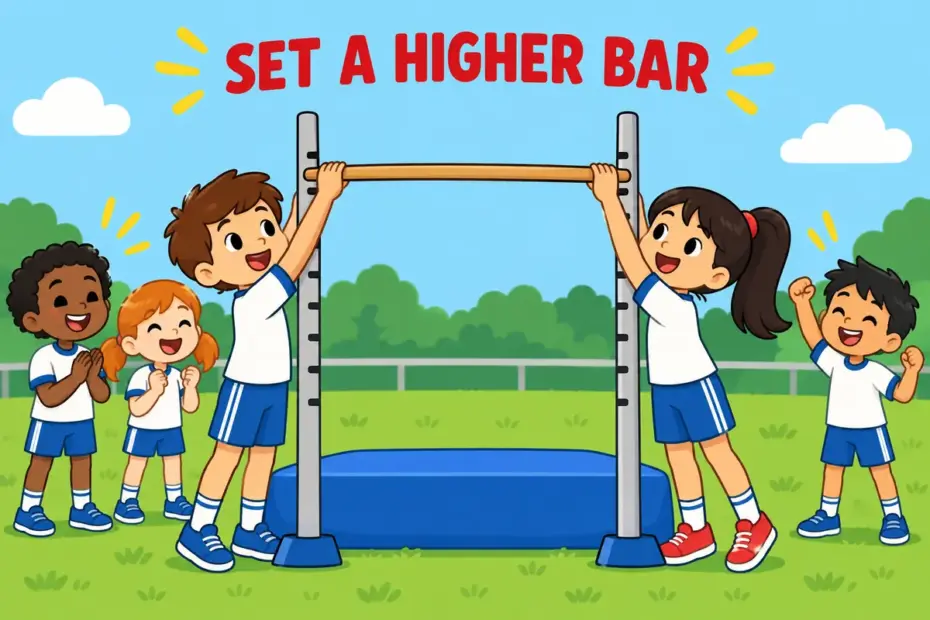
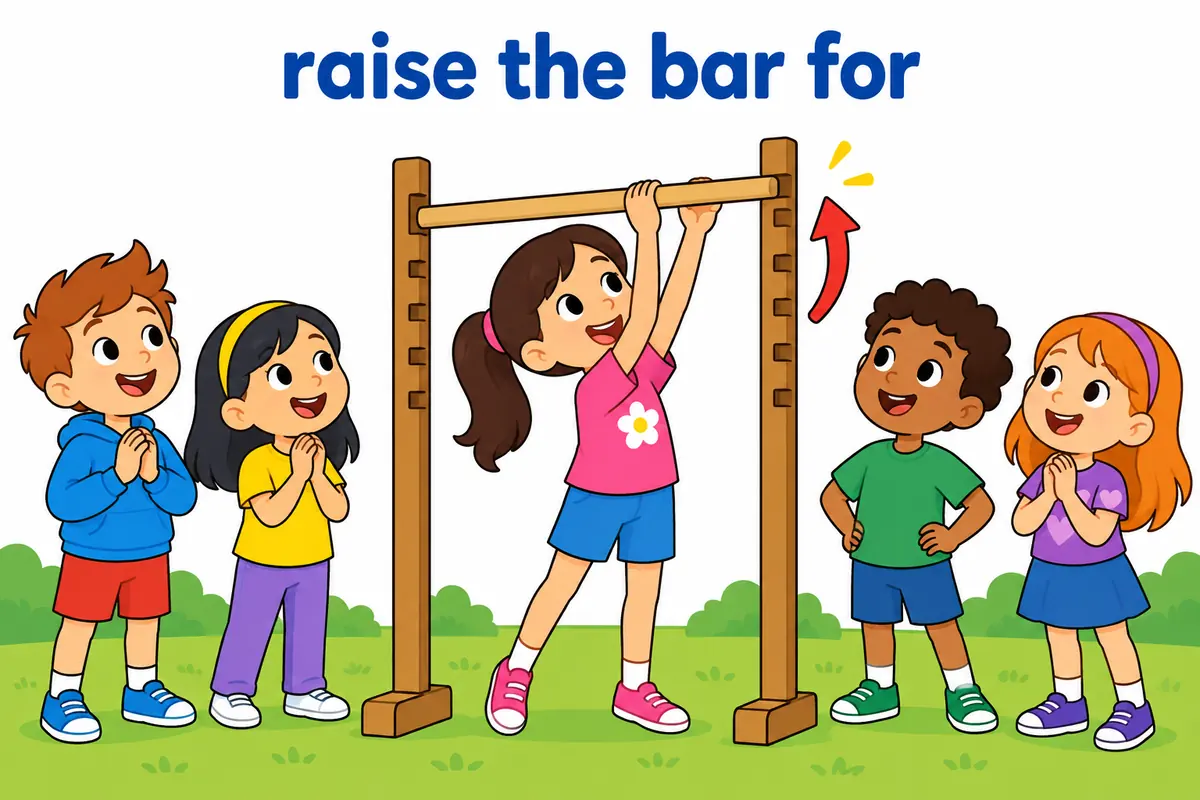
Raise the bar means to set a higher standard than before, usually for a team, a product or a piece of work. To use raise the bar in a sentence, name who lifts the standard and what it covers: “The new coach raised the bar for fitness.” The idiom treats the bar as a measure others must now clear.
Raise the bar at a glance
- Raise the bar is an idiom meaning to set a higher standard than the one that applied before.
- The bar stands for the measure that people, teams or products are now compared against.
- The phrase follows the pattern raise the bar for a group, on a topic, or to a level.
- It belongs to work, sport and education, and it names a standard others must meet.
- The commonest error is adding higher, as in raise the bar higher, which repeats the idea.
What does raise the bar mean?
Raise the bar is an idiom meaning to set a higher standard than the one that applied before. The Cambridge entry for raise the bar records this sense of a higher level of quality, and the bar stands for the measure that people must now meet. The phrase is almost always about achievement, effort or quality, never about a physical bar. Where you mean only that something got better, improve a service is the plainer choice.
| Sense | Plain meaning | Example sentence |
|---|---|---|
| Set a higher standard | Demand more than before | The review raised the bar for everyone. |
| Improve on a past best | Beat a previous level | Her second novel raised the bar again. |
| Tighten a requirement | Make a rule or test stricter | The regulator raised the bar for new banks. |
One limitation is worth stating plainly. Raise the bar is not a synonym for any improvement. Repainting an office is not raising the bar, because no standard changes for anyone else. The idiom implies a measure against which others are now judged, so using it for small personal tasks sounds inflated.
How do you use raise the bar in a sentence?
Name the person or group who lifts the standard, then say who or what the new standard applies to. Six patterns cover almost every real sentence, and the passive is common when the standard itself is the focus.
| Pattern | Example | What it signals |
|---|---|---|
| raise the bar | The team raised the bar this season. | The standard rises with no named target. |
| raise the bar for + group | The school raised the bar for tutors. | Names who must now meet the standard. |
| raise the bar on + topic | The agency raised the bar on safety. | Names the area of the standard. |
| raise the bar to + level | They raised the bar to a new high. | States where the standard now sits. |
| set / clear the bar | She set the bar; he cleared it. | Related idioms: set establishes, clear meets. |
| the bar was raised | The bar was raised without warning. | Passive keeps attention on the standard. |
Writers who add higher to the idiom repeat the meaning, because the verb raise already carries it. Where the emphasis is beating a previous mark rather than setting one, exceed a target is more precise than raise the bar.
Raise the bar in a sentence: examples across contexts
Raise the bar keeps its sense of a new standard across registers, and the subject is always a person, a team or an event that lifts it. The eleven sentences below move from a gym to a conference hall, and the strongest ones would read just as well with surpass a record, which stresses beating a mark rather than setting a rule.
| Context | Example sentence | Why this works |
|---|---|---|
| Sport | The champions raised the bar for the whole league. | A group is named as the new benchmark. |
| Workplace email | This quarter has raised the bar for customer care. | The topic of the standard is named. |
| Education | The new syllabus raised the bar for first-year essays. | Applies the idiom to assessed work. |
| News report | Rivals say the launch raised the bar on battery life. | on marks the field being changed. |
| Business writing | Every competitor has raised the bar since then. | Shows the standard moving across an industry. |
| Technology | Her design raised the bar to an impractical height. | to states where the standard now sits. |
| Music review | The album raised the bar for debut releases. | Names the category now judged afresh. |
| Cooking | That little cafe raised the bar for the whole street. | A local, affectionate use. |
| Academic writing | Peer review raised the bar for evidence. | Abstract subject shows a process at work. |
| Charity sector | The campaign raised the bar on transparency. | Applies the idiom to ethical standards. |
| Conversation | You have really raised the bar for birthday cakes. | Playful use between friends. |
The last row matters: the idiom often carries warmth and admiration, and it is not always a demand. The context decides whether the raised bar feels like a challenge or a compliment.
Raise the bar vs lower the bar
Raise the bar and lower the bar are exact opposites, and set the bar stands between them as a neutral act. To lower the standard is to reduce a requirement, while to set the bar is simply to fix where it starts. Where the standard is pushed up rather than set, elevate a standard is the closer synonym.
| Attribute | raise the bar | lower the bar | set the bar |
|---|---|---|---|
| Direction | Upward | Downward | Neutral |
| Meaning | Demand a higher standard | Accept a weaker standard | Fix the first standard |
| Typical feeling | Challenge or praise | Disappointment or relief | Fairness |
| Typical sentence | The coach raised the bar for fitness. | Cutting training lowered the bar. | The first winner set the bar. |
| Register | Business, sport, education | Critical commentary | Formal and explanatory |
Verdict: choose raise the bar for a new, higher standard, lower the bar when standards slip, and set the bar when the standard is simply established for the first time.
When raise the bar becomes a cliche
Raise the bar is one of the most overworked phrases in business writing, and using it for every small improvement makes a sentence sound like a press release. The idiom earns its place only when a genuine benchmark changes and other people are measured against it. If nothing now clears a higher mark, a plain verb such as improve or strengthen does the job better.
A second warning sign is the vague subject. A sentence such as we raised the bar this year tells a reader nothing, because no group and no standard are named. Naming both, as in the safety team raised the bar on inspections, turns a slogan back into a statement with content.
Word forms and grammar of raise the bar
Only the verb inside the idiom inflects; the rest of the phrase stays fixed. The bar itself never becomes plural in the idiom, and a team that moves first can advance a cause for everyone who follows.
| Form | Part of speech | Example |
|---|---|---|
| raise the bar | idiom, base form | They raise the bar a little each year. |
| raises the bar | idiom, third person singular | Her work raises the bar for the team. |
| raised the bar | idiom, past form | The final raised the bar for the series. |
| raising the bar | idiom, participle | They are raising the bar on wages. |
| the bar was raised | idiom, passive | The bar was raised for every entry. |
| raise the bars | not standard | The team raised the bar for the league. |
Note the last row: the bar stays singular in the idiom, so raise the bars changes the meaning or breaks the phrase.
Common mistakes with raise the bar
- Incorrect:
The team raised the bar higher this year.Correct: The team raised the bar this year. Rule: raise already means higher, so higher repeats the idea. - Incorrect:
We raised the bars on safety.Correct: We raised the bar on safety. Rule: the bar stays singular in the idiom. - Incorrect:
He raised up the bar for the staff.Correct: He raised the bar for the staff. Rule: raise needs no up, unlike lift up or put up. - Incorrect:
The bar was risen by the new captain.Correct: The bar was raised by the new captain. Rule: the passive uses raised, not risen; rise is intransitive. - Incorrect:
Cleaning the desk raised the bar.Correct: Cleaning the desk improved the office. Rule: the idiom needs a standard that others must now meet.
Practice using raise the bar
Work through the seven items, then check the reasoning rather than only the answer.
- Fill the gap: The new sales figures ______ the bar for the whole department.
- Choose the better word: For beating a previous record, use (raise the bar / exceed a target).
- Correct the error: The school raised up the bar for homework.
- Build a sentence: use raise the bar for + group about a coach and a squad.
- Spot the register: which suits a formal report — the pilot raised the bar on efficiency, or we upped our game?
- Opposite meaning: The rule change lowered the bar. Rewrite it with raise the bar and adjust the sense.
- Rewrite in the passive: The design team raised the bar. Start with The bar.
Answers
- raised — the past form marks a standard set above the previous one.
- exceed a target — exceed names beating a mark, while raise the bar is about setting a new standard.
- The school raised the bar for homework — raise takes no up, so raised up is wrong here.
- Model answer: The coach raised the bar for the whole squad.
- The pilot raised the bar on efficiency — the formal idiom suits a report, while upped our game is casual.
- The new rule raised the bar, demanding more of every application.
- The bar was raised by the design team — the passive keeps raised and names the agents with by.
The bottom line
Use raise the bar in a sentence when a person, team or event sets a higher standard that others must now meet, and name what that standard covers. The two details that settle most sentences are these: higher is already inside the verb, and the bar stays singular. Where you only mean beating a previous mark, surpass a record is the more exact phrase.
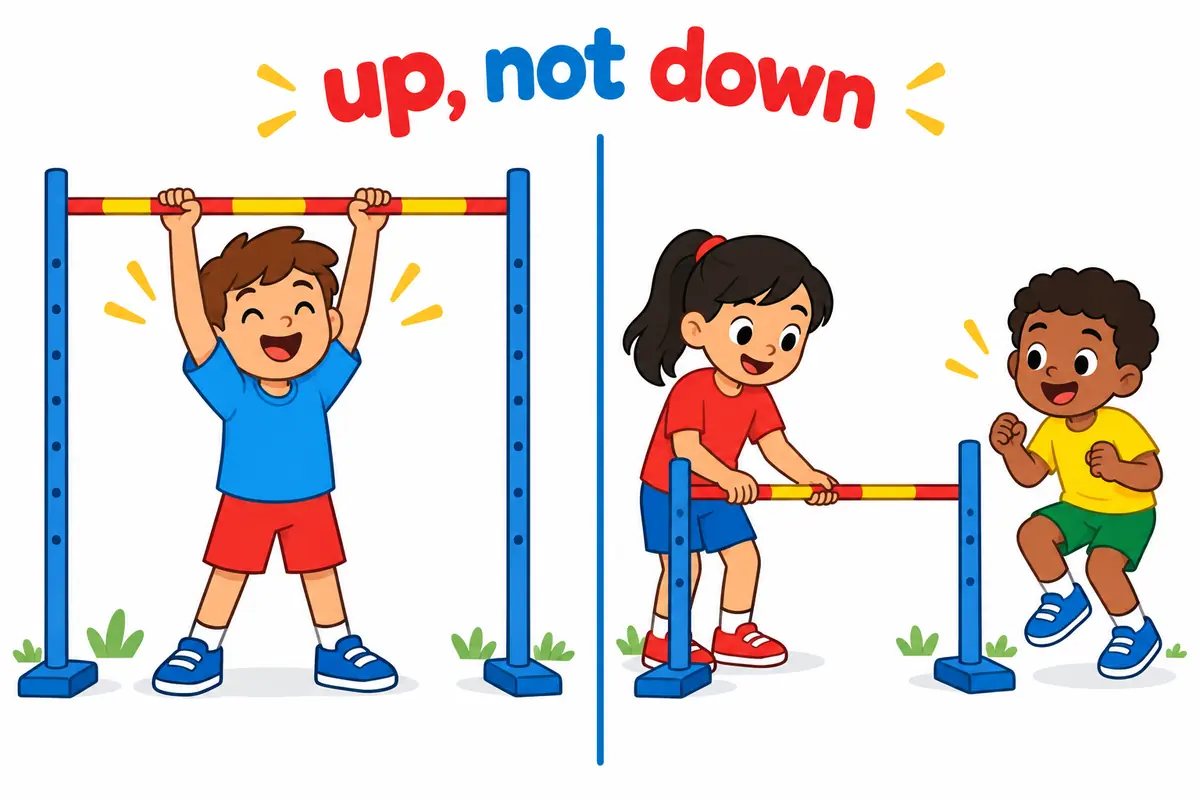
Frequently asked questions about raise the bar
Is raise the bar a formal phrase?
Raise the bar sits comfortably in business, sport and education writing, where standards are discussed openly. It is not overly formal, but it is overused, so a plain verb may read better in a short email. In casual speech people often say upped their game instead.
What is the opposite of raise the bar?
The direct opposite is lower the bar, which means to accept a weaker standard. Set the bar is not an opposite but a neutral relative, because it establishes a standard for the first time. Where a requirement is softened rather than removed, reduce a requirement is the plain equivalent.
Can you say raise the bar higher?
You can, but the higher repeats the meaning of raise and makes the sentence sound padded. The verb already carries the sense of moving the standard upward, so raise the bar alone is standard. If you need to stress the distance, say raised the bar to a new high.
Does raise the bar always involve other people?
Almost always. The idiom implies a measure against which others are judged, whether they are rivals, colleagues or future entrants. Using it for a private task with no comparison stretches the phrase. If nobody else is measured differently, improve or strengthen describes the change more honestly.