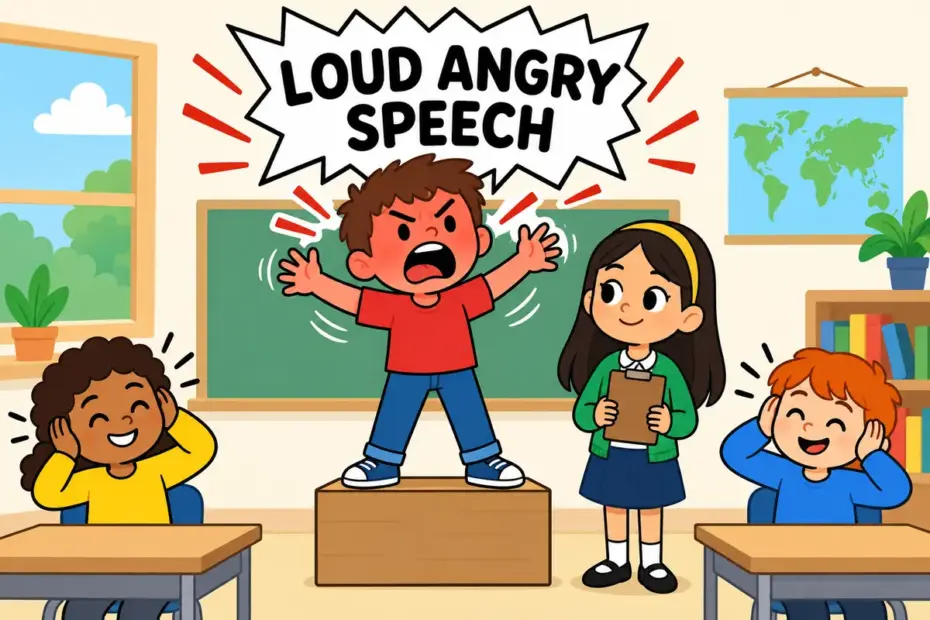
Rant means to speak or shout at length in an angry, uncontrolled way, and it also names that kind of speech. To use rant in a sentence, name who is angry and what they are angry about: “The coach ranted about the referee for ten minutes.” The verb takes about, at or against.
Rant at a glance
- Rant is both a verb and a noun; the verb forms are rants, ranted and ranting.
- The target of a rant follows about, at or against, never a bare object.
- The verbs rant and rave form a fixed pair in the phrase rant and rave.
- The register is informal, so it suits conversation, opinion columns and social posts.
- The commonest error is using rant for calm, evidence-based criticism.
What does rant mean?
Rant is a verb, and also a noun, meaning to talk or shout at length in an angry, uncontrolled way. The Cambridge entry for rant records both the verb and the noun, and the noun sense is the one learners miss: a rant is the speech itself, not only the act of delivering it. When a complaint is short, quiet and supported by evidence, a diatribe or a review is the better label.
| Sense | Plain meaning | Example sentence |
|---|---|---|
| Complain loudly | Speak on and on in anger about something | He ranted about the ticket price for twenty minutes. |
| Scold at a person | Direct that anger at somebody | The supervisor ranted at the whole shift. |
| Angry speech (noun) | The long outburst itself | Her post was a rant about hidden fees. |
One limitation is worth stating plainly. Rant is not the word for reasoned criticism, and it is not a measure of whether the speaker is right. A calm, documented objection is a review or a complaint, not a rant, because rant always carries excess emotion and length.
How do you use rant in a sentence?
The pattern that decides most sentences is the preposition after the verb: about introduces the topic, at introduces the person, and against introduces a public target. Five patterns cover nearly every real use.
| Pattern | Example | What it signals |
|---|---|---|
| rant about + topic | Neighbours ranted about the noise all evening. | The trigger is a situation or subject. |
| rant at + person | He ranted at the driver who cut him off. | Anger aimed directly at somebody. |
| rant against + target | The editorial ranted against the new tax. | Public, often formal opposition. |
| rant and rave | She ranted and raved for an hour. | The fixed pair intensifies the outburst. |
| rant (noun) | His rant filled three pages. | Names the speech rather than the act. |
Writers who want a noun for a long angry speech, rather than a verb for the act, reach for a tirade; the two often describe the same moment from different angles. The practitioner rule is simple: if the complaint is stated without heat, drop rant and use complain or object.

Rant in a sentence: examples across contexts
Rant changes tone more than meaning as it moves between contexts. People who vent frustration to a friend are often ranting about a small problem. The eight sentences below keep the same verb while shifting from a classroom to an opinion column.
| Context | Example sentence | Why this works |
|---|---|---|
| Classroom | The pupils ranted about the surprise quiz, then settled down to work. | A concrete everyday trigger keeps the tone light. |
| Workplace email | Please do not rant at the delivery team; list the problems instead. | At marks the person, and the correction shows a calmer alternative. |
| News report | Residents ranted against the plan at the council meeting. | Against signals a public target and a formal setting. |
| Sports commentary | The manager ranted about the penalty long after the whistle. | The topic, not a person, is the source of anger. |
| Social post | One post ranted about airline fees and drew a thousand replies. | The informal register fits the platform. |
| Fiction | The old sailor rants at the sea before the storm breaks. | At turns the weather into the target, which reads as deliberate. |
| Conversation | I ranted at my brother for losing the keys. | The first person and a family target make it sound natural. |
| Opinion column | The column rants against red tape for four hundred words. | Against suits an abstract institutional target. |
Only the conversational example sounds at home in speech with the first person as subject. That asymmetry is the clearest signal of where this verb lives.
Rant vs tirade
Rant and tirade both name an angry speech, and they are not interchangeable. a harangue is a third close relative, usually a public scolding, so the choice turns on length, formality and who is listening.
| Attribute | rant | tirade | harangue |
|---|---|---|---|
| Part of speech | Verb and noun | Noun only | Noun and verb |
| Length and heat | Loud, rambling, emotional | Sustained and intense | Formal and accusatory |
| Typical trigger | An everyday annoyance | A moral or political wrong | A person who must be corrected |
| Who uses it | Friends, bloggers, commentators | Journalists, critics, novelists | Public speakers, officials |
| Light-hearted | Often, a playful rant is possible | Rarely; a tirade sounds harsh | Almost never |
Verdict: choose rant for a spoken or written outburst, tirade for a polished blast of anger, and harangue for a public scolding delivered to somebody.
Word forms and grammar of rant
Rant inflects regularly as a verb and takes a standard plural as a noun. The table also lists the adverb form, which writers build and then misuse.
| Form | Part of speech | Example |
|---|---|---|
| rant | verb, base form | Do not rant about it here. |
| rants | verb, third person singular | She rants whenever the trains are late. |
| ranted | verb, past | He ranted for an hour without pausing. |
| ranting | verb, present participle | Stop ranting and tell me the facts. |
| rant | noun, singular | That was a long rant about parking. |
| rants | noun, plural | His rants rarely change anyone’s mind. |
The bit that catches learners is the register gap: the verb rave about something can mean enthusiastic praise, so the pair rant and rave covers both extremes of feeling.
Common mistakes with rant
- Incorrect:
He ranted about at the meeting.Correct: He ranted about the delay at the meeting. Rule: When about is present it still needs its own object, and at cannot follow it. - Incorrect:
She ranted to the referee.Correct: She ranted at the referee. Rule: At marks the target of anger; to suggests calm speech aimed at a listener. - Incorrect:
The report gave a rant of the findings.Correct: The report criticised the findings. Rule: A rant is emotional, so it cannot describe an analytical summary. - Incorrect:
He ranted and raged for hours.Correct: He ranted and raved for hours. Rule: The fixed pair is rant and rave, which has no verb raged to match it.
Practice using rant
Work through the six items, then check the reasoning rather than only the answer.
- Fill the gap: The passengers ______ about the cancelled train for half an hour.
- Choose the better word: A calm, documented complaint is a (rant / review).
- Correct the error: The coach ranted to the referee about the offside call.
- Build a sentence: use rant about in a message about a noisy neighbour.
- Spot the register: which belongs in a formal letter — I ranted at the manager, or I raised the issue with the manager?
- Rewrite as a noun: She ranted about parking fees. Use rant as the subject.
Answers
- ranted — the passengers are the subject and about introduces the topic.
- review — a rant carries excess emotion, so it cannot be calm and documented.
- The coach ranted at the referee about the offside call — at marks the person, about the topic.
- Model answer: We ranted about the neighbour’s music until the walls shook.
- I raised the issue with the manager — a formal letter avoids informal ranting.
- Her rant about parking fees lasted an hour — the noun takes the same about phrase.
The bottom line
Use rant in a sentence when the speech is loud, long and driven by anger, and let the preposition show what the anger is aimed at. Two nuances decide most sentences: the verb is informal, so it rarely belongs in a formal letter, and the noun names the speech itself rather than the act of complaining. When the criticism is calm and supported, complain, object or review state the point more accurately.
Frequently asked questions about rant
Is rant always negative?
Rant is negative about the manner of speaking rather than the facts. A person can rant about a genuine injustice, so the complaint may be fair while the delivery is loud and uncontrolled. Some writers use it playfully for their own opinions, as in a friendly rant about bad coffee, but the word still signals strong emotion.
What is the difference between a rant and a tirade?
A rant is informal and can be spoken or written, and it doubles as a verb. A tirade is always a noun and sounds more polished and severe, as if the speaker has rehearsed it. Choose rant for an everyday outburst and tirade for a sustained blast of moral or political anger.
Can rant be used as a noun?
Yes, and the noun sense is common. A rant is the angry speech itself, as in her rant about hidden fees filled three pages. The noun takes the same about phrase as the verb, and it has a regular plural, so one person can deliver several rants in a single meeting.
Is rant suitable in formal writing?
Rant belongs in informal and semi-formal writing, such as blogs, columns and messages. In a report, a complaint or an academic essay, the word sounds too heated, because it judges the manner of the speech. Use criticise, object, complain or argue when the tone must stay neutral.
Do you ever find yourself going on a passionate, often lengthy diatribe about a topic that really gets under your skin? That, my friends, is known as a “rant.”
A rant is a way to express strong opinions or frustrations about something, often in a forceful or vociferous manner. People rant about a wide range of subjects, from politics and social issues to everyday annoyances and personal grievances.
7 Examples Of Rant Used In a Sentence For Kids
- I like to rant about my favorite toy.
- We can rant about our favorite animals.
- Let’s all take turns to rant about our day.
- It’s fun to rant about our favorite colors.
- We can rant about our favorite foods.
- I will rant about my best friend.
- Let’s have a rant about our favorite games.
14 Sentences with Rant Examples
- Rant I can’t believe how expensive textbooks are this semester!
- Rant Why are the college cafeteria prices going up every month?
- Rant It’s ridiculously hard to find a good place to study on campus.
- Rant I can’t deal with all the traffic on the way to college every morning.
- Rant Why do we have to pay so much for parking permits at college?
- Rant I’m so tired of professors scheduling exams back to back.
- Rant Why is the Wi-Fi always so slow in the dorms?
- Rant The library always runs out of the books I need for my assignments.
- Rant Why are the printers in the computer lab always out of order?
- Rant I can’t believe how early the college shuts down the gym.
- Rant The college events are always on weekdays when I have classes.
- Rant Why are there never enough seats in the college auditorium?
- Rant I wish there were more vegetarian options in the college cafeteria.
- Rant The college website is so outdated and hard to navigate.
How To Use Rant in Sentences?
Rant is a powerful tool for expressing strong emotions or opinions in written form. To use rant effectively in a sentence, first, identify the topic you want to rant about. Next, think about the specific points you want to make and how you want to convey your message. You can start by writing a draft of your rant, making sure to include your main arguments and supporting details. It’s important to be clear and concise in your writing to ensure your rant is impactful. Once you have written your rant, read it over and make any necessary revisions to improve clarity and coherence. Finally, share your rant with others to get feedback and start a conversation. Remember to keep your tone respectful and constructive even though you are expressing strong feelings. By following these steps, you can effectively use rant in a sentence and communicate your thoughts and feelings effectively.
Conclusion
In conclusion, it is evident from the examples provided that ranting in sentences can involve expressing strong emotions, opinions, or complaints in a lengthy, often passionate manner. Rants can serve as a tool for catharsis, advocacy, or even humor, depending on the context and purpose of the communication. While some may view ranting as negative or unproductive, it can also be a way to process emotions and provoke thought or discussion.
Whether it is a colorful tirade about a frustrating experience, a fervent monologue on a controversial topic, or a humorous diatribe on everyday annoyances, sentences with rants can effectively convey intense feelings and perspectives. Understanding the nuances and intentions behind these passionate expressions can lead to better communication and empathy in various interpersonal and public settings.


