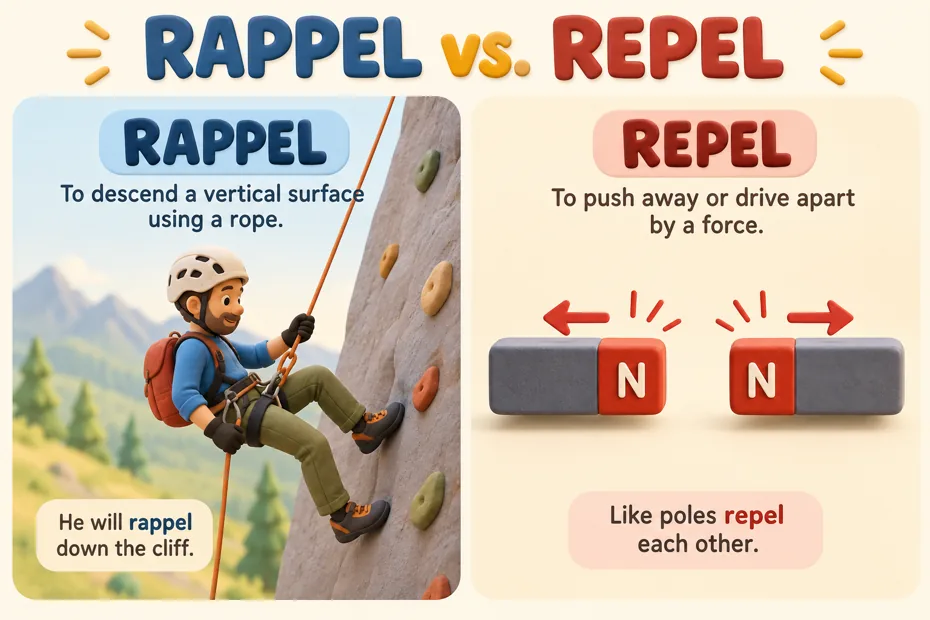
Rappel vs. repel: descend by rope or drive away?
Rappel means descend using a rope and can also name that descent. Repel means drive back, keep away, resist, or cause aversion. Write “rappel down the wall” for the descent and “repel water” for resisting water. Similar pronunciation does not make these words interchangeable; their meanings determine the spelling.
The older discussion’s action-versus-reaction shortcut is unreliable. Both words can describe actions, and repelling need not be a person’s reaction. Magnets can repel each other, for example. Use the concrete meaning instead: rappel concerns a rope descent, while repel concerns pushing away, resisting, or causing dislike.

Key facts
| Word | Meaning | Example |
|---|---|---|
| rappel | Descend using a rope; a descent of that kind | The climber will rappel down the wall. |
| repel | Drive away or resist | The fabric repels water. |
| repel | Cause aversion | The harsh tone repelled the audience. |
| rappelling / repelling | Different actions with similar endings | Rappelling descends; repelling drives away. |
Rappel: the rope-descent word
Merriam-Webster’s rappel entry identifies descending by rope and also records the noun. Collins’s rappel entry supports the same descent meaning. Use it in a report about a climber, an activity description, or a scene in a story when that is the movement being described.
“The climber rappelled down the rock face” tells readers the person descended by rope. “The group watched the rappel” names the descent. A person ascending the same face is doing something different; do not choose rappel simply because ropes appear in the scene. Meaning matters more than a general association with climbing equipment.
These sentences explain vocabulary rather than demonstrate a rope setup or technique. A drawing can illustrate the broad descent concept, but the spelling guide does not provide procedural instructions. In a clear description, identify the person, direction, and setting without adding equipment details that the source does not establish.
Repel: push away or resist
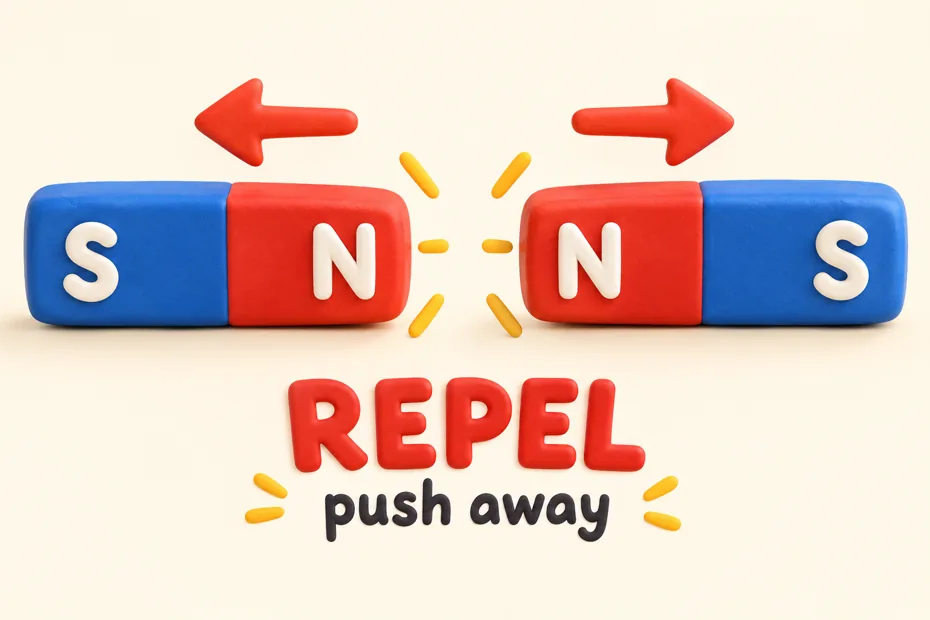
Merriam-Webster’s repel entry includes driving back, rejecting, resisting, and causing aversion. Unlike rappel, it does not require a rope or a descent. “The coating repels water” describes resistance to water; “The magnets repel each other” describes pushing apart.
In the magnet example, the context matters. Saying “Magnets repel” without describing their arrangement is incomplete as an explanation, because magnets can also attract. A language example such as “The facing like poles repel each other” supplies the relevant condition while preserving the verb’s push-away meaning.
With an object, the sentence identifies what is being driven away or resisted: repel water, repel an attack, or repel unwanted attention. Those phrases belong to different subject areas but share the central away-or-against idea. Avoid spelling them with ra-, which would suggest the unrelated descent word.

Repel in figurative writing
Collins’s repel entry also records the aversion meaning. “The character’s cruelty repelled the reader” describes dislike rather than a physical force pushing the reader backward. “The unpleasant smell repelled visitors” similarly concerns an effect that discourages people from staying.
Context keeps the sentence precise. “The speech repelled the audience” is stronger than “The audience disagreed with the speech.” The first suggests aversion; the second may describe a simple difference of opinion. Choose the meaning you intend instead of treating every unfavorable response as an instance of repelling.
Forms and spelling clues
Common forms of rappel include rappels, rappelled, and rappelling. Merriam-Webster also records the single-l variants rappeled and rappeling. For a consistent page, the doubled-l forms are a straightforward choice. The initial ra- stays the same in each form.
For repel, write repels, repelled, and repelling. The doubled final l in the latter forms does not turn the verb into rappel. Compare “The climber is rappelling” with “The fabric is repelling water.” Look near the start of the word as well as at its ending.
A practical substitution test is descend by rope versus drive away. “They plan to descend by rope” supports rappel. “The barrier helps drive intruders away” supports repel. With water or aversion meanings, use a context-specific substitute such as resist or disgust.
Practice
Complete these sentences: “The climber will ___”; “The coating can ___ water”; “The harsh remarks ___ several listeners”; “They watched the climber ___ down the wall.” The answers are rappel, repel, repelled, and rappel. The first and last concern descent; the middle sentences concern resistance and aversion.
Frequently asked questions
Is it repel down a cliff?
Use rappel down a cliff when you mean descend by rope. Repel means drive away, resist, or cause aversion and does not name that descent. Check whether your sentence describes moving downward by rope rather than simply associating the word with an outdoor or climbing scene.
Can rappel be a noun?
Yes. It can name a rope descent as well as describe descending. “The rappel took several minutes” uses the noun, while “They rappel down the wall” uses the verb. This grammatical variety does not change the central descent meaning or make the word interchangeable with repel.
Is repelling only a reaction?
No. The verb can describe an action or a physical effect, such as repelling water or like magnetic poles pushing apart. It can also describe causing dislike. The older action-versus-reaction shortcut therefore cannot reliably choose the spelling. Identify the meaning directly instead of assigning each word a fixed response category.
How do I remember the difference?
Pair rappel with a rope descent and repel with pushing something away. Then practice complete examples: “The climber rappelled” and “The coating repelled water.” The meanings remain clear even when the endings sound similar. Check the initial spelling as well as the doubled-l forms when proofreading.
Ever found yourself confused between “rappel” and “repel”? Don’t worry, you’re not alone. As an experienced writer, I’ve encountered this common dilemma countless times. In this text, I’ll guide you through the proper usage of these two words and help you avoid any embarrassing mix-ups. Understanding the difference between “rappel” and “repel” is essential for effective communication, whether you’re writing an essay, a business proposal, or simply engaging in casual conversation. So, let’s immerse and unravel the mystery behind these similar-sounding yet distinct terms. Get ready to master the art of using “rappel” and “repel” appropriately, and never second-guess yourself again.
Key Takeaways
- Understanding the difference between “rappel” and “repel” is crucial for effective communication.
- Rappelling refers to the act of descending a vertical surface using ropes and specialized equipment, while repelling means to drive away or keep something or someone at a distance.
- Rappelling is an action, whereas repelling is a reaction.
- Rappelling is a physical act, while repelling can be physical or conceptual.
- Rappelling is typically associated with descending vertical surfaces like cliffs, while repelling can be applied to various scenarios and circumstances, both physical and metaphorical.
- Correct usage of these words can prevent confusion and misinterpretation.
Understanding the Difference
As an experienced writer, I understand the importance of using words accurately and effectively to convey our intended message. One common source of confusion for many people is the difference between the words “rappel” and “repel.” Let’s investigate into the definitions of these words to gain a clear understanding of their distinct meanings and usage.
Definition of Rappel
To start, let’s examine the word “rappel.” Rappelling refers to the act of descending a vertical surface, such as a cliff or a building, using ropes and specialized equipment. It’s a thrilling activity often associated with rock climbing or military training exercises. When I think of rappelling, I envision adventurers bravely descending down imposing mountains, fully harnessed and following strict safety protocols.
Definition of Repel
On the other hand, we have the word “repel.” Now, this word has a completely different meaning. To repel means to drive away, reject, or keep something or someone at a distance. When faced with an unwanted or unpleasant situation, we might naturally try to repel it. For example, wearing insect repellent helps keep pesky bugs away during a picnic, or installing a security system can repel potential burglars from our homes.
Key Differences
Now that we have defined both “rappel” and “repel,” let’s highlight the key differences between them:
- Action vs. Reaction: Rappelling is an action, involving descending down a vertical surface using ropes and equipment. Repelling, on the other hand, refers to a reaction, driving away or keeping something at a distance.
- Physical vs. Conceptual: Rappelling is a physical act, requiring physical exertion and equipment. Repelling, but, is more of a conceptual or metaphorical idea, usually involving emotions or situations we want to distance ourselves from.
- Vertical vs. General: Rappelling is typically associated with descending vertical surfaces like cliffs, while repelling can be applied to various scenarios and circumstances, both physical and metaphorical.
Understanding these key differences between “rappel” and “repel” is crucial for effective communication. Misusing these words can lead to confusion and misinterpretation, which is something we want to avoid. So, let’s continue our journey of mastering these words, exploring their similarities, examples, and practical usage.
What is Rappel?
Rappel is a common word in the area of adventure sports and climbing. It refers to the act of descending a vertical surface, such as a cliff or a rock face, using ropes and specialized equipment. As an avid adventurer, I find rappelling to be an exhilarating and adrenaline-pumping activity that requires both skill and courage.
The definition of rappel is straightforward – it’s a controlled descent using a rope. It involves attaching oneself to a rope, typically tied to an anchor point at the top of the vertical surface, and gradually lowering oneself down while controlling the speed and movement using various techniques.
One key aspect that distinguishes rappel from other activities is that it is an action. You actively participate in the process of descending, taking charge of your movement and the speed at which you go down. It requires physical effort, technique, and concentration.
Rappel is not just a recreational activity; it is also extensively used in professions such as rock climbing, rescue operations, and military operations. It is a skill that requires training and practice to ensure safety and efficiency.
Understanding the difference between rappel and repel is crucial for effective communication. By knowing the distinction between these words, you can avoid confusion and convey your intended meaning accurately. Now that we have explored the definition of rappel, let’s move on to understanding the concept of repel and how it differs from rappel.
What is Repel?
Repel is a word that is often confused with rappel due to their similar spellings. But, they actually have quite different meanings and usage. Let’s investigate into the definition of repel to understand it better.
When we talk about repel, we’re referring to a reaction or a response to something. It involves creating distance or pushing away to avoid contact or harm. Repelling can be both physical and conceptual.
In physical terms, repelling can refer to warding off or driving away someone or something. This could include repelling insects, repelling an attacker, or repelling water with a waterproof material. On the other hand, in a more conceptual context, repelling can involve avoiding or rejecting an idea, proposition, or person.
To summarize:
- Repel is a reaction or response to something.
- It can involve creating distance or pushing away.
- It can be both physical and conceptual.
Understanding the distinction between rappel and repel is crucial for effective communication. The next section will investigate into the concept of rappel, highlighting the key differences between these two words.
Stay tuned to discover the exciting world of rappelling and its various applications.
Common Confusions
For students learning English, there are often common confusions between certain words. Understanding the difference between these words is essential for effective communication. In this section, I will address the common confusions between “rappel” and “repel” and provide clear explanations of their distinct meanings and usage.
Difference between “rappel” and “repel”
To begin with, let’s clarify the definitions of “rappel” and “repel.” While these two words may sound similar, they actually have quite different meanings and applications.
- “Rappel” refers to the act of descending a vertical surface, such as a cliff or a building, using ropes and specialized equipment. It is an action that requires skill, training, and the right equipment. Rappelling is commonly used in adventure sports, rock climbing, rescue operations, and military operations.
- “Repel” is a reaction or response to something. It involves creating distance or pushing away. Whether it’s fending off insects or rejecting an idea, repelling can have both physical and conceptual applications.
Key Differences
Now that we have defined the two words, let’s investigate into the key differences between “rappel” and “repel.” These differences are crucial to avoid confusion and ensure accurate usage:
- Action vs. Reaction: Rappelling is an action, while repelling is a reaction. Rappelling involves actively descending a vertical surface using ropes and equipment, while repelling involves pushing away or warding off something.
- Physical vs. Conceptual: Rappelling is a physical act that requires physical exertion and specialized gear. On the other hand, repelling can be physical (such as repelling insects) or conceptual (such as repelling an idea).
- Specific vs. General: Rappelling is associated with descending vertical surfaces, such as cliffs or buildings. But, repelling can be applied to various scenarios, such as repelling insects, repelling an attacker, or repelling negative thoughts.
Understanding these distinctions between “rappel” and “repel” is crucial for effective communication. Incorrect usage can lead to confusion and misunderstanding. So, next time you find yourself unsure, remember these key differences.
In the next section, we will explore practical examples and context to further solidify your understanding of these two words.
Examples of Incorrect Usage
Many people often confuse the words “rappel” and “repel,” leading to incorrect usage and potential misunderstandings. To help you avoid these common pitfalls, let me provide you with some examples of incorrect usage:
- Incorrect: I can’t wait to repel down the rock wall during our adventure trip.
Correct: I can’t wait to rappel down the rock wall during our adventure trip.
The word “rappel” is the appropriate term for descending a vertical surface using ropes and specialized equipment. “Repel,” on the other hand, means to push away or create distance.
- Incorrect: The mountaineer used his repelling skills to conquer the mountain peak.
Correct: The mountaineer used his rappelling skills to conquer the mountain peak.
Here, “rappelling” accurately describes the action of descending down the mountain using ropes. “Repelling” would suggest the mountaineer was pushing away or creating distance, which is not the intended meaning in this context.
- Incorrect: The repellent adventurer gracefully rappelled off the cliff.
Correct: The adventurous rappeller gracefully rappelled off the cliff.
In this example, using “repellent” incorrectly describes the adventurer. The term “rappeller” is more appropriate, as it specifically refers to someone engaging in the act of rappelling.
These examples highlight the importance of understanding the distinction between “rappel” and “repel” to ensure accurate and effective communication. Using the correct word not only prevents confusion but also showcases your mastery of the English language. So, next time you find yourself tempted to confuse these words, remember these examples of incorrect usage and opt for the correct term instead.
How to Use Rappel Properly
Understanding the proper usage of the word “rappel” is essential for effective communication. Let me explain how to use it correctly.
To start, rappel is an action, a physical act of descending a vertical surface using ropes and specialized equipment. It is commonly used in adventure sports, such as rock climbing, where individuals lower themselves down cliffs or walls with the aid of ropes.
When using rappel, it’s important to provide context and be specific about the activity or situation. Here are a few guidelines to help you use it appropriately:
- Define the activity: If you are discussing the act of descending a vertical surface using ropes, equipment, and proper techniques, it is appropriate to use rappel. For example, “I learned how to rappel during my rock climbing training.”
- Describe the equipment: When talking about the specific gear used for rappelling, such as harnesses, carabiners, and ropes, it is correct to use rappel. For instance, “Make sure you have the necessary equipment before you attempt to rappel.”
- Refer to the action: If you are describing someone performing the act of rappelling, use rappel. For example, “I watched the experienced climber rappel down the cliff effortlessly.”
Remember, rappel is always associated with descending vertical surfaces and requires ropes and specialized equipment. By using it correctly, you can clearly convey your message and avoid confusion.
In the next section, we will explore the appropriate usage of the word “repel.” Stay tuned to gain a comprehensive understanding of both words and how to use them accurately.
How to Use Repel Properly
When it comes to using the word “repel” correctly, it’s essential to understand its meaning and usage. Let’s jump into the details to ensure you’re equipped with the knowledge to communicate effectively.
Definition of Repel:
- Repel is a verb that refers to the act of pushing away or creating distance from something. It can be both a physical and conceptual reaction to a stimulus.
Examples of Using Repel:
To give you a better idea of how to use “repel” in context, here are a few examples:
- Physical Repelling: Imagine you’re enjoying a picnic, and suddenly ants start crawling all over your food. You would try to repel the ants by brushing them away or using an insect repellent.
- Conceptual Repelling: Let’s say someone presents an idea that you strongly disagree with. You might express your disagreement by repelling the idea or rejecting it outright.
Common Mistakes:
To avoid confusion and ensure accuracy in your writing, it’s crucial to avoid these common mistakes when using “repel”:
- Incorrect Usage: “I tried to rapel the idea.” The correct form should be “I tried to repel the idea.”
- Incorrect Verb Form: “They were trying to repelling the pests.” Instead, use the correct verb form: “They were trying to repel the pests.”
Now that you have a clear understanding of what “repel” means and how it should be used, you can confidently use this word in your everyday communication. Remember, repelling can involve both physical and conceptual reactions, so choose the appropriate context to express your intention accurately.
In the next section, I will discuss some common pitfalls and offer guidelines on how to use “rappel” properly, providing you with an all-around understanding of these two often confused words.
Tips to Remember the Difference
As a language enthusiast, I understand how confusing it can be to differentiate between words that sound similar but have entirely different meanings. That’s why I’m here to provide you with some useful tips to help you remember the difference between “rappel” and “repel.” Let’s immerse!
Understand the Definitions
To start, it’s essential to have a clear understanding of the definitions of both words:
- Rappel: It refers to the action of descending a vertical surface, such as a cliff or a building, using ropes and specialized equipment. Rappelling is commonly associated with adventure sports, rock climbing, rescue operations, and military operations.
- Repel: This word signifies the act of pushing away, creating distance, or warding off something. It can be both physical, such as repelling insects, or conceptual, like rejecting an idea or repelling negative energy.
Visualize the Actions
One effective way to remember the difference between “rappel” and “repel” is to visualize the actions associated with each word:
- When you think of “rappel,” imagine someone descending a sheer rock face with ropes and equipment. Picture the adrenaline rush and physicality of the activity. This mental image will help solidify the idea that rappelling involves descending vertical surfaces.
- On the other hand, imagine someone swatting away insects or defending themselves against an idea they strongly disagree with when you think of “repel.” This mental image encompasses both the physical and conceptual aspects of repelling.
Associate with Key Characteristics
To further differentiate between the two words, associate them with their unique characteristics:
- Rappel: Focus on the action-oriented nature of rappelling. Think of it as a physical activity that requires technique, equipment, and skill. This will help you remember, rappel is associated with descending vertical surfaces.
- Repel: Emphasize the reaction or response aspect of repelling. It can be physical, like repelling insects or repelling an attacker, but it can also be conceptual, like repelling negative thoughts or ideas. Think of repel as the act of creating distance or pushing away.
Conclusion
To conclude, understanding the difference between “rappel” and “repel” is essential for effective communication. By grasping their distinct meanings and usage, we can avoid confusion and accurately convey our message.
Rappelling is an action, involving descending vertical surfaces using ropes and specialized equipment. It is commonly used in adventure sports, rock climbing, rescue operations, and military operations. On the other hand, repelling is a reaction or response, creating distance or pushing away. It can be both physical, like warding off insects, and conceptual, like rejecting an idea.
Remember, rappelling is associated with descending vertical surfaces, while repelling can be applied to various scenarios. By visualizing the actions associated with each word and understanding their unique characteristics, we can easily differentiate between them.
To use “rappel” correctly, define the activity, describe the equipment, and refer to the action. For “repel,” provide a clear definition and examples of both physical and conceptual repelling. Avoid common mistakes and follow the guidelines for accurate usage.
By mastering the distinction between “rappel” and “repel,” we can communicate with precision and showcase our command of the English language.
Frequently Asked Questions
Q: What is the difference between “rappel” and “repel”?
A: Rappel is an action of descending a vertical surface using ropes and equipment, while repel is a reaction or response involving creating distance or pushing away.
Q: Can “rappel” be used in different scenarios?
A: No, rappel is specifically associated with descending vertical surfaces.
Q: How is “repel” different from “rappel”?
A: Repel can be physical or conceptual, while rappel is mainly a physical act.
Q: Why is it important to understand the distinction between “rappel” and “repel”?
A: Understanding the difference helps ensure accurate communication and avoids confusion.
Q: What are some incorrect usages of “rappel” and “repel”?
A: Incorrect usage includes using “repel” to describe descending a vertical surface or using “rappel” to mean pushing something away.
Q: How can I use “rappel” correctly?
A: To use “rappel” correctly, define the activity, describe the equipment, and refer to the action of descending.
Q: How should “repel” be correctly used?
A: “Repel” should be used to describe a reaction or response involving pushing away or creating distance, both physically and conceptually.
Q: What tips can help me remember the difference between “rappel” and “repel”?
A: Understand their definitions, visualize the associated actions, and remember their unique characteristics.


