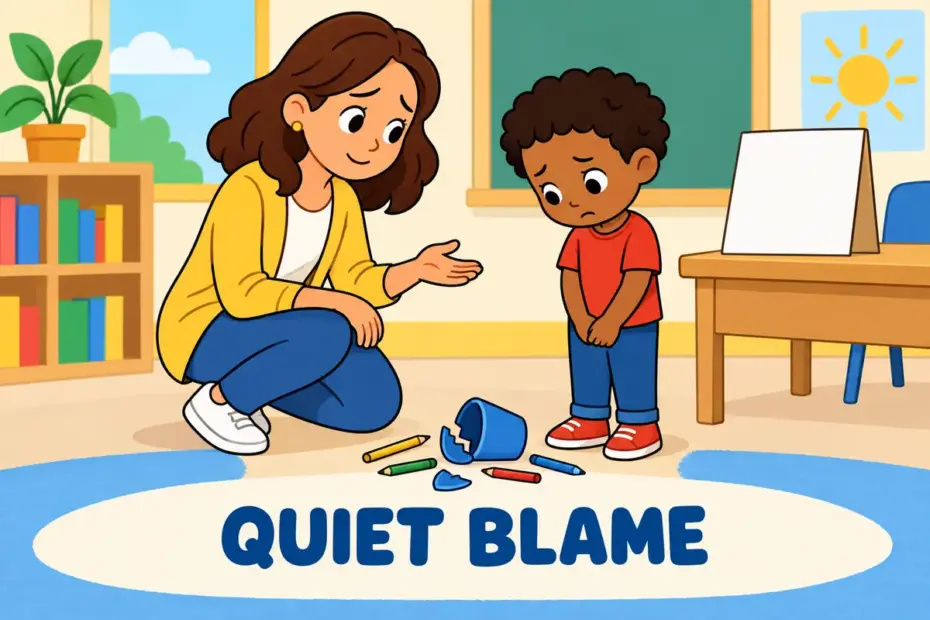
Reproach means to blame or express disappointment to somebody for a fault, and as a noun it names that blame. To use reproach in a sentence, name who is blamed and why: the teacher reproached him for cheating. As a noun it often follows beyond, as in beyond reproach.
Reproach at a glance
- Reproach works as both a verb and a noun, with the forms reproaches, reproached and reproaching.
- The verb takes a person as its object and for or with before the fault: reproach somebody for a mistake.
- The reflexive form reproach oneself turns the blame inward.
- The fixed phrase beyond reproach means completely blameless.
- The commonest error is inserting to after the verb, as in reproached to him.
What does reproach mean?
Reproach is a verb meaning to blame someone or show quiet disappointment in them, and a noun naming that blame or the person who earns it. The Cambridge entry for reproach records both jobs, and the verb is the one to master first: it takes a person as its object, never a clause. Where the blame is general and not aimed at anyone in particular, blame someone is the plainer, more direct verb.
| Sense | Plain meaning | Example sentence |
|---|---|---|
| Verb: blame gently | Tell someone with disappointment that they are at fault | She reproached him for leaving the gate open. |
| Noun: blame | Criticism or disapproval directed at someone | His conduct drew reproach from the whole board. |
| Noun: source of shame | A person or thing that brings discredit | The empty memorial was a reproach to the town. |
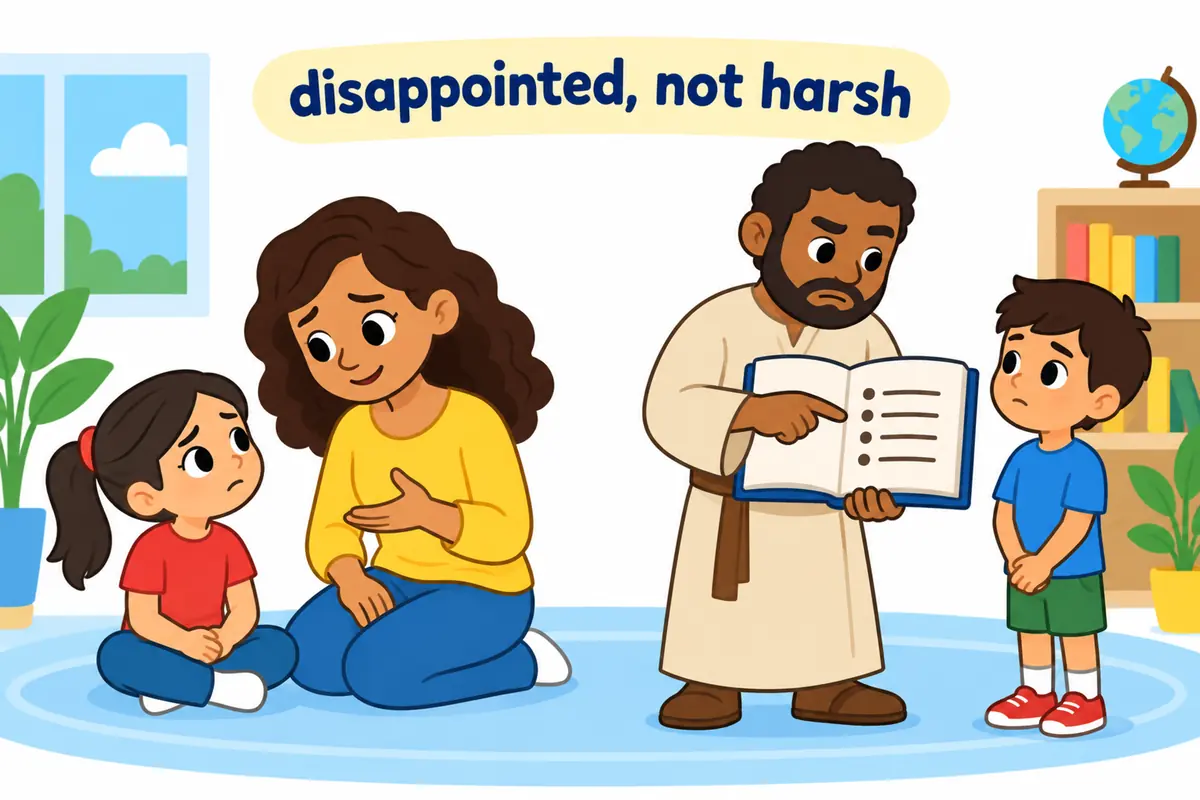
One limitation is worth stating plainly. Reproach is quieter than its synonyms: it suggests disappointment rather than anger. If a person in authority delivers a sharp, official criticism, rebuke or reprimand is more accurate, and when the criticism is merely personal, the word can sound heavier than the moment deserves.
How do you use reproach in a sentence?
The verb puts the person straight after it and the fault after for or with. Five patterns cover almost every real sentence, and the preposition you choose changes the flavour: for names the offence, while with repeats the charge.
| Pattern | Example | What it signals |
|---|---|---|
| reproach + person + for | The coach reproached the team for giving up. | Names the person and the fault directly. |
| reproach + person + with | She reproached him with his broken promise. | More formal; restates the charge. |
| reproach oneself | He reproached himself for the missed deadline. | The blamer and the blamed are the same person. |
| be above / beyond reproach | Her honesty is beyond reproach. | Fixed phrase; means completely blameless. |
| a reproach to + noun | The litter was a reproach to the whole street. | The noun names the source of shame. |
The fixed phrase beyond reproach is worth learning as a single unit, because it never takes an article and it never means literal scolding. In a school report, a teacher is more likely to reprove a pupil, which is the older and more formal verb for the same quiet correction.
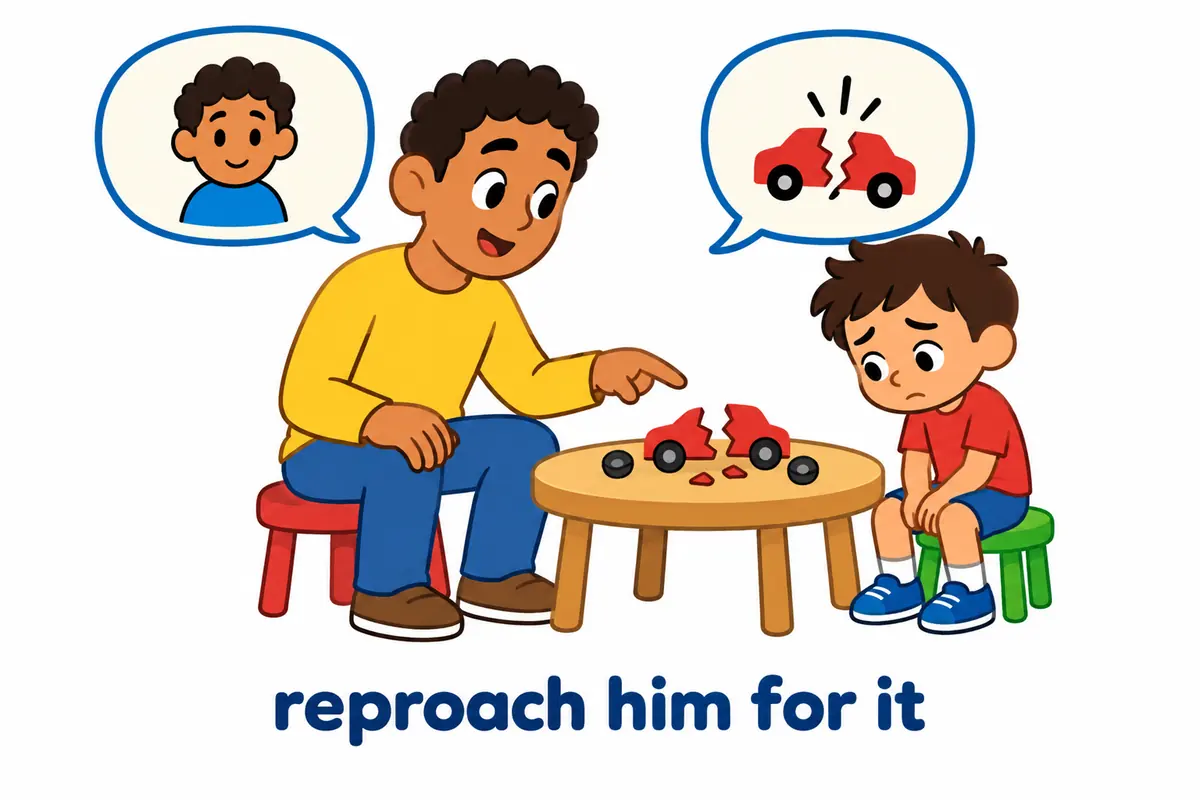
Reproach in a sentence: examples across contexts
Reproach shifts tone quickly with context: gentle in a family, formal in a report, and almost legal in a disciplinary letter. Each example below makes clear who is disappointed and what caused it.
| Context | Example sentence | Why this works |
|---|---|---|
| Classroom | The teacher reproached the class for talking during the test. | Names the group and the behaviour in one clean clause. |
| Family | His mother reproached him for forgetting her birthday. | The for-phrase makes the hurt concrete. |
| Workplace email | The manager reproached the team for missing the deadline. | A neutral verb for criticism in a professional setting. |
| News report | Critics reproached the ministry for delaying the report. | The formal register suits public accountability. |
| Diplomatic writing | Delegates reproached one another with broken promises. | The with-pattern restates the charge. |
| Legal report | The judge’s conduct was beyond reproach. | The fixed phrase asserts complete integrity. |
| Academic writing | The review reproached the authors for ignoring prior work. | Points to a specific scholarly omission. |
| Conversation | I reproached myself for not saying goodbye. | The reflexive form turns mild guilt inward. |
Note how often the sentence supplies the fault in a for-phrase. Remove the reason and the reproach stops sounding fair and starts sounding like a mood.
Reproach vs rebuke
Reproach and rebuke both point out a fault, but they differ in who may speak and how hard the words land. Where an official delivers stern criticism, rebuke a colleague is the sharper, more public verb.
| Attribute | reproach | rebuke |
|---|---|---|
| Core meaning | Express quiet blame or disappointment | Deliver sharp, formal criticism |
| Who speaks | Anyone, often an equal | Usually a person in authority |
| Tone | Gentle, disappointed | Harsh, corrective |
| Grammar | reproach somebody for or with | rebuke somebody for |
| Example | She reproached him for forgetting. | The chair rebuked him for interrupting. |
Verdict: choose reproach when the tone is disappointment between equals, and rebuke when authority delivers a formal correction. For an official body passing a public judgement, censure a member is the most precise verb of all.
Word forms and grammar of reproach
Reproach builds a small, regular family. The adjective reproachful look describes the disappointed expression, and the adverb measures the tone of the words, as in she spoke reproachfully.
| Form | Part of speech | Example |
|---|---|---|
| reproach | verb, base form | Managers reproach staff who ignore the rules. |
| reproaches | verb, third person singular | She reproaches herself for every small delay. |
| reproached | verb, past and past participle | He was reproached for the silent treatment. |
| reproaching | verb, present participle | Stop reproaching the child for a genuine mistake. |
| reproach | noun | The decision brought reproach on the whole committee. |
| reproachful / reproachfully | adjective / adverb | A reproachful glance said more than words. |
Common mistakes with reproach
- Incorrect:
She reproached to him for the delay.Correct: She reproached him for the delay. Rule: Reproach takes a person as a direct object, with no to. - Incorrect:
He reproached that she was late.Correct: He reproached her for being late. Rule: The verb takes an object and for, never a that-clause. - Incorrect:
Her work is over reproach.Correct: Her work is beyond reproach. Rule: The fixed phrase is beyond or above reproach. - Incorrect:
He gave me a reproach man.Correct: He gave me a reproachful look. Rule: Use the adjective reproachful before a noun, not the noun reproach. - Incorrect:
The committee reproached the mistake.Correct: The committee reproached the manager. Rule: The object of reproach is a person, not the fault itself.
Practice using reproach
Work through the six items, then check the reasoning rather than only the answer.
- Fill the gap: The principal ______ the students for missing the rehearsal.
- Choose the better word: For a sharp, official correction from a chair, (reproach / rebuke) is stronger.
- Correct the error: They reproached to the council for the delay.
- Build a sentence: use beyond reproach about a referee.
- Spot the register: which belongs in a formal letter — The officer’s record is beyond reproach, or He got told off?
- Rewrite with the reflexive: The engineer felt guilty about the error. Use reproach oneself.
Answers
- reproached — the students are the object and for names the fault.
- rebuke — it marks the formal authority that reproach does not.
- They reproached the council for the delay — no to is used after the verb.
- Model answer: The referee’s decisions were beyond reproach throughout the final.
- The officer’s record is beyond reproach — a formal letter prefers the fixed phrase.
- The engineer reproached himself for the error — the reflexive form turns the blame inward.
The bottom line
Use reproach in a sentence when the point is quiet blame for a specific fault, and give the reason in a for-phrase. Two nuances decide most sentences: the verb takes a person as its object, never a clause, and its tone is disappointment rather than anger. When the criticism is public and official, rebuke or censure will serve you better than reproach.
Frequently asked questions about reproach
Is reproach a verb or a noun?
Reproach is both. As a verb it means to blame somebody or show disappointment, as in she reproached him for lying. As a noun it names that blame, as in his conduct drew reproach, or a source of shame, as in the ruin was a reproach to the town. The verb is the more common use.
What does beyond reproach mean?
Beyond reproach is a fixed phrase meaning completely blameless or impossible to criticise. It describes a person, a record or a reputation, as in her honesty is beyond reproach. Above reproach carries the same meaning, and both forms take no article, so never write beyond the reproach.
What is the difference between reproach and rebuke?
Reproach suggests quiet disappointment between people who may be equals, while rebuke is a sharp, formal correction usually delivered by somebody in authority. A friend reproaches you for forgetting; a chair rebukes a member for interrupting. Choose the word that matches how much power the speaker holds.
Is reproach a formal word?
Reproach sits in neutral to formal writing. It appears in reports, reviews and careful conversation, but it rarely turns up in casual chat, where tell off or be disappointed is more natural. The fixed phrase beyond reproach is the most formal use of all and belongs in writing about character.
Have you ever found yourself in a situation where someone has criticized or rebuked you for a mistake or wrongdoing? This act of expressing disapproval or disappointment towards someone is known as reproach.
Reproach can manifest in various forms, such as a stern glance, a scolding tone, or even hurtful words. It is a way for individuals to communicate their disapproval or disappointment towards others.
7 Examples Of Reproach Used In a Sentence For Kids
- Reproach means to show disapproval.
- We should always speak kindly and not reproach others.
- It’s important to listen to our teachers without reproach.
- We should try to understand others without reproach.
- Kindergarten is a place where we learn to be kind and without reproach.
- Remember to always treat others with respect and without reproach.
- Let’s work together without reproach to create a happy and peaceful environment.
14 Sentences with Reproach Examples
- Reproach your classmate for not studying before the exam.
- I reproach myself for missing the submission deadline.
- Reproach your roommate for not cleaning up after themselves.
- The teacher reproached the students for talking during the lecture.
- Reproach your friend for copying your assignment without permission.
- Don’t reproach your group members for not contributing equally.
- She reproached her lab partner for not following safety protocols.
- Reproach your colleague for not attending the important seminar.
- The professor reproached the students for not participating in the class discussion.
- Don’t reproach your team members for making mistakes in the group project.
- Reproach yourself for not managing your time efficiently during exams.
- The senior students reproached the juniors for not respecting college traditions.
- Reproach your friend for missing out on important lectures.
- The dean reproached the students for vandalizing the college property.
How To Use Reproach in Sentences?
Reproach means to express disapproval or disappointment towards someone. When using reproach in a sentence, follow these steps:
-
Identify the situation: Determine when someone’s behavior warrants reproach. It could be due to a mistake, failure, or inappropriate action.
-
Choose the proper context: Ensure that using reproach is suitable for the situation and the relationship you have with the person involved.
-
Construct the sentence: When constructing a sentence with reproach, make sure to express your disapproval or disappointment clearly but respectfully. For example, “She couldn’t help but reproach him for forgetting their anniversary.”
-
Use appropriate tone: When using reproach, be mindful of your tone of voice and body language to convey your message effectively.
-
Provide feedback: After using reproach, be prepared to explain the reasons behind your disapproval and offer constructive criticism if necessary.
Remember that reproach is a serious expression of disapproval. It is essential to use it judiciously and with the intent to improve the situation or behavior. By following these steps, you can effectively use reproach in a sentence to communicate your disapproval or disappointment in a situation.
Conclusion
In conclusion, sentences with reproach are expressions of disapproval or criticism towards someone or something. They convey a sense of blame or disappointment, often highlighting a perceived wrongdoing or fault. These sentences may serve to point out errors, challenge behaviors, or express dissatisfaction with actions taken. For example, “She spoke with reproach in her voice when discussing his irresponsibility.”
Using sentences with reproach can be a powerful way to communicate displeasure or condemnation, emphasizing the speaker’s disapproval or disappointment. Whether in personal interactions or written communication, such sentences can convey strong emotions and convey a message of rebuke or criticism effectively. Paying attention to the use of reproach in sentences is crucial for expressing disapproval or holding someone accountable for their actions.


