Resolve is a noun meaning firm determination and a verb meaning to settle a problem or decide firmly. To use resolve in a sentence, match the word class to the job: “Her resolve never faltered,” or “They resolved the dispute at last.” The two senses share a core of settling something firmly.
Resolve at a glance
- Resolve is both a noun, meaning determination, and a verb, meaning to settle or decide.
- The noun is uncountable, so it takes no article: she showed great resolve.
- The verb patterns are resolve a problem, resolve to do something and be resolved.
- Its noun form for an outcome is resolution, which is not the same as resolve.
- The commonest error is writing a resolve for the noun, or confusing resolve with resolute.
What does resolve mean?
Resolve is a noun meaning firm determination, and a verb meaning to settle a problem, make a firm decision, or separate something into its parts. The Cambridge entry for resolve lists the decide and settle senses, and the Merriam-Webster entry records the related sense of reducing a complex thing into simpler elements. The table keeps the senses apart, because they are easy to blend.
| Sense | Part of speech | Example sentence |
|---|---|---|
| Firm determination | noun | Her resolve never faltered under pressure. |
| Settle or solve | verb | The mediator resolved the dispute in an hour. |
| Decide firmly | verb | They resolved to repay the loan early. |
| Separate into parts | verb, technical | The lens resolved the two distant stars. |
One limitation is worth stating plainly. The noun resolve means only determination, never a solution. If a sentence needs the answer to a problem, the noun is resolution or outcome, not resolve. Where a simple word works, determine carries the verb sense for decisions and findings. The noun sits close to commitment and firmness, but resolve stresses steadiness under pressure.
How do you use resolve in a sentence?
Decide first whether you need the noun or the verb, then follow the pattern. Four frames cover almost every real sentence, and only the verb takes an object or a to-infinitive.
| Pattern | Example | What it signals |
|---|---|---|
| possessive + resolve | Her resolve never faltered under pressure. | The noun, always uncountable and article-free. |
| resolve + object | The mediator resolved the dispute in an hour. | The verb takes the problem as its object. |
| resolve to + verb | They resolved to repay the loan early. | A firm decision about a future action. |
| be resolved | The matter was resolved by Friday. | The passive, used when the outcome matters more than the solver. |
Native writers reach for the verb when a problem is closed and for the noun when a person keeps going. That is why a headline says the strike was resolved while a profile says the striker’s resolve held. The word class alone changes the subject from a situation to a state of mind.
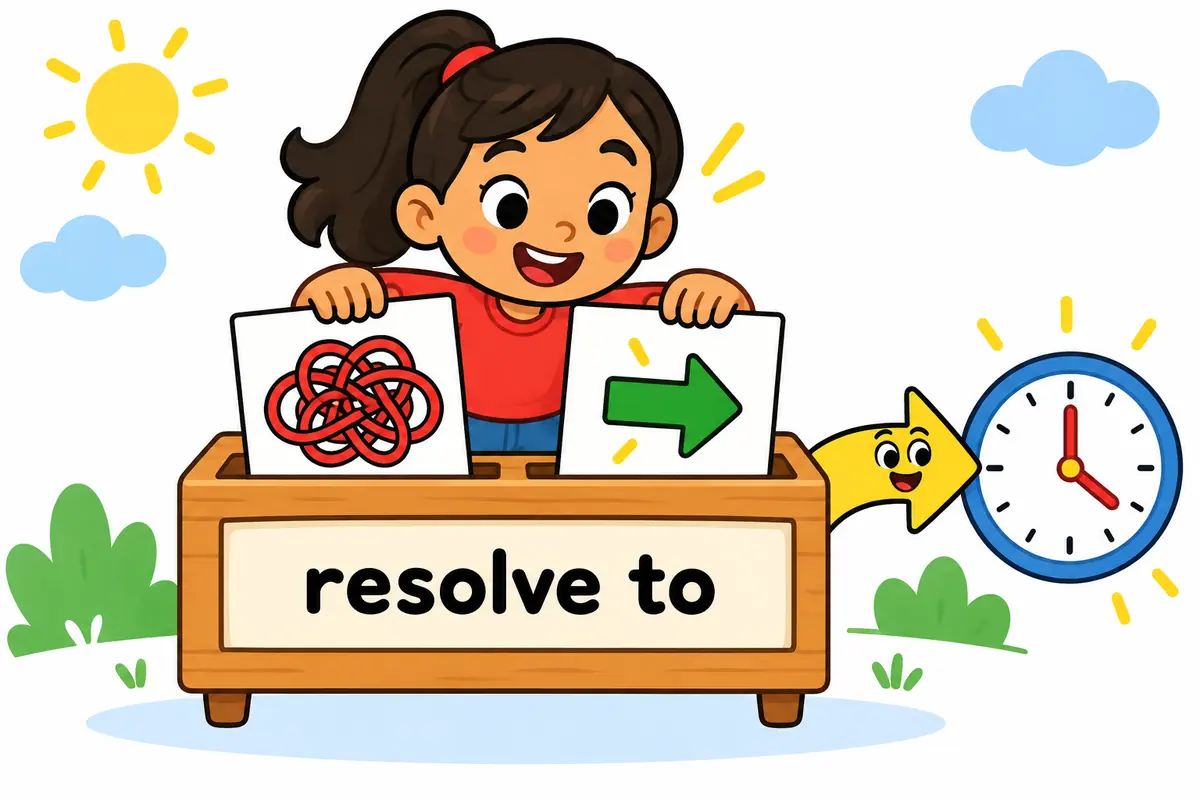
Resolve in a sentence: examples across contexts
The word shifts from feeling to action depending on which sense a writer needs. The eight sentences below each make clear whether resolve is determination or the act of settling.
| Context | Example sentence | Why this works |
|---|---|---|
| Classroom | Her resolve to finish the project grew after a poor first draft. | The noun names the determination behind the effort. |
| Workplace email | We resolved the billing error and refunded the customer. | The verb reports a problem that is now closed. |
| News report | The strike was resolved after two days of talks. | The passive keeps the focus on the outcome. |
| Sports commentary | The captain’s resolve showed in the final ten minutes. | The noun captures a state of mind under pressure. |
| Legal writing | The parties resolved their claims without going to trial. | The verb states a formal settlement. |
| Academic prose | The team resolved to test a smaller sample first. | The to-infinitive records a decision cleanly. |
| Conversation | He lost his resolve and ordered the cake after all. | The noun is natural in speech with lose or keep. |
| Science writing | The telescope resolved the twin stars at last. | The technical sense of separating detail appears. |
Half of these sentences use the noun and half the verb, and none mixes them. That clean split is the surest sign a writer understands the word, since the two senses rarely share a sentence.
Resolve vs resolute
Resolve and resolute look like family and behave like strangers, because one is a noun or verb and the other is only an adjective. Resolute means firmly determined, so it describes a person or a stand rather than a problem.
| Attribute | resolve | resolute |
|---|---|---|
| Part of speech | noun and verb | adjective only |
| Core meaning | Determination, or to settle | Firmly determined |
| Typical use | Her resolve held; they resolved the case | A resolute leader; a resolute refusal |
| What it describes | A quality or an action | A person or a stance |
| Register | Neutral to formal | Formal and slightly literary |
| Common partner | show, keep, lose, resolve | remain, stand, stay |
Verdict: use resolve when you need the quality itself or the act of settling, and resolute when you are describing somebody who refuses to waver. A good test is the article: resolute takes a and an, while the noun resolve never does.
Word forms and grammar of resolve
Resolve belongs to a wide family, and the forms differ in meaning as well as in grammar. The table lists the ones learners most often need and the one they wrongly build.
| Form | Part of speech | Example |
|---|---|---|
| resolve | verb and noun | They resolved the fault; her resolve grew. |
| resolved | verb and adjective | The case was resolved; she was resolved to stay. |
| resolving | verb, present participle | He is resolving the last of the errors. |
| resolution | noun, outcome | The resolution satisfied both sides. |
| resolutely | adverb | She resolutely refused to sign. |
| resoluteness | noun, non-standard | Writers use resolve instead of this heavy noun. |
The pair that causes most trouble is resolved and resolution, because both point to an outcome while resolve points to determination. Keeping the three words in separate sentences is the discipline that keeps the family clear.
Common mistakes with resolve
- Incorrect:
She showed a strong resolve to continue.Correct: She showed strong resolve to continue. Rule: The noun resolve is uncountable and takes no article. - Incorrect:
The company found a resolve to the dispute.Correct: The company found a resolution to the dispute. Rule: The noun for an outcome is resolution; resolve means determination. - Incorrect:
The manager was very resolve about the deadline.Correct: The manager was very resolute about the deadline. Rule: Use the adjective resolute after a linking verb, not the noun. - Incorrect:
They resolved postponing the meeting.Correct: They resolved to postpone the meeting. Rule: The verb takes a to-infinitive, never an -ing form. - Incorrect:
The error resolved by the engineer.Correct: The error was resolved by the engineer. Rule: Use the passive was resolved when the solver follows by.
Practice using resolve
Work through the six items, then check the reasoning as well as the answer.
- Fill the gap: The two neighbours ______ their boundary dispute over a cup of tea.
- Choose the better word: She remained (resolve / resolute) despite the setbacks.
- Correct the error: He showed a firm resolve to finish the race.
- Build a sentence: use resolve to about a student who decides to practise every morning.
- Spot the register: which belongs in a legal summary — the parties resolved their claims, or they worked it out?
- Rewrite with the noun: The talks settled the dispute. Use resolution instead.
Answers
- resolved — the verb takes the dispute as its object.
- resolute — a linking verb needs the adjective, not the noun.
- He showed firm resolve to finish the race — resolve is uncountable and takes no article.
- Model answer: The student resolved to practise every morning before breakfast.
- The parties resolved their claims — a legal summary keeps the plain formal verb.
- The talks produced a resolution of the dispute — resolution names the outcome.
The bottom line
Use resolve in a sentence as a noun for determination and as a verb for settling a problem or deciding firmly, and keep the two roles in separate clauses. Two nuances decide most sentences: the noun is uncountable and never takes an article, and the outcome noun is resolution, not resolve. Where a plain verb is enough, settle closes a dispute just as well.
Frequently asked questions about resolve
Is resolve a noun or a verb?
Resolve is both. As a noun it means firm determination and is uncountable, as in her resolve held. As a verb it means to settle a problem, as in they resolved the dispute, or to decide firmly, as in they resolved to leave. The context makes the role clear.
What is the difference between resolve and resolution?
Resolve is determination itself, while resolution is the act or outcome of settling something. A person shows resolve, and a dispute reaches a resolution. Keeping them apart matters because a resolution to a problem is a result, whereas resolve describes the inner strength that may or may not produce one.
How do you use resolve to in a sentence?
The pattern resolve to plus a base verb records a firm decision, as in she resolved to save more. The subject resolves to do something in the future. It differs from resolve plus an object, which settles a present problem, as in they resolved the error before the audit. Both are standard.
Is resolve a formal word?
Resolve appears in formal and journalistic writing in both senses, but the noun is common enough in ordinary speech with the verbs show, keep and lose. The verb is more formal than fix or sort out, so an email to a friend is more likely to say we sorted it than we resolved it.
Have you ever found yourself in a situation where you needed to find a solution to a problem or conflict? This process of finding a resolution or settling a dispute is known as resolve.
Resolve involves untangling complex issues, making decisions, and taking action to bring about a satisfactory outcome. It requires critical thinking, problem-solving skills, and the ability to communicate effectively to address the root of the problem.
7 Examples Of Resolve Used In a Sentence For Kids
- We can resolve conflicts by talking calmly.
- Let’s resolve to be kind to everyone we meet.
- We should resolve to always try our best in everything we do.
- If we have a problem, we can resolve it by asking for help.
- I resolve to be brave and stand up for what is right.
- We can resolve differences by listening to each other.
- Let’s resolve to always be good friends to one another.
14 Sentences with Resolve Examples
- Resolve to manage your time efficiently so you can balance your studies and extracurricular activities effectively.
- Make it a point to resolve any conflicts or misunderstandings with your classmates through open communication.
- Resolve to stay organized by creating a study schedule and setting achievable goals for each week.
- Take steps to resolve any technical issues with your laptop or software applications that may hinder your academic progress.
- Resolve to seek help from professors or academic advisors whenever you face challenges understanding a particular subject.
- Resolve to maintain a healthy lifestyle by eating nutritious meals, getting enough sleep, and staying active.
- Work on ways to resolve financial issues by creating a budget and looking for part-time job opportunities.
- Resolve to improve your study habits by practicing active reading, taking effective notes, and participating in study groups.
- When faced with difficult assignments or projects, resolve to break them down into smaller tasks to make them more manageable.
- Resolve to attend all your classes regularly and actively participate in discussions to enhance your learning experience.
- Find ways to resolve conflicts with roommates or hostel mates by discussing issues openly and finding common ground.
- Resolve to take care of your mental health by practicing mindfulness, seeking counseling if needed, and surrounding yourself with supportive friends.
- Resolve to limit distractions while studying by turning off social media notifications and finding a quiet place to focus.
- Resolve to improve your communication skills by participating in public speaking events, debates, or joining a communication club.
How To Use Resolve in Sentences?
To properly use the word Resolve in a sentence, you first need to understand its meaning. Resolve is a verb that means to find a solution to a problem or to make a firm decision about something.
Here is a simple guide on how to use Resolve in a sentence:
-
Subject: Start your sentence with the person or thing that is taking action. For example: “She” or “The team”.
-
Action: Use the word Resolve as the action verb in your sentence. For example: “resolved”, “resolving”, “will resolve”.
-
Problem or Decision: Clearly state the problem or decision that needs to be addressed. For example: “a conflict”, “an issue”, “what to do next”.
-
Result: Conclude your sentence with the outcome of the Resolve action. For example: “by compromising”, “by reaching a consensus”, “by taking a firm stance”.
Putting it all together, an example sentence using Resolve could be: “She resolved the conflict with her colleague by having an open and honest conversation.”
Remember, using Resolve in a sentence is about finding solutions and making decisions. Practice incorporating it into your everyday language to strengthen your communication skills.
Conclusion
In conclusion, sentences with resolve demonstrate a strong determination to overcome challenges or achieve goals. They depict a mindset of perseverance and unwavering commitment towards a desired outcome. These sentences often convey a sense of firm decision-making and courage in the face of adversity.
By using sentences with resolve, individuals can assert their intentions clearly and motivate themselves and others to stay on track towards success. Whether it involves personal growth, professional goals, or overcoming obstacles, incorporating resolve into one’s communication can inspire confidence and drive towards achieving desired results.


