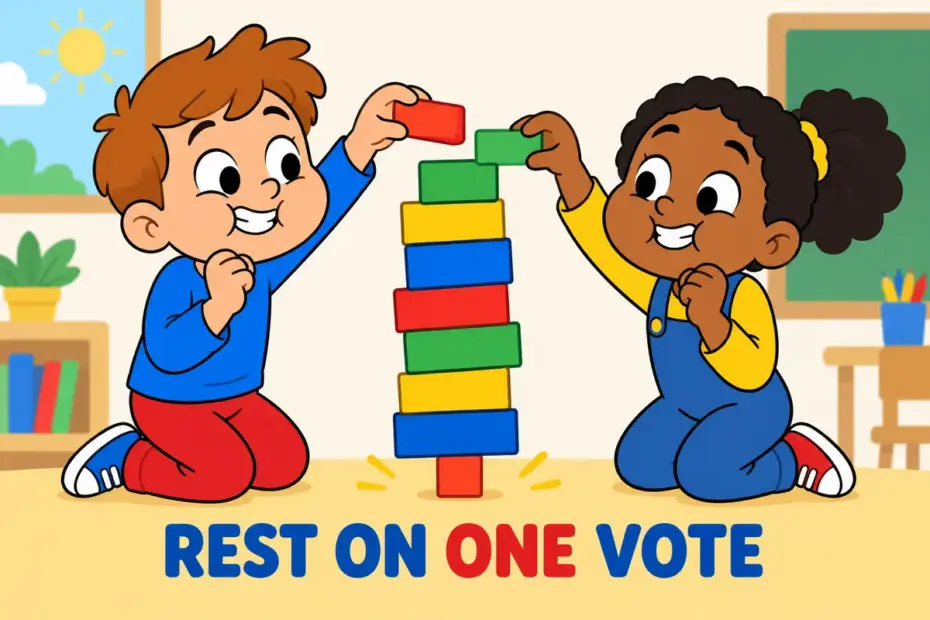
Rest on means to depend on something, to be supported by it, or to settle on it. To use rest on in a sentence, put the thing that carries the weight first and the thing it depends on after on: “The plan rests on one vote.” The phrase never splits, so on must stay attached to its object.
Rest on at a glance
- Rest on is a phrasal verb; it appears as rests on, rested on and resting on.
- The thing being supported is the subject, and the supporter follows the particle on.
- The dominant sense is dependence: X rests on Y means X cannot succeed without Y.
- Common subjects are plans, decisions, cases, arguments, roofs and gazes.
- The two words stay together, so on cannot move away from its object.
- The commonest error is using rest on where rest with fits better for responsibility.
What does rest on mean?
Rest on is a phrasal verb meaning to depend on something, to be supported by something, or to settle on something. The Cambridge entry for rest on puts the dependence sense first, and that is the sense most sentences need. Two further senses keep the same shape but change the subject: a bridge rests on its piers, and a gaze rests on whatever it settles upon. That dependence sense is the one that appears in news, law and academic writing alike. Where a claim is grounded in evidence, writers often prefer to base a claim on it.
| Sense | Plain meaning | Example sentence |
|---|---|---|
| Depend on | Cannot happen or succeed without | The result rests on the final vote. |
| Be supported by | Held up from below | The upper shelf rests on two brackets. |
| Settle on | Look at or land on briefly | Her eyes rested on the letter for a moment. |
| Ground in | Base an argument on something | She rested her case on the signed contract. |
One limitation is worth stating plainly. Rest on describes support that already exists; it says nothing about effort. If you mean that somebody is working hard to keep something going, choose rely on or count on, because rest on names the foundation rather than the labour.
How do you use rest on in a sentence?
Keep the thing being supported as the subject and the supporter after on. Five patterns cover almost every real sentence, and the intransitive ones never let on drift away from its object. A close cousin, hinge on, works the same way but sounds more decisive.
| Pattern | Example | What it signals |
|---|---|---|
| subject + rest on + noun | The appeal rests on a single witness. | Everything depends on one thing. |
| subject + rest on + noun (physical) | The bridge rests on concrete piers. | Literal support from below. |
| gaze + rest on + noun | Her gaze rested on the empty seat. | A look that settles briefly. |
| noun + clause + rest on | This is the evidence the case rests on. | The particle strands at the end of a relative clause. |
| rest + object + on + noun | They rested the argument on two studies. | Transitive: you base one thing on another. |
The last pattern is the exception that trips people up: rest on is intransitive and fixed, but the separate transitive verb rest can take an object before on, as in rest your hopes on one result. Note too that rest on never takes a that-clause, so the words after on must form a noun phrase.
Rest on in a sentence: examples across contexts
Rest on keeps the same meaning while the subject moves from a classroom to an engineering report. The twelve sentences below each name the thing doing the supporting, and a related verb, build on, adds to what already exists rather than depending on it.
| Context | Example sentence | Why this works |
|---|---|---|
| Classroom | The group’s mark rests on the final presentation. | A concrete task supplies the single point of dependence. |
| Science writing | The whole model rests on one measured constant. | Names the exact quantity that supports a larger claim. |
| Workplace email | The launch date rests on approval from legal. | One department becomes the foundation for a plan. |
| Legal writing | The defence rests on a single unsigned note. | Shows the evidence that carries the argument. |
| News report | The peace deal rests on two fragile promises. | Compresses a complex situation into its supports. |
| Engineering | The walkway rests on four steel columns. | Uses the literal, physical sense of the phrase. |
| Conversation | Our whole trip rests on the weather tomorrow. | Everyday dependence, stated without formality. |
| Academic prose | The conclusion rests on a small sample of interviews. | Signals the evidential base in cautious language. |
| Sports commentary | The title race now rests on one away match. | Turns a season into a single deciding fixture. |
| Financial writing | The forecast rests on steady energy prices. | Names the assumption holding the numbers up. |
| Project management | The schedule rests on the supplier delivering on time. | Turns a whole plan into a single dependency. |
| Debate | The motion rests on a contested definition. | Shows an argument built on one disputed point. |
Across all twelve contexts the subject is the thing at risk and the object of on is the thing it leans on, so the grammar stays constant even as the setting changes.
Rest on vs depend on and hinge on
Rest on is closest to depend on, and the two are often interchangeable. Hinge on is sharper, and rest with shifts the whole idea to a person. None of the three is a drop-in for the others in every sentence, and to lean against a support is a different action again, which is why lean on implies pressure.
| Attribute | rest on | depend on | rest with |
|---|---|---|---|
| Core idea | Held up by a foundation | Necessary for success | Belongs to someone |
| Typical subject | Plans, cases, roofs, gazes | People, outcomes, machines | Responsibility, blame, choice |
| Strength | Neutral and structural | Neutral and general | Exclusive to one party |
| Takes a person | Rarely | Often | Always |
| Register | Neutral to formal | Casual to formal | Formal |
Verdict: choose rest on for a foundation, depend on for a general need, and rest with when the question is whose decision or duty something is. When the whole structure gives way, English reaches for collapse rather than any of them.
Word forms and grammar of rest on
The phrase changes only for tense and agreement; on never changes. The base verb rest also means to relax, which is a different verb and a common source of confusion.
| Form | Part of speech | Example |
|---|---|---|
| rest on | phrasal verb, base form | Everything will rest on the recount. |
| rests on | phrasal verb, third person singular | The whole case rests on one email. |
| rested on | phrasal verb, past and past participle | The verdict rested on the timeline. |
| resting on | phrasal verb, present participle | The roof is resting on temporary props. |
| rest upon | phrasal verb, formal variant | The ruling rests upon a single statute. |
| rest | verb, different meaning | The hikers rested on the ridge. |
Common mistakes with rest on
- Incorrect:
The plan rests in a single vote.Correct: The plan rests on a single vote. Rule: Dependence uses on; in would describe a position inside something. - Incorrect:
It rests on that the evidence is strong.Correct: It rests on evidence that is strong. Rule: The pattern is rest on + noun phrase, never rest on + that-clause. - Incorrect:
The choice rests on the manager.Correct: The choice rests with the manager. Rule: Use rest with when the meaning is whose duty or decision something is. - Incorrect:
The company rested on its past success.Correct: The company relied on its past success. Rule: Rest on names a present foundation, not reliance on achievement; use rely on. - Incorrect:
The roof rests in the beams.Correct: The roof rests on the beams. Rule: Physical support from below always takes on.
Practice using rest on
Work through the six items, then read the reasons as carefully as the answers.
- Fill the gap: The entire argument ______ a single footnote.
- Choose the better word: Responsibility for the timetable now (rests on / rests with) the head of department.
- Correct the error: The whole case rests in the new witness.
- Build a sentence: use rest on about a science project that depends on one measurement.
- Spot the register: which belongs in a formal report — the award rests on the panel’s vote, or we are banking on the panel?
- Rewrite with a relative clause: The plan rests on one assumption. Move on to the end of the clause.
Answers
- rests — the argument is the subject and the footnote is what supports it.
- rests with — the sentence is about whose duty the timetable is, so rest with is natural.
- The whole case rests on the new witness — dependence takes on, not in.
- Model answer: Our project rests on one careful measurement of rainfall.
- The award rests on the panel’s vote — a report keeps formal phrasing and avoids we.
- The one assumption the plan rests on is that funding continues — the particle strands at the end.
The bottom line
Use rest on in a sentence when one thing is held up, or made possible, by another, and name the supporter after on. Two points decide most sentences: the phrase is not separable, so on stays with its object, and rest with, not rest on, is the pattern for whose duty something is. When the support fails, we say the plan falls apart. Read the particle first: if the next word is a person and the meaning is duty, switch to rest with.
Frequently asked questions about rest on
Is rest on separable?
No. The particle on must stay in front of its object, so you write the plan rests on one vote, never the plan rests one vote on. The only exception is the separate transitive verb rest, which can take an object: they rested the decision on one report.
What is the difference between rest on and rest with?
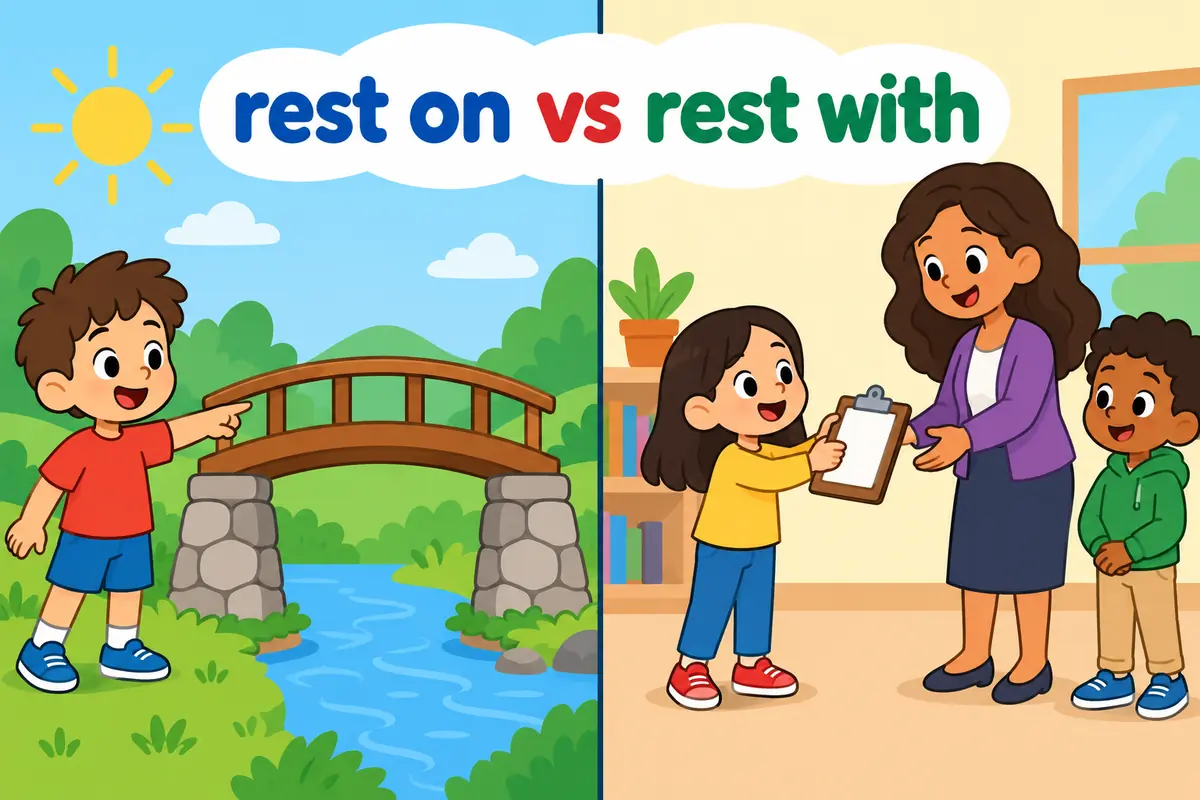
Rest on points to a foundation: the verdict rests on the evidence. Rest with points to a person: the decision rests with the chair. Use rest on when something is supported, and rest with when something is somebody’s responsibility or choice.
Can you say that a person rests on something?
Not usually. People rely on, count on or depend on other people, while rest on is reserved for plans, cases, arguments and physical things. A sentence like the child rests on her parents sounds foreign; the child depends on her parents is the natural choice.
Does rest on mean the same as rely on?
Only partly. Both can describe dependence, but rest on stresses the base that holds something up, while rely on stresses trust in that support. A plan can rest on a single vote without anyone relying on the voter to behave well.