Roll off describes something that comes away from a surface, or something said with easy, flowing delivery. To use roll off in a sentence, choose the sense you need: “the rain rolled off the roof” or “the names rolled off her tongue”. The particle off stays close to the verb.
Roll off at a glance
- Roll off is a phrasal verb; its forms are rolls off, rolled off and rolling off.
- It carries several senses: to flow off a surface, to be said easily, to fail to affect someone, and to come off a production line.
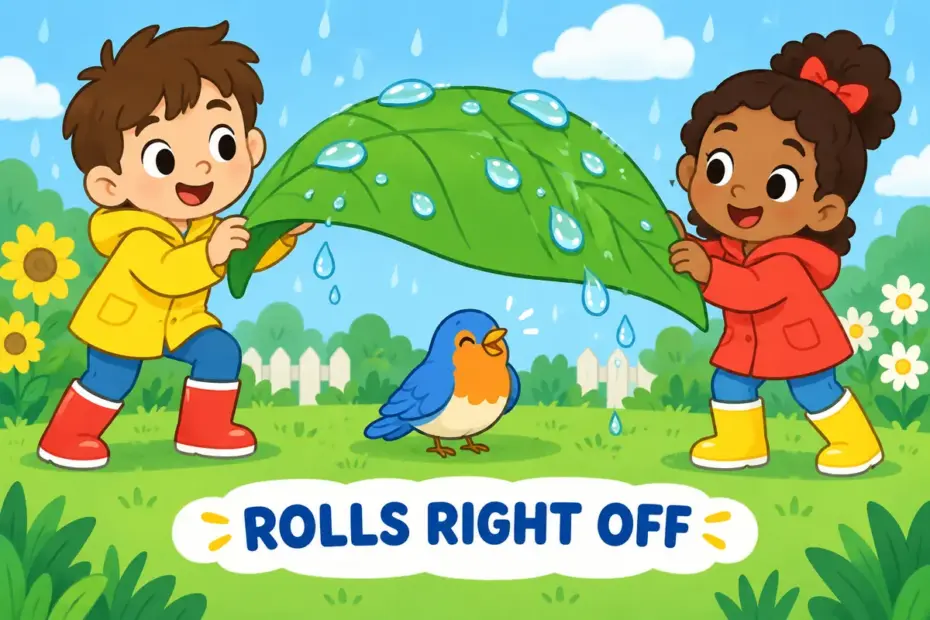
- The core image is movement away and down from a surface, plus a figurative ease.
- In the recite sense the object can sit between roll and off: roll the names off.
- The commonest error is confusing roll off with reel off, which means to recite rapidly.
What does roll off mean?
Roll off is a phrasal verb whose central meaning is to move away from a surface while turning or sliding. The Cambridge entry for roll off records this physical sense and the figurative phrase roll off the tongue. In practice the verb spreads across four related meanings, and the setting tells you which one is in play.
| Sense | Plain meaning | Example sentence |
|---|---|---|
| Flow off a surface | Liquid or an object moves away and down | Rain rolled off the windscreen. |
| Be said easily | Words come out smoothly and without effort | The speech rolled off his tongue. |
| Fail to affect | Insults or trouble do not leave a mark | The criticism rolled off her. |
| Come off a line | Products leave a production line in sequence | A new bike rolls off the line every minute. |
One limitation is worth stating. On its own, roll off is vague: a bare the news rolled off leaves the reader asking off what. The physical sense needs a surface, the recite sense needs a tongue or a list, and the unaffecting sense needs a person. Supply that partner and the meaning becomes exact.
How do you use roll off in a sentence?
Position matters as much as meaning. In the physical sense the particle stays attached to the verb, while the recite sense allows the object to sit between roll and off. The table sets out the patterns.
| Pattern | Example | What it signals |
|---|---|---|
| roll off + surface (no object) | Water rolls off the leaves. | Movement away from a stated surface. |
| roll off + object | The ball rolled off the table. | An object leaves the surface it rested on. |
| roll + object + off | She rolled the answers off without notes. | The recite sense, with the object split from off. |
| roll off + person | The insults rolled off him. | A blow that leaves no effect. |
| roll off + the line | Cars roll off the line all day. | Manufactured goods leaving in sequence. |
The particle can strand at the end in the recite sense, as in the names she rolled off, which is a useful test: if the sentence still makes sense, you are in the figurative delivery meaning rather than the physical one. The physical sense also overlaps with flow, which names continuous movement without the turning image of roll. When the sense is to recite names or answers, roll off needs a human subject to do the speaking.
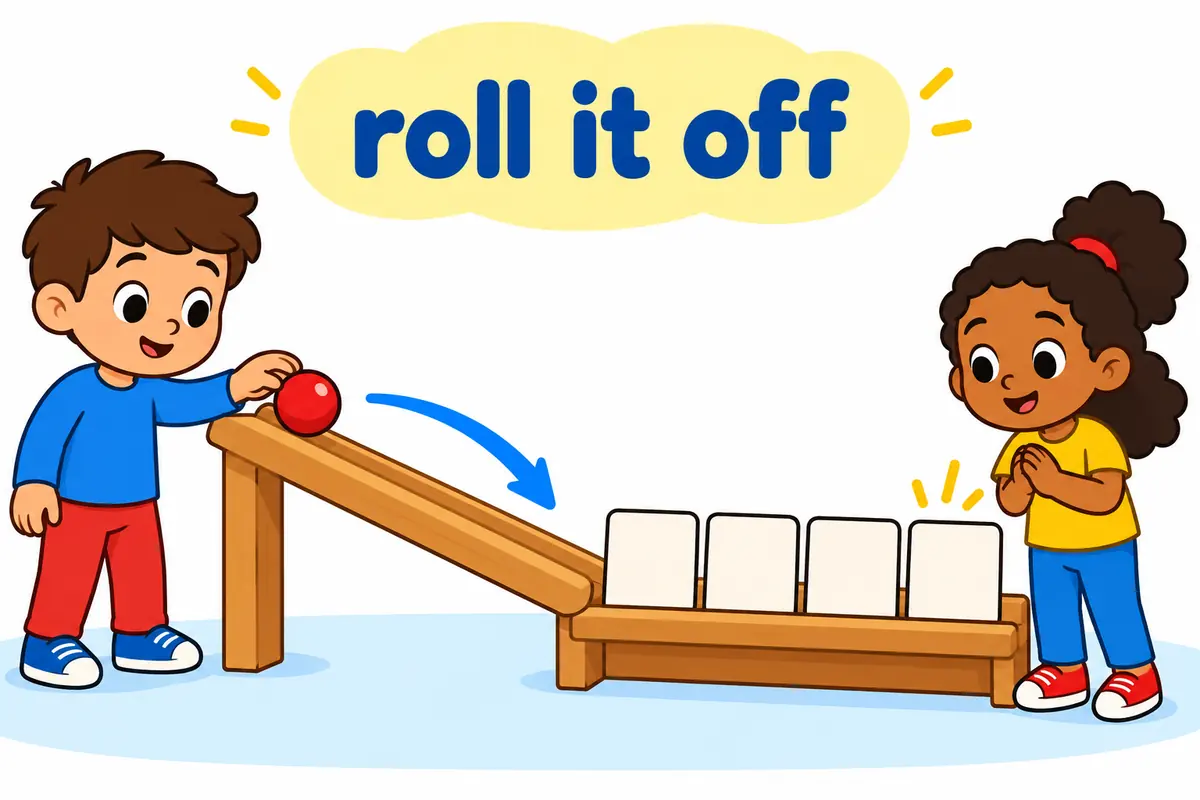
Roll off in a sentence: examples across contexts
The verb moves from weather to speech to manufacturing without losing its image of smooth movement away. Each sentence below shows one sense in a real setting.
| Context | Example sentence | Why this works |
|---|---|---|
| Weather report | Heavy rain rolled off the awning and onto the path. | Names the surface the water left. |
| Classroom | The poem rolled off her tongue as if she had written it. | The tongue makes the ease explicit. |
| Sports commentary | The striker’s celebration rolled off him with a shrug. | The unaffecting sense fits the scene. |
| Manufacturing | Two hundred desks roll off the line each day. | The line supplies the production sense. |
| Workplace email | The names roll off the system in alphabetical order. | An automatic, list-like movement. |
| News report | The criticism rolled off the minister during the debate. | The figurative sense, plainly reported. |
| Conversation | Her address rolled off the tongue in three languages. | The idiom shows effortless delivery. |
| Review | The jokes roll off the scriptwriter with practised timing. | Ties ease of delivery to craft. |
| History essay | Steam engines rolled off the works gate for forty years. | A dated scene anchors the sense. |
Notice that in every figurative example a partner word follows the person: a tongue, a shrug, a debate, a language. That partner is what keeps the meaning clear.
Roll off vs reel off and rattle off
Roll off shares its recite sense with reel off and rattle off, and the three are easy to mix. The difference lies in what each stresses: ease, speed or mechanical delivery.
| Attribute | roll off | reel off | rattle off |
|---|---|---|---|
| Main stress | Ease and flow | Speed and continuity | Speed with little thought |
| Implies a list | Sometimes | Usually | Almost always |
| Physical sense | Yes: slide off a surface | No | No |
| Register | Neutral, often spoken | Informal to neutral | Informal |
| Example | The words rolled off him. | She reeled off the dates. | He rattled off five excuses. |
Verdict: use roll off for easy, flowing delivery or movement off a surface, reel off for a fast continuous recitation, and rattle off when the point is speed without much care.
Word forms and grammar of roll off
Roll off is a phrasal verb, so its grammar lives in the whole unit rather than in an inflection. The table lists its forms and the particle cousins that change the meaning.
| Form | Part of speech | Example |
|---|---|---|
| roll off | phrasal verb, base form | The beads will roll off if you tilt it. |
| rolls off | third person singular | The rain rolls off the roof. |
| rolled off | past and past participle | The names rolled off her tongue. |
| rolling off | present participle | Cars are rolling off the line now. |
| roll out | phrasal verb, different particle | They roll out the update in June. |
| roll down | phrasal verb, different particle | Please roll down the window. |
Roll out changes the meaning to a launch, and roll down keeps the downward movement but changes what moves, which is why the particle, not the verb, carries the sense.
Roll off in different registers
The phrasal verb sits comfortably in speech but appears in writing too, usually in weather, sport and manufacturing. The table shows how the same verb shifts tone.
| Register | Example sentence | Effect |
|---|---|---|
| Conversation | The joke rolled off him and he kept smiling. | Relaxed and informal. |
| Sports writing | Boos rolled off the young keeper all afternoon. | Vivid and slightly dramatic. |
| Weather report | Rain rolls off the canopy into the gutter. | Plain and descriptive. |
| Business writing | Units roll off the line ahead of schedule. | Neutral and factual. |
| Literary prose | Her promises rolled off like water off glass. | Figurative and deliberate. |
Because roll off is informal, it rarely opens a formal paragraph. In a report, the physical sense is usually rewritten as drains away or flows off, and the recite sense as lists without effort.
Common mistakes with roll off
- Incorrect:
The rain rolled off.Correct: The rain rolled off the roof. Rule: The physical sense needs a surface, or the sentence leaves the reader guessing. - Incorrect:
The names rolled off her.Correct: The names rolled off her tongue. Rule: The recite sense needs tongue or a similar partner, not a bare person. - Incorrect:
She reeled off the poem easily from memory.Correct: She rolled off the poem easily from memory. Rule: Reel off stresses speed; roll off stresses ease. - Incorrect:
He rolled the ball off.Correct: He rolled the ball off the step. Rule: Even with an object, the physical sense names the surface it leaves. - Incorrect:
The new phone rolled out off the line.Correct: The new phone rolled off the line. Rule: Roll out means to launch, so it does not combine with the line. - Incorrect:
The criticism rolled off on him.Correct: The criticism rolled off him. Rule: The unaffecting sense takes a direct person, with no on.
Practice using roll off
Work through the seven items, then read the reasoning rather than only the answers.
- Fill the gap: The water ______ the umbrella and onto the path.
- Choose the better word: The champion (reeled off / rolled off) six wins in a row.
- Correct the error: The names rolled off her.
- Build a sentence: use roll off in its unaffecting sense about a harsh comment.
- Spot the register: which belongs in a factory report — units roll off the line each hour, or stuff rolls off the line?
- Rewrite with a stranded particle: change she rolled off the answers into the split pattern.
- Separate the senses: which sentence is physical and which is figurative — the ball rolled off the table, or the joke rolled off him?
Answers
- rolled off — the surface, the umbrella, follows the verb.
- reeled off — six wins in a row is a fast continuous list, so reel off fits.
- The names rolled off her tongue — the recite sense needs tongue or a list.
- Model answer: The harsh comment rolled off her without a flinch.
- Units roll off the line each hour — a report avoids the informal stuff.
- She rolled the answers off — the object moves between roll and off.
- The ball rolled off the table is physical; the joke rolled off him is figurative.
The bottom line
Use roll off in a sentence when something slides away from a surface or is delivered with easy flow, and give it a surface, a tongue or a person to complete the sense. The two nuances that decide most sentences are that the particle stays with the verb in the physical sense and may split in the recite sense, and that reel off is the better choice when speed is the point. Where the meaning is a launch, roll out covers it more exactly.
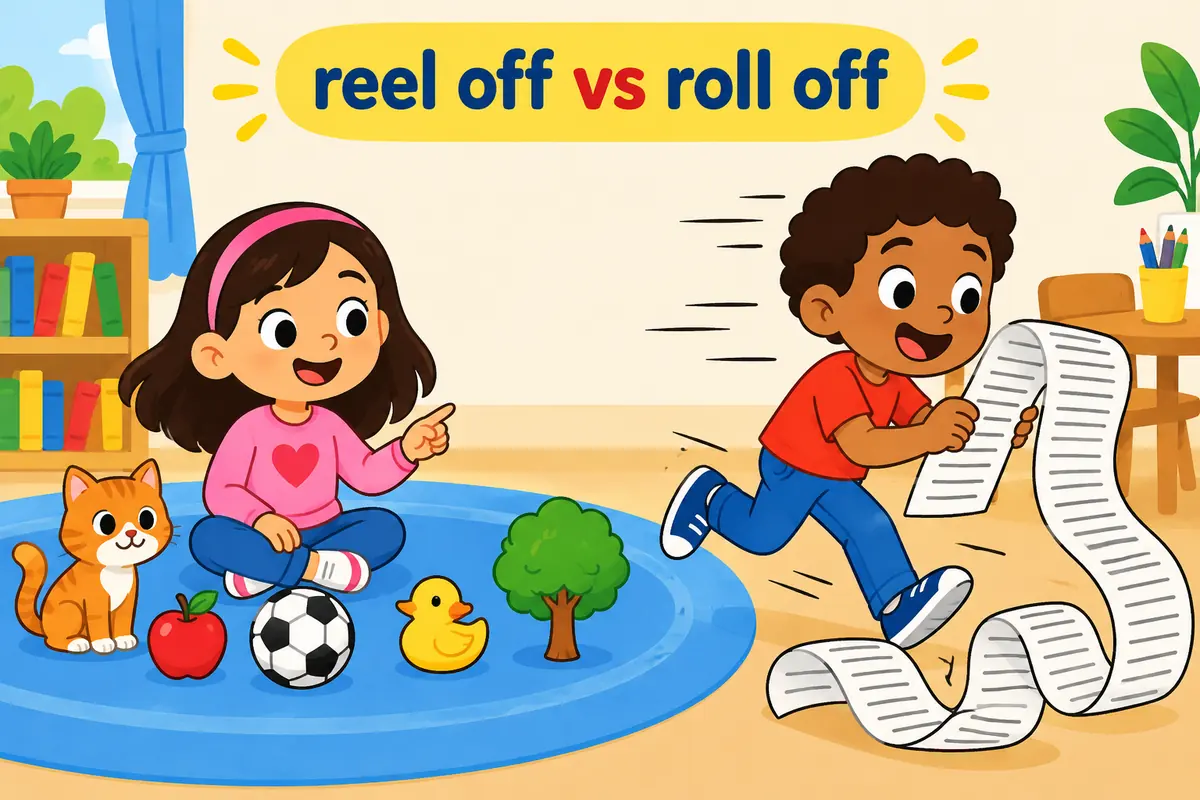
Frequently asked questions about roll off
Is roll off separable?
It depends on the sense. In the physical sense the particle stays attached to the verb, as in the ball rolled off the table. In the recite sense the object may sit between roll and off, as in she rolled the answers off. If the object can move to the middle, you are in the recite sense.
What does roll off the tongue mean?
The phrase roll off the tongue describes words that are easy and pleasant to say. A name that rolls off the tongue is smooth and natural in speech, while one that does not is awkward or clunky. The idiom comes from the physical sense of something sliding easily away from a surface.
What is the difference between roll off and reel off?
Roll off stresses ease and flow, while reel off stresses speed and continuity, especially for a long list. A speaker who rolls off a few names sounds smooth; a speaker who reels off twenty dates sounds quick and fluent. Only roll off also has the physical sense of sliding off a surface.
Can roll off mean something does not affect you?
Yes. When criticism, insults or bad news roll off a person, they leave no lasting effect, as in the taunts rolled off him. The image is the same as water sliding off a smooth surface. This figurative sense usually needs a person right after off to make the meaning clear.