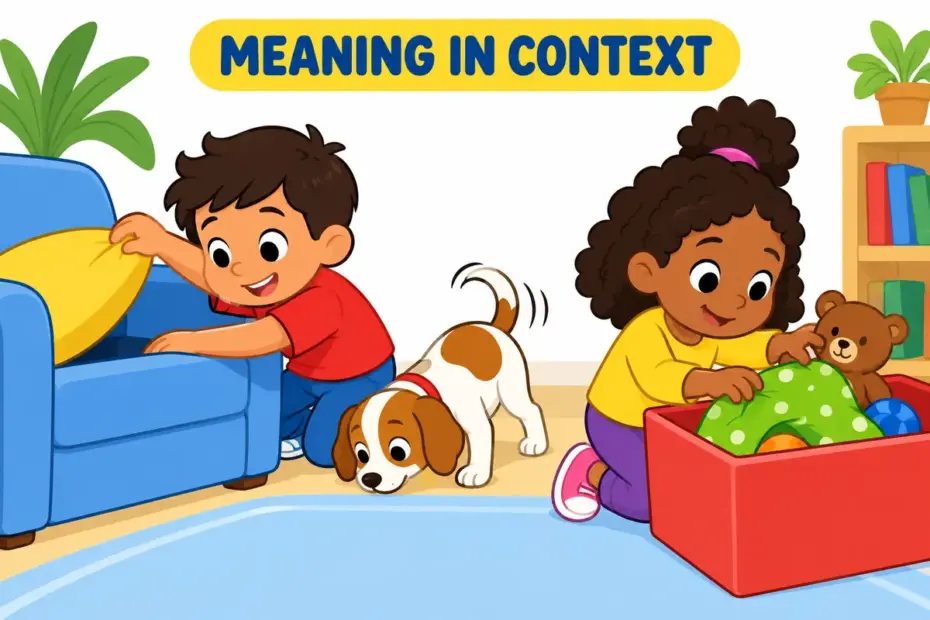
The phrase root about in a sentence means search around by moving or pushing things aside, often while looking for food or an object. Its grammar depends on the intended sense: root about. For example, “The puppy rooted about in the garden for its toy.” shows root about in a natural, complete sentence with enough context to understand the expression.
Root About at a glance
- Part of speech: phrasal verb phrase with the base form root about.
- Core meaning: Search around by moving or pushing things aside, often while looking for food or an object.
- Grammar: root about is a common construction.
- Useful contrast: rummage overlaps in meaning but does not fit every sentence.
- Common learner issue: selecting the right preposition or object for the intended sense.
What does root about mean?
Root About is a phrasal verb meaning search around by moving or pushing things aside, often while looking for food or an object. Root about belongs naturally with subjects that physically probe or push things aside. With people and organized belongings, “look through” or “rummage” may be clearer. The preposition carries useful information: “root about in the leaves for beetles” identifies both the search area and its goal without adding a direct object.
| Sense | Plain meaning | Example |
|---|---|---|
| Search by moving things | Look around by pushing or disturbing material. | The puppy rooted about in the garden for its toy. |
| Search for food | Look through soil or loose material for something to eat. | The pig rooted about in the mud for fallen apples. |
The Cambridge Dictionary: root about supports these core meanings and patterns. Nearby vocabulary includes burrow, forage, and dig; each can express a related idea, but none automatically substitutes for every sense of root about.
How do you use root about in a sentence?
Root About takes different complements according to its meaning. These patterns show the particle or preposition’s job and whether a direct object is required. Root about belongs naturally with subjects that physically probe or push things aside. With people and organized belongings, “look through” or “rummage” may be clearer. The preposition carries useful information: “root about in the leaves for beetles” identifies both the search area and its goal without adding a direct object.
| Pattern | Example | What it signals |
|---|---|---|
| root about | The dog rooted about near the fence. | About can stand alone when the place is supplied. |
| root about in + place/material | She rooted about in the drawer for a key. | In names the area being searched. |
| root about among + plural items | He rooted about among the papers. | Among introduces a group of items. |
| root about for + object | The badger rooted about for insects. | For identifies the thing sought. |
It is not separable: keep the particle after the verb. It is intransitive and uses in, among, or for to identify the area or thing sought.

Root About in a sentence: examples across contexts
Each example gives enough surrounding detail to identify the sense. The subject, complement and preposition are part of the meaning, rather than decoration.
| Context | Example sentence | Why this works |
|---|---|---|
| Garden | The puppy rooted about in the garden for its toy. | The animal subject makes the physical search vivid. |
| Kitchen | She rooted about in the pantry for the missing jar. | In identifies the place and for the goal. |
| Desk | I rooted about among the papers until I found the receipt. | Among is natural with a group of loose items. |
| Wildlife | A pig rooted about in the soil for acorns. | The soil and food goal suggest animal foraging. |
| Storage | We rooted about in the shed for the spare lantern. | The search is informal and involves looking through stored things. |
| Conversation | He rooted about in his bag for a pen. | The phrase works with everyday belongings. |
| Fiction | The badger rooted about beneath the leaves after dusk. | The location and subject support a literal search. |
| Contrast | She searched the drawer carefully rather than rooting about in it. | The contrast shows root about suggests a less orderly search. |
Root About vs rummage
Rummage is a useful comparison because it overlaps with one sense of root about, but its grammar or emphasis differs. Choose by asking what the sentence needs to communicate.
| Feature | root about | rummage |
|---|---|---|
| Core meaning | search around by moving or pushing things aside, often while looking for food or an object | broader or adjacent meaning |
| Typical subject/object | root about | depends on the verb’s own pattern |
| Emphasis | the specific action or sense shown above | the related idea without the same nuance |
| Useful context | Garden | general situations where the simpler word is enough |
| When to choose it | when the particle/preposition and context fit | when its plain meaning is the intended one |
Verdict: choose root about when the sentence needs its specific pattern; choose rummage when its broader or simpler meaning is intended.
Word forms and grammar of root about
Use the form that matches the subject and time reference. Do not transfer the pattern of a related word automatically: the example in each row shows the form in a complete clause.
| Form | Use | Example |
|---|---|---|
| root about | base form | Pigs root about in the soil. |
| roots about | third-person present | The puppy roots about in the leaves. |
| rooted about | past form | She rooted about in the drawer. |
| rooting about | present participle | They are rooting about for the missing tool. |
Common mistakes with root about
These errors arise when a learner treats the particle as a separate preposition or gives the verb an object pattern it does not take.
- Incorrect:
I rooted about the drawer.Correct: I rooted about in the drawer. Rule: Use in to identify the place being searched. - Incorrect:
They rooted about the key.Correct: They rooted about for the key. Rule: Use for before the object sought. - Incorrect:
She rooted around among the drawer.Correct: She rooted around in the drawer. Rule: Use in with a single place; among introduces a group. - Incorrect:
He rooted the papers about.Correct: He rooted about among the papers. Rule: The phrasal verb is not separable; keep about after root.
Practice using root about
Complete each task by checking both meaning and grammar. The final two items ask for interpretation and revision, so more than one well-formed answer may be possible.
- Fill the gap: The puppy rooted about in the garden for its toy.
- Choose the better word, root about or rummage: “She rooted about in the pantry for the missing jar.”
- Correct the error: “I rooted about the drawer.”
- Build a sentence that uses root about in + place/material.
- Explain the meaning in this example: “I rooted about among the papers until I found the receipt.”
- Rewrite this sentence more precisely: “It happened.”
Answers
- The puppy rooted about in the garden for its toy. — the context supplies the intended sense.
- root about — the sentence follows the target phrase’s pattern.
- I rooted about in the drawer. — Use in to identify the place being searched.
- Model: She rooted about in the drawer for a key. — this uses the specified construction.
- Among is natural with a group of loose items. — the subject and complement signal the sense.
- Model: The puppy rooted about in the garden for its toy. — the revised sentence names the subject and action.
How context changes root about
Root About is easiest to interpret when the sentence gives a concrete subject and complement. Compare these cases: the same phrase can look different when the actor changes, when a preposition is added, or when the sentence shifts from literal to figurative use.
- Garden: The puppy rooted about in the garden for its toy. The animal subject makes the physical search vivid.
- Kitchen: She rooted about in the pantry for the missing jar. In identifies the place and for the goal.
- Desk: I rooted about among the papers until I found the receipt. Among is natural with a group of loose items.
- Wildlife: A pig rooted about in the soil for acorns. The soil and food goal suggest animal foraging.
- Storage: We rooted about in the shed for the spare lantern. The search is informal and involves looking through stored things.
- Conversation: He rooted about in his bag for a pen. The phrase works with everyday belongings.
- Fiction: The badger rooted about beneath the leaves after dusk. The location and subject support a literal search.
- Contrast: She searched the drawer carefully rather than rooting about in it. The contrast shows root about suggests a less orderly search.
A reader should not have to guess which sense is intended. Add the object, place, time, or result that distinguishes it. For example, “The puppy rooted about in the garden for its toy.” names the situation; “She rooted about in the pantry for the missing jar.” adds a different clue. The two sentences share vocabulary but communicate distinct details.
For a related vocabulary step, compare burrow, forage, or dig only after deciding which sense of root about is active. A synonym may fit one context and fail in another because prepositions and objects belong to particular constructions. Replacing a phrase without checking the whole clause can create a grammatical error even when the dictionary meanings overlap.
The bottom line
Use root about in a sentence when the subject and surrounding words support the intended meaning. The most useful distinction is root about belongs naturally with subjects that physically probe or push things aside. If a simpler word communicates the point more clearly, prefer it.

Frequently asked questions about root about
What does “root about” mean?
Root about means search around by pushing or moving things aside, often to find food or an object. It commonly describes an animal nosing through soil or a person looking through a drawer. The phrase suggests a less orderly search than simply checking a place.
Is “root about” the same as “rummage”?
The meanings overlap, but rummage commonly describes searching through belongings, while root about can suggest probing or nosing around in soil, loose material, or objects. “Root about in a drawer” is possible, but “rummage through a drawer” is often the more ordinary choice for a person.
Which preposition follows “root about”?
Use in for the area searched, among for a group of things, and for for the object sought: “root about in the leaves for insects.” These prepositions do different jobs. Avoid placing the sought object directly after about without a preposition.
Can a person “root about”?
Yes. A person can root about in a bag or among papers, although rummage may sound more usual for searching through personal belongings. Root about fits especially well when the search involves moving or probing through loose material. The verb does not imply that the search succeeds.
Sentence subjects make this pattern easier to recognize.